What Was Goethe's IQ? Cox's 1926 Estimate Explained | Riot IQ
Oct 31, 2026·Famous People & IQ
What Was Goethe's IQ? Cox's 1926 Estimate Explained
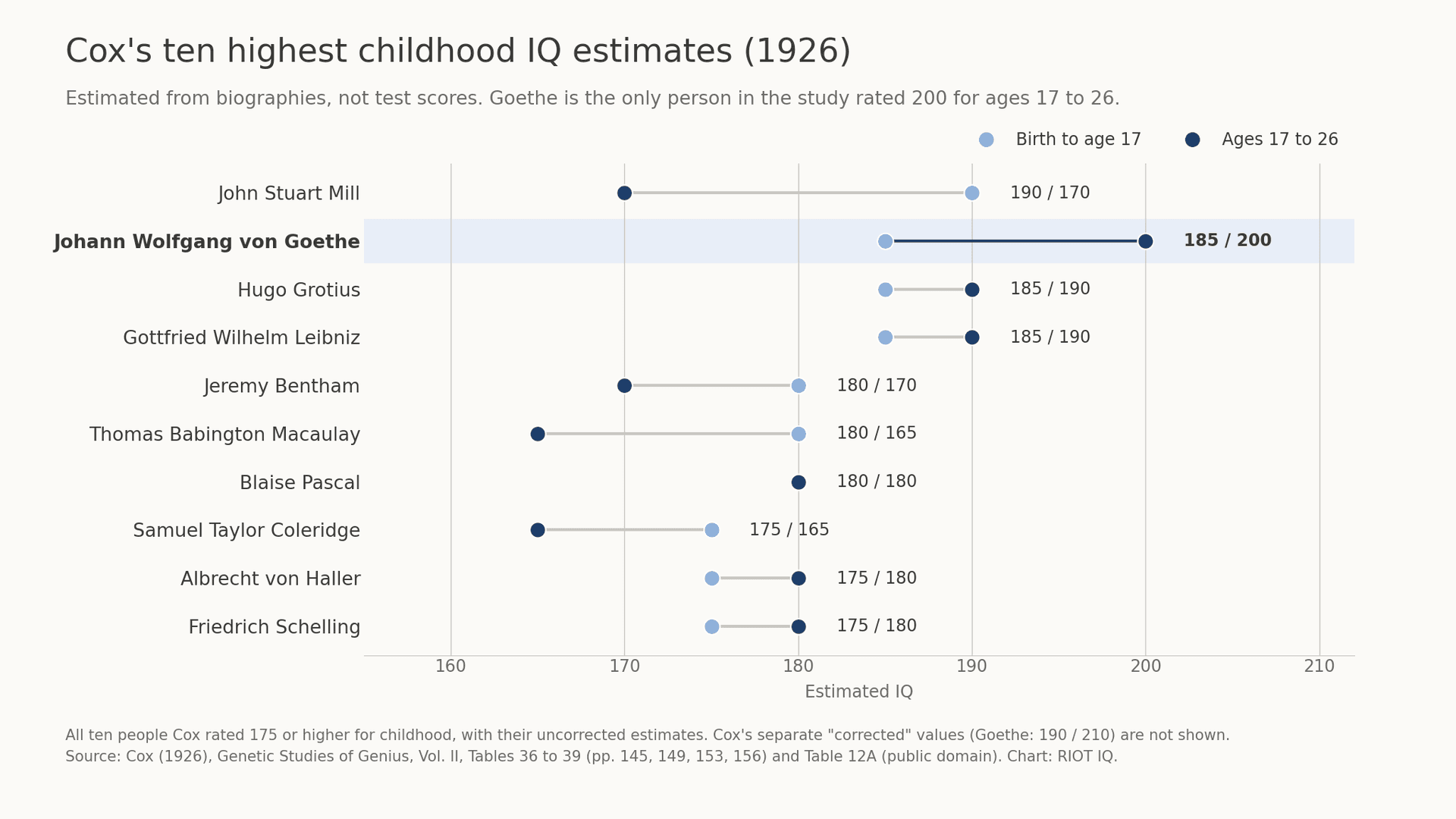
Goethe's IQ was never tested. Cox's 1926 study estimated Goethe's IQ at 185 in childhood and 200 for ages 17 to 26, her highest adult rating.
Dr. Russell T. WarneChief Scientist
Share
Johann Wolfgang von Goethe never took an IQ test, because he died in 1832 and the first intelligence test appeared in 1905. The only citable Goethe IQ figures come from Catharine Cox's 1926 Stanford study of 301 eminent people, which estimated his IQ at 185 for birth to age 17 and 200 for ages 17 to 26, the single highest early-adult rating in the whole study. Those numbers are judgments made by psychologists who read his biography, and the 210 and 225 figures found online come from the same study. This article explains how Cox reached her estimate, what Goethe's documented childhood actually contains, where the bigger numbers come from, and why an estimate of this kind says more about a paper trail than about a mind.
How Cox arrived at 185 and 200
Cox's Genetic Studies of Genius, Volume II was part of Lewis Terman's long project on gifted people. Her raters read a case history for each person, compiled from biographies, letters and school records, and asked what IQ would typically produce that record at that age. They gave two estimates: "AI" for birth to 17 and "AII" for 17 to 26. The method, called "historiometry", rates the surviving record of a childhood; our page on Napoleon's IQ walks through it in more detail.
Goethe's case study is headed "AI IQ 185, AII IQ 200", with a data reliability of .82, the top grade Cox used. In her tables he shares the 185 childhood level with the jurist Hugo Grotius and the philosopher Gottfried Wilhelm Leibniz. Only John Stuart Mill was rated higher for childhood, at 190. For ages 17 to 26, Goethe stands alone. Cox wrote that "an estimated AII IQ of 200 was obtained in a single case", and the case was Goethe. Grotius and Leibniz came next at 190.
Her verdict was unusually warm for a statistical monograph: "Goethe's true IQ may in the history of mankind have been equalled in a few instances; one may well wonder whether it has ever been exceeded."
What Goethe's childhood record shows
The record behind the 185 is detailed, which is one reason it scored so high. Cox built the case study from the standard biographies of her day and from Der junge Goethe, a six-volume edition of his early writings, and it reports the following.
• Home schooling at a fast pace: From age 7 to 17, Goethe and his sister were taught by private tutors in Frankfurt. The subjects included Latin, Greek, Hebrew, French, English, Italian, history, geography, mathematics, drawing and music, with at least ten teachers involved. Within months of starting Latin at 7 he was writing free Latin compositions.
• Competing with older students: At 8 and a half he was translating exercises designed for the senior class of the local grammar school, which put a boy in his ninth year alongside students aged 16 to 22. Cox also reports that he picked up Italian by overhearing his sister's lessons while doing his own Latin.
• Early writing: At 7 and 8 he wrote three short dialogues that Cox judged to have "genuine creative quality", followed by a little play at 10 and, at 12, a story told in letters written in Latin with passages in Greek, English, French, Italian, Yiddish and German.
• A real weakness: Grammar bored him, and Cox notes he "learned it only with some difficulty". When his handwriting was compared with that of 30 town children, it ranked about 9th.
The Internet Encyclopedia of Philosophy gives a cooler summary of the same years: his education was "inconsistently directed by his father and sporadic tutors", yet he learned Greek, Latin, French and Italian "relatively well by the age of eight." He entered law at Leipzig in 1765, aged 16, and finished his legal studies at Strasbourg, where the critic Johann Gottfried Herder steered him toward Homer and Shakespeare, the writer Goethe credited above all with his literary awakening. He published The Sorrows of Young Werther in 1774, which brought him fame across Europe at 25. Cox's AII rating covers exactly those years.
Where the 210 and 225 figures come from
Popular lists often put Goethe at 210, sometimes "210 to 225". Unlike many celebrity IQ numbers, both figures can be traced to Cox.
• The 210: Cox also published "corrected" estimates, which adjust each score upward to make up for gaps in the biographical record. In her large table of individual ratings (Table 12A), Goethe's corrected values are 190 for childhood and 210 for ages 17 to 26. The 210 seen online is that corrected AII value, usually presented without the word "corrected". Cox herself warned that "the purpose of the corrected estimates is not to furnish exact values for the score of an individual or even of a group."
• The 225: One of the three raters scored Goethe's early-adult record at 225, while the other two gave 200 and 180. Cox mentions the 225 in her text as "the impression in terms of intelligence made upon one rater by Goethe's later record." It is one person's rating, and the published average was 200.
Any figure above 225, or any claim that Goethe "scored" a number, has no documented source.
Why the estimate is shakier than it looks
Historiometric IQs are useful for comparing groups, and they are fragile for individuals. Several problems apply directly to Goethe.
The raters disagreed by 45 points on his early-adult record, from 180 to 225. A spread that wide on one person would be unacceptable on a modern test, where a score is usually reported with a margin of error of a few points.
The estimate also depends on how much was written down. Cox found that the IQ estimates rose with the completeness of the records, and she described the true IQs as "even higher than the obtained estimates" for that reason. Goethe's early exercises survived, and he wrote a long autobiography, Dichtung und Wahrheit (1811-1833), that covers his youth. The Internet Encyclopedia of Philosophy notes that the image of Goethe as an "unspoiled and uninfluenced genius" is "doubtless over-romanticized" and that Goethe himself helped create it, partly through that book. A gifted child whose papers were lost would score lower in the same system, and a child who later wrote a flattering memoir might score higher.
Two further cautions matter. Cox expressed her estimates as old-style "ratio IQs", mental age divided by actual age, which behave differently at the extremes from the deviation scores modern tests report, so a 200 here cannot be read like a 200 on a current test. And the raters knew whom they were rating. Cox instructed them to judge each record on its own merits, but a rater reading about the future author of Faust knows the ending of the story.
Within those limits, the estimates still carry some signal. The psychologist Dean Keith Simonton, who has reanalysed Cox's data for decades, classes these IQs as one of four kinds of historiometric measurement. Simonton and Song's 2009 reanalysis of 282 of Cox's subjects found that eminence rose with estimated IQ, and Simonton's 2009 review found that historiometric and test-based studies agree on a modest link between intelligence and adult achievement, around r = .25. That supports the overall pattern while leaving any single figure, Goethe's included, very uncertain.
What Goethe's achievements say about his intelligence
Goethe's adult record is unusually wide. Besides Werther and Faust, which he finished in 1831, the year before he died, he ran ministries for the Duke of Weimar, wrote "The Metamorphosis of Plants" (1790) on the idea of a common form underlying plant organs, studied anatomy, and published a long theory of colour, Zur Farbenlehre (1810). He considered the colour theory his life's true work. It found few followers, and his challenge to Newton's optics is remembered as a scientific miss by an extraordinary mind.
That breadth is consistent with very high general ability, and it is also exactly what IQ cannot fully explain. Persistence, long life, literary gifts and a father who could pay for at least ten tutors all shaped the record. If you want to know what a score near the top of the scale means in practice, our guide to what counts as a genius IQ score explains the cut-offs and how rare they are.
Frequently asked questions
What was Goethe's IQ?
Goethe never took an IQ test. Catharine Cox's 1926 historiometric study estimated his IQ at 185 for birth to 17 and 200 for ages 17 to 26.
Did Goethe have the highest IQ in history?
No one can know. Cox's 200 for his early adulthood was the highest such rating among her 301 subjects, but she rated only people born between 1450 and 1850 whose early years left some written record.
Where does Goethe's IQ of 210 come from?
It is Cox's "corrected" estimate for ages 17 to 26, an upward adjustment for incomplete records. Cox warned that corrected estimates were not exact values for any individual.
How did Goethe compare with Leibniz and Newton?
Leibniz was rated 185 for childhood and 190 for early adulthood, close to Goethe. Newton was rated lower, 130 and 170, and his childhood record was far thinner (a reliability of .43, against Goethe's .82).
Was Goethe a child prodigy?
The record suggests so. He was writing Latin compositions at 7, working at the level of much older grammar-school students by 8 and a half, and studying several languages before his teens.
The takeaway
Goethe's IQ is an estimate built from one of the best-documented childhoods in history, and Cox's raters placed it at 185 and 200, with a corrected 210 that circulates without its caveats. The number reflects a remarkable record, read a century later by three psychologists who did not fully agree. If you want a figure that comes from an actual measurement with a stated margin of error, you can take the RIOT IQ test.
References
1. Cox, C. M. (1926). Genetic studies of genius: Vol. II. The early mental traits of three hundred geniuses. Stanford University Press. [archive.org](. archive.org
2. Cox, C. M. (1926). Genetic studies of genius: Vol. II. The early mental traits of three hundred geniuses [alternate scan]. Stanford University Press. [archive.org](. archive.org
3. Jensen, A. K. (n.d.). Johann Wolfgang von Goethe (1749-1832). Internet Encyclopedia of Philosophy. [iep.utm.edu](. iep.utm.edu
4. Simonton, D. K. (2009). The "other IQ": Historiometric assessments of intelligence and related constructs. Review of General Psychology, 13(4), 315-326. [doi.org/10.1037/a0017141](. doi.org
5. Simonton, D. K., & Song, A. V. (2009). Eminence, IQ, physical and mental health, and achievement domain: Cox's 282 geniuses revisited. Psychological Science, 20(4), 429-434. [doi.org/10.1111/j.1467-9280.2009.02313.x](. doi.org
Hero chart: RIOT IQ, from Cox (1926), Genetic Studies of Genius, Vol. II, Tables 36 to 39 and Table 12A (public domain).
Take our professional IQ test
Want to know your IQ? Try the first ever professional online IQ test.