Jul 29, 2026·Famous People & IQWhat Is Bill Gates's IQ?
Is Bill Gates’s IQ really 160? Discover why popular estimates are inflated, what his 1590 SAT score actually means, and try the RIOT test!
Dr. Russell T. WarneChief Scientist
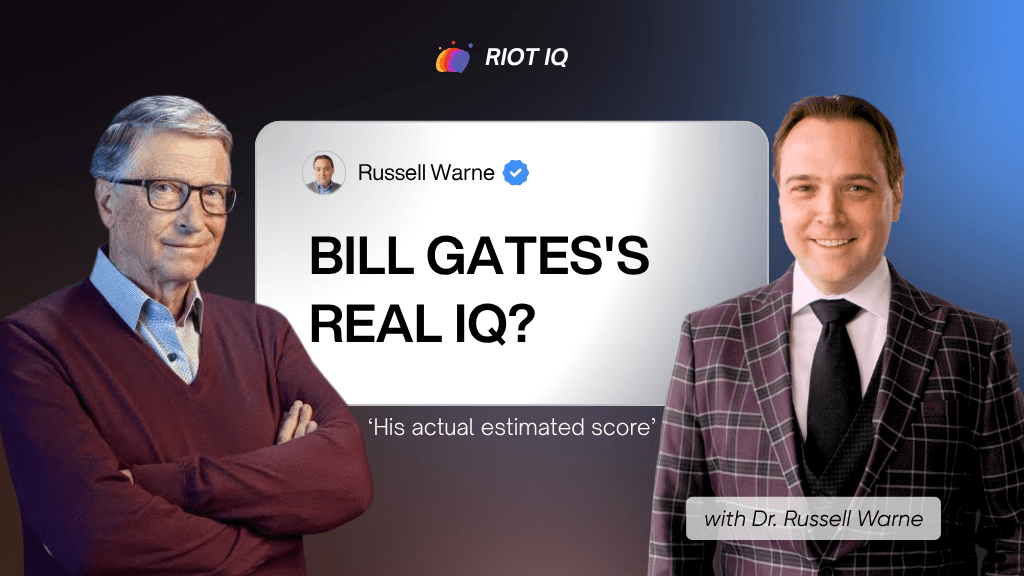
Bill Gates is among the most studied figures in the popular intelligence literature, and one of the few public figures who left behind genuinely hard cognitive evidence rather than just a biography of impressive outcomes. Taking an IQ test and comparing your result to Gates's is a common impulse, but the honest answer to what his IQ is requires unpacking a specific methodological problem with the figure most commonly cited online. The 160 that circulates everywhere is not a measurement. It is a derivation and one that contains a statistical correction most sources skip.
What We Do and Don't Know
Let me establish the foundational fact first. No verified, publicly documented IQ score exists for Bill Gates. He has never disclosed a score from a standardized clinical battery administered under controlled conditions, and no such result has ever been publicly linked to him. The figures circulating online — 150, 155, 157, 160, 170 — are all estimates derived from proxy indicators, not from testing. The range across different sources reflects genuine methodological disagreement about how to weight those indicators, not merely careless aggregation. What makes Gates's case more tractable than most celebrity IQ discussions is that, unlike many public figures, he left behind two genuinely hard pieces of cognitive evidence that most public figures never produce. Both are worth examining carefully.
The SAT Evidence and Why 160 Is Probably Too High
The anchor for the 160 figure is Gates's widely reported SAT score of 1590 out of 1600 on the pre-1995 version of the test. He scored 1590 out of 1600 on the pre-1995 SAT, a harder and far less coachable test than today's version that correlated strongly with general ability. The SAT-IQ correlation on the pre-1995 version, before the test was redesigned and the score ceiling raised, was approximately r = 0.80, making it a genuine psychometric signal. A 1590 out of 1600 is a near-ceiling performance on a demanding instrument, and it places Gates in a very small slice of the tested population. The problem is what happens when you convert that score to an IQ estimate. The most defensible estimate, weighing both indicators and correcting honestly for the imprecision of converting a near-ceiling test score, places Gates most likely in the 140 to 150 range, with a roughly 90% confidence band of approximately 132 to 158. The correction matters because of a well-documented statistical phenomenon called regression to the mean and ceiling compression: at the very top of a score scale, a given raw score increase corresponds to a progressively smaller true ability difference. Converting a 1590 out of 1600 to an IQ of 160 treats the top of the SAT scale as linearly equivalent to the population IQ scale, and it isn't. The same 1590 maps to different IQ estimates depending on which conversion model you use, and the spread across legitimate models is approximately 40 points.
 The honest range from the SAT evidence alone is approximately 140–155. The 160 figure is the upper end of that range, not the central estimate.
The Pancake Sorting Problem: The More Compelling Evidence
The second piece of cognitive evidence Gates left behind is considerably more specific and more impressive than his SAT score. It involves a mathematical problem he solved as a Harvard undergraduate, and the story is worth telling in full because it illustrates something that no standardized test score can capture.
During his first year at Harvard, Gates enrolled in a combinatorial mathematics course taught by Professor Harry Lewis. Lewis posed an open problem to the class — the pancake sorting problem, which asks: what is the minimum number of "prefix reversals" (flipping a portion of a stack of items) needed to sort any arrangement of n distinct items? A simple approach requires at most 2n flips. Lewis had posed it as an example of an unsolved problem and moved on.
A day or two later, this smart sophomore came into my office and explained that he'd got a (5n+5)/3 algorithm, Lewis recalled. Gates had independently improved the known upper bound, reducing the maximum number of flips required from 2n to (5n+5)/3. He then worked on it with a young assistant professor, Christos Papadimitriou, and the research was published in the journal Discrete Mathematics in 1979 under the title "Bounds for Sorting by Prefix Reversals". The result stood as the best known upper bound for approximately 30 years, until another team, using computers that Gates's company had helped build, improved it by roughly 1%.
The pancake sorting result is not an academic credential. It is an independent mathematical contribution, produced without collaborative assistance in response to an unsolved problem, by a student in his first year of university. Papadimitriou later described Gates as the smartest person he had ever met. Lewis said the same. These are not social compliments from people who say such things casually. Papadimitriou is one of the most eminent computer scientists alive, and Lewis is a distinguished Harvard professor of computer science. Their assessments are professional judgments from highly credentialed observers. The cognitive operation involved in the pancake sorting contribution, recognizing a structural mathematical constraint, constructing an algorithm that exploits it, and proving the bound, draws directly on fluid reasoning, working memory, and the kind of inductive mathematical creativity that operates at the extreme upper end of the ability distribution. It is precisely the type of performance that historiometric analysis uses to infer exceptional cognitive ability in the absence of test scores.
What the Dropout Reveals and What It Doesn't
Gates left Harvard after two years to co-found Microsoft. This is sometimes cited as evidence that his abilities were practical rather than academic, or that academic success is a poor proxy for intelligence. Both conclusions are wrong.
He dropped out to found Microsoft — an opportunity-cost choice, not a cognitive limit. By the time he left, he had already demonstrated what he was capable of academically: the pancake sorting result was published, his academic performance was strong, and he was operating comfortably in advanced mathematics coursework. He left because he judged correctly, as it turned out, that the opportunity represented by the emerging personal computing industry would not wait for a degree. That is a strategic decision reflecting both cognitive ability and risk tolerance, not evidence of academic limitation. Harvard awarded him an honorary degree in 2007. His dropout success story is frequently misread as evidence that education doesn't matter for success. Gates's own position on this is more nuanced; he has consistently supported education access and intellectual development through his philanthropic work, and his departure from Harvard reflected assessment of a specific opportunity, not a rejection of learning.
What a Reasonable Estimate Looks Like
Using the same proxy-based framework applied throughout this series: the most careful, methodologically transparent analysis of the available evidence places Gates in the 140 to 150 range as the most defensible central estimate, with a 90% confidence band of approximately 132 to 158. This is the range supported by the corrected SAT conversion combined with the pancake sorting contribution, weighted appropriately for the uncertainty inherent in proxy-based estimation.
That range places Gates solidly in the highly gifted tier, well within the top 1% of the general population at the low end of the estimate, and approaching the profoundly gifted range at the high end. The 160 figure that dominates online discussion is the ceiling of the plausible range, not the central estimate, and treating it as a point estimate ignores the uncertainty that honest proxy-based analysis must acknowledge. What the evidence cannot support is the precision implied by any specific number. The 132 to 158 confidence band means a real score could land anywhere in it, or rarely outside. Anyone who presents a single number for Gates's IQ with apparent confidence is either misapplying the methodology or not applying one at all.
What This Profile Tells Us About IQ and Extraordinary Success
Gates's career trajectory illustrates a point the CEO IQ research literature makes consistently: cognitive ability above approximately 120 is necessary but not sufficient for extraordinary entrepreneurial success. The same intelligence that produced the pancake sorting bound and a 1590 SAT was also present in other Harvard students who did not go on to build one of the most consequential technology companies in history.
His success at Microsoft came from combining cognitive ability with business strategy, competitive instinct, and the ability to identify and exploit market opportunities. The timing of the personal computing revolution, the specific partnership with IBM, the licensing structure that made Microsoft's software the standard across the industry; these reflect strategic judgment, competitive aggression, and fortunate circumstance operating alongside exceptional cognitive ability. The intelligence is a necessary part of the story. It is not the whole story.
The Takeaway
Bill Gates's IQ is unknown, and no verified score from a standardized clinical instrument exists. The figure of 160 that dominates popular discussions is an extrapolation from his SAT score that contains a statistical overcorrection at the ceiling of the scale. The most defensible estimate, derived from both the corrected SAT conversion and the independently verifiable pancake sorting contribution, places his IQ most likely in the 140–150 range, with a confidence band of approximately 132–158.
What the documented record supports without any need for a specific number is that Gates's cognitive profile operates at an exceptional level across the mathematical reasoning and fluid problem-solving domains most directly captured by standardized cognitive assessment. The pancake sorting result specifically is one of the clearest demonstrations of independent mathematical reasoning in any tech founder's public record, more cognitively specific, and more impressive, than any SAT score.
If you want to understand where your own cognitive profile sits across the domains that Gates's evidence most directly illuminates — fluid reasoning, mathematical problem-solving, and working memory — the RIOT gives you a systematic, domain-level measurement that goes considerably further than any celebrity estimate.
References
ACIS IQ. (2026). Bill Gates's IQ: What the Evidence Actually Shows — corrected SAT conversion, pancake sorting, 140–150 central estimate. https://acisiq.com/bill-gates-iq MyIQScores. (2026). Bill Gates' IQ: Estimated at 150–160 — SAT evidence and Microsoft context. https://www.myiqscores.com/famous-iq/bill-gates BrainManager.io. (2024). Bill Gates' IQ: Is He Really a Genius or Just a Tech Visionary? https://brainmanager.io/blog/cognitive/bill-gates-iq Yahoo Finance / Business Insider. (2015). Professor who knew Bill Gates as a student at Harvard: He was the smartest person I've ever met — Papadimitriou account. https://finance.yahoo.com/news/professor-knew-bill-gates-student-143000630.html NPR. (2008). Before Microsoft, Gates Solved a Pancake Problem — Harry Lewis account of the 5n/3 algorithm. https://www.npr.org/2008/07/04/92236781/before-microsoft-gates-solved-a-pancake-problem CogniDNA. (2025). Celebrity IQ Scores — Bill Gates 157 ± 6, SAT-based methodology. https://www.cognidna.com/celebrity-iq-scores/ Core Brain. (2026). Bill Gates IQ — Estimated Score & Cognitive Profile. https://corebrain.app/famous-iq/bill-gates/ Life Score Test. (2026). Bill Gates's Estimated IQ: 155+ — historiometric analysis methodology. https://lifescoretest.com/history/bill-gates
Take our professional IQ test
Want to know your IQ? Try the first ever professional online IQ test.
AuthorDr. Russell T. WarneChief Scientist
