Jul 24, 2026·Famous People & IQWhat Was Nikola Tesla's IQ?
Was Nikola Tesla’s IQ 160 or 300? Discover the truth behind his unverified scores and extraordinary spatial mind. Read the guide and try the RIOT test!
Dr. Russell T. WarneChief Scientist
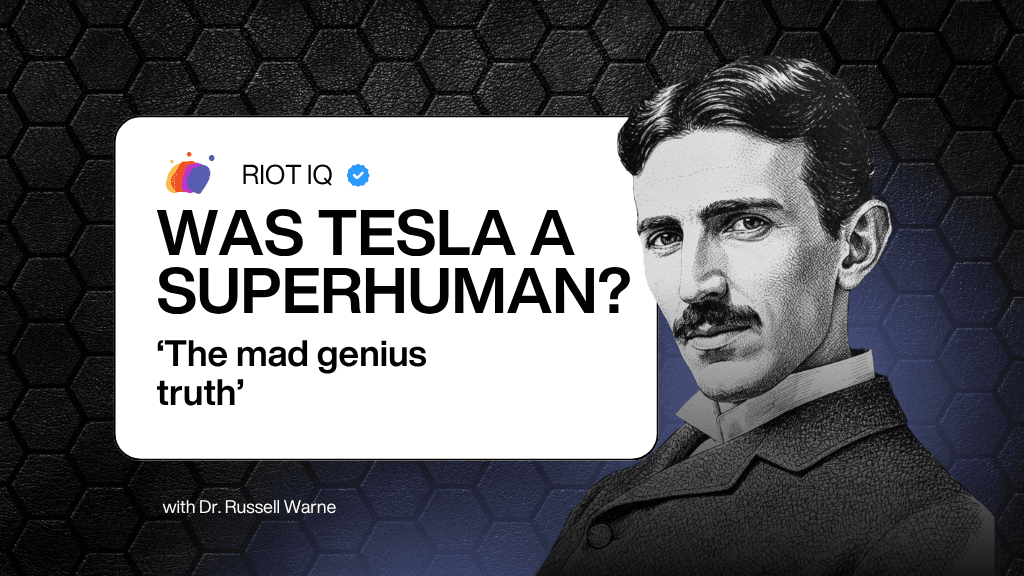
Few historical figures attract more cognitive mythology than Nikola Tesla. The estimates circulating online range from 160 to 310 — a span so wide that it is essentially meaningless as a psychometric claim. Taking an IQ test and comparing your score to Tesla's is an understandable impulse, but the honest starting point for this discussion is the same one I've applied throughout this series: no verified, publicly documented IQ score exists for him. What does exist is a documented cognitive profile — specific, well-attested, and genuinely unusual — that the proxy-based historiometric approach can analyze with more precision than any invented number conveys. That profile is more interesting than any single figure suggests.
The Numbers Online Are Not Data
Let me establish the baseline fact immediately. No verified public Nikola Tesla IQ score exists. Tesla was born in 1856 and died in 1943. Standardized IQ testing as we understand it today — norm-referenced, administered under controlled conditions, scored against a representative sample — was not available in the form that would produce a psychometrically defensible score during his lifetime. The figures of 160, 200, and 310 that appear across online lists are historiometric estimates, celebrity aggregator inventions, or both. Famous-person IQ estimates circulate widely but are often unreliable — many historical figures never took any IQ test, and scores are extrapolated from their work rather than measured. The range across different sources — from 160 to 310 — is itself evidence of the problem. A legitimate psychometric instrument produces scores with known margins of error and a defined ceiling. Estimates that span 150 points are not measurements. They are expressions of admiration dressed in numerical clothing.
What can be evaluated honestly is the pattern of documented cognitive abilities Tesla possessed — and what that pattern implies about where on the ability spectrum he operated.
The Visualization Capacity: Unprecedented in the Documented Literature
The cognitive ability most consistently and specifically documented in Tesla's biography is his spatial visualization — specifically, a form of internal mental simulation that his contemporaries found difficult to believe and that he himself described at length in his autobiography. Tesla designed the AC motor entirely in his head without making any drawings — a feat that astonished his contemporaries because the motor worked on first construction. He described his process in his autobiography with considerable specificity: he would construct a complete mental model of a device, then run it mentally for weeks, observing wear patterns on components, adjusting tolerances, testing modifications — all without any physical model or drawing. He visualized a particular apparatus and then tested it, disassembled it, and checked for proper action and wear entirely within his imagination before building anything physical.
 The initial idea for his AC induction motor arrived during a walk in a Budapest park in 1882. He was reciting from memory a passage of Goethe's Faust when the concept crystallized. His companion Szigeti confirmed that the solution came to Tesla suddenly while they were admiring the sunset, and that when Tesla attempted to explain what he was seeing, he had to describe an invention that existed, at that moment, only in his mind — but in complete, functional detail.
From the perspective of the cognitive domains that psychometric research has identified, this is extraordinary visual-spatial working memory operating simultaneously with fluid inductive reasoning. To do what Tesla described requires exceptional mental rotation, strong quantitative intuition, advanced domain knowledge, very high working memory for meaningful patterns, and the patience to keep all of it stable long enough to refine a design. Each of those capacities is independently a recognized correlate of high general intelligence. Their simultaneous operation at the level Tesla described is, as the same analysis notes, "rare. Very rare."
This is not the same as saying Tesla had an IQ of any specific number. It is saying that the particular cognitive profile his visualization capacity implies sits at the extreme upper end of the visual-spatial and working memory distributions — domains that IQ batteries directly measure and that the research literature consistently links to the highest levels of scientific and engineering achievement.
The Memory: Eidetic but Specific
Tesla's memory is the second most frequently cited cognitive feature in his biography, and it requires careful handling because the popular account overstates what the evidence supports.
Tesla reportedly could memorize entire books and recite them years later, and he could visualize intricate machines in complete detail. He attributed his visualization capacity partly to early childhood exercises his mother devised — guessing each other's thoughts, detecting defects in expressions, and repeating long sentences — that trained his attention and recall from an early age. The term "eidetic memory" — the capacity to recall visual images with photographic precision — is applied to Tesla frequently in popular literature, but the scientific status of true eidetic memory in adults is contested. What is documented in Tesla's biography is something more specific and more useful as a cognitive signal: domain-specific expert memory of the kind that cognitive science has studied extensively in chess grandmasters, musicians, and engineers. Expert memory is not random photographic recall — it is the encoding of meaningful patterns in a domain so deeply that retrieval becomes unusually fast, accurate, and detailed. Tesla's "eidetic" memory likely reflects this expert-pattern encoding rather than true photographic recall — which doesn't make it less impressive, but does make it more explainable within the framework of what high cognitive ability combined with extraordinary domain investment produces.
The Academic and Linguistic Profile
Beyond visualization and memory, the documented biographical record provides several additional proxy indicators of cognitive ability.
At the Realschule in Karlovac, Croatia, Tesla completed a four-year curriculum in three years, performing integral calculus mentally — a capacity his teachers initially suspected was cheating. He subsequently attended the Austrian Polytechnic Institute in Graz, where in his first year he studied more than required and received the highest possible grades in nine subjects. His professor wrote to his father that Tesla was a first-rate student who might become one of the best engineers of his time. Tesla's linguistic range was equally documented. He spoke approximately nine languages — Serbian, Czech, English, French, German, Hungarian, Italian, Latin, and Greek. The sustained acquisition of multiple structurally diverse language systems requires the kind of pattern extraction and working memory that general intelligence research consistently links to high Gf and Gc. His predictive capacity is also worth noting as a cognitive signal. Tesla's documented predictions included wireless communication devices resembling smartphones, global information networks resembling the internet, and wireless energy transmission — all articulated decades before they became technically feasible. The ability to extrapolate current data into accurate long-term simulations is a high-level cognitive function, one that draws on fluid reasoning, domain knowledge, and the same kind of systematic mental modeling that his visualization capacity exemplifies.
What the Edison Contrast Reveals
One of the more revealing dimensions of Tesla's cognitive profile is the contrast with Thomas Edison — his most famous contemporary and antagonist. The two men represent genuinely distinct cognitive styles, and understanding the difference illuminates what makes Tesla's profile unusual.
Edison was an empiricist — relentlessly iterative, willing to test thousands of variations to find what worked. Tesla was a theorist — constructing a complete mental model first, then building only when certain. Edison's famous statement that genius is 99% perspiration is entirely consistent with his cognitive approach: he compensated for a less powerful internal model-building capacity with exhaustive trial-and-error. Tesla's approach — mental simulation to completion before physical construction — is only viable for a mind capable of holding and operating an entire mechanical system in internal representation with sufficient fidelity to detect errors before they are built.
This is not a statement about which approach is superior. Both produced extraordinary results. It is a statement about the specific cognitive architecture that made Tesla's approach possible, and why it is so rare: most engineers cannot build mental models of sufficient fidelity to replace physical prototyping. Tesla apparently could.
What a Reasonable Estimate Looks Like
Using the same proxy-based approach I've applied throughout this series — inferring cognitive range from documented behavioral and academic indicators rather than fabricating precision — what does the available evidence support?
The Graz academic performance, the multilingual acquisition, the mental calculus, and the documented verbal memory all point toward general intelligence well above the gifted threshold of 130. The spatial visualization and mental simulation capacity — particularly the documented ability to design, run, modify, and refine complete mechanical systems in internal representation — points toward something operating at the extreme upper end of the visual-spatial distribution, well above 145 by any reasonable inference.
The most defensible estimate, based on historiometric analysis of the complexity of work and documented accomplishments, places Tesla at 160 or above — placing him in the profoundly gifted range. That estimate is more credible than the 200 or 310 figures that appear on some sites, which exceed what any standardized instrument can reliably measure and imply a precision that the method cannot support. It is also more credible than lower estimates, because the spatial-visualization capacity specifically — documented by multiple witnesses and described at length in his own autobiography — reflects something operating at a cognitive level that general ability research has not often encountered in recorded form.
The honest range, given the uncertainty inherent in proxy-based estimation of historical figures, is 160–180. That places Tesla in the genuinely profoundly gifted tier — a range where standardized test ceilings become a practical constraint, where off-level testing would be required, and where the cognitive profile is qualitatively different from what 130 or even 145 describes.
The Takeaway
Nikola Tesla's IQ is unknown. The figures of 160 to 310 circulating online span a range so wide that they reflect estimation conventions and admiration more than psychometric rigor. What is documented — in his autobiography, in the testimony of contemporaries, and in the academic record — is a cognitive profile centered on exceptional spatial visualization, domain-specific expert memory, multi-language acquisition, and a specific form of mental simulation capacity that allowed complete mechanical design and testing without physical prototyping.
That profile almost certainly places him in the profoundly gifted range — well above 160 on any reasonable proxy estimate — but the specific number carries false precision that the historical evidence cannot support. What the evidence can support is something more interesting: a description of a cognitive architecture that was genuinely unusual even among the brilliant peers of his era, centered on a spatial-visualization capacity that the neuroscience of high performance is only now beginning to describe with the precision it deserves.
If you want to understand where your own cognitive profile sits — including the visual-spatial and working memory domains that defined Tesla's most extraordinary capacities — the RIOT gives you a domain-level picture that reveals the shape of your profile, not just a single number.
References
ACIS IQ. (2026). Nikola Tesla IQ: Official Score or 160 Estimate? https://acisiq.com/nikola-tesla-iq Core Brain. (2026). Nikola Tesla's IQ: 160 — Estimated Score, Sources & Facts. https://corebrain.app/famous-iq/nikola-tesla/ BrainManager.io. (2025). Nikola Tesla IQ: Genius or Madman? The Truth About His Intelligence. https://brainmanager.io/blog/cognitive/nikola-tesla-iq Success Consciousness. (2024). Nikola Tesla — Creative Thinking and Imagination — eidetic memory and visualization autobiography description. https://www.successconsciousness.com/blog/creative-visualization/nikola-tesla/ Tesla Universe. The Miracle Mind of Nikola Tesla — AC motor visualization account, witness testimony. https://teslauniverse.com/nikola-tesla/articles/miracle-mind-nikola-tesla Digest Knowledge. (2024). Nikola Tesla: An Overlooked Genius — nine languages, four-year curriculum in three years. https://digestknowledge.com/knowledgebase/nikola-tesla-an-overlooked-genius The Genius Index. Nikola Tesla — IQ Analysis: Edison contrast, predictive capacity, and mental simulation. https://thegeniusindex.com/people/nikola-tesla/
Take our professional IQ test
Want to know your IQ? Try the first ever professional online IQ test.
AuthorDr. Russell T. WarneChief Scientist
