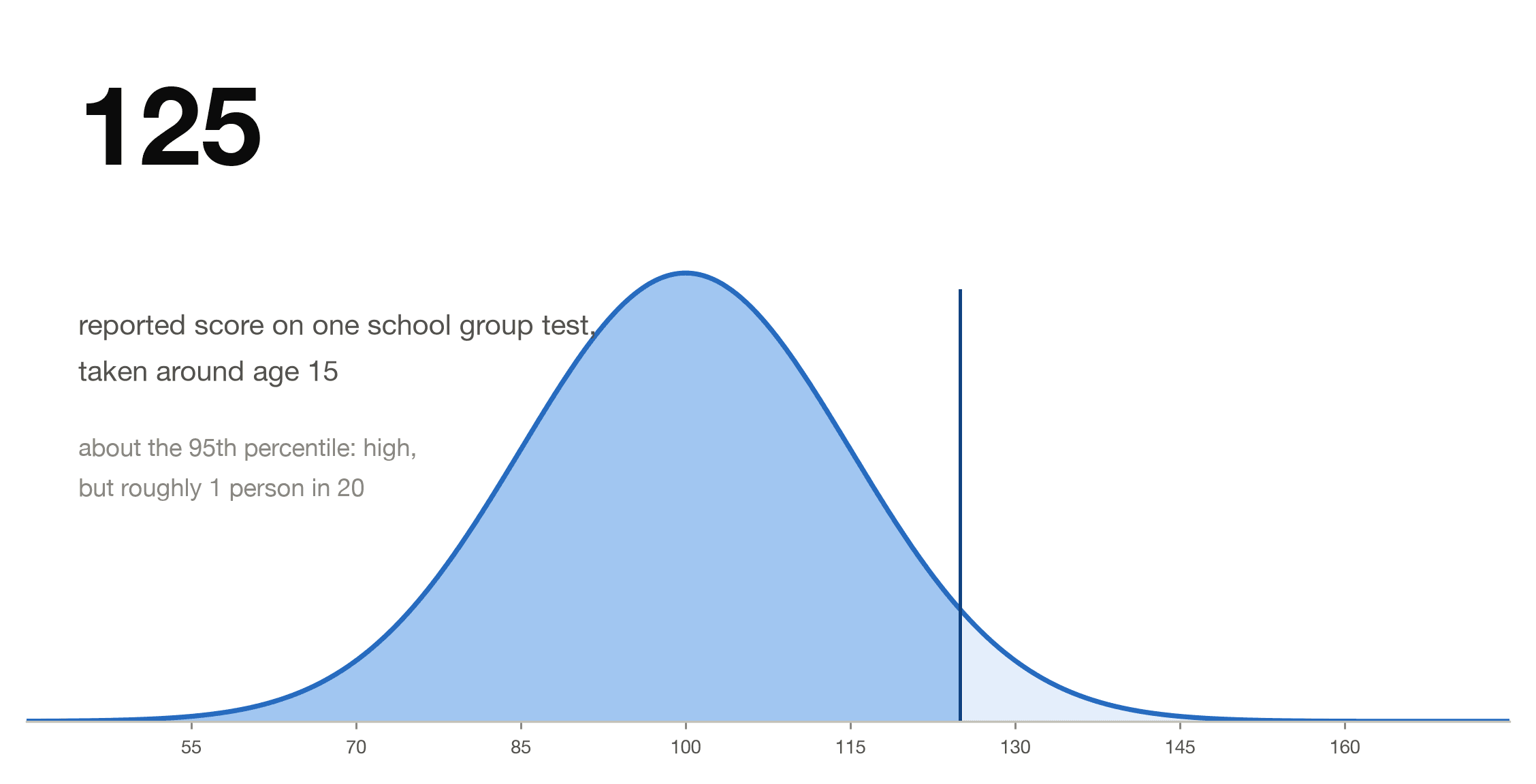
Richard Feynman's IQ was reportedly 125 on a school test, yet he won the 1965 Nobel Prize in Physics. What his score says about IQ tests and genius.
Dr. Russell T. WarneChief Scientist
Share
The only IQ score ever reported for Richard Feynman is 125, from a school test he took as a teenager in Far Rockaway, New York. His biographer James Gleick records it in a single dry line: "his score on the school IQ test was a merely respectable 125." Feynman went on to finish first in the 1939 Putnam mathematics competition and to win the 1965 Nobel Prize in Physics. This article is about how both facts can be true at once, and what one old score can and cannot tell you about a mind like his.
Where the 125 comes from
The number has a specific paper trail, and it is thinner than most people assume. Gleick's 1992 biography Genius reports the score from Feynman's high school days in Far Rockaway, around age 15, in the early 1930s. It was a school-administered group test. The test's name, its content, and the original record have never surfaced, so the 125 is best described as a reported score rather than a verified one. No other professionally administered result was ever documented for him, which makes this single number the entire measurement record for one of the most celebrated physicists of the twentieth century.
The resume that does not look like a 125
Putnam 1939: a gap that astounded the scorers
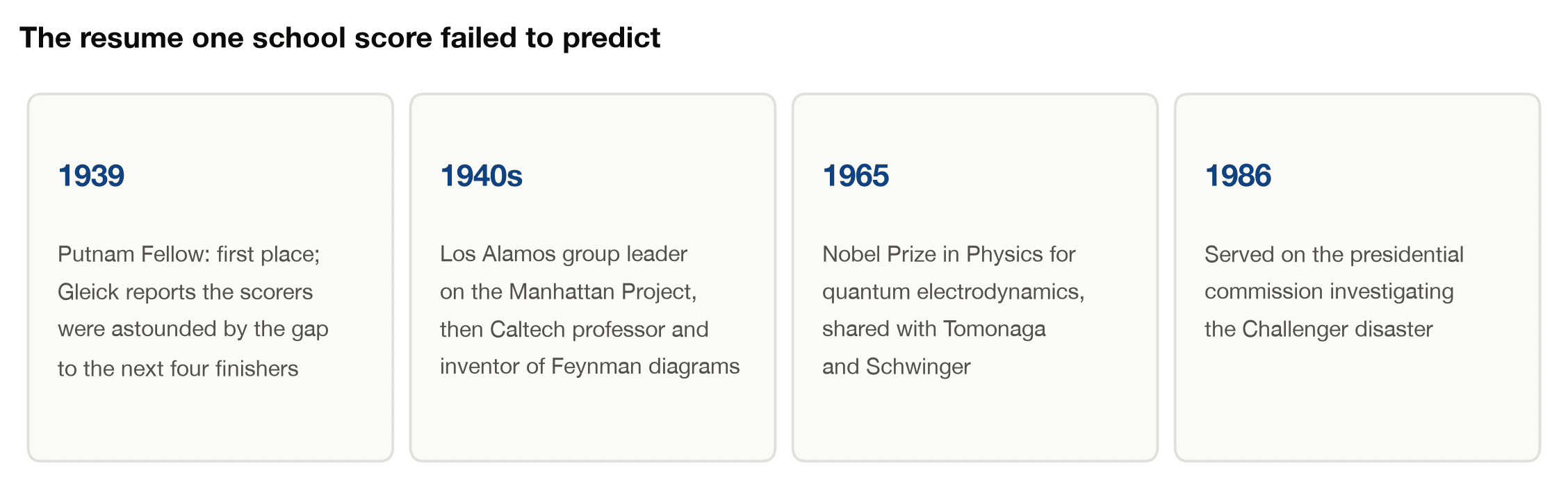
As an MIT senior, Feynman entered the William Lowell Putnam competition, the hardest undergraduate mathematics contest in North America. The exam is difficult enough that in some years the median score has been zero, with more than half the entrants failing to solve a single problem. The top five finishers are named Putnam Fellows. Feynman finished first, and by Gleick's account he later learned that the scorers had been astounded by the gap between his result and the next four. Harvard sounded him out about the scholarship that goes with the title; he told them he was already going to Princeton.
The 1965 Nobel Prize
Feynman shared the 1965 Nobel Prize in Physics in equal thirds with Sin-Itiro Tomonaga and Julian Schwinger, in the Nobel Foundation's words "for their fundamental work in quantum electrodynamics, with deep-ploughing consequences for the physics of elementary particles." Along the way he had been a group leader at Los Alamos during the Manhattan Project, become a professor at Caltech, invented the diagrams that carry his name, and later served on the presidential commission that investigated the Challenger disaster.
Three honest ways to reconcile the gap
• A low-ceiling school test: Group tests given in 1930s schools were short, had relatively easy item pools, and often leaned on verbal material. An instrument like that cannot distinguish a bright student from a once-in-a-generation one; it simply runs out of hard questions.
• A tilted ability profile: Feynman's documented feats are overwhelmingly mathematical. A profile that extreme in quantitative and spatial reasoning can coexist with more ordinary verbal scores, and a verbally weighted test would average the two together.
• Scores are predictors, not destinies: IQ scores forecast outcomes statistically, across large groups. They do not cap what any individual, especially one with obsessive curiosity and decades of focused work, can produce.
For what a score at this level typically means in practice, see our guide to what an IQ of 125 means.
The Mensa story
Feynman liked to joke that he could not join Mensa because his IQ was too low. The story appears in credible retellings, including the Princetoniana Museum's profile of him, but no letter or document of the exchange has ever been published, so it is best treated as a joke he enjoyed rather than a verified event. It fit a lifelong habit: Feynman spent his career puncturing prestige, his own included.
What Feynman's case really says about IQ tests
It is tempting to read this story as proof that IQ tests are meaningless, and that is not the lesson. Across large groups, IQ scores remain among the best predictors psychology has for school and work outcomes. The lesson is about single scores: one group test, taken once, in childhood, with an unknown ceiling, is weak evidence about any individual, and especially about an individual whose ability was as lopsided as Feynman's. The same caution applies to the numbers attached to Albert Einstein, who never took an IQ test at all, and it is why the childhood testing of Terence Tao, done properly with individually administered instruments, reads so differently.
Frequently asked questions
What was Richard Feynman's IQ?
According to his biographer James Gleick, Feynman scored "a merely respectable 125" on a school IQ test as a teenager in Far Rockaway. No other professionally administered score was ever documented, so 125 is the only number on record.
How could a Nobel Prize winner have an IQ of 125?
The 125 came from one group school test taken around age 15, likely with a low ceiling and a strong verbal component. His first-place Putnam finish in 1939 shows mathematical ability far beyond what that single score suggests. One childhood test is a noisy estimate, and it is not a lifetime verdict.
Did Feynman really turn down Mensa because his IQ was too low?
He liked to tell the story that way, and it is repeated in credible profiles, but no primary document of the exchange has been published. Treat it as a joke he enjoyed rather than a verified event.
What did Feynman win the Nobel Prize for?
The 1965 Nobel Prize in Physics, shared equally with Sin-Itiro Tomonaga and Julian Schwinger, for fundamental work in quantum electrodynamics.
Does Feynman's case prove IQ tests do not matter?
No. It shows a single old score can badly underestimate one extraordinary person, especially with an uneven ability profile. Across large groups, IQ scores remain among the best predictors psychology has for school and work outcomes.
The takeaway
Feynman's 125 is real, and it understates him, and both of those statements can stand together once you know what a 1930s school group test could and could not measure. A modern, professionally developed instrument with current norms gives a far better estimate of ability than anything available in Far Rockaway in 1933. The Reasoning and Intelligence Online Test from RIOT IQ offers a free IQ test built to those standards, with stated precision instead of a single unqualified number.
References
1. Gleick, J. (1992). Genius: The life and science of Richard Feynman. Pantheon Books. archive.org
2. Nobel Foundation. (1965). Richard P. Feynman - Facts. NobelPrize.org. nobelprize.org
3. Nobel Foundation. (1965). The Nobel Prize in Physics 1965 - Summary. NobelPrize.org. nobelprize.org
5. Warne, R. T. (2020). In the know: Debunking 35 myths about human intelligence. Cambridge University Press. doi.org
Hero image: Richard Feynman's Los Alamos badge photo. Los Alamos National Laboratory, courtesy AIP Emilio Segre Visual Archives, CC0, via Wikimedia Commons.
Take our professional IQ test
Want to know your IQ? Try the first ever professional online IQ test.