What Was Jim Simons's IQ? The Codebreaker, Geometer and Quant Behind Renaissance | Riot IQ
Nov 1, 2026·Famous People & IQ
What Was Jim Simons's IQ? The Codebreaker, Geometer and Quant Behind Renaissance
Jim Simons's IQ was never published. His only known test score is a 750 on the SAT math section, which he mentioned in 2019. Here is what his record shows.
Dr. Russell T. WarneChief Scientist
Share
Jim Simons never published an IQ score, so his IQ is unknown and any Jim Simons IQ figure online is an estimate. The only standardized test result on record is one he volunteered himself: in a 2019 interview he said he scored 750 out of 800 on the math section of the SAT. Simons, who died in New York on May 10, 2024, at 86, was a prize-winning geometer who went on to found Renaissance Technologies, one of the most profitable investment firms in history. This article covers what that SAT score can and cannot tell us, what his documented record shows, and what he said about intelligence and talent.
The one test score on record
At the Institute for Advanced Study's Einstein gala in March 2019, Carlyle co-founder David Rubenstein interviewed Simons on stage. Institutional Investor's report of the evening opens with the detail: Simons "did not receive a perfect score on the math section of his SATs. He scored 750 out of 800."
That is a strong score, though not a perfect one, at the start of a career that changed a branch of geometry. It still cannot be turned into an IQ. It is a single section, recalled decades later from an SAT taken in the 1950s before he entered MIT at 17, and the research conversions all start from combined scores on later versions of the test. In the best-known study, Meredith Frey and Douglas Detterman found that SAT totals correlated .82 with "g," the general intelligence factor, which makes the SAT a strong proxy for general ability. Our page on how to convert an SAT score into an IQ estimate explains why even those conversions carry error bands of roughly a dozen IQ points.
The other popular claims have no test behind them. Simons has been called "the world's smartest billionaire," as Berkeley's alumni magazine noted in 2016, but that is a press label. The specific IQ numbers that appear on celebrity lists cite no test, no date and no source.
What the documented record shows
Simons's career is documented in unusual detail, much of it in Rob Kirby's biography for Celebratio Mathematica and in obituaries from Berkeley and the Simons Foundation.
• MIT in three years: Simons grew up in Newton, Massachusetts, entered MIT at 17 and graduated in 1958, three years later.
• A Berkeley PhD at 23: He finished his doctoral thesis in 1961 under Bertram Kostant, earning the degree at 23, according to UC Berkeley. Kirby notes that the degree was formally awarded in 1962. The thesis, on holonomy systems, appeared in the Annals of Mathematics that year, and Berkeley's obituary notes that he wrote it against his advisor's advice, on a problem in the geometry of curved spaces that had defeated other mathematicians.
• Codebreaking: In 1964 he joined the Institute for Defense Analyses in Princeton, which did code-breaking work for the National Security Agency. He stayed four years, splitting his time between their problems and his own mathematics, and was fired in 1968 for publicly opposing the Vietnam War.
• Landmark geometry: His 1968 paper on minimal varieties in the Annals of Mathematics settled cases of a long-standing problem about minimal surfaces. In 1974 he and Shiing-Shen Chern published "Characteristic forms and geometric invariants," the source of the Chern-Simons forms now used widely in theoretical physics. He shared the American Mathematical Society's 1976 Oswald Veblen Prize in Geometry with William Thurston.
• Building a department: From 1968 he chaired the mathematics department at Stony Brook University for ten years.
• Renaissance and Medallion: In 1978 he founded the firm that became Renaissance Technologies. Drawing on records reconstructed in Gregory Zuckerman's book The Man Who Solved the Market, Barry Ritholtz reported that the firm's Medallion Fund returned 66.1% a year before fees from 1988 to 2018, and 39.1% after fees.
• Philanthropy: In 1994 he and his wife, Marilyn Simons, founded the Simons Foundation to support research in mathematics and the basic sciences.
What Simons said about intelligence and talent
When Simons described his success, he usually credited the people he hired, and sometimes luck.
In a 2015 TED interview with Chris Anderson, he described Renaissance's edge as data plus "very smart people," adding that he did not know how to hire fundamental traders, "but I did know how to hire scientists, because I have some taste in that department." He also said his early trading gains came from "pure luck," before he began building mathematical models of the kind he had worked on at the Institute for Defense Analyses.
In a 2010 talk at MIT, quoted by the Simons Foundation, he listed his guiding principles: "Do something new; don't run with the pack. Surround yourself with the smartest people you can find. Be guided by beauty. Don't give up easily. Hope for good luck!"
He was equally modest about Chern-Simons theory, which physicists picked up years after publication. "So it was a fluke," he told Kirby. "I didn't set out to change physics but you never know what you're going to get when you set out with a good problem."
What his achievements say about IQ
Research-level mathematics is among the most cognitively demanding work there is, and a doctorate at 23 followed by prize-winning geometry is consistent with very high general ability. That inference is reasonable. The step from "very high" to a specific number is where it fails, because no test of Simons exists and his work does not come with a scale.
His investing record is harder still to read as a measure of one person's mind. By his own account, Renaissance was built by hiring scientists and letting the models do the trading, so Medallion's returns belong to a team and decades of data as much as to its founder. As with Charlie Munger, whose investing career is also read as proof of genius, a famous outcome can make high ability likely without saying how high.
Historical comparisons have the same weakness. Our article on John von Neumann's IQ shows how a mathematician with no test on record still acquired a list of invented scores, and our look at who the smartest person in the world is explains why rankings of that kind cannot be settled with numbers.
Frequently asked questions
What was Jim Simons's IQ?
Nobody knows. Simons never published an IQ score, and no IQ test result for him has been reported, so any number is an estimate.
What did Jim Simons score on the SAT?
He said in a 2019 interview that he scored 750 out of 800 on the math section, short of a perfect score. A single remembered section score from the 1950s cannot be converted into an IQ.
How old was Jim Simons when he got his PhD?
He completed his Berkeley doctorate in mathematics at 23, finishing the thesis in 1961 under Bertram Kostant.
Was Jim Simons a codebreaker?
Yes. From 1964 to 1968 he worked at the Institute for Defense Analyses in Princeton, which broke codes for the National Security Agency, until he was fired for opposing the Vietnam War.
What is Chern-Simons theory?
It grew out of a 1974 paper by Simons and Shiing-Shen Chern on geometric invariants. Physicists later built a quantum field theory on their formula, and it is now used in string theory and condensed matter physics.
The takeaway
Jim Simons has no IQ score on record, and the one test number he ever shared, a 750 on the SAT math section, is too partial to convert. His documented record is extraordinary, from a Berkeley PhD at 23 to the Chern-Simons forms and the Medallion Fund, and it points to exceptional ability without putting a number on it. If you want a measured score of your own, take the RIOT IQ test, which reports a full-scale result against published norms.
References
1. Orr, L. (2019, March 16). How Jim Simons scored on his math SAT. Institutional Investor. [institutionalinvestor.com](. institutionalinvestor.com
2. Sumner, T. (2024, May 10). Simons Foundation co-founder, mathematician and investor Jim Simons dies at 86. Simons Foundation. [simonsfoundation.org](. simonsfoundation.org
3. Frey, M. C., & Detterman, D. K. (2004). Scholastic assessment or g? The relationship between the Scholastic Assessment Test and general cognitive ability. Psychological Science, 15(6), 373-378. [doi.org/10.1111/j.0956-7976.2004.00687.x](. doi.org
4. California Magazine. (2016). The world's smartest billionaire: James Simons, Cal alumnus. Cal Alumni Association. [alumni.berkeley.edu](. alumni.berkeley.edu
5. Kirby, R. (2016). James Harris Simons. Celebratio Mathematica. Mathematical Sciences Publishers. [celebratio.org](. celebratio.org
6. University of California, Berkeley. (n.d.). Jim Simons (1938-2024): A mind at play in the real world. [inspire.berkeley.edu](. inspire.berkeley.edu
7. Simons, J. (1962). On the transitivity of holonomy systems. Annals of Mathematics, 76(2), 213-234. [doi.org/10.2307/1970273](. doi.org
8. Simons, J. (1968). Minimal varieties in Riemannian manifolds. Annals of Mathematics, 88(1), 62-105. [doi.org/10.2307/1970556](. doi.org
9. Chern, S.-S., & Simons, J. (1974). Characteristic forms and geometric invariants. Annals of Mathematics, 99(1), 48-69. [doi.org/10.2307/1971013](. doi.org
10. O'Connor, J. J., & Robertson, E. F. (n.d.). Oswald Veblen Prize of the AMS. MacTutor History of Mathematics Archive, University of St Andrews. [mathshistory.st-andrews.ac.uk](. mathshistory.st-andrews.ac.uk
11. Ritholtz, B. (2019, October 28). How Jim Simons built the best hedge fund ever [Review of the book The man who solved the market, by G. Zuckerman]. Bloomberg Opinion, via WealthManagement.com. [wealthmanagement.com](. wealthmanagement.com
12. Simons, J., & Anderson, C. (2015). The mathematician who cracked Wall Street [Video interview and transcript]. TED. [ted.com](. ted.com
13. Sumner, T. (2024, May 10). Remembering the life and careers of Jim Simons. Simons Foundation. [simonsfoundation.org](. simonsfoundation.org
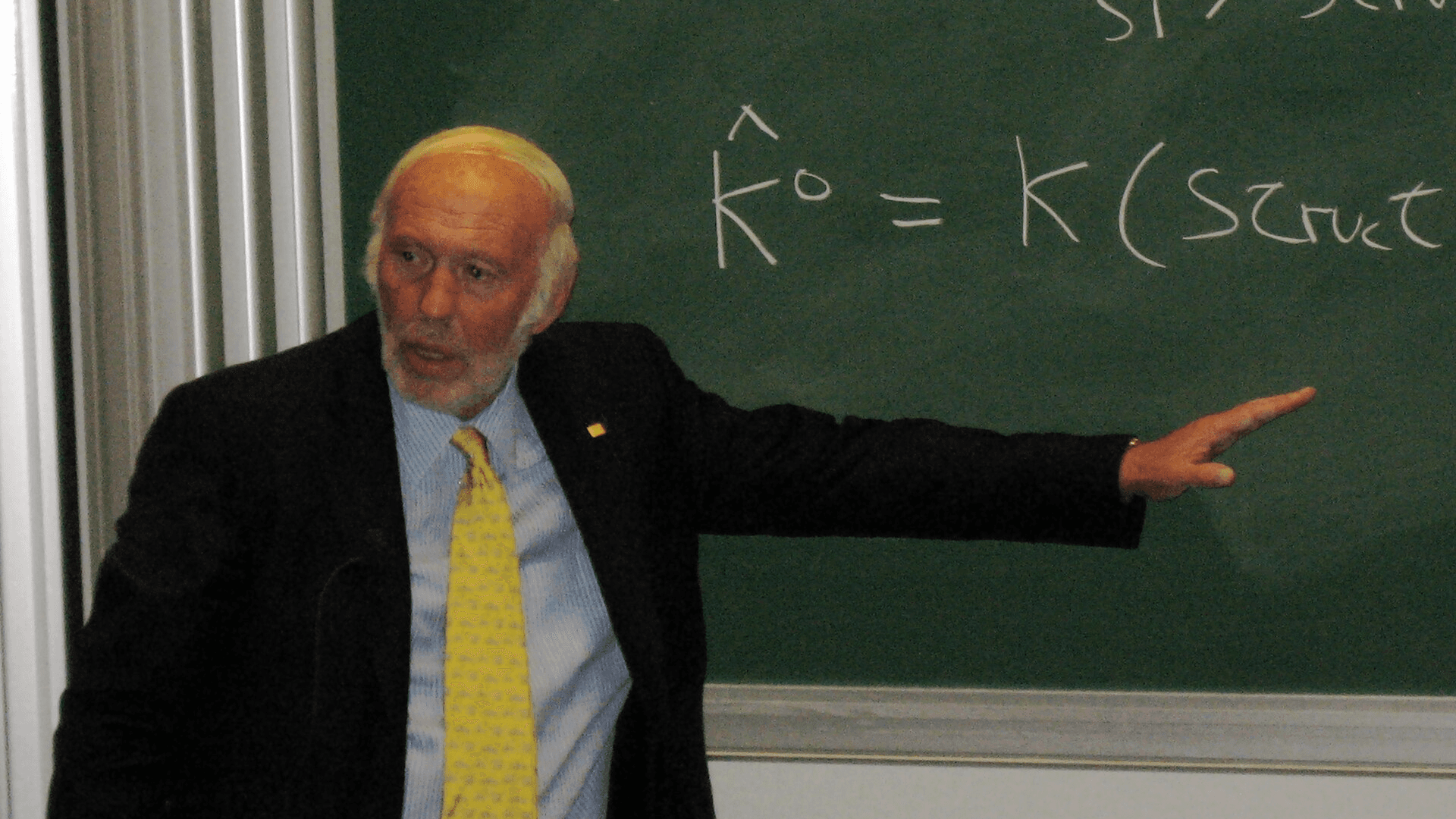
Hero image: James Simons (2007), photo by Gert-Martin Greuel, CC BY-SA 2.0 DE. Via Wikimedia Commons.
Take our professional IQ test
Want to know your IQ? Try the first ever professional online IQ test.