What Was Carl Sagan's IQ? What He Actually Said About Intelligence | Riot IQ
Nov 1, 2026·Famous People & IQ
What Was Carl Sagan's IQ? What He Actually Said About Intelligence
Carl Sagan's IQ was never published, and the numbers online cite no test. He did win a Pulitzer for a book on the evolution of intelligence, and he doubted IQ tests.
Dr. Russell T. WarneChief Scientist
Share
Carl Sagan's IQ was never published: there is no test score on record, and the Carl Sagan IQ numbers that circulate online cite no test or examiner. What is documented is a University of Chicago doctorate, a Cornell professorship, a central role in NASA's planetary missions and a Pulitzer Prize for a book about the evolution of human intelligence.
That last point makes Sagan unusual among the famous names people ask about. He wrote at length about intelligence and about IQ tests, and he was skeptical of them. This article covers why no score exists, what the record shows, what Sagan himself said about intelligence and IQ testing (and which parts have held up), and what his achievements do and do not tell us.
In The Dragons of Eden (1977), Sagan wrote that machines were "just passing over an important threshold: the threshold at which, to some extent at least, they give an unbiased human being the impression of intelligence." Today's language models make that question practical. Whether a machine seems intelligent and whether it has the general reasoning ability that IQ tests were built to measure in people are separate questions, and they are worth keeping apart.
Why there is no Carl Sagan IQ score
No test result for Sagan has been published by him, his family, his biographers or any news outlet, and none of the figures on celebrity-IQ pages names a source. He was born in 1934, so he is also far outside Catharine Cox's 1926 study of historical geniuses, which covered people born between 1450 and 1850. Any number attached to his name is a guess.
One thing is often mistaken for evidence.
• The 1992 poll: In January 1992 the Deseret News reported that readers of Parade magazine had voted Sagan "the smartest person in the country," ahead of Norman Schwarzkopf and William F. Buckley Jr. That was a popularity vote among magazine readers, and it says more about his fame as a television scientist than about any test. Sagan's reply was characteristic: "A good definition of intelligence is understanding how little we understand of what there is to know." Lists of this kind are a recurring theme in our article on who is the smartest person in the world.
What the documented record shows
Cornell's 1996 obituary and NASA's profile give a consistent outline.
• Early interest: Sagan was born in Brooklyn on November 9, 1934. NASA notes that he described himself as a "childhood science fiction addict" who became fascinated by astronomy when he learned that every star in the night sky was a distant Sun.
• Education: He earned a bachelor's degree in 1955 and a master's in 1956, both in physics, and a doctorate in astronomy and astrophysics in 1960, all at the University of Chicago.
• Academic career: He taught at Harvard in the early 1960s, joined Cornell in 1968, became a full professor in 1971, and directed Cornell's Laboratory for Planetary Studies. He published more than 600 scientific papers and popular articles and edited the planetary science journal Icarus for 12 years.
• Space science: He played a leading role in NASA's Mariner, Viking, Voyager and Galileo missions, and his research addressed the greenhouse effect on Venus, windblown dust as the explanation for seasonal changes on Mars and organic haze on Saturn's moon Titan. Voyager's project manager also appointed him to head the committee that chose the contents of the Voyager Golden Record.
• Public science: The PBS series Cosmos was seen by more than 500 million people in 60 countries, and the companion book spent 70 weeks on The New York Times bestseller list.
He died in Seattle on December 20, 1996, at 62, of pneumonia after a two-year illness with the bone marrow disease myelodysplasia.
A Pulitzer for a book about intelligence
Sagan won the 1978 Pulitzer Prize for The Dragons of Eden: Speculations on the Evolution of Human Intelligence. The book tours the evolution of the brain, from brain-to-body-mass ratios to experiments teaching chimpanzees to communicate, and it is where Sagan put his views on IQ testing in print.
He described how the Stanford-Binet tried to test both brain hemispheres, for example with items asking a child to predict how a folded, cut piece of paper will look when opened, and then concluded: "Unsurprisingly, IQ tests also seem to be powerfully biased toward the left hemisphere."
Two of the book's central ideas have not aged well, and it is fair to Sagan to say so, since he presented them as speculation.
• The "triune brain": Sagan built much of the book on Paul MacLean's model of a human brain made of a reptilian core, a mammalian limbic layer and a newer cortex. Neuroscientists who study brain evolution now reject that layered picture. In 2020 Joseph Cesario, David Johnson and Heather Eisthen wrote that this view "has long been discredited among neurobiologists" and urged psychologists to abandon it.
• Left-brain and right-brain thinkers: The idea that people, or tests, lean on one hemisphere has also weakened. A study of resting-state brain scans from 1,011 people aged 7 to 29 found that lateralization is a local property of particular networks and found no evidence for "left-brained" or "right-brained" individuals. Modern intelligence batteries also include spatial and nonverbal tasks alongside verbal ones, so the charge of a one-sided test fits them less well than it fit the tests Sagan knew.
His instinct that a single score leaves a lot out was reasonable. His proposed explanation was a product of 1970s brain science.
What his achievements do and do not say about IQ
Sagan's record would be hard to build without high reasoning ability. A physics and astrophysics doctorate, hundreds of papers and years of work on interplanetary missions all demand it. Research on gifted students backs up the general link: in a 20-year study of youths who scored in the top 1% at age 13, Jonathan Wai, David Lubinski and Camilla Benbow found that ability differences even within that top 1% predicted later doctorates, patents and university tenure.
That is a finding about groups, and it cannot be run backward to give one person a score. Sagan's particular strengths, such as explaining science on television and in prose to hundreds of millions of people, also include things IQ tests do not try to measure. Our article on Neil deGrasse Tyson's IQ reaches the same conclusion for another astrophysicist and science communicator, one who is openly skeptical of IQ talk.
Frequently asked questions
What was Carl Sagan's IQ?
Nobody knows. No test score was ever published, and the numbers online cite no source, so any figure is a guess.
Was Carl Sagan voted the smartest person in America?
Yes, in a sense. In 1992 readers of Parade magazine voted him the smartest person in the country, according to the Deseret News. It was a reader poll, and it measured fame and admiration, not IQ.
What did Carl Sagan think of IQ tests?
He was skeptical. In The Dragons of Eden he wrote that IQ tests "seem to be powerfully biased toward the left hemisphere," a view based on 1970s split-brain research that later studies have not supported.
Which Carl Sagan book won the Pulitzer Prize?
The Dragons of Eden: Speculations on the Evolution of Human Intelligence (1977) won the Pulitzer Prize in 1978.
What degrees did Carl Sagan have?
All three were from the University of Chicago: a bachelor's in physics (1955), a master's in physics (1956) and a doctorate in astronomy and astrophysics (1960).
The takeaway
There is no Carl Sagan IQ score, and the numbers online are guesses. His record, from a Chicago doctorate to the Voyager Golden Record and a Pulitzer for a book on the evolution of intelligence, points clearly to a powerful mind, and he would probably have been the first to say that a single number leaves a lot out. If you want to see what a modern, normed measurement of your own reasoning looks like, you can take the RIOT IQ test and judge its usefulness for yourself.
References
1. Brand, D. (1996, December 19). Carl Sagan, Cornell astronomer, dies today (Dec. 20) in Seattle. Cornell Chronicle. [news.cornell.edu](. news.cornell.edu
2. NASA Science. (n.d.). Carl Sagan (1934-1996). [science.nasa.gov](. science.nasa.gov
3. NASA Science. (n.d.). Voyager at 30: The golden record. [science.nasa.gov](. science.nasa.gov
4. Sagan, C. (1977). The dragons of Eden: Speculations on the evolution of human intelligence. Random House. [penguinrandomhouse.com](. penguinrandomhouse.com
5. Deseret News. (1992, January 2). Sagan is voted smartest person in U.S. [deseret.com](. deseret.com
6. Cox, C. M. (1926). Genetic studies of genius: Vol. II. The early mental traits of three hundred geniuses. Stanford University Press. [archive.org](. archive.org
7. Cesario, J., Johnson, D. J., & Eisthen, H. L. (2020). Your brain is not an onion with a tiny reptile inside. Current Directions in Psychological Science, 29(3), 255-260. [doi.org/10.1177/0963721420917687](. doi.org
8. Nielsen, J. A., Zielinski, B. A., Ferguson, M. A., Lainhart, J. E., & Anderson, J. S. (2013). An evaluation of the left-brain vs. right-brain hypothesis with resting state functional connectivity magnetic resonance imaging. PLoS ONE, 8(8), e71275. [doi.org/10.1371/journal.pone.0071275](. doi.org
9. Wai, J., Lubinski, D., & Benbow, C. P. (2005). Creativity and occupational accomplishments among intellectually precocious youths: An age 13 to age 33 longitudinal study. Journal of Educational Psychology, 97(3), 484-492. [doi.org/10.1037/0022-0663.97.3.484](. doi.org
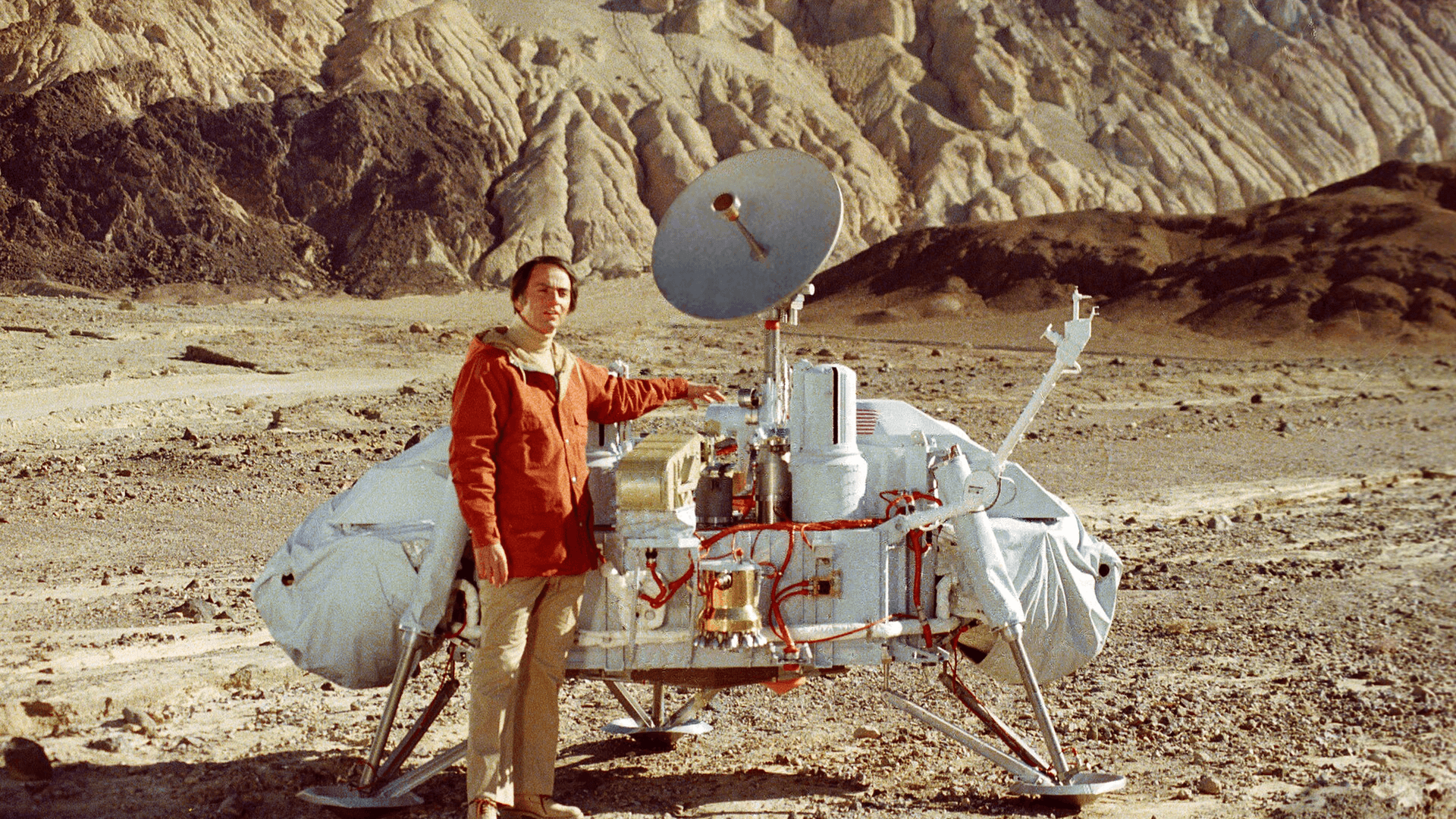
Hero image: Carl Sagan with a Viking lander model, NASA/JPL. Public domain, via Wikimedia Commons.
Take our professional IQ test
Want to know your IQ? Try the first ever professional online IQ test.