Oppenheimer's IQ was never recorded. Numbers like 135 or 190 are modern guesses. See what his documented record actually shows about his intelligence.
Dr. Russell T. WarneChief Scientist
Share
J. Robert Oppenheimer never took a documented IQ test, so no score for him exists anywhere in the record. The numbers circulating online, from 135 up to 190 and beyond, are modern guesses reverse-engineered from his reputation, and the sites publishing them concede he was never tested. What the record does contain is extraordinary: a Harvard degree finished in three years, a physics PhD at 23 under Max Born, and the scientific direction of Los Alamos. This article explains where the invented numbers come from and what the documented evidence of his intelligence actually looks like.
Why you see numbers like 135 or 190 online
Search interest in Oppenheimer's IQ spiked after Christopher Nolan's 2023 film, and the listicle economy supplied answers on demand. One entertainment site attributes 135 to him; others float 150, 165, 190, even 200. None cites a test, and the spread is itself the tell: real measurements of one person do not scatter across 65 points. The most candid of these sites, ScreenRant, admits as much in plain text: "Both Oppenheimer and Einstein were never officially tested for their IQs. Instead, these estimates of their intellectual prowess are based on biographical studies and historical analyses of their achievements." The same no-test problem sits behind Albert Einstein's IQ, the figure Oppenheimer is most often compared against.
The documented record
The 12-year-old invited to lecture on mineralogy
The National Museum of Nuclear Science & History's profile preserves the best childhood anecdote in the genre. Young Robert corresponded with the New York Mineralogical Club so capably that the club invited him to deliver a lecture, before "realizing that Robert was a twelve-year-old boy." His letters had read like an adult scientist's.
Valedictorian, then Harvard in three years
He graduated as valedictorian of his high school class in 1921. Per the same profile, "Oppenheimer enrolled at Harvard in September 1922. He graduated in three years, excelling in a wide variety of subjects."
A PhD at 23 in the middle of the quantum revolution
In 1925 he began graduate work at Cambridge's Cavendish Laboratory under J. J. Thomson, moved to the University of Gottingen in 1926 to study under Max Born, and received his physics PhD there in 1927. Born in April 1904, he was 23, and he had trained at the exact center of the quantum mechanics revolution.
Scientific director of Los Alamos
General Leslie Groves picked him to direct weapons development for the Manhattan Project, and the museum's profile renders the verdict simply: "As director of the Los Alamos Laboratory, Oppenheimer proved to be an extraordinary choice." He ran the laboratory in his late thirties. For all that, one credential is routinely misremembered: Oppenheimer was nominated for the Nobel Prize but never won one.
Could anyone measure a 190 anyway?
Even if Oppenheimer had wanted a score, numbers like 190 are beyond what instruments report. The WAIS-IV, the flagship adult test, spans Full Scale IQs from 40 to 160, about four "standard deviations" (the scale's unit of spread, 15 points each) above the mean. Beyond that ceiling there are too few people for any norm sample to anchor a score.
Estimating IQs from biography has a name, "historiometry," and a founding study: Catharine Cox's 1926 Genetic Studies of Genius, which assigned estimated IQs to 300 historical figures. Cox herself flagged the method's central bias: "The more complete the record the higher the average IQ for any considerable group in our study." Better-documented lives got higher numbers. Oppenheimer, born in 1904, is not in her sample; the websites guessing at his IQ are running amateur versions of her method with no stated procedure at all. IQ tests are reliable, valid instruments, and that is exactly why a number with no administration, no instrument, and no record behind it deserves no weight.
What Oppenheimer's case teaches about celebrity IQ claims
Documented achievement beats invented precision. A PhD at 23 under Max Born and the successful direction of Los Alamos are stronger evidence of exceptional ability than any retrofitted number could be, because they are facts. "Genius" is a judgment about achievement rather than an IQ cutoff, a distinction our guide to genius IQ scores unpacks. The pattern repeats across the great physicists: as with Stephen Hawking's IQ, the man produced historic physics and no test score, and the internet supplied the missing number anyway.
Frequently asked questions
What was Oppenheimer's IQ?
J. Robert Oppenheimer never took a documented IQ test, so his IQ is unknown. Numbers circulating online, from 135 up to 190 or more, are modern guesses based on his achievements, and the sites publishing them admit he was never tested.
Was Oppenheimer's IQ higher than Einstein's?
Unanswerable, because neither man has a documented IQ score. Comparisons you see online stack one estimate against another. What is documented is that both produced physics of historic importance, which no single test number could rank.
Was Oppenheimer a genius?
His documented record is about as strong as genius evidence gets: lecturing to a mineralogy club at 12, a Harvard degree in three years, a PhD at 23 under Max Born, and scientific direction of the Manhattan Project at Los Alamos. "Genius," though, is a judgment about achievement rather than an IQ cutoff.
How smart was Oppenheimer as a child?
Exceptionally precocious. The New York Mineralogical Club invited him to lecture based on his letters, not realizing he was a twelve-year-old, and he graduated as valedictorian of his high school class in 1921.
What was Oppenheimer's education?
Harvard from 1922 to 1925, with the degree finished in three years, then graduate work at Cambridge's Cavendish Laboratory under J. J. Thomson, then the University of Gottingen under Max Born, where he received his physics PhD in 1927 at age 23.
Could an IQ of 190 even be measured?
Not on modern instruments. The flagship adult test, the WAIS-IV, has a Full Scale IQ ceiling of 160, about four standard deviations above the mean. Claims far beyond a test's ceiling cannot come from any properly normed measurement.
The takeaway
Oppenheimer's record needs no invented number: the twelve-year-old the mineralogists mistook for a colleague became the physicist who ran Los Alamos, and no IQ test appears anywhere in that story. The guesses attached to his name measure our appetite for rankings rather than his mind. If you are curious where you stand on a real, modern, normed scale, take the free RIOT IQ test, the Reasoning and Intelligence Online Test, and get a score with an actual instrument behind it.
References
1. National Museum of Nuclear Science & History. (n.d.). J. Robert Oppenheimer [Atomic Heritage Foundation profile]. ahf.nuclearmuseum.org
2. Bird, K., & Sherwin, M. J. (2005). American Prometheus: The triumph and tragedy of J. Robert Oppenheimer. Alfred A. Knopf. archive.org
3. Cox, C. M. (1926). Genetic studies of genius: Vol. II. The early mental traits of three hundred geniuses. Stanford University Press. archive.org
4. Canivez, G. L. (2010). Review of the Wechsler Adult Intelligence Scale, Fourth Edition. In The eighteenth mental measurements yearbook. Buros Institute of Mental Measurements. ux1.eiu.edu
5. Warne, R. T. (2020). In the know: Debunking 35 myths about human intelligence. Cambridge University Press. doi.org/10.1017/9781108593298
6. Dag, R. (2023, July 23). Oppenheimer may have had a high IQ, but he wasn't smarter than Einstein. ScreenRant. screenrant.com (cited only as an example of circulating estimates; it concedes no test exists)
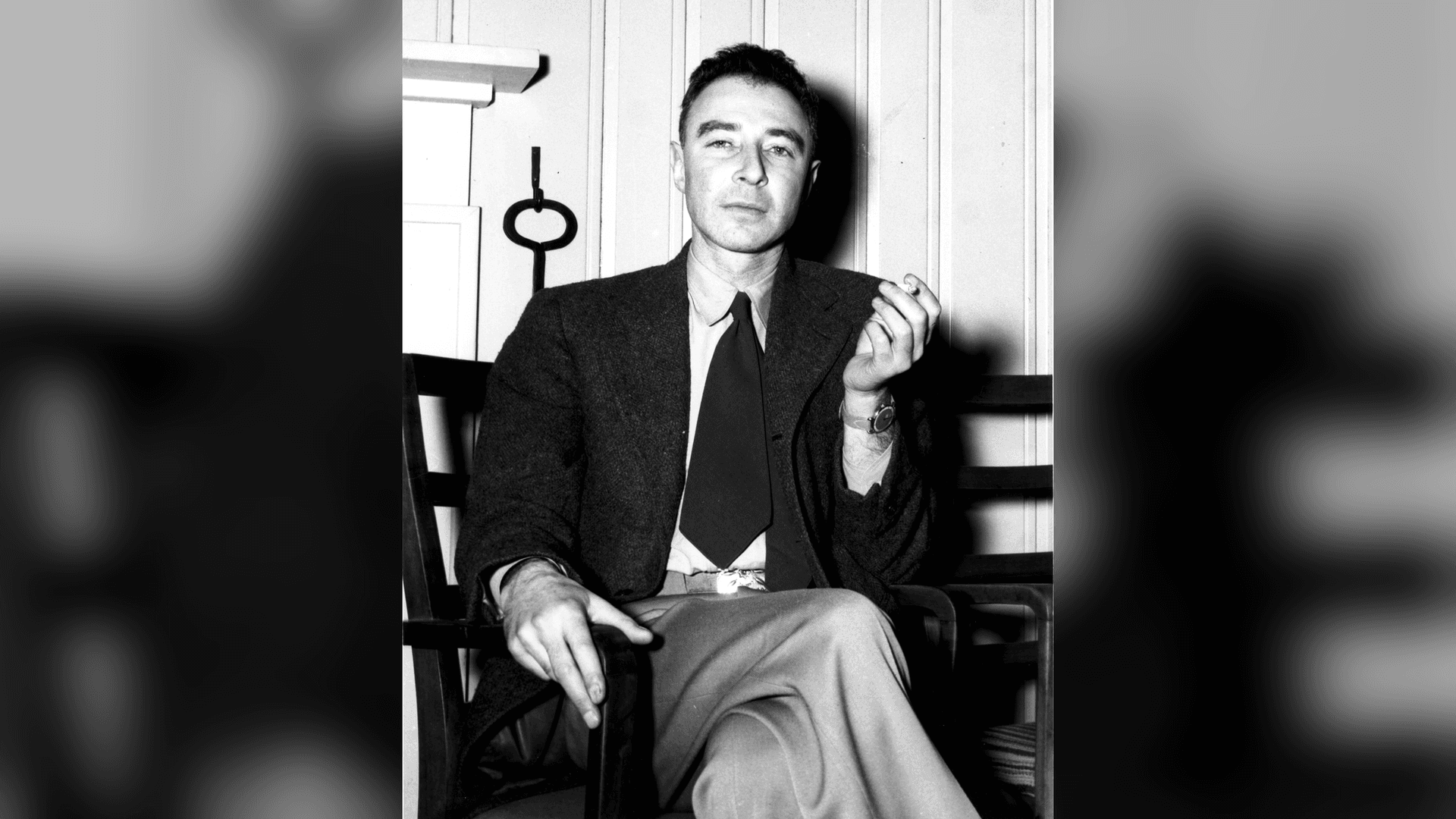
Hero image: J. Robert Oppenheimer at the Guest Lodge, Oak Ridge, in 1946. Photo: Ed Westcott, U.S. Department of Energy, public domain, via Wikimedia Commons.
Take our professional IQ test
Want to know your IQ? Try the first ever professional online IQ test.