What Was Socrates' IQ? Why No Real Number Exists | Riot IQ
Nov 1, 2026·Famous People & IQ
What Was Socrates' IQ? Why No Real Number Exists
Socrates' IQ is unknown. He wrote nothing, he lived 2,300 years before IQ tests, and the Socrates IQ figures online trace back to no rater or method.
Dr. Russell T. WarneChief Scientist
Share
Socrates' IQ is unknown, and no credible estimate exists. He died in 399 BCE, more than 2,300 years before the first intelligence test, and the Socrates IQ figures that circulate online come with no named source or method behind them.
That does not leave us with nothing. The written record of Socrates is unusually rich for someone who never wrote a word, and the oldest attempt to rank his ability (from 1869, decades before IQ existed) can be traced. This page covers why no number is possible, where the popular numbers come from, what the ancient sources actually show, the famous "I know that I know nothing" line, and what Socrates' reputation can and cannot tell us about intelligence.
Why no IQ number for Socrates can exist
IQ testing began with the scale Alfred Binet and Théodore Simon published in 1905. Every claim about the intelligence of anyone earlier is an estimate, and the only estimates with a documented method come from historiometry, in which raters judge recorded childhood achievements. Our article on Napoleon's IQ explains how Catharine Cox did this in her 1926 study of 301 eminent people.
Socrates was never a candidate for that study. Cox writes that "eminent men born before 1450 were also omitted," and Socrates was born in 469 BCE. He appears in her book only secondhand: in the entry for Benjamin Franklin, Cox notes that the teenage Franklin "read Xenophon's Memorable Things of Socrates, and adopted the Socratic method in argument."
Even if the method could be stretched back to ancient Athens, it would have almost nothing to work with. Historiometry rates what a person did as a child, and almost nothing is recorded about Socrates' childhood. Our earlier look at Plato's IQ ran into the same wall, and Socrates is a harder case still: Plato at least left his own writings.
Where the popular Socrates IQ numbers come from
Search for a Socrates IQ and you will find figures in the 140s and higher on celebrity-IQ lists, quiz sites and videos. None that we could find names who produced the number, what evidence it rests on or how it was calculated. These figures have no traceable source. They are compliments with a number attached.
There is one older ranking that can be traced. In Hereditary Genius (1869), Francis Galton graded natural ability on a scale of classes lettered from A upward, with each letter standing for a rarer level of natural ability. Writing about Athens between 530 and 430 BCE, Galton said Europe had "never produced" equals to Socrates and the sculptor Phidias, so "they might rank as I or J," two or three grades above his top regular class.
Galton's letters were never IQ scores. They were inferred from reputation, and Galton had no test of any kind. The same passage goes on to rank whole races by ability in terms that modern science rejects. It is a piece of Victorian enthusiasm for Athens, and converting it into an IQ would add false precision to a guess.
What the ancient record shows about Socrates
According to the Stanford Encyclopedia of Philosophy (SEP), Socrates lived from 469 to 399 BCE. His father, Sophroniscus, was a stoneworker, and his mother, Phaenarete, later became a midwife. The SEP concludes that he received a formal education and that Plato was not exaggerating when he described the young Socrates eagerly acquiring the philosopher Anaxagoras's books. He served as a hoplite (an armored foot soldier) at Potidaea in 432 BCE, at Delium in 424 and at Amphipolis in 422.
Socrates left no writings. Nearly everything known about him comes from authors with their own purposes: Aristophanes, who mocked him in the comedy Clouds in 423 BCE; Xenophon, a former companion who wrote memoirs of his conversations; and Plato, who made him the main speaker of most of his dialogues. Scholars call the difficulty of recovering the real man from these portraits the "Socratic problem." The SEP quotes the classicist W. K. C. Guthrie: "There is, and always will be, a 'Socratic problem'. This is inevitable."
In Plato's Apology, Socrates tells the jury that his friend Chaerephon once asked the oracle at Delphi whether anyone was wiser than Socrates, and "the Pythia replied that there was no one wiser" (21a). Socrates says he set out to prove the oracle wrong by questioning people with a reputation for wisdom, and found that they did not know what they believed they knew. That habit made him enemies.
In 399 BCE, at 70 by his own account, he was tried on the charge that he "corrupts the youth and does not believe in the gods the state believes in" (Apology 24b). He was convicted by a narrow margin. In Plato's account he remarks that "if only thirty votes had been cast the other way, I should have been acquitted" (36a). He was executed by a cup of hemlock, the poison used for citizen executions in Athens.
Did Socrates say "I know that I know nothing"?
Not in those words. The line is a later compression of a longer passage. After questioning a politician, Plato's Socrates reflects: "I am wiser than this man; for neither of us really knows anything fine and good, but this man thinks he knows something when he does not, whereas I, as I do not know anything, do not think I do either" (Apology 21d). A little later he concludes that the god's message was that the wisest human is the one "who, like Socrates, recognizes that he is in truth of no account in respect to wisdom" (23b).
That is a claim about knowing the limits of your own knowledge. Psychologists study something close to it under the name "intellectual humility," the recognition that your beliefs could be wrong. It is a different thing from general mental ability, and the evidence linking the two is thin and mixed. One 2019 study found that people who scored higher on a reasoning test also tended to report more intellectual humility, but our review of humility and intelligence shows that general humility is barely related to IQ.
Socratic wisdom, in other words, is not a high IQ score under another name. A person can score very well on an intelligence test and still be badly overconfident, and a person of average ability can be careful about what they know.
What Socrates' reputation does and does not say about IQ
The picture of Socrates that most people carry is Plato's: a relentless questioner who could take apart any argument. That portrait is strong evidence that the real Socrates was a formidable conversationalist, since he impressed some of the ablest writers of his age enough that they built their work around him. It is also a literary creation by an admirer, painted after Socrates' death, and the Clouds shows a very different man.
An IQ score is something narrower and more concrete. It describes how a person performed on a standardized set of tasks compared with a large norm group, with a known margin of error. Two and a half thousand years of influence reflect ability, but also the survival of Plato's dialogues, the drama of the trial, and centuries of later thinkers who adopted Socrates as a symbol. None of that can be turned into a point on the IQ scale, and none of it allows a fair comparison with anyone alive today.
There is one more irony. Socrates built his life around exposing people who claimed knowledge they did not have. A confident number for his IQ, offered with no evidence behind it, is exactly the kind of claim he would have questioned.
Frequently asked questions
What was Socrates' IQ?
Nobody knows. Socrates died in 399 BCE, long before IQ tests existed, he left no writings of his own, and the numbers attached to him online have no documented source.
Is Socrates in Cox's 1926 study of geniuses?
No. Catharine Cox studied eminent people born between 1450 and 1850 and explicitly omitted anyone born earlier. Socrates appears in her book only as an influence on Benjamin Franklin, who adopted the Socratic method of argument as a teenager.
Did anyone ever rank Socrates' intelligence?
Francis Galton did in Hereditary Genius (1869), placing Socrates two or three grades above his top regular class of ability. His grades were based on reputation, not testing, and they cannot be converted into an IQ.
Did Socrates really say "I know that I know nothing"?
Not in those words. In Plato's Apology (21d), Socrates says that, unlike a man who thinks he knows something he does not, he does not think he knows what he does not know. The famous one-line version is a later paraphrase.
Why did Athens execute Socrates?
He was convicted in 399 BCE of corrupting the young and not believing in the city's gods, by a margin he described as about 30 votes. He was put to death with hemlock.
The takeaway
There is no Socrates IQ, and no credible one can be produced. The record shows a man who never wrote a word and spent his life questioning people who were sure they knew things, a man we see mostly through the eyes of his admirers. If you want a measured result for your own reasoning instead of a borrowed number for a philosopher, try a professionally developed IQ test.
References
1. Nails, D., & Monoson, S. S. (2022). Socrates. In E. N. Zalta & U. Nodelman (Eds.), The Stanford Encyclopedia of Philosophy. [plato.stanford.edu](. plato.stanford.edu
2. Plato. (1966). Apology (H. N. Fowler, Trans.; Plato in Twelve Volumes, Vol. 1). Harvard University Press. Perseus Digital Library. [perseus.tufts.edu](. perseus.tufts.edu
3. Cox, C. M. (1926). Genetic studies of genius: Vol. II. The early mental traits of three hundred geniuses. Stanford University Press. [archive.org](. archive.org
4. Galton, F. (1869). Hereditary genius: An inquiry into its laws and consequences. Macmillan. [galton.org](. galton.org
5. Binet, A., & Simon, T. (1905). Méthodes nouvelles pour le diagnostic du niveau intellectuel des anormaux. L'Année Psychologique, 11, 191-244. [doi.org/10.3406/psy.1904.3675](. doi.org
6. Zmigrod, L., Zmigrod, S., Rentfrow, P. J., & Robbins, T. W. (2019). The psychological roots of intellectual humility: The role of intelligence and cognitive flexibility. Personality and Individual Differences, 141, 200-208. [doi.org/10.1016/j.paid.2019.01.016](. doi.org
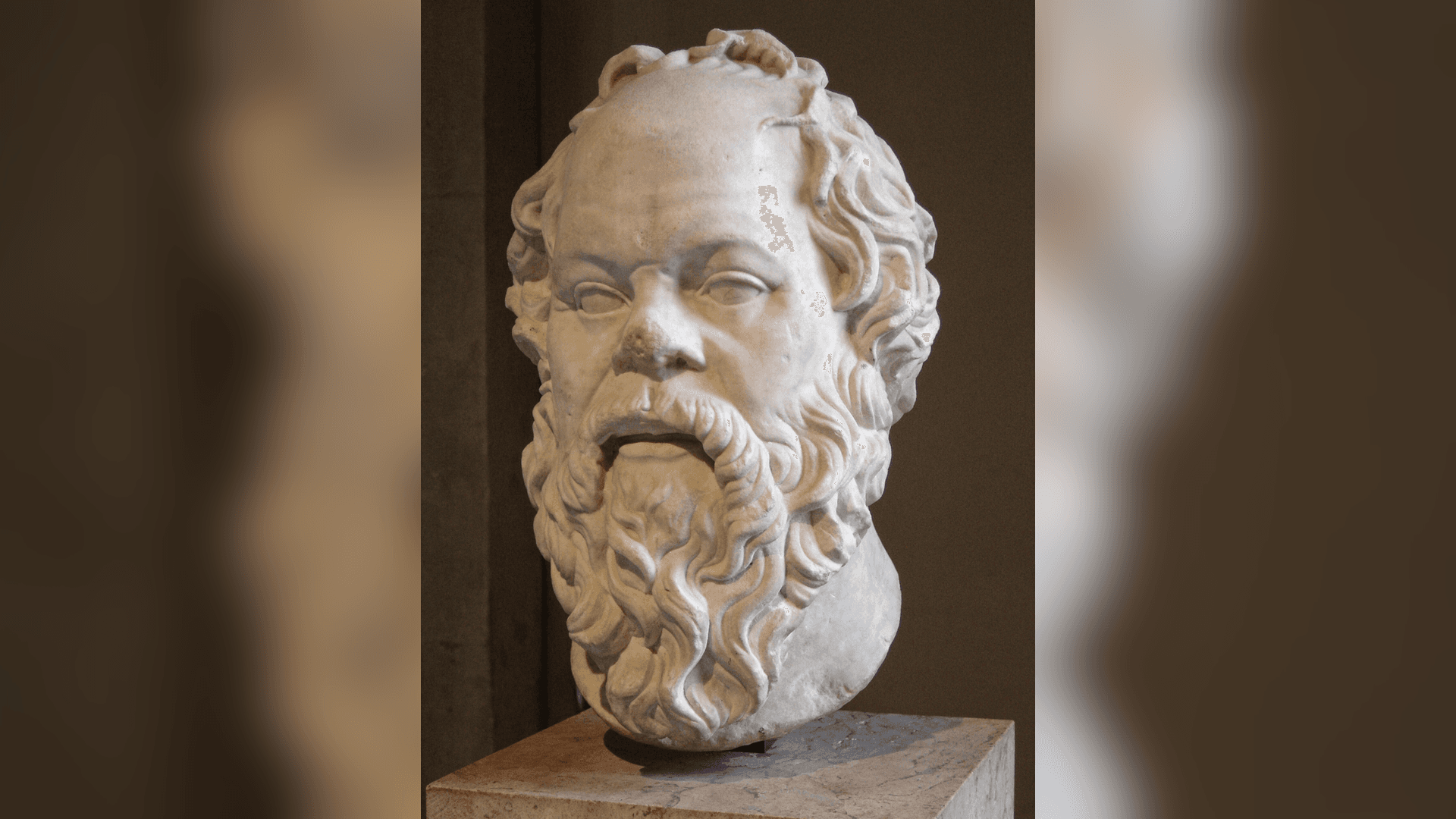
Hero image: Portrait of Socrates, Roman marble copy (1st century), Louvre Museum. Public domain, via Wikimedia Commons.
Take our professional IQ test
Want to know your IQ? Try the first ever professional online IQ test.