What was Thomas Jefferson's IQ? Historiometric studies estimate it at roughly 145 to 160, among the highest of any president. Here is where that comes from.
Thomas Jefferson never took an IQ test; he died on July 4, 1826, roughly 80 years before the first practical intelligence test existed. The numbers attached to him, roughly 145 to 160, are "historiometric" estimates: scholarly inferences from his biographical record, originating in Catharine Cox's 1926 study of 301 geniuses and carried into Dean Keith Simonton's 2006 analysis of presidential intelligence. Those estimates place Jefferson among the highest-rated presidents on record. This article explains where the numbers come from and what they actually mean.
One of the highest presidential estimates on record
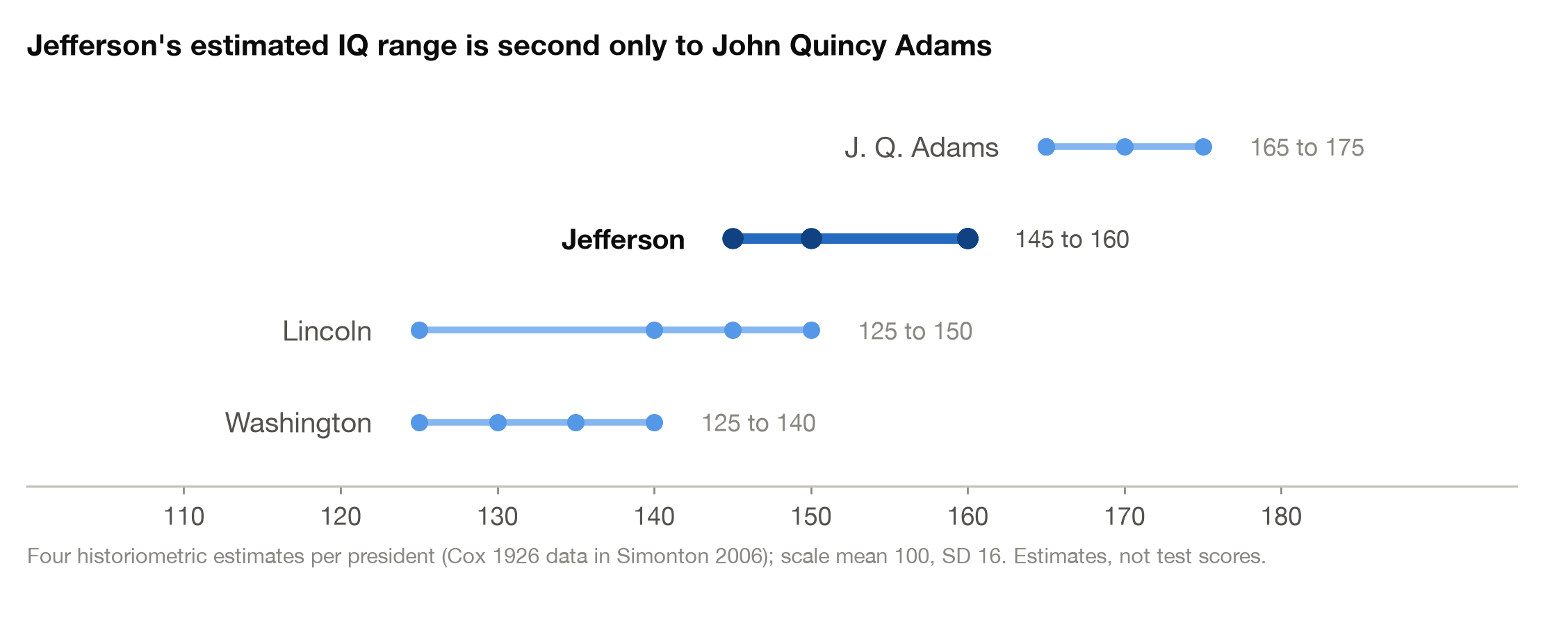
In Simonton's table, Jefferson's row carries four IQ estimates: 145, 160, 150, and 160, on a scale with a mean of 100 and a standard deviation of 16. The four numbers cover two biographical periods (birth to age 17, and ages 18 to 26), each in an uncorrected version and a version corrected for the reliability of the underlying data. Only John Quincy Adams, at 165 to 175, rates higher among the 42 presidents studied. For comparison, Lincoln's row runs 125 to 150 and Washington's 125 to 140.
Where the Jefferson IQ numbers come from
Jefferson was one of only eight presidents eminent enough to appear in Cox's 1926 volume of the Genetic Studies of Genius series, which estimated the intelligence of 301 historical figures. Cox compiled chronologies of childhood and adolescent achievement and scored them for "precocity," unusual attainment relative to age and opportunity. Simonton adopted her figures directly, so the modern presidential numbers and the 1926 estimates are the same underlying data.
Why both 145 and 160 get quoted
The 160 figures are the statistically corrected estimates; the uncorrected ones are 145 and 150. Simonton notes that corrected scores tend to run higher by construction, and that this "does raise the issue of whether the corrected scores might be too high." Listicles that state "Jefferson's IQ was 160" are quoting the top of the range and dropping the caveat. The defensible summary is 145 to 160, presented as an estimate range rather than a score.
The record behind the estimate
The documentary record is what drives the numbers. Jefferson completed undergraduate studies at the College of William & Mary. He was the primary author of the Declaration of Independence and the first U.S. Secretary of State, and after his presidency he founded the University of Virginia, chartered in 1819. His range of serious competence, spanning law, political philosophy, architecture, and science, is the kind of documented achievement Cox's method converts into a high estimate.
"When Thomas Jefferson dined alone"
The most famous tribute to Jefferson's mind came from President Kennedy at a 1962 White House dinner for Nobel Prize winners: "I think this is the most extraordinary collection of talent, of human knowledge, that has ever been gathered together at the White House, with the possible exception of when Thomas Jefferson dined alone."
How Jefferson compares with other presidents
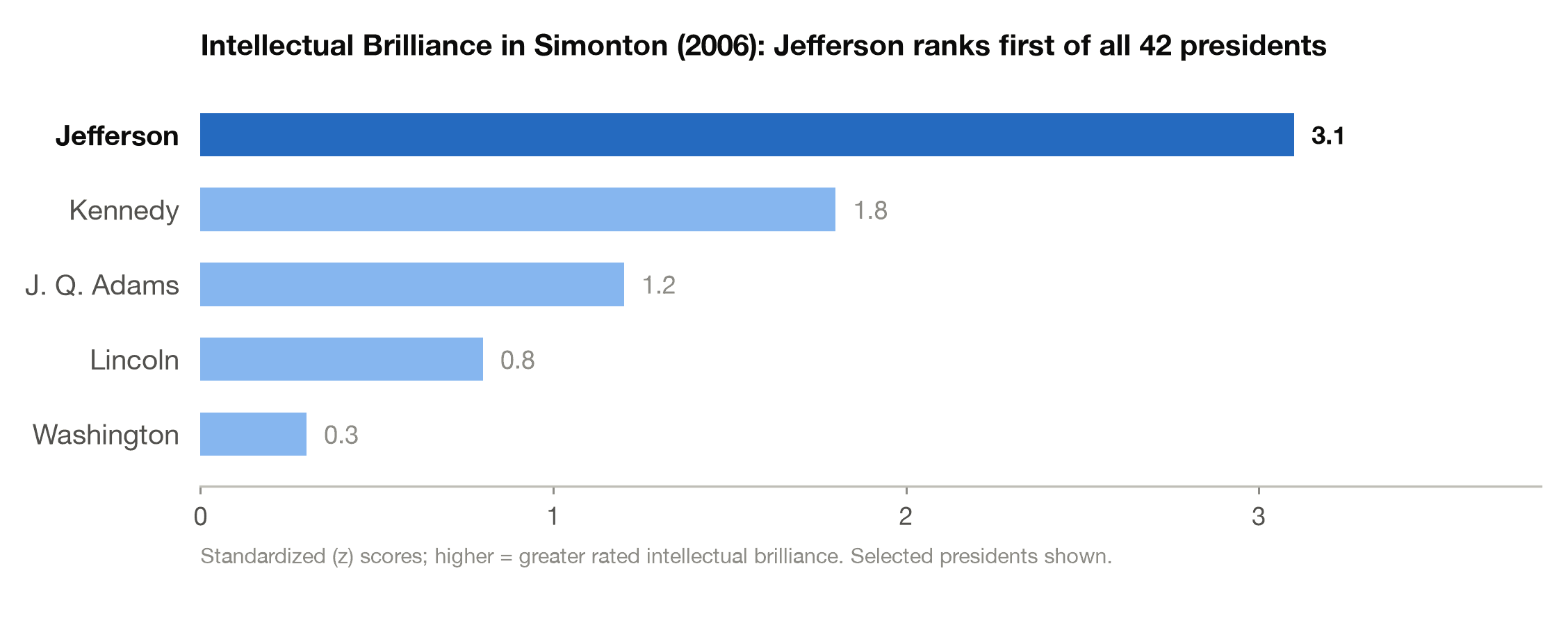
Beyond the Cox IQ figures, Simonton's study scored the presidents on "Intellectual Brilliance," a standardized composite of rated intellectual characteristics. Jefferson ranks first of all 42 presidents at 3.1, ahead of Kennedy (1.8) and John Quincy Adams (1.2). His Openness score of 99.1 on a 0 to 100 scale is also the highest recorded. On the estimated IQ numbers themselves he is second to John Quincy Adams. The full picture is in our article on US presidents ranked by IQ.
What historiometric estimates can and cannot tell you
A real IQ test is a standardized measurement; a historiometric estimate is an inference from whatever the biographical record preserved. The method is legitimate scholarship, and in Jefferson's case the record is rich, but the outputs still carry wide uncertainty and depend on modeling choices the researchers themselves flag. A range of 145 to 160 would sit in the territory our guide to genius IQ scores describes, but no one can verify that Jefferson would have scored there on an actual test. The same caution applies to every pre-20th-century figure, as our article on Albert Einstein's IQ illustrates for a more recent case.
Frequently asked questions
What was Thomas Jefferson's IQ?
He never took an IQ test, so no measured score exists. The standard scholarly estimates, from Cox (1926) via Simonton (2006), put him at roughly 145 to 160 on a mean-100, SD-16 scale, among the highest of any president.
Was Jefferson the smartest US president?
He is at or near the top on every scholarly measure. He has the highest Intellectual Brilliance and Openness scores of all 42 presidents in Simonton's data, though John Quincy Adams edges him on the estimated IQ figures (165 to 175 versus 145 to 160).
How can anyone know the IQ of someone who died in 1826?
No one can know it; researchers estimate it. Historiometric methods score documented precocity and achievement against available opportunity. The results are evidence-based estimates with wide uncertainty, not test results.
What real evidence shows Jefferson's intelligence?
He completed undergraduate studies at William & Mary, drafted the Declaration of Independence as its primary author, served as Secretary of State and President, and founded the University of Virginia.
Is the "Jefferson IQ 160" number real?
It is the top end of the Cox/Simonton estimate range, specifically the versions corrected for data reliability. Simonton himself notes the corrected scores may run too high, so honest reporting gives 145 to 160 as a range.
The takeaway
Jefferson's estimated 145 to 160 is the considered judgment of a century of historiometric scholarship, and it is still an estimate. The achievements are the hard data; the number is an educated guess placed on top of them. If you are curious where you would score on a modern, properly normed instrument, the Reasoning and Intelligence Online Test reports measured deviation scores with stated precision; you can take the RIOT IQ test here.
References
1. Simonton, D. K. (2006). Presidential IQ, openness, intellectual brilliance, and leadership: Estimates and correlations for 42 U.S. chief executives. Political Psychology, 27(4), 511-526. doi.org
2. Cox, C. M. (1926). Genetic studies of genius: Vol. 2. The early mental traits of three hundred geniuses. Stanford University Press. archive.org
3. Kennedy, J. F. (1962, April 29). Remarks at a dinner honoring Nobel Prize winners of the Western Hemisphere. The American Presidency Project, UC Santa Barbara. presidency.ucsb.edu
4. William & Mary. (n.d.). History & traditions.wm.edu
5. University of Virginia. (n.d.). About UVA.virginia.edu
6. Warne, R. T. (2020). In the know: Debunking 35 myths about human intelligence. Cambridge University Press. doi.org
Hero image: Thomas Jefferson by Rembrandt Peale, 1800. Public domain, via White House Historical Association / Wikimedia Commons.
Take our professional IQ test
Want to know your IQ? Try the first ever professional online IQ test.