Alan Turing's IQ was never tested or recorded. The famous 185 figure online has no source. Here is what Turing's documented genius actually looked like.
Dr. Russell T. WarneChief Scientist
Share
Alan Turing never took a documented IQ test, and no score for him exists in any archive or biography. The "185" attached to his name circulates on celebrity IQ sites and social posts that cite no test, no document, and not even a named estimator. The documented record is the real answer: a Cambridge fellowship at 23, the 1936 paper that founded theoretical computer science, the wartime attack on the German naval Enigma cipher, and the 1950 paper that launched machine intelligence. This article explains why the 185 is folklore and what Turing's documented genius actually looked like.
The 185 myth and where it comes from
Andrew Hodges's definitive biography, Alan Turing: The Enigma, records no IQ test for Turing, and neither does the archival material Hodges catalogs. The 185 appears only on listicle sites and social media posts that cite one another. Folklore numbers share a signature: a suspiciously precise figure, no named test, no date, no examiner. Absence of a record means absence of a datum, and for Turing there is no record of any kind. It is the same pattern our article on Albert Einstein's IQ documents for the other great name on those lists.
There is a fitting irony here. Turing himself helped replace vague talk about how smart a mind is with an operational test. His 1950 paper in Mind opens: "I propose to consider the question, 'Can machines think?'" and then swaps the unanswerable question for a measurable game. The man the internet decorates with a fake score spent his career insisting on real criteria.
What Turing's mind actually produced
Fellow of King's at 23, foundational paper at 24
Per Hodges's biography, Turing was elected a Fellow of King's College, Cambridge, in 1935, at age 23, on the strength of his mathematical work. The next year he wrote "On Computable Numbers, with an Application to the Entscheidungsproblem," the paper that defined the universal Turing machine and founded theoretical computer science.
Bletchley Park and naval Enigma
During the Second World War, Turing led Hut 8 at Bletchley Park, the section attacking the German naval Enigma cipher. The work, recounted in detail by Hodges, applied his theoretical machinery to one of the highest-stakes problems of the century.
A national verdict on his importance
Britain eventually rendered its own judgment. In the Bank of England's words: "We first issued our £50 in 2021 - it features the scientist Alan Turing." The note celebrates his pioneering work with computers, with a portrait based on the photograph held by the National Portrait Gallery.
The Olympic-class marathoner
One documented fact corrects the stereotype that genius means frailty. Hodges's own scrapbook on Turing's running records: "Alan Turing achieved world-class Marathon standards. His best time of 2 hours, 46 minutes, 3 seconds, was only 11 minutes slower than the winner in the 1948 Olympic Games. In a 1948 cross-country race he finished ahead of Tom Richards who was to win the silver medal in the Olympics." Asked by a clubmate why he trained so hard, Turing answered, "I have such a stressful job that the only way I can get it out of my mind is by running hard." A mind is more than one number, and a person is more than a mind.
Could 185 even be a real score?
Set aside the missing test and the number still fails. Modern instruments report "deviation IQs" against a norm sample, and the WAIS-IV, the flagship adult test, spans Full Scale IQs from 40 to 160. Scores like 185 existed only under the obsolete childhood "ratio IQ" formula, mental age divided by chronological age times 100, and Turing has no documented score under either system. IQ is a valid, reliable measure of a real general ability, which is exactly why unsourced numbers should be rejected rather than repeated. Our guide to the highest possible IQ explains where real scales stop, and our article on the smartest person in the world shows how rarely the biggest claims survive scrutiny.
Frequently asked questions
What was Alan Turing's IQ?
Unknown. Turing never took a documented IQ test, and his definitive biography records no score. The 185 you see online circulates on celebrity IQ sites with no source; it is folklore rather than measurement.
Where does the "Turing IQ 185" number come from?
No one has ever produced a source. It appears only on listicle sites and social media posts that cite each other. A number with no test, no date, and no document behind it is not evidence of anything.
Was Alan Turing a genius?
His documented output is the strong form of the answer: the 1936 paper that founded theoretical computer science at age 24, leadership in breaking naval Enigma at Bletchley Park, and the 1950 paper that launched the field of machine intelligence. That record outweighs any single test score, real or invented.
What did Alan Turing actually achieve?
He defined the universal Turing machine in 1936, led Hut 8's attack on the German naval Enigma cipher in the Second World War, helped design early stored-program computers, and proposed the Turing test in 1950. Britain put him on the current 50 pound note in 2021.
Was Alan Turing athletic?
Yes, seriously so. His best marathon time was 2 hours, 46 minutes, 3 seconds, only 11 minutes slower than the 1948 Olympic winner, and he beat future Olympic silver medalist Tom Richards in a 1948 cross-country race.
Could someone actually score 185 on an IQ test?
Not on a modern adult test. The WAIS-IV Full Scale IQ tops out at 160, about four standard deviations above average. Scores like 185 only existed under the obsolete childhood ratio-IQ formula, and Turing has no documented score under any system.
The takeaway
Turing's legacy is a set of documents anyone can read: the 1936 paper, the 1950 paper, the biography, the banknote. An IQ score appears in none of them, and the 185 adds nothing to a record this strong. If you want a real number for yourself, skip the folklore and take the free RIOT IQ test, the Reasoning and Intelligence Online Test, which reports a modern, professionally normed score with an actual test behind it.
References
1. Hodges, A. (1983). Alan Turing: The enigma. Burnett Books / Simon & Schuster. archive.org
2. Hodges, A. (n.d.). Alan Turing internet scrapbook: The runner.turing.org.uk
3. Turing, A. M. (1937). On computable numbers, with an application to the Entscheidungsproblem. Proceedings of the London Mathematical Society, s2-42(1), 230-265. cs.virginia.edu
4. Turing, A. M. (1950). Computing machinery and intelligence. Mind, 59(236), 433-460. courses.cs.umbc.edu
6. Canivez, G. L. (2010). Review of the Wechsler Adult Intelligence Scale, Fourth Edition. In The eighteenth mental measurements yearbook. Buros Institute of Mental Measurements. ux1.eiu.edu
7. Warne, R. T. (2020). In the know: Debunking 35 myths about human intelligence. Cambridge University Press. doi.org/10.1017/9781108593298
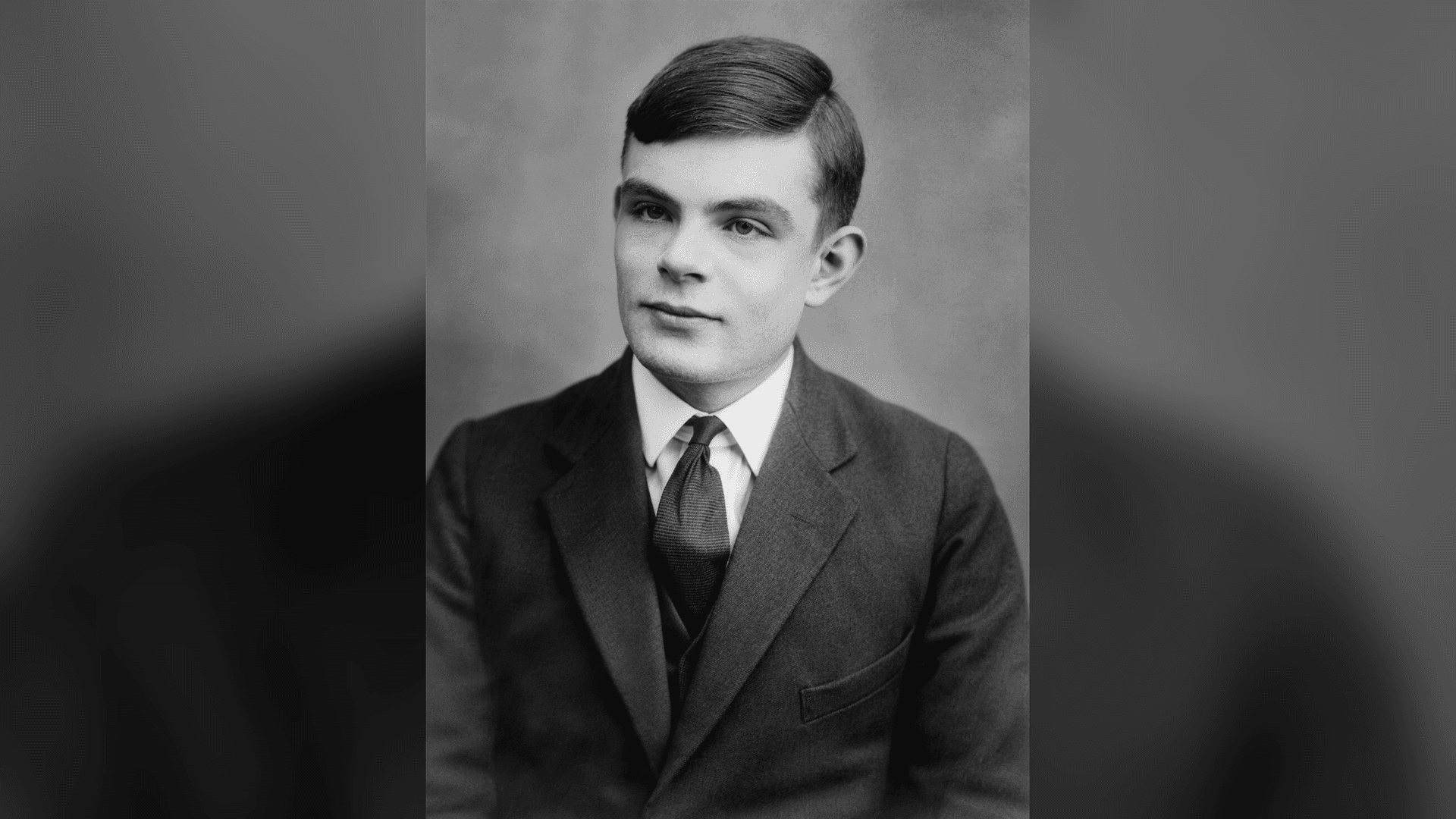
Hero image: passport-style photograph of Alan Turing at age 16. Photo: unknown photographer, public domain, via Wikimedia Commons.
Take our professional IQ test
Want to know your IQ? Try the first ever professional online IQ test.