Jensen Huang's IQ has never been publicly tested or verified. Here is what his Oregon State and Stanford degrees and his long NVIDIA career really show.
Dr. Russell T. WarneChief Scientist
Share
Jensen Huang has no verified IQ score. He has never said he took an IQ test, no result has ever been published, and the "180" or "185" attached to his name on celebrity IQ sites cites no test, no examiner, and no date. His documented record is a different kind of evidence: an electrical engineering degree from Oregon State in 1984, a Stanford master's earned in 1992 while working full time, and NVIDIA, which he co-founded in 1993 and has led ever since. This article explains why the online numbers are empty, and what the real record does and does not say about his intelligence.
Why you see numbers like "180 IQ" online
Celebrity IQ figures follow a predictable life cycle: one aggregator site invents a plausible-sounding number, others copy it, and within a few years the figure appears in search results with the confidence of a fact. No primary source exists at any point in the chain. The numbers also tend to inflate with fame; when a CEO's company becomes one of the most valuable in the world, his invented IQ rises with the stock price. None of this is measurement. An IQ score exists only when a person sits a standardized, professionally administered test, and there is no evidence Huang ever has publicly.
What Jensen Huang's real record shows
From the dish room to an engineering degree
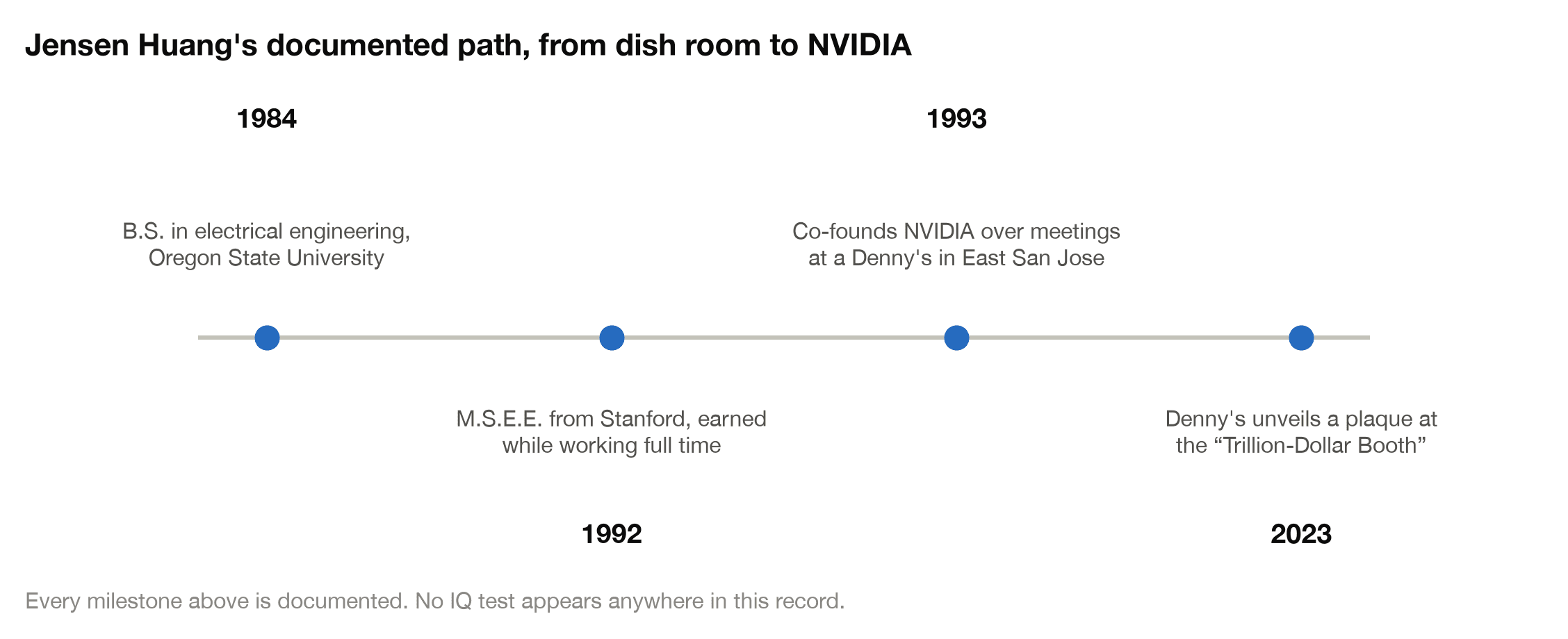
Huang's first job as a teenager was at a Denny's. In his own words: "I was a dishwasher, I was a busboy, I waited tables." He went on to earn a B.S. in electrical engineering from Oregon State University in 1984, where he also met his wife Lori in the program; the two later gave $50 million toward Oregon State's Jen-Hsun and Lori Mills Huang Collaborative Innovation Complex.
A master's degree on top of a full-time job
After college he worked at LSI Logic and Advanced Micro Devices, and in 1992 he completed an M.S. in electrical engineering at Stanford University, earned while working full time. Holding down a chip-industry job and a Stanford graduate program simultaneously is a documented fact that says more than any listicle number.
Founding NVIDIA at a Denny's booth
In 1993 Huang and two friends, Chris Malachowsky and Curtis Priem, met at a Denny's in East San Jose to plan a chip that would bring realistic 3D graphics to personal computers. The company they founded was NVIDIA, and Huang has served as president and CEO since its inception. In 2023 Denny's unveiled a plaque at the booth, now called the "Trillion-Dollar Booth," marking where the company began.
What research says about careers like his
Cognitive ability is a genuine predictor of educational and occupational outcomes; decades of research show that "g," the general factor of intelligence, forecasts school achievement and job performance at the group level. Engineering programs select heavily for quantitative reasoning, so completing two of them, one while employed full time, is consistent with high measured ability. Consistent with is the strongest honest phrasing. Group-level correlations cannot be run backward to assign a specific score to one person, and success as extreme as NVIDIA's also reflects timing, judgment, persistence, and luck. That is why psychologists treat reverse-engineered celebrity IQs as marketing content, whatever the person's achievements. For how measurement actually works, see how accurate IQ tests are, and for the labels people reach for in cases like his, our guide to genius IQ scores.
Frequently asked questions
What is Jensen Huang's IQ?
There is no verified IQ score for Jensen Huang. He has never said he took an IQ test, and no result has ever been published. Figures like 180 that circulate online come from celebrity IQ sites that cite no test, examiner, or date.
How smart is Jensen Huang?
His documented record points to very high ability: a BSEE from Oregon State in 1984, an MSEE from Stanford in 1992 earned while working full time, and co-founding NVIDIA in 1993 and leading it ever since. Those are verified facts, unlike any IQ number attached to his name.
Where did Jensen Huang go to college?
He earned a bachelor's degree in electrical engineering from Oregon State University in 1984 and a master's in electrical engineering from Stanford University in 1992. NVIDIA's official biography confirms both degrees.
Did Jensen Huang really start NVIDIA at a Denny's?
Yes. NVIDIA's own blog confirms that Huang, Chris Malachowsky, and Curtis Priem planned the company in 1993 at a Denny's in East San Jose, and Denny's installed a plaque at the booth in 2023. Huang also worked at a Denny's as his first job.
Can you estimate someone's IQ from their success?
Not with any precision. Cognitive ability predicts educational and career outcomes on average across groups, but an individual's IQ can only be measured with a professionally administered test. Reverse-engineering a number from achievements is guesswork.
The takeaway
Jensen Huang's rise from the Denny's dish room to the helm of one of the world's most valuable companies is documented in detail, and an IQ score appears nowhere in it. The record is evidence of unusual ability; the numbers pasted onto it are not. If you are curious where you stand, skip the listicles and take the free RIOT IQ test, the Reasoning and Intelligence Online Test, which reports a modern, properly normed score with stated precision. For who carries the labels people apply to Huang, see who is the smartest person in the world.
References
1. NVIDIA. (n.d.). Jensen Huang, founder and CEO [Corporate biography]. NVIDIA Newsroom. nvidianews.nvidia.com
2. NVIDIA. (2023, September 26). NVIDIA founder and CEO Jensen Huang returns to Denny's, where NVIDIA launched a trillion-dollar vision. NVIDIA Blog. blogs.nvidia.com
3. Oregon State University College of Engineering. (2013). Jen-Hsun Huang: Engineering Hall of Fame.engineering.oregonstate.edu
4. Warne, R. T. (2020). In the know: Debunking 35 myths about human intelligence. Cambridge University Press. doi.org/10.1017/9781108593298
5. Deary, I. J., Strand, S., Smith, P., & Fernandes, C. (2007). Intelligence and educational achievement. Intelligence, 35(1), 13-21. doi.org/10.1016/j.intell.2006.02.001