What is Tony Stark's IQ? Marvel has never published one. See where the 186 Tony Stark IQ figure comes from and what that score would mean on a real test.
Dr. Russell T. WarneChief Scientist
Share
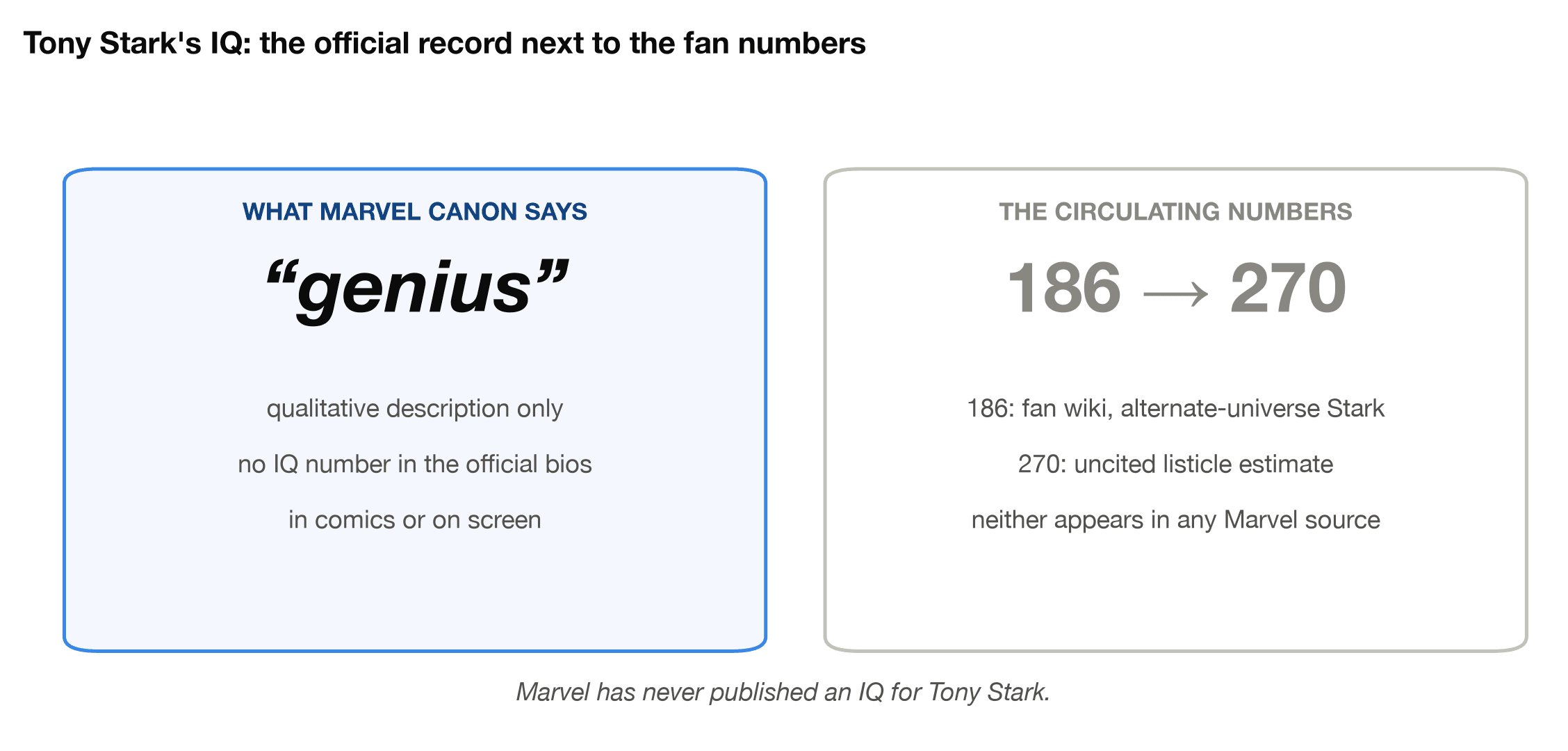
Tony Stark has no official IQ. Marvel has never published a number for him in the comics or the films; the company's in-comics bio says he "grew up a genius with a brilliant mind for technology and inventions," and its on-screen page leads with "Genius. Billionaire. Philanthropist." The widely shared 186 comes from a fan wiki entry about an alternate-universe version of the character, and no modern IQ test reports a score that high in any case: the current Wechsler adult scale stops at 160.
What Marvel canon actually says about Tony Stark
Marvel's official bios stay entirely qualitative. The in-comics page describes "the wealthy son of industrialist and weapons manufacturer Howard Stark" who "grew up a genius with a brilliant mind for technology and inventions." The on-screen page adds that his "confidence is only matched by his high-flying abilities as the hero called Iron Man." Search both pages end to end and no IQ number appears on either.
The MIT legend: boy genius, "summa cum laude"
The best-known piece of Stark lore is his MIT backstory, and interestingly, Marvel's current official bios do not mention MIT at all. The MIT angle survives because the university itself has engaged with it. MIT's admissions blog discusses the character's background, quoting the description of "a boy genius, entering MIT at the age of 15, and graduating at the top of his class," and notes that the 2008 film has Stark graduating "summa cum laude." The blog then delivers a fact-check only MIT could: "MIT doesn't have Latin honors, or a valedictorian, or class rank, or anything like that." Even the fictional resume contains an impossible credential.
Where does the "186 IQ" claim come from?
The 186 traces to the Marvel fan wiki, where it is attached to the Ultimate universe version of the character (Earth-1610), a different continuity from the mainline comics and the films: "Tony is a phenomenal scientific genius and inventor with an IQ of 186." So even taken at face value, the number belongs to an alternate-universe Stark. Listicle sites push further; one estimates his IQ "to be around 270," citing nothing. That drift, from a wiki figure to an uncited 270, is a tidy demonstration of how fan numbers inflate once they detach from any source.
What would an IQ of 186 actually mean?
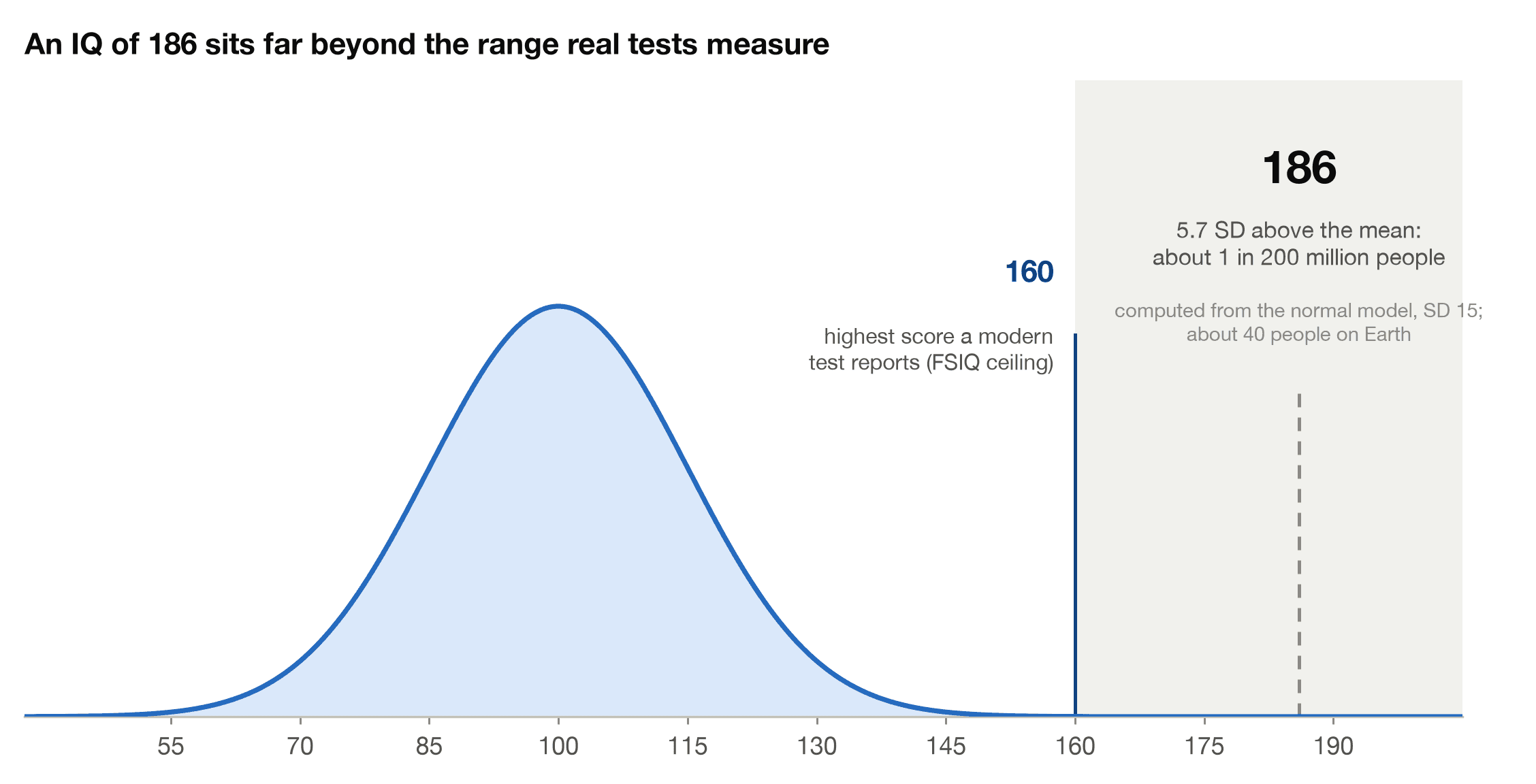
Modern tests report "deviation IQs" on a bell curve with a mean of 100 and a "standard deviation," a measure of score spread, of 15. A 186 would sit (186 - 100) / 15 = 5.73 standard deviations above the mean. Computed from the normal model with SD 15, that is roughly 1 in 200 million, or about 40 people among 8.2 billion alive today.
No instrument could verify such a score. Pearson's technical documentation for the current Wechsler adult scale, the WAIS-5, gives the Full Scale IQ a range of 40 to 160, and 160 is already about a 1 in 31,574 rarity under the normal model. Past the ceiling, norming samples run out of people and the scale runs out of meaning; our article on ceiling effects on IQ tests explains why. A 186 is storytelling shorthand for "very smart," the same device Forrest Gump uses in the opposite direction with its canon IQ of 75.
How real prodigies are actually identified
Real-world Tony Starks, the teenagers who enter elite universities early, are found through "above-level testing," giving a young student a test built for older examinees so the ceiling moves out of the way. The Study of Mathematically Precocious Youth, founded by Julian C. Stanley in 1971 and now run at Vanderbilt, has followed more than 5,000 intellectually talented people identified through talent searches by age 13, spanning the top 3 percent to the top 0.01 percent in quantitative or verbal reasoning. That is what documentation of extreme ability looks like: decades of records, real instruments, stated percentiles. For how such claims are weighed outside fiction, see our article on the smartest person in the world.
Frequently asked questions
Is Tony Stark's IQ really 186?
No official Marvel source gives Tony Stark an IQ. The 186 circulates on the Marvel fan wiki attached to the alternate-universe Ultimate version of the character. Marvel's own bios describe him only as a "genius with a brilliant mind for technology and inventions."
Did Tony Stark really go to MIT at 15?
That is part of the character's fictional backstory rather than anything on Marvel's current bios, which do not mention MIT. MIT's admissions blog quotes the "entering MIT at the age of 15" lore and notes the movie's "summa cum laude" line describes an honor MIT does not award.
Can anyone actually score 186 on an IQ test?
No. The current Wechsler adult scale reports Full Scale IQs only from 40 to 160. Under the normal model with SD 15, a true 186 would be 5.73 standard deviations above the mean, roughly 1 in 200 million, or about 40 living people.
Who is smarter, Tony Stark or Batman?
Neither has a canon IQ, so the popular 186 versus 192 debate compares two fan-made numbers. Marvel and DC both describe their characters as geniuses in qualitative terms only, and both figures exceed what real tests can measure.
How are real-life prodigies identified?
Through above-level testing rather than impossible IQ scores. The Study of Mathematically Precocious Youth has tracked more than 5,000 talented young people identified through talent searches by age 13, from the top 3 percent to the top 0.01 percent in reasoning ability.
The takeaway
Marvel wrote a genius and let adjectives do the work; the 186 was added later by fans, for a version of Stark most readers have never met. Real measurement is more modest and more useful: a defined range, known precision, actual norms. If you want to see where you stand on a scale built that way, the Reasoning and Intelligence Online Test from RIOT IQ reports modern deviation scores, and you can take the free RIOT IQ test online.
References
1. Marvel. (n.d.). Iron Man (Tony Stark): In comics [Official character bio]. Marvel Entertainment. marvel.com
2. Marvel. (n.d.). Iron Man (Tony Stark): On screen [Official character bio]. Marvel Entertainment. marvel.com
3. MIT Admissions. (n.d.). Iron Man, MIT '87 (?) [Blog post]. Massachusetts Institute of Technology. mitadmissions.org
4. Study of Mathematically Precocious Youth. (n.d.). SMPY homepage. Vanderbilt University. my.vanderbilt.edu
5. Raiford, S. E., & Courville, T. (2024). Equivalence of Q-interactive and paper administration of cognitive tasks: WAIS-5 (Q-interactive Technical Report 16). NCS Pearson. pearsonassessments.com
6. Warne, R. T., & Burningham, C. (2019). Spearman's g found in 31 non-Western nations: Strong evidence that g is a universal phenomenon. Psychological Bulletin, 145(3), 237-272. doi.org/10.1037/bul0000184
7. Marvel Database contributors. (n.d.). Antonio Stark (Earth-1610). Fandom. marvel.fandom.com (cited as documentation of where the non-canon 186 figure circulates)
Hero image: Robert Downey Jr., who played Tony Stark in the Marvel films, at San Diego Comic-Con 2014; this is a photograph of the actor, and no film still or promotional art. Gage Skidmore, CC BY-SA 2.0, via Wikimedia Commons.
Take our professional IQ test
Want to know your IQ? Try the first ever professional online IQ test.