What Was Carl Friedrich Gauss's IQ? The Missing Estimate and the Schoolroom Legend | Riot IQ
Oct 31, 2026·Famous People & IQ
What Was Carl Friedrich Gauss's IQ? The Missing Estimate and the Schoolroom Legend
Gauss's IQ was never tested, and no scholarly estimate exists: he is not in Cox's 1926 genius study. The 250-plus figures online have no traceable source.
Dr. Russell T. WarneChief Scientist
Share
Carl Friedrich Gauss never took an IQ test, and unlike Newton, Galileo or Goethe he has no scholarly IQ estimate at all, because he is not among the 301 people in Catharine Cox's 1926 Stanford study of historical geniuses. The "Gauss IQ 250 to 300" figures that circulate online have no traceable source. Gauss died in 1855, fifty years before Alfred Binet's first intelligence scale appeared in 1905, so any number attached to him is a guess. This article explains why the usual source is silent, where the famous schoolroom story actually comes from, what the documented record of his early life shows, and what his work can and cannot tell us about intelligence.
Why Cox's study has no Gauss estimate
When people ask about the IQ of someone born between 1450 and 1850, the citable answer usually comes from Cox's Genetic Studies of Genius, Volume II. Her raters read compiled records of each subject's childhood and youth and judged what IQ would typically produce those achievements, a method called "historiometry." Our article on Napoleon's IQ walks through how it works.
Cox's subject list came from James McKeen Cattell's 1903 ranking of the 1,000 most eminent people in history, which measured eminence by the space each person received in biographical dictionaries. Cox dropped the hereditary aristocracy and anyone born before 1450, then kept only names within the first 510 on Cattell's list. Gauss, born in 1777, met the date rule, yet he is absent from her master table of individual ratings (Table 12A), which runs straight from Gassendi to Gay-Lussac. Nowhere in the 1926 volume is he rated.
That absence matters. It means every Gauss IQ number online lacks even the shaky scholarly footing that the Cox figures for other historical geniuses have. For a sense of what Cox's method produced for a mathematician of Gauss's generation, she rated Pierre-Simon Laplace at 145 for childhood and 170 for ages 17 to 26, with a reliability coefficient of only .20 for the childhood data. That is Laplace's number, and it should not be transferred to Gauss.
Where the 250-plus numbers come from
I could not find a study, biography or historiometric paper that assigns Gauss an IQ of 200, 250 or 300. These figures appear on list-style websites without citations and are copied from one list to the next.
One reason such numbers feel plausible is the way older IQ arithmetic worked. Cox's estimates, like the early Stanford-Binet, used a "ratio IQ," mental age divided by chronological age and multiplied by 100. Under that formula, a three-year-old credited with the arithmetic of a much older child produces an enormous quotient, which is why ratio IQs for very young prodigies can run into the 200s. Modern tests use "deviation IQs," which describe where a score falls relative to people of the same age on a bell curve with a mean of 100 and a standard deviation of 15. On that scale, a score of 200 would sit more than six standard deviations above the mean, far beyond anything a test's norm sample can support.
That bell curve has a direct Gauss connection. In his 1809 Theoria motus, a treatise on calculating planetary orbits, Gauss derived the normal curve as a law of errors in astronomical observations, which is why it is often called the Gaussian distribution. Every modern IQ score is defined by its position on that curve, as our explainer on the IQ bell curve shows. Gauss shaped how intelligence is scored without ever being scored himself.
The schoolroom sum: what the record says
The best-known Gauss story says that a schoolmaster told his class to add the numbers from 1 to 100, and young Gauss instantly answered 5,050 by pairing 1 with 100, 2 with 99, and so on into 50 pairs of 101. Many reputable sources, including the MacTutor History of Mathematics archive, repeat this version as fact.
The story has one early source. In 1856, a year after Gauss's death, his Göttingen colleague Wolfgang Sartorius von Waltershausen published a memorial, Gauss zum Gedächtniss. Sartorius says Gauss entered Büttner's school in Braunschweig in 1784, after his seventh birthday, and reached the arithmetic class about two years later. Büttner then set "the summation of an arithmetic series." Gauss put his slate on the table almost at once with the words "Ligget se" ("there it lies" in Braunschweig dialect), and when the slates were checked, his single answer was correct while many others were wrong. Sartorius adds that Gauss told this story often, with relish, in old age.
What Sartorius does not say is just as important. In his survey for American Scientist, Brian Hayes (2006) collected more than a hundred versions of the anecdote in eight languages and traced them back to this memorial. He found no mention of the numbers 1 to 100, and no description of the pairing method, in Sartorius. In the literature Hayes surveyed, the 1-to-100 series first appears in 1938, about 80 years later. Later tellers changed the series freely, from 1 to 10 up to 1 to 1,000.
The fair reading is that something like this probably happened, since Gauss described it himself, but the familiar details are later additions. The same memorial is the source for two other early anecdotes: that Gauss taught himself to read, and that when he was barely three he corrected an error in his father's payroll arithmetic. These rest on family tradition passed through Gauss and should be read that way.
What the documented record shows
The firmer evidence of Gauss's ability comes from what he produced as a teenager and young man.
• Early mentors: Büttner's assistant, Martin Bartels, studied mathematics books together with the ten-year-old Gauss, including the general binomial theorem and infinite series. Bartels and others brought him to the attention of the Duke of Brunswick, who paid for his education.
• Formal schooling: He entered the Gymnasium in 1788, the Collegium Carolinum in Brunswick in 1792, and the University of Göttingen in 1795, leaving in 1798 without a diploma.
• The 17-sided polygon: On 30 March 1796, a month before his 19th birthday, he found that a regular 17-sided polygon can be constructed with ruler and compass. MacTutor calls it the biggest advance in this area since Greek mathematics, and Sartorius reports that it settled his decision to devote his life to mathematics.
• Doctorate and first book: His 1799 dissertation, accepted by the University of Helmstedt, dealt with the fundamental theorem of algebra. In 1801, at 24, he published Disquisitiones Arithmeticae, a book that reorganized number theory.
• Ceres: The dwarf planet Ceres, discovered on 1 January 1801, disappeared behind the Sun after astronomers had tracked only 9 degrees of its orbit. When astronomers found it again in December 1801, it was almost exactly where Gauss had predicted.
What his achievements do and do not say about IQ
Gauss's work demanded exceptional abstract reasoning and, by many accounts, unusual ease with long calculations; MacTutor notes his "extraordinary mental capacity for calculations" during his survey of Hanover. It is reasonable to infer that he would have scored very far above average on a modern test of general reasoning.
A specific number is another matter. Historiometric estimates rate the documents that survive, and Cox herself found that "the more complete the record the higher the average IQ" for any sizeable group in her study. Even within her sample, estimated IQ correlated only about .25 with eminence, according to Dean Keith Simonton's reanalysis. Achievement on Gauss's scale also depends on things an IQ test does not measure, including decades of focused work and a patron willing to fund it.
The same problems arise for Srinivasa Ramanujan, the other mathematician most often named in online rankings. Ranking either of them with a three-digit number gives an impression of precision the evidence cannot support.
Frequently asked questions
What was Carl Friedrich Gauss's IQ?
Nobody knows. Gauss was never tested, and he is not included in Cox's 1926 study, the usual source for historical IQ estimates. No scholarly work assigns him a number.
Is it true Gauss had an IQ of 250 or 300?
No source supports those figures. They appear on uncited lists, and on modern deviation-IQ scales scores that high lie far beyond anything a test's norms can support.
Did Gauss really add the numbers from 1 to 100 as a child?
The earliest account, from 1856, says he instantly summed an arithmetic series in Büttner's class, but it does not name the series or the method. The 1-to-100 detail first appears in the 1930s, according to Brian Hayes's study of the legend.
Why is the bell curve called the Gaussian curve?
Gauss derived it in 1809 as a law of errors in astronomical measurements. IQ scores today are defined by where they fall on this curve.
How old was Gauss when he wrote Disquisitiones Arithmeticae?
He published it in 1801 at 24, after finding the construction of the regular 17-sided polygon at 18.
The takeaway
Gauss is a rare case where even the usual scholarly estimate is missing, so every Gauss IQ number online is invented. The documented record still shows extraordinary early work, from the 17-sided polygon at 18 to a landmark book at 24, and the schoolroom sum is best read as a real event wrapped in later embellishment. If you want a score that comes from measurement rather than legend, try an online IQ test built by psychometricians that reports where you fall on the same Gaussian curve.
References
1. Cox, C. M. (1926). Genetic studies of genius: Vol. II. The early mental traits of three hundred geniuses. Stanford University Press. [archive.org](. archive.org
2. Hayes, B. (2006). Gauss's day of reckoning. American Scientist, 94(3), 200-205. [doi.org/10.1511/2006.59.200](. doi.org
3. Sartorius von Waltershausen, W. (1856). Gauss zum Gedächtniss. S. Hirzel. [archive.org](. archive.org
4. O'Connor, J. J., & Robertson, E. F. (1996). Johann Carl Friedrich Gauss. MacTutor History of Mathematics Archive, University of St Andrews. [mathshistory.st-andrews.ac.uk](. mathshistory.st-andrews.ac.uk
5. Stahl, S. (2006). The evolution of the normal distribution. Mathematics Magazine, 79(2), 96-113. [doi.org/10.1080/0025570X.2006.11953386](. doi.org
6. Simonton, D. K. (2006). Presidential IQ, openness, intellectual brilliance, and leadership: Estimates and correlations for 42 U.S. chief executives. Political Psychology, 27(4), 511-526. [acsu.buffalo.edu](. acsu.buffalo.edu
7. Warne, R. T. (2020). In the know: Debunking 35 myths about human intelligence. Cambridge University Press. [doi.org/10.1017/9781108593298](. doi.org
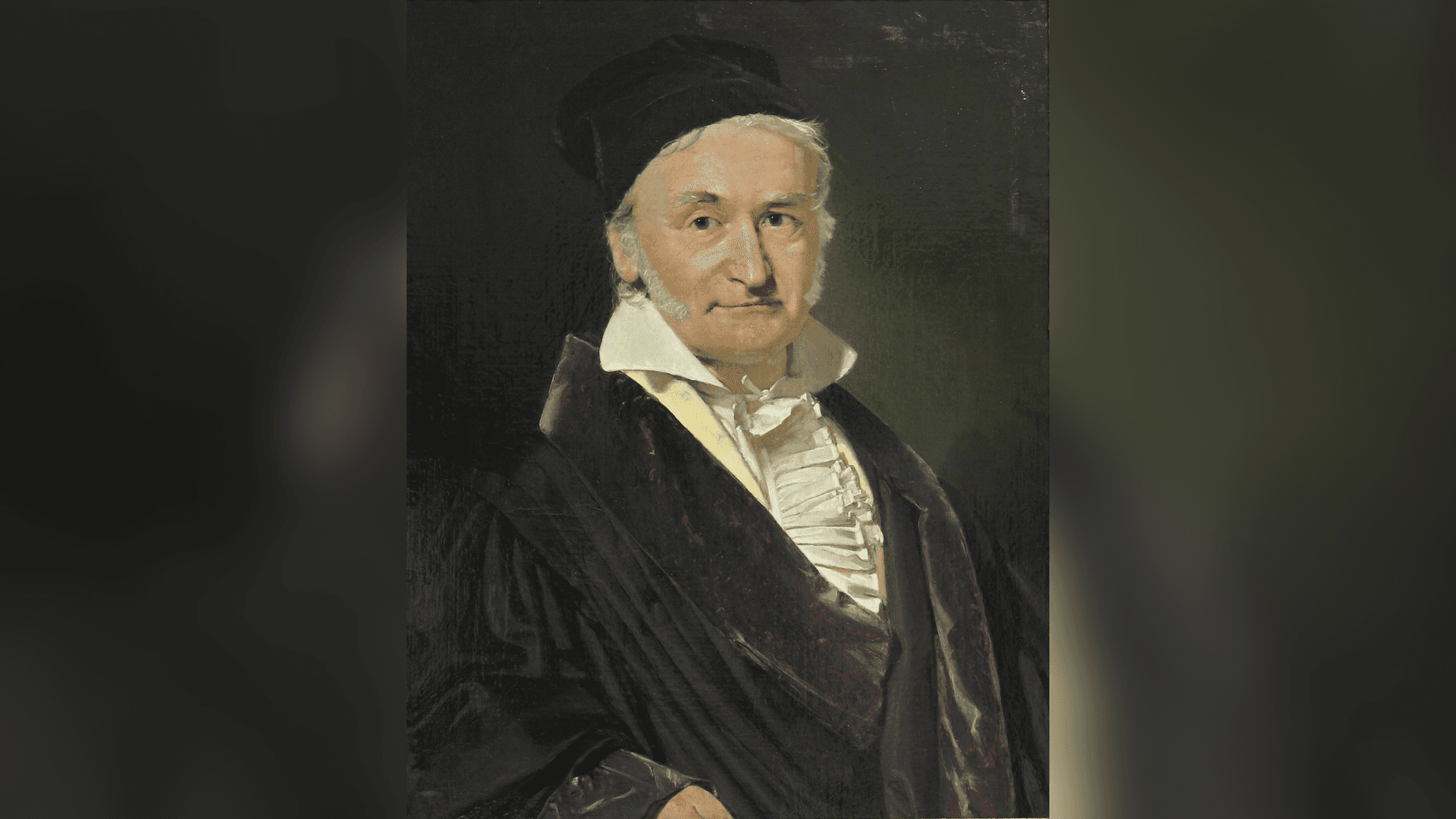
Hero image: Carl Friedrich Gauss, by Christian Albrecht Jensen (1840), public domain. Via Wikimedia Commons.
Take our professional IQ test
Want to know your IQ? Try the first ever professional online IQ test.