Aug 3, 2026·Famous People & IQWhat Is Jeff Bezos's IQ?
Is Jeff Bezos a 160 IQ genius? Discover the truth behind his Princeton records, the famous PDE story, and an evidence-based 135–148 range. Try RIOT!
Dr. Russell T. WarneChief Scientist
Jeff Bezos is the founder of Amazon, executive chairman of one of the largest and most complex companies in history, founder of Blue Origin, and — at the time of writing — one of the wealthiest individuals alive. Taking an IQ test and wondering how your score compares to his is a reasonable impulse. The answer requires the same honesty I've applied throughout this series: no verified score exists, the numbers circulating online are invented, and the most accurate estimate is more specific — and more bounded — than the 145–160 figures that dominate search results.
What makes Bezos's case particularly tractable is that his public record contains unusually specific cognitive evidence — and one of the most psychometrically informative self-disclosures any public figure has ever made about their own cognitive limits.
What We Don't Know: The Online Numbers Are Invented
No verified, publicly documented IQ score exists for Jeff Bezos. He has never disclosed a score from a standardized clinical battery, and no such result has been publicly linked to him through any source that names a test, a date, or an examiner. The figures circulating online — 142, 145, 150, 160 — span an 18-point range that is itself evidence of the problem: legitimate psychometric instruments don't produce estimates that vary by 18 points depending on which website you read. What makes Bezos an easier case than most is that the public record is unusually detailed — a documented high-school honors record, a top-ranked university degree with named academic distinctions, and a specific, self-told account of his own intellectual limits.
The high end of online estimates — 150 to 160 — inflates the evidence substantially. Those figures typically trace to celebrity IQ aggregator sites that assign numbers based on wealth and cultural prominence rather than on any psychometric methodology. A score of 150 places a person in roughly the top 0.07% of the population — a range where psychometric instruments have limited norming data and wide confidence intervals. Assigning that precision to Bezos based on the fact that he built a successful company misrepresents what IQ measurement is.
The Academic Floor: What the Documented Record Shows
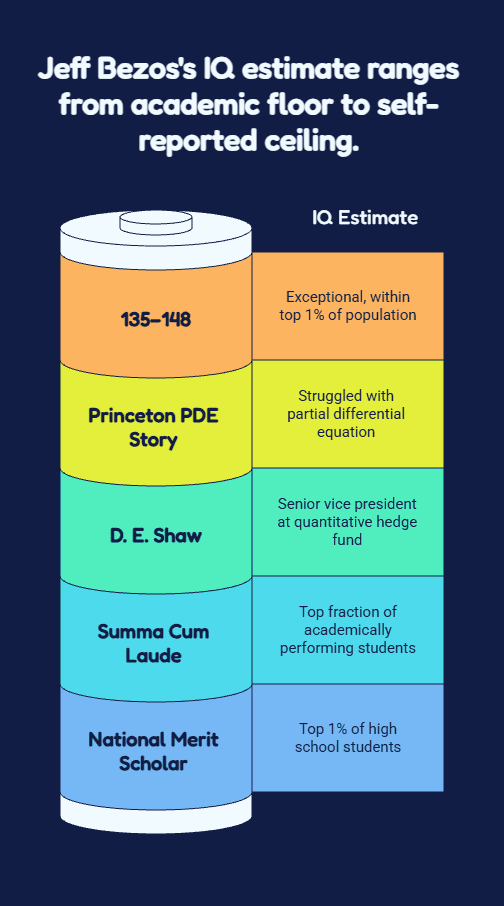
The biographical record sets a clear floor on any honest estimate, and it is strong enough that a below-average or merely-average estimate collapses immediately under the record.Bezos was valedictorian of Miami Palmetto High School, a National Merit Scholar, and a Silver Knight Award winner in 1982. National Merit Scholar status corresponds to approximately the top 1% of high school students nationally — a threshold that correlates with an IQ around 135 or higher on standardized measures.At Princeton, he enrolled initially as a physics major inspired by Stephen Hawking, ran the university chapter of Students for the Exploration and Development of Space, and then switched to electrical engineering and computer science. He graduated summa cum laude in 1986 with a 4.2 GPA and a Bachelor of Science in electrical engineering and computer science, earning membership in both Phi Beta Kappa — the liberal arts honor society — and Tau Beta Pi — the engineering honor society. Both honor societies select from the top fraction of academically performing students in their respective disciplines. A summa cum laude designation at Princeton requires sustained performance across extraordinarily demanding coursework — advanced algorithms, quantum mechanics, circuit design, and theoretical computer science.
Following Princeton, Bezos rose rapidly at D. E. Shaw & Company — a quantitative hedge fund requiring mathematical modeling and algorithmic reasoning — becoming senior vice president by age 30 before leaving to found Amazon. The quantitative demands of D. E. Shaw selection and performance are independently meaningful cognitive signals.
The Princeton PDE Story: A Self-Reported Ceiling
Here is the most psychometrically interesting piece of evidence in Bezos's public record — and the one that most clearly differentiates an honest estimate from an inflated one.During his freshman year at Princeton, Bezos was struggling with a partial differential equation required for a quantum mechanics course. After several hours of frustration with his study partner, they visited a classmate who glanced at the equation and said: "Cosine." After they expressed incredulousness, the classmate proceeded to draw three pages of equations that flowed through and showed that it was cosine. It led to a realization: there were people whose brains were wired to process abstract concepts in a very graceful way, and Bezos was not one of those people. "It was initially devastating," Bezos says, "very, very, troubling."This anecdote is one of the most useful self-reported cognitive data points from any public figure in the literature. It is not false modesty — Bezos tells the story to explain why he pivoted from physics to engineering and computer science. And the implication is specific: at Princeton, in his freshman year, among the most cognitively selected undergraduates in the United States, Bezos encountered the ceiling of his mathematical fluid reasoning. The classmate who saw "cosine" immediately — who could hold the entire structure of a quantum mechanics differential equation in working memory and resolve it in seconds — was operating at a level Bezos recognized he couldn't match.That recognition is an upper bound. Bezos's own story of encountering a partial differential equation at Princeton provides a self-reported upper bound on his mathematical IQ. His intelligence is applied and strategic, not mathematical prodigy-level. The classmate who solved the equation effortlessly was almost certainly operating at or above the 99.9th percentile in mathematical fluid reasoning. Bezos, finding it genuinely beyond him after hours of effort, was operating comfortably above average but below that extreme ceiling.
What a Reasonable Estimate Looks Like
Synthesizing the available evidence with the same methodology applied throughout this series:
The floor established by the documented record is clear. National Merit Scholar status, valedictorian honors, and summa cum laude graduation from Princeton in electrical engineering and computer science collectively place Bezos at or above the 99th percentile on academic cognitive measures — corresponding to an IQ floor of approximately 135.
The ceiling established by the PDE anecdote is also clear. A Princeton freshman who genuinely found a quantum mechanics differential equation beyond his capacity after sustained effort, and who recognized that other students were operating at a fundamentally different level of abstract mathematical reasoning, is providing specific evidence that he does not occupy the extreme upper tail of fluid mathematical reasoning — the range above approximately IQ 145 on mathematical ability specifically.
The most defensible estimate, derived from the academic achievements, career evidence, and the self-reported cognitive ceiling, places Bezos most likely in the 135–148 range. This is genuinely exceptional — well within the top 1% of the general population at the low end, and approaching profoundly gifted territory at the high end. It reflects a cognitive profile of exceptional verbal reasoning, strategic thinking, and applied quantitative intelligence — alongside the specific acknowledgment that the extreme upper tail of pure mathematical fluid reasoning was not his territory.
The 150–160 figures that dominate online discussion are not supported by specific evidence at that level of precision and should be treated as the admiration-inflated estimates they are.
What the Cognitive Profile Actually Reflects
What Bezos's career trajectory most directly implies about his cognitive profile is not mathematical brilliance of the kind his Princeton classmate demonstrated. It is something different: exceptional strategic reasoning, long-term pattern recognition, and the ability to hold and act on a vision across a multi-decade time horizon against consistent skepticism.
Amazon's architecture — its logistics infrastructure, AWS, the Kindle, the flywheel business model, the early willingness to operate at a loss for years to build market dominance — reflects a form of applied strategic intelligence that draws on verbal reasoning, working memory, and the capacity to model multi-variable systems across long time horizons. This is not the same cognitive profile as the theoretical physicist who solves differential equations intuitively. It is arguably more suited to the specific demands of building and scaling a complex organization.
The same pivot that Bezos describes as "devastating" — recognizing he would not be among the best theoretical physicists and redirecting toward engineering and computer science — is itself a cognitively mature response. The ability to accurately assess one's own cognitive profile, identify where it does and doesn't compete at the extreme level, and redirect accordingly is a metacognitive capacity that the Dunning-Kruger literature suggests is more developed in higher-ability individuals. The story is not one of failure. It is one of accurate self-assessment and strategic redirection — both of which are genuine cognitive signals.
Bezos in the Tech Founder Context
Comparing Bezos's estimated profile to the other tech founders analyzed in this series is instructive. Bill Gates's most defensible range is approximately 140–150, anchored by his corrected SAT estimate and the pancake sorting result. Mark Zuckerberg's most defensible range is approximately 135–145, supported by his cross-domain Exeter prizes and the Synapse project. Bezos's range of 135–148 places him in comparable territory to Zuckerberg — similarly strong academic credential evidence, similarly bounded by a specific self-reported cognitive ceiling that caps the upper estimate.
What differentiates Bezos from Gates in the cognitive profile analysis is the nature of the most specific evidence available. Gates's pancake sorting result is a demonstrably original mathematical contribution produced at 17, without collaboration, in response to an unsolved problem — evidence that his mathematical fluid reasoning sits at the extreme upper end. Bezos's PDE story is evidence that his mathematical fluid reasoning, while clearly above average, does not operate at that extreme level. The academic credentials are strong for both; the domain-specific evidence differentiates their profiles.
The Takeaway
Jeff Bezos's IQ is unknown. The figures of 145–160 that circulate widely online are inflated beyond what the evidence supports and trace to no transparent psychometric methodology. The most defensible estimate, derived from documented academic achievements and the specific self-reported cognitive ceiling at Princeton, places Bezos most likely in the 135–148 range — genuinely exceptional, solidly within the highly gifted tier, and consistent with the applied strategic intelligence that building and scaling Amazon required.
What the PDE story adds to this analysis — which no other public figure's record provides as clearly — is a specific upper bound on mathematical fluid reasoning that prevents the kind of unbounded inflation that celebrity IQ lists typically apply. Bezos himself identified where his cognitive ceiling was, with unusual specificity and candor. That honesty is more useful to a psychometrically grounded estimate than any number invented by an admiring website.
If you want to understand where your own cognitive profile sits — across the strategic reasoning, applied quantitative thinking, and verbal comprehension domains that Bezos's record most directly illuminates — the RIOT gives you a domain-level measurement that goes considerably further than any celebrity estimate.
References
ACIS IQ. (2026). Jeff Bezos's IQ: What the Evidence Actually Shows — 135–148 estimate, floor and ceiling methodology. https://acisiq.com/jeff-bezos-iq Geek Extreme. (2026). Jeff Bezos IQ: The Evidence-Based Estimate (135–148) — PDE anecdote as upper bound, summa cum laude floor. https://www.geekextreme.com/jeff-bezos-iq-estimate-135-148/ Intelligence and IQ. (2024). Jeff Bezos: One of the Greatest Entrepreneurs of All-Time — PDE story full account. https://www.intelligence-and-iq.com/jeff-bezos/ BestColleges. (2022). Did Jeff Bezos Go to College? — Princeton summa cum laude, Phi Beta Kappa, Tau Beta Pi. https://www.bestcolleges.com/news/2021-2/10/29/did-jeff-bezos-go-to-college/ Wikipedia. Jeff Bezos — valedictorian, National Merit Scholar, Silver Knight Award. https://en.wikipedia.org/wiki/Jeff_Bezos BrainManager.io. (2024). What Is Jeff Bezos's IQ? Uncovering the Intelligence Behind His Success — 145–160 popular estimates and their basis. https://brainmanager.io/blog/cognitive/what-is-jeff-bezos-iq Press.farm. (2025). What Is Jeff Bezos' Education at Princeton and Beyond — 4.2 GPA, coursework detail, senior thesis. https://press.farm/what-is-jeff-bezos-education-at-princeton/ Real IQ Test Online. (2024). Jeff Bezos IQ Score — 142 estimate, strategic thinking analysis. https://realiqtestonline.com/celebrity-iq/jeff-bezos-iq/
Take our professional IQ test
Want to know your IQ? Try the first ever professional online IQ test.
AuthorDr. Russell T. WarneChief Scientist