Garry Kasparov's IQ was measured at 135 in a 1987 Der Spiegel testing project, not the mythical 190. Here is what the tests found and what they missed.
Dr. Russell T. WarneChief Scientist
Share
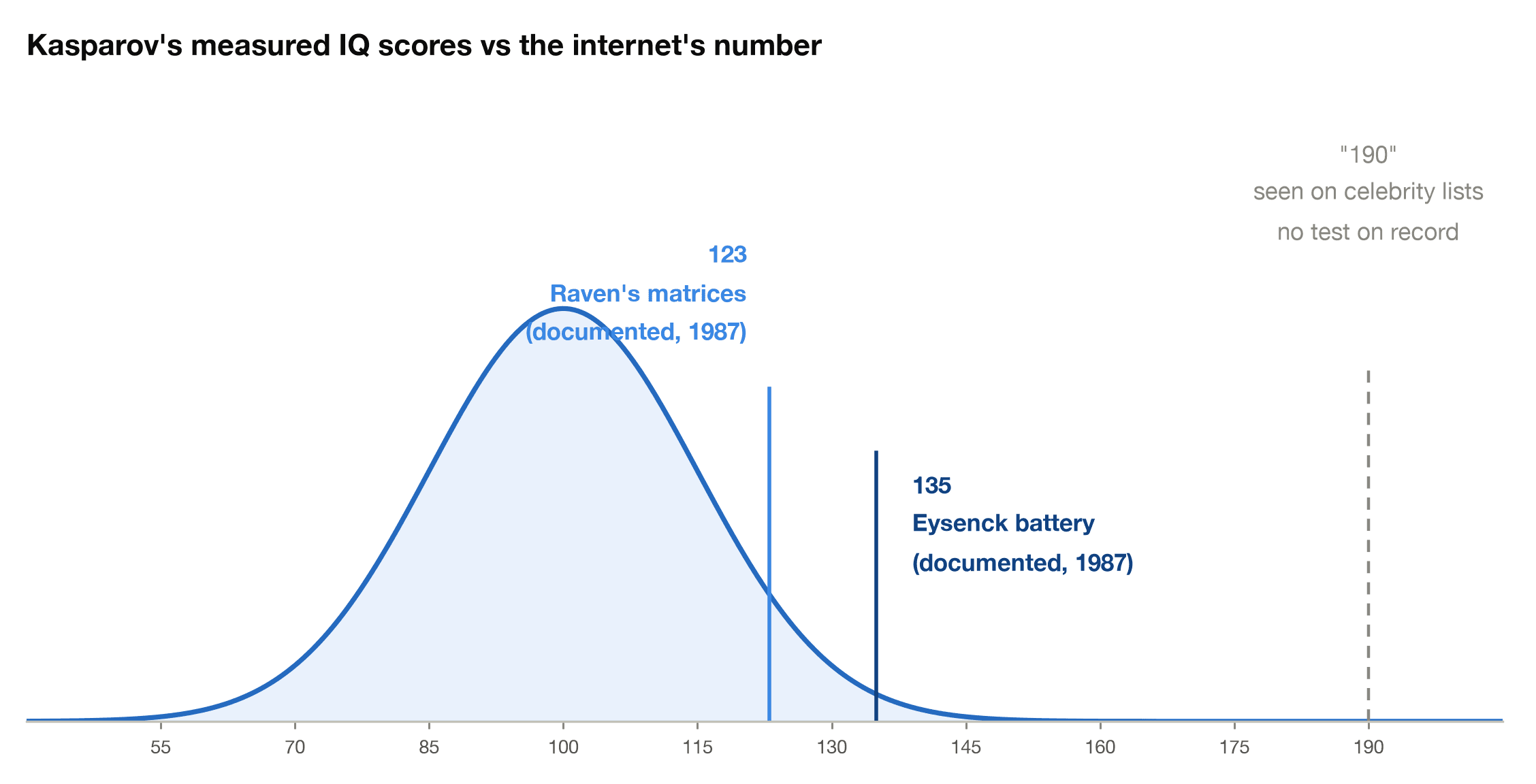
Garry Kasparov is one of the very few world-famous people whose IQ was actually measured by professionals and published. In December 1987, the German magazine Der Spiegel sent a testing team to Baku, and the results appeared in print: Kasparov scored 135 on a battery assembled by the psychologist Hans Jurgen Eysenck and 123 on Raven's Advanced Progressive Matrices. The 190 you see on celebrity IQ lists has no test behind it. This article covers what the testers found, why the two real numbers differ, and what they can and cannot explain about the longest championship reign in modern chess.
The 1987 Der Spiegel experiment
Der Spiegel's team traveled to Baku with three major intelligence tests, one each from Eysenck, the Scottish psychologist John C. Raven, and the Berlin researcher Adolf Otto Jager, plus a chess test and several smaller tasks. Eysenck had assembled his battery specifically for Kasparov. By the magazine's account, the champion had neither read test books nor practiced test items beforehand, so the sessions captured him cold.
The published results: 135 on the Eysenck battery and 123 on Raven's matrices. The magazine itself was careful with the numbers, writing that no IQ can be more than a vague indication of ability. The most extreme result was not an IQ score at all. On the memory tasks, Kasparov correctly recalled 117 of the 120 chess pieces shown to him across five briefly displayed positions, and the testers compared his recall to a camera.
Why the same brain scored 135 and 123
A 12-point gap between two tests taken in the same week looks strange until you know how testing works. Different instruments sample different content: Eysenck's battery mixed verbal and numerical material, while Raven's matrices are a purely nonverbal pattern test. Each also carries "measurement error," the normal variation you would see if the same person took the same test on different days. Der Spiegel noted at the time that differences of this size are not unusual, and that remains true on modern tests.
Both numbers are high. A 135 sits near the 99th percentile, roughly the top 1 percent of the population, and a 123 is around the top 6 percent. Neither is anywhere near the ceiling of human measurement, and that is the interesting part: the most dominant chess player of his era tested as exceptional, and clearly not as a statistical impossibility.
Where the 190 myth comes from
The 190 attached to Kasparov circulates on celebrity IQ sites without a source. No test, no examiner, no date has ever been produced for it, which puts it in the same category as the 180 long attributed to Bobby Fischer: folklore that grew to fit the legend. Kasparov's case is unusual because the folklore can be checked against a real measurement. When professionals actually tested him, the documented numbers came out 55 to 67 points lower than the myth.
The record that needs no inflation
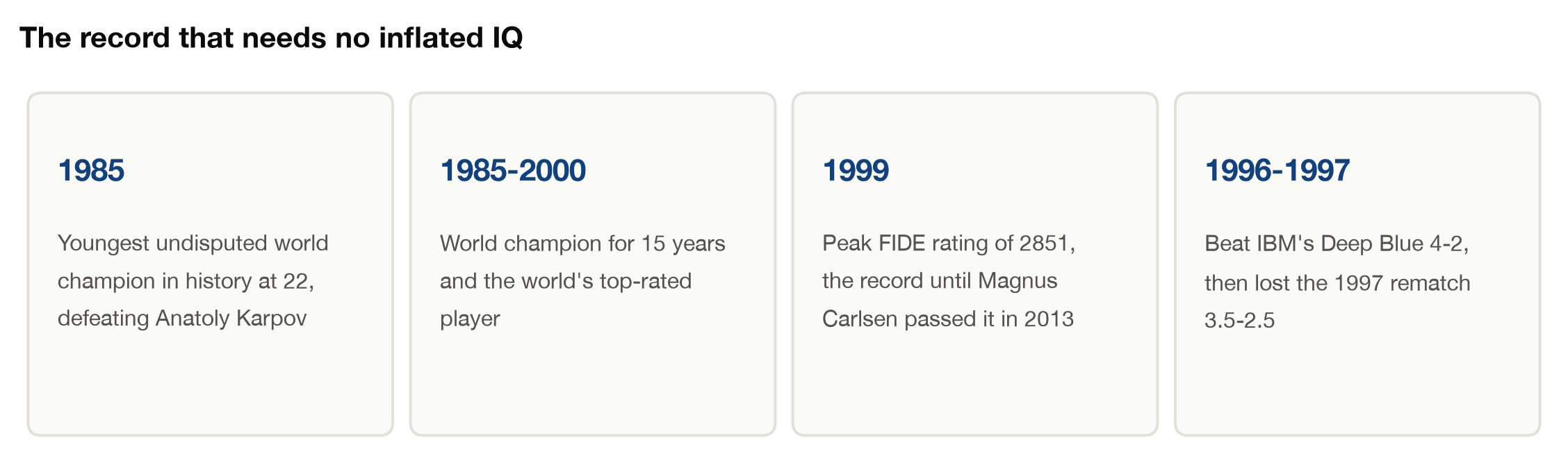
The measured scores take nothing away from the resume, which speaks for itself. Kasparov became the youngest undisputed world champion in history in 1985, at age 22, by defeating Anatoly Karpov, and he held the title until Vladimir Kramnik beat him in London in 2000. His peak FIDE rating of 2851, set in 1999, stood as the record until Magnus Carlsen passed it in 2013. We look at what is known about his successor's ability in our article on Magnus Carlsen's IQ.
His matches against IBM's Deep Blue bracket the era when computers caught up with human chess. Kasparov won the first match in Philadelphia in 1996 by 4 to 2, despite losing the opening game, the first ever won by a computer against a reigning world champion under regular time controls. Deep Blue took the 1997 rematch 3.5 to 2.5. Kasparov paid tribute afterward, saying the computer was far stronger than anybody expected.
What Kasparov's scores say about IQ and mastery
Thousands of people score around 135, and none of the others dominated world chess for 15 years. That is the honest lesson of the Baku experiment. General reasoning ability matters in chess, but world-class play is built on top of it: tens of thousands of hours of study, an enormous store of memorized patterns, and the competitive temperament to use both under pressure. Kasparov's near-perfect recall of chess positions was far more extreme than either IQ score, which is exactly what expertise research predicts. Chess skill is a trained specialty, and playing it is not a substitute for an IQ test; we review the transfer evidence in our article on whether chess makes you smarter.
Frequently asked questions
What is Garry Kasparov's IQ?
The only professional testing on record was organized by Der Spiegel in Baku in late 1987. Kasparov scored 135 on a battery assembled by Hans Jurgen Eysenck and 123 on Raven's Advanced Progressive Matrices.
Is Kasparov's IQ really 190?
No test supporting 190 has ever been produced. The number circulates on celebrity IQ lists without a source. When Kasparov actually sat for professional tests in 1987, the published results were 135 and 123.
How did Kasparov do on the memory tests?
Exceptionally. Der Spiegel reported that he correctly recalled 117 of 120 chess pieces shown across five briefly displayed board positions, and the testers compared his recall to a camera.
Does a 135 IQ explain being world champion for 15 years?
Only partly. A 135 is around the top 1 percent, but thousands of people share that level and none of them dominated world chess. Kasparov's edge combined strong reasoning with immense chess-specific knowledge, training from childhood, and elite competitive drive.
Did Deep Blue beating Kasparov mean it was smarter than him?
No. Deep Blue won the 1997 rematch 3.5 to 2.5 by searching millions of positions per second, a brute-force method nothing like human intelligence. Kasparov had won the first match in 1996, 4 to 2.
The takeaway
Kasparov's file is the rare case where measurement and mythology can be laid side by side, and the measurement is more interesting. Two real scores, 135 and 123, plus a memory that astonished the examiners, describe an exceptional mind more credibly than an invented 190 ever could. If you are curious where you would land on a professionally built instrument, the Reasoning and Intelligence Online Test from RIOT IQ offers a free IQ test with modern norms and stated precision, which is what separates a score from a legend.
References
1. Der Spiegel. (1987, December 21). Genieblitze und Blackouts: Der SPIEGEL testete Intelligenz, Gedachtnis und Schachkunst Garri Kasparows. Der Spiegel, 52/1987. spiegel.de
5. Warne, R. T. (2020). In the know: Debunking 35 myths about human intelligence. Cambridge University Press. doi.org
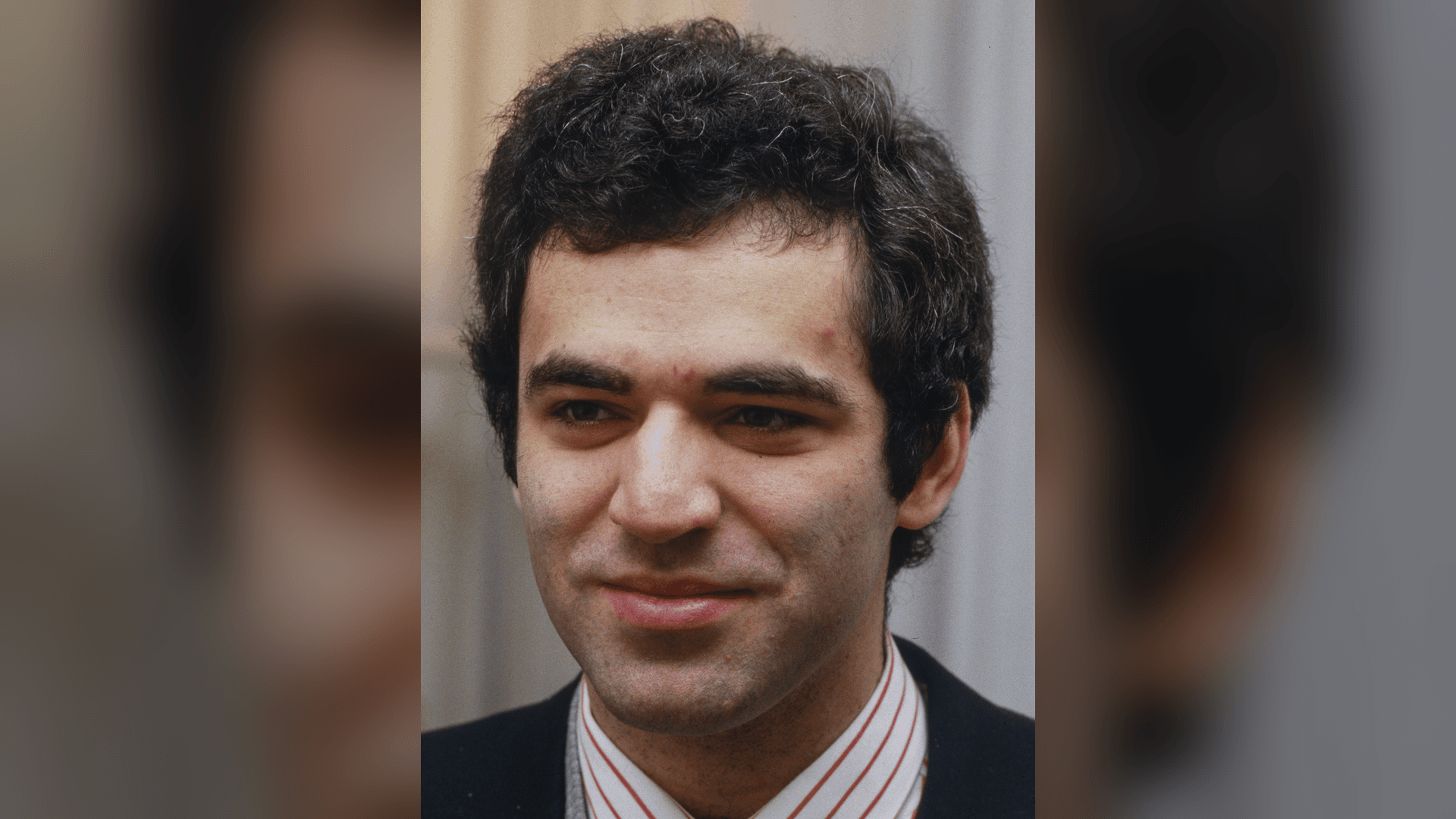
Hero image: Garry Kasparov in April 1987, the year of the Der Spiegel testing. Photo: Comet Photo AG (Zurich) / ETH-Bibliothek Zurich Bildarchiv, CC BY-SA 4.0, via Wikimedia Commons.
Take our professional IQ test
Want to know your IQ? Try the first ever professional online IQ test.