Homer Simpson's IQ is 55 in the episode HOMR, rising to 105 when a crayon is removed from his brain. See what those numbers would mean on a real IQ test.
Dr. Russell T. WarneChief Scientist
Share
Homer Simpson's IQ is 55. The number comes from "HOMR," the ninth episode of The Simpsons' twelfth season, first aired on Fox on January 7, 2001. In the story, doctors discover a crayon that has been lodged in Homer's brain since childhood; removing it raises his IQ by 50 points to 105, which is how the 55 baseline is established, and by the closing scene he has the crayon put back. Both figures are jokes written for a cartoon. No test produced them, and no real person's score behaves the way Homer's does. This article covers where the numbers come from, what a 55 and a 105 would mean on a real IQ scale, and why a 50-point overnight jump is impossible outside animation.
The episode behind the number: "HOMR"
"HOMR" (stylized "HOMЯ") is the 257th episode of The Simpsons overall. The plot turns on a childhood incident in which young Homer stuck sixteen crayons up his nose and sneezed all but one of them out. Decades later, doctors find the last crayon still lodged in his brain. After surgeons remove it, his IQ climbs 50 points to 105, the arithmetic that gives the famous 55 starting point.
Newly capable Homer bonds with Lisa for the first time, and he discovers that being the smart one carries costs the show had never charged him before: his old friends stop enjoying his company, and ordinary life starts to grate. At Moe's bar he has the crayon pushed back into place, returning him to the man he was at the start of the episode. Even in canon, Homer's IQ ends the story back at 55.
A Flowers for Algernon parody
The writers were open about the model. The episode is inspired by Flowers for Algernon, Daniel Keyes' award-winning science fiction story about a man whose surgically boosted intelligence proves temporary, and the title "HOMR" nods to Charly, the 1968 film adaptation. The tragic arc is the same: a brief window of clarity, then a deliberate return.
How the episode was received
The gag landed. The broadcast reached 10.2 million households and was the highest-rated Fox program that week, and IGN's Cindy White later called the episode a classic in her review of the season 12 DVD set.
What would an IQ of 55 mean on a real test?
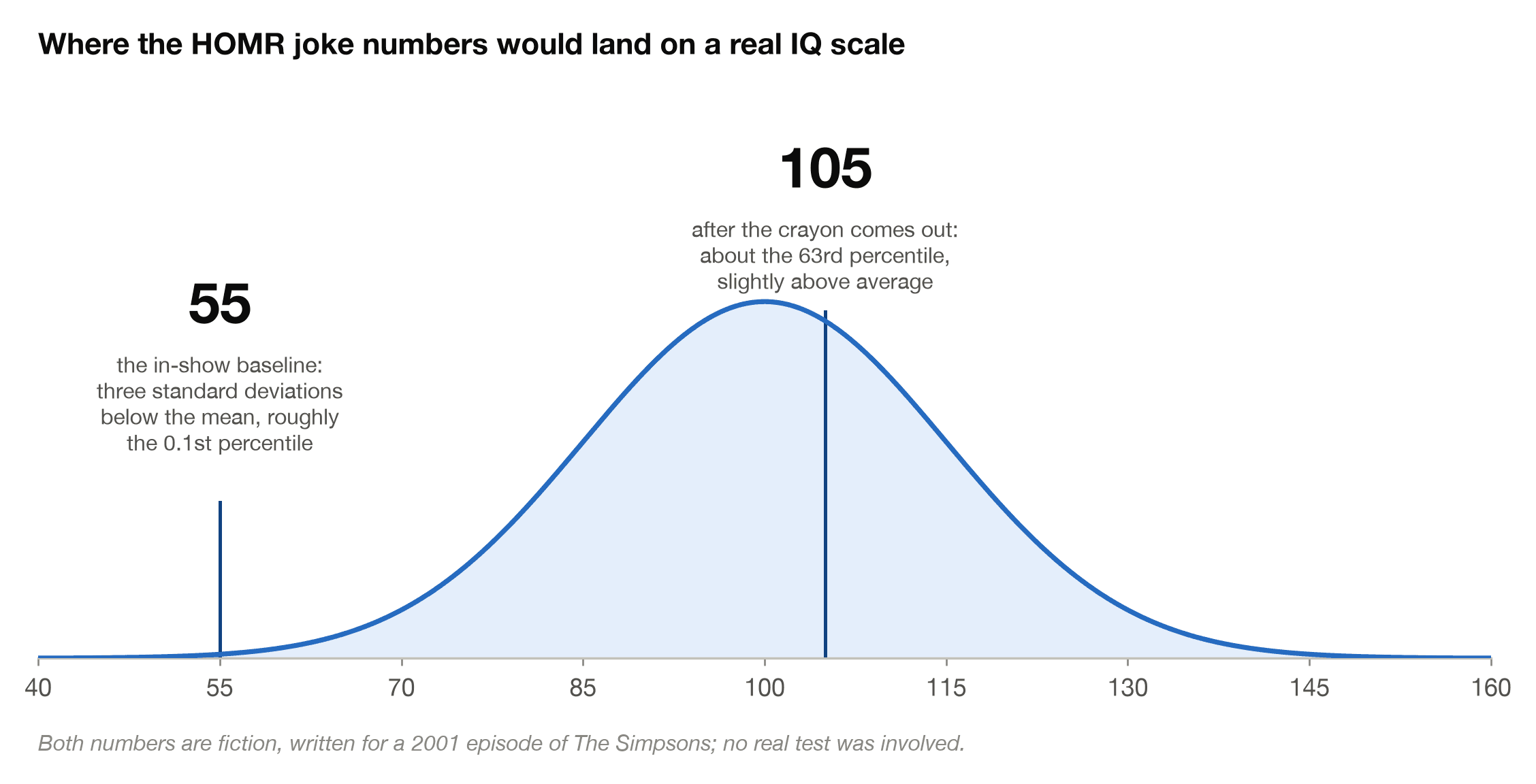
Real IQ tests are scaled so that the average score is 100 and the "standard deviation," a measure of how spread out scores are, is 15 points. On that scale a 55 sits three standard deviations below the mean, at roughly the 0.1st percentile. About one person in 750 scores that low or lower.
• The clinical threshold is 70: A score of 70 or below, two standard deviations under the mean, is the conventional cutoff clinicians consider when evaluating "intellectual disability," a condition that affects about 1% of the population. We cover the real meaning of that line in our guide to what an IQ of 70 means.
• 55 falls in the mild band: Scores from 50 to 70 are classified as mild intellectual disability, which accounts for about 85% of cases. A diagnosis is never the score alone: a person with an IQ below 70 who functions well in daily life does not meet the criteria, because adaptive skills matter as much as the number.
• 105 is simply above average: Post-crayon Homer's 105 lands near the 63rd percentile, slightly better than a coin flip against a random stranger. The joke is that a modestly above-average Homer becomes unrecognizable to everyone who knows him.
The deeper joke is the mismatch. A man who holds down a job at a nuclear power plant, drives a car, and raises three children does not fit the profile of a 55 in any clinical sense. The writers picked a number for comic extremity, which is a good reminder that labels describe scores rather than people. For how psychologists actually classify the low end of the scale, see our article on what is considered a low IQ.
Could an operation really add 50 IQ points?
No. Adult IQ is one of the most stable traits psychology measures, and no surgery, supplement, or training program has ever been shown to produce a genuine gain of that size. As intelligence researcher Russell T. Warne documents in his myth-debunking book In the Know, quick fixes that promise large IQ gains reliably fail when tested carefully. Real scores do move a few points between sittings, because every test carries "measurement error," the small day-to-day variation in performance. A 50-point jump is another category of event entirely, and the crayon gag works precisely because it is absurd.
The smartest Simpsons are the daughters
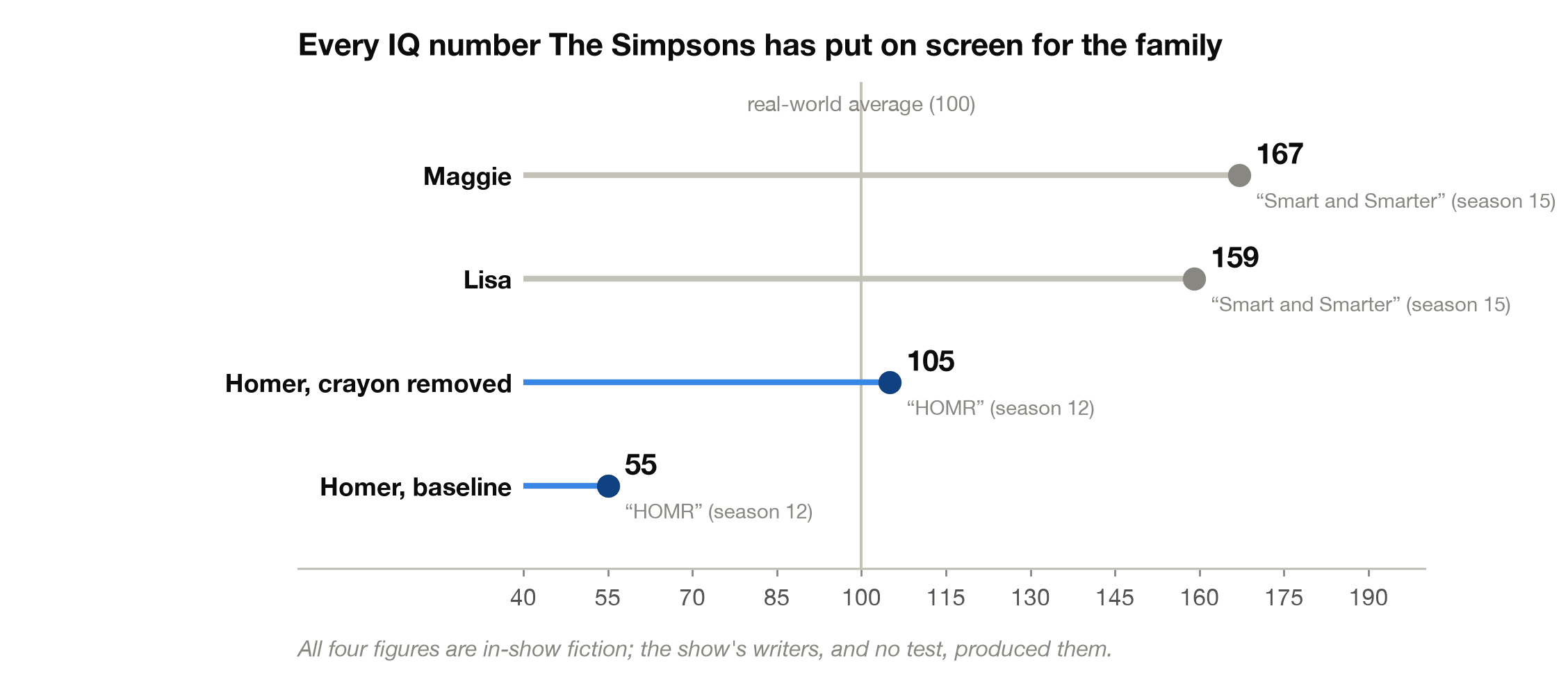
The show has put exactly two other IQ numbers on screen for the family. In "Smart and Smarter" (season 15), baby Maggie's apparent IQ of 167 comes in higher than Lisa's 159, and Lisa briefly loses her standing as the smart one. Those figures are fiction too, and they sit past the ceiling of most real tests, but they make the family hierarchy clear: even crayon-free Homer at 105 is the intellectual junior of both of his daughters.
Frequently asked questions
What is Homer Simpson's IQ?
In the season 12 episode "HOMR" (2001), Homer's IQ is established as 55. Removing a crayon lodged in his brain raises it 50 points to 105, and reinserting the crayon returns it to 55. It is a joke number written for a cartoon, not a real test result.
In which episode does Homer's IQ go up?
"HOMR," the ninth episode of season 12, first aired on Fox on January 7, 2001. The story is a parody homage to Flowers for Algernon: Homer briefly becomes smart, finds intelligence isolating, and has the crayon put back.
What would an IQ of 55 mean in real life?
On a real test with a mean of 100 and a standard deviation of 15, a 55 is three standard deviations below average, around the 0.1st percentile. Clinically, scores from 50 to 70 fall in the mild intellectual disability band, though a diagnosis also requires deficits in adaptive functioning.
Could removing something from your brain raise your IQ by 50 points?
No. Adult IQ is a stable trait, and no known surgery, supplement, or brain-training program produces genuine gains of that size. The gag lands because a 50-point jump is absurd, which the writers understood.
Is Homer smarter than Lisa or Maggie in the show?
No. In "Smart and Smarter" (season 15), Lisa's IQ is given as 159 and baby Maggie briefly appears to score 167. Even post-crayon Homer, at 105, trails both daughters in canon.
The takeaway
Homer's 55 is a punchline with a precise episode citation and no psychometrics behind it. Real scores come from normed tests, move only a little between sittings, and carry stated error bars. If you are curious where you would actually land on the scale the joke borrows, the Reasoning and Intelligence Online Test from RIOT IQ is a properly normed assessment that reports a real score, which is more than a crayon can do.
References
1. Wikipedia. (2026). HOMR. In Wikipedia, The Free Encyclopedia. en.wikipedia.org
2. Wikipedia. (2026). Smart and Smarter. In Wikipedia, The Free Encyclopedia. en.wikipedia.org
3. White, C. (2009, August 18). The Simpsons: The Complete Twelfth Season DVD review. IGN. ign.com
4. Lee, K., Cascella, M., & Marwaha, R. (2024). Intellectual disability. In StatPearls. StatPearls Publishing. ncbi.nlm.nih.gov
5. National Library of Medicine. (2024). Intellectual disability. MedlinePlus Medical Encyclopedia. medlineplus.gov
6. Warne, R. T. (2020). In the know: Debunking 35 myths about human intelligence. Cambridge University Press. doi.org
Hero image: Dan Castellaneta, the voice of Homer Simpson, in a 1988 Fox Broadcasting Company publicity photo. Public domain, via Wikimedia Commons.
Take our professional IQ test
Want to know your IQ? Try the first ever professional online IQ test.