Who Is Kim Ung-yong? The Prodigy Behind a 210 IQ Record
Kim Ung-yong solved calculus on live television at four and was listed by Guinness with an IQ of 210. His later life rewrote what that number should mean.
Dr. Russell T. WarneChief Scientist
Share
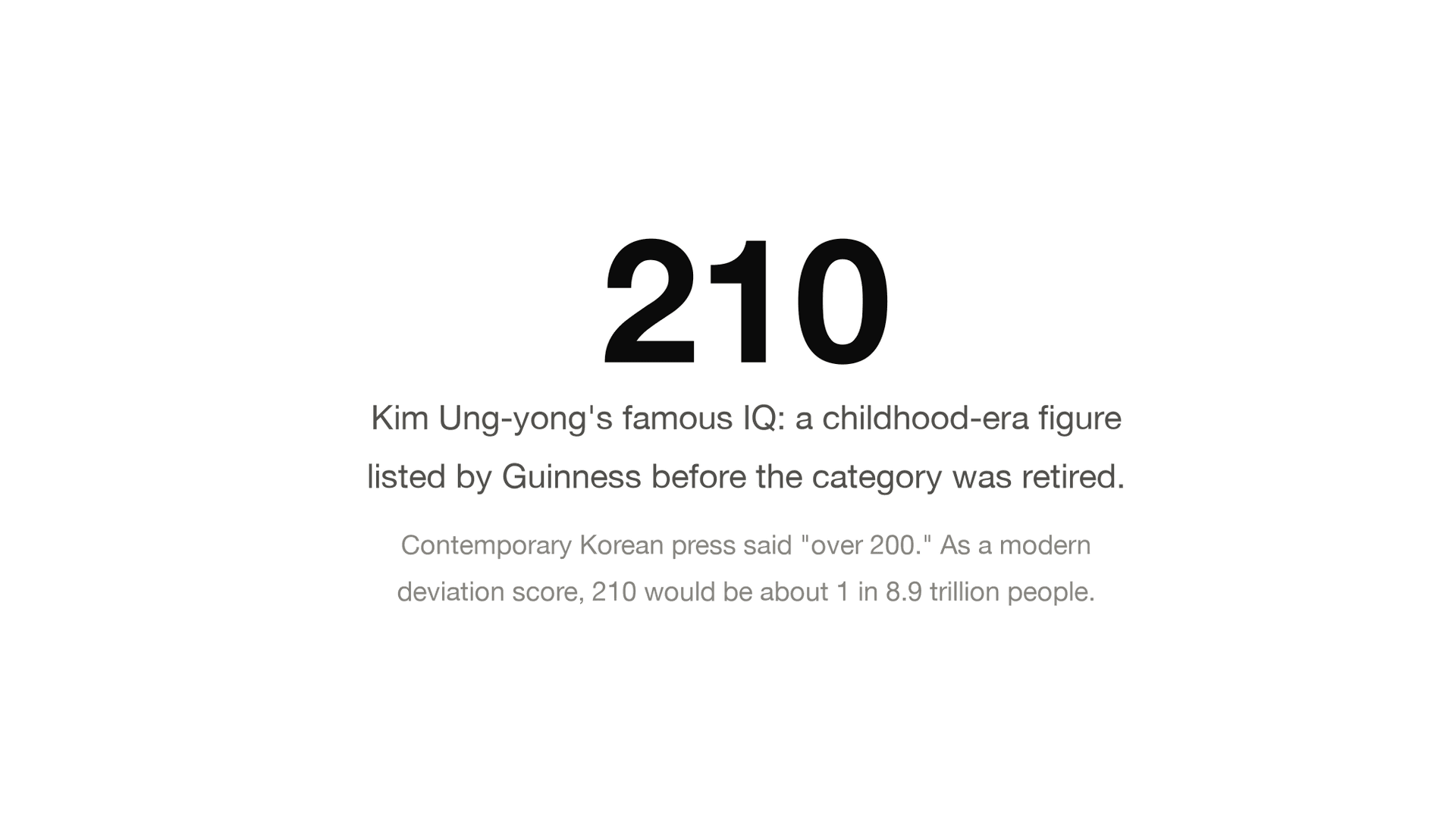
Kim Ung-yong is a South Korean former child prodigy who solved calculus problems on Japanese television as a small child and was listed by the Guinness Book of World Records with an IQ commonly cited as 210. Contemporary Korean press reported it as "over 200." Like every number from Guinness's Highest IQ category, retired in 1990 as unreliable, it is a childhood-era figure with no modern equivalent. What makes Kim's story remarkable is not the number; it is what he chose to do after the world stopped watching.
A prodigy on television
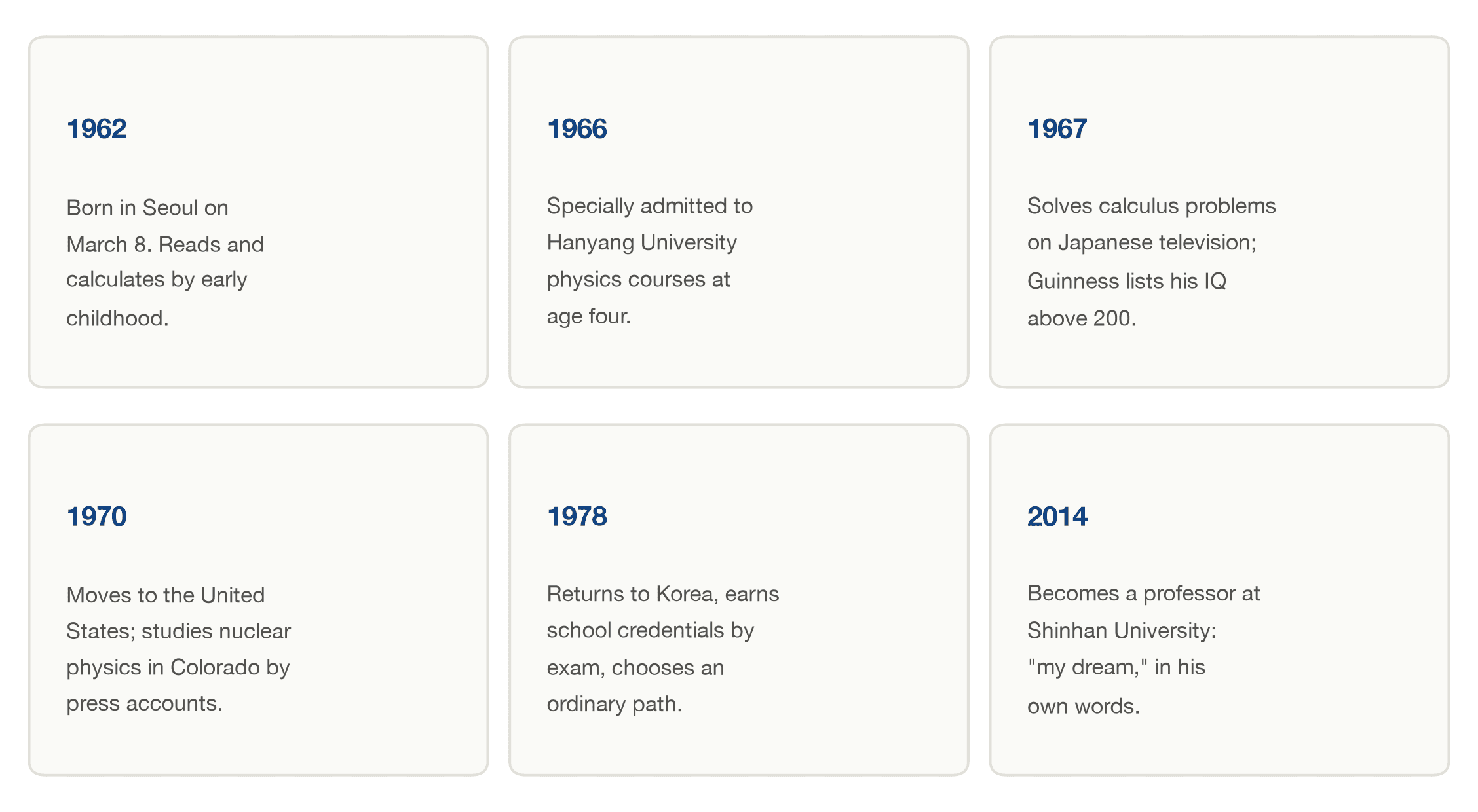
Born in Seoul on March 8, 1962, Kim was reading and calculating far beyond his years as a toddler. In 1966, at age four, he was specially admitted to physics courses at Hanyang University, and his televised appearances, including solving differential equations on Japanese TV, made him a national sensation. The Guinness Book listed him under Highest IQ, with editions citing 210.
The Guinness listing and its retirement
The 210 deserves the same scrutiny as every extreme IQ claim. It dates from his early childhood, from an unspecified assessment in the ratio-IQ era, when a four-year-old performing like a nine-year-old could arithmetically score 200 and up. On the modern deviation scale, mean 100 and standard deviation 15, a 210 would imply a rarity of roughly one in 8.9 trillion, more people than have ever lived. Guinness retired the Highest IQ category in 1990 after concluding extreme scores were too unreliable to rank, which is why no one has held the record since. Our guide to the IQ scale explains what modern scores can and cannot say.
America, and the road back
Around 1970 Kim moved to the United States. His own later account is that NASA invited him at eight and that he spent roughly a decade doing assigned calculation work there, years he described as lonely and mechanical: "I led my life like a machine," he told an interviewer in 2010. Contemporary Korean press reported those years differently, as study in nuclear physics at the University of Colorado; no independent NASA documentation has surfaced, so the employment claim rests on his own telling. What is not in dispute is that in 1978, at 16, he walked away and went home.
An ordinary happy life, by choice
Back in Korea, Kim had no domestic diplomas, so he earned elementary through high school credentials by examination, then studied civil engineering at a provincial university, completing a doctorate in 1998. The Korean media, which had crowned him a genius, now labeled him a "failed genius." His answer became the best line of his story: "I'm trying to tell people that I am happy the way I am. But why do people have to call my happiness a failure?" In 2014 he joined Shinhan University as a professor, calling teaching his long-held dream.
He has also been direct about what a famous IQ does not mean: "Some think people with a high IQ can be omnipotent, but that's not true. Look at me, I don't have musical talent, nor am I excelling in sports." It is as clean a statement of the limits of a single number as any psychometrician could write.
Frequently asked questions
What is Kim Ung-yong's IQ?
Guinness editions listed 210, and 1998 Korean press said "over 200." It is a childhood-era figure from an unspecified assessment; no modern deviation-scored test reports numbers in that range.
Was Kim Ung-yong the smartest person ever?
No measurement can establish that; the record category itself was retired as unreliable. He belongs on any list of history's most precocious children, which is the claim the evidence supports. See who is the smartest person in the world.
Did Kim Ung-yong work at NASA?
He has said so in interviews, describing about a decade of assigned calculation work. Contemporary Korean press instead reported he studied nuclear physics in Colorado, and no independent documentation exists, so the claim rests on his own account.
What does Kim Ung-yong do now?
He earned a civil engineering doctorate in 1998, worked in regional development, and since 2014 has been a university professor in Gyeonggi Province, a role he calls his dream.
Is a 210 IQ possible on modern tests?
No. Modern tests stop reporting around 160 because norming samples run out of people; 210 as a deviation score would be about one in 8.9 trillion. Such figures are ratio-era childhood calculations.
The takeaway
Kim Ung-yong's story is usually told as a cautionary tale about wasted genius, and he has spent decades politely correcting it: the number was never the point, and an ordinary life chosen freely is not a failure. His famous score belongs to the same retired record book as Marilyn vos Savant's 228. For a number that reflects how testing actually works today, the Reasoning and Intelligence Online Test from RIOT IQ measures reasoning against modern norms, with the precision stated rather than legendary.
References
1. Hwang, J. (2010, October 10). Life in the high IQ lane. The Korea Herald (syndicated in The Star). thestar.com.my
2. The Korea Herald. (2014, January 14). Former child genius to become full-time university professor.koreaherald.com
3. The Korea Herald. (2016, January 8). From prodigies to geniuses: The "gifted" fascination.koreaherald.com
4. An, N.-Y. (1998, February 26). "Forgotten genius" Kim Ung-yong to take the lectern from the new semester. JoongAng Ilbo. joongang.co.kr
5. Dolan, E. W. (2025). What is the highest IQ ever recorded? The truth behind the numbers. PsyPost. psypost.org
Take our professional IQ test
Want to know your IQ? Try the first ever professional online IQ test.