US Presidents Ranked by IQ: What the Estimates Really Show
US presidents ranked by IQ: every number traces to Simonton's 2006 estimates, from John Quincy Adams near 175 to Grant near 110. No president was tested.
Dr. Russell T. WarneChief Scientist
Share
No U.S. president has ever released a professionally administered IQ score. The numbers you see in “presidential IQ rankings” trace almost entirely to one academic study: psychologist Dean Simonton's 2006 analysis, which estimated scores from historical records rather than tests. His estimates run from roughly 108 to 175 depending on the method, with John Quincy Adams at the top and Ulysses S. Grant and Warren Harding near the bottom. This article explains where those numbers come from, what they can and cannot tell us, and why real rankings are impossible.
Where the Presidential IQ Numbers Come From
Simonton used a method called “historiometry”: trained raters scored biographical records of the first 42 presidents on traits linked to intelligence, such as early achievements, writings, openness to ideas, and intellectual brilliance as described by historians. Those ratings were then converted onto the familiar IQ scale, where 100 is average and 15 points is one “standard deviation.” Because the conversion can be done several defensible ways, each president got four estimates, not one.
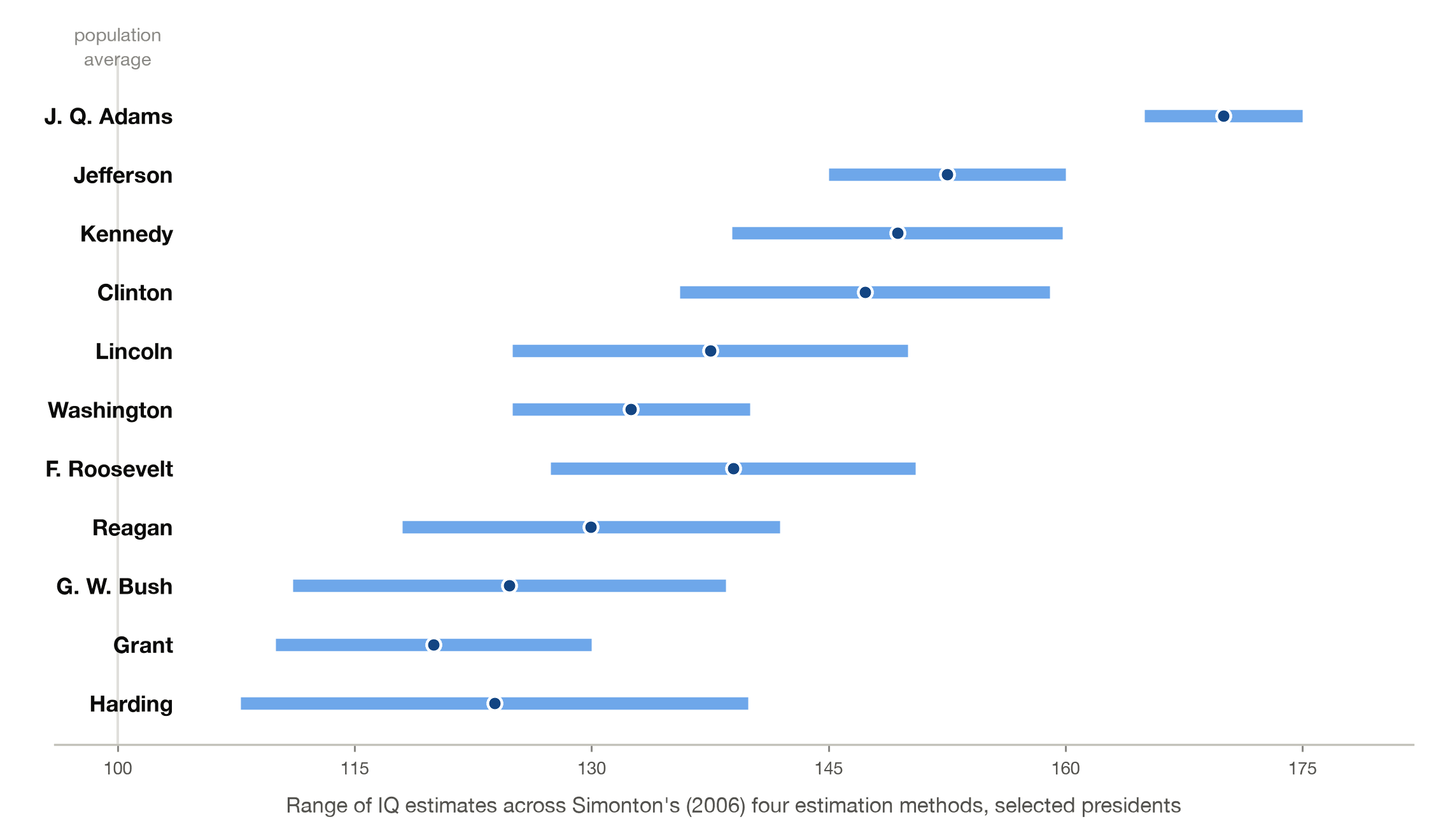
The ranges are the honest part of the story. John Quincy Adams spans 165 to 175, Jefferson 145 to 160, Lincoln 125 to 150, Grant 110 to 130, and Harding about 108 to 140. A spread of 20 or 30 points is not a measurement; it is an educated reconstruction with wide error bars, which is exactly how Simonton presented it.
How Four Numbers Per President Happened
Simonton's four estimates per president come from running the conversion two different ways, each with and without a statistical correction for the unreliability of the historical ratings. The uncorrected, conservative variant puts the range floor low; the corrected, generous variant lifts everyone. Neither is “the real number,” and Simonton never claimed otherwise. The spread between them is a built-in reminder that the input is biography, not behavior in a testing room.
It is also worth knowing what poisoned this well: in 2001 a chain email attributed invented presidential IQs to a nonexistent “Lovenstein Institute,” claiming a 91 for George W. Bush. Fact-checkers documented the hoax, but its numbers still resurface in social media rankings two decades later. If a presidential IQ figure does not trace to Simonton's paper, it usually traces to that hoax.
What the Estimates Do Show
• A high floor: Even the lowest estimates sit near or above the population average of 100, and under the most generous method every president lands at 130 or higher. Reaching the presidency selects for verbal ability, learning, and ambition.
• Intellect is not electability: Simonton's analysis found intellectual brilliance relates to historians' ratings of presidential greatness, but plenty of highly estimated presidents struggled in office. Adams, the top estimate, served a single frustrated term.
• Estimates track fame for ideas: The method rewards presidents who left intellectual paper trails: books, speeches, inventions, languages learned. Presidents whose strengths were organizational or military, like Grant, rank low on that specific signal.
Patterns Across the Eras
Reading the full table, a few patterns stand out. The founding generation scores high partly because the record rewards writers: Jefferson (145 to 160) and Madison (120 to 160) left enormous intellectual paper trails. Among modern presidents, Kennedy (roughly 139 to 160), Carter (130 to 157), and Clinton (136 to 159) top the estimates, while Wilson, the only president with a doctorate, spans about 133 to 155. Simonton also scored a related trait, “openness to experience,” where the contrast is sharper than in IQ: Jefferson rated at the 99th percentile among presidents, while George W. Bush rated at the very bottom of the distribution.
None of this ranks the presidents as thinkers in any definitive way. It ranks how intellectually engaged each man appears in the surviving record, which conflates ability with bookishness, opportunity, and the era's habits of documentation. A president who processed everything orally, or whose papers were destroyed, is invisible to the method.
Why Real Presidential IQs Are Unknowable
A genuine ranking would require every president to sit the same modern test under standard conditions. That has never happened, and historical figures cannot be tested retroactively. Reconstructing scores from biography also cannot separate ability from opportunity: colonial-era schooling, family libraries, and career paths all shape the historical record the raters scored. The same caution applies to any famous figure; our article on Albert Einstein's IQ covers the most famous case, and our piece on Donald Trump's IQ looks at a modern one. For what tested scores actually mean, start with our guide to the IQ scale.
Reading Rankings Critically
When a listicle announces that a president “had an IQ of 132.5,” the decimal is doing theater. All such numbers are Simonton's estimates, rounded or misquoted, and often stripped of their ranges. Treat them as a scholar's structured guess about historical reputation, useful for studying leadership, and nothing like a test report.
Get a Number That Is Actually Measured
Your own IQ, unlike a president's, can be measured directly. The Reasoning and Intelligence Online Test, developed by a team led by intelligence researcher Dr. Russell T. Warne, reports scores across five cognitive domains on the standard scale, with the confidence interval shown rather than hidden. Take the RIOT IQ test.
Frequently Asked Questions
Which president had the highest IQ?
By Simonton's estimates, John Quincy Adams, at roughly 165 to 175. No president has an actual tested score on record.
Which president had the lowest IQ?
Grant and Harding received the lowest estimates, roughly 108 to 140 depending on method. Even those floors sit near or above the population average.
Did any president ever take a real IQ test?
None has released one. Several modern presidents took military or academic aptitude tests, and journalists have occasionally reconstructed SAT or service scores, but converting those to IQ adds another layer of approximation, and no full-scale IQ result has ever been made public.
Are the viral presidential IQ chain emails real?
No. A famous 2001 chain email inventing low scores for then-President Bush was a documented hoax. Legitimate numbers trace to Simonton's published estimates.
Does a president need a high IQ to be great?
Estimated intellect correlates with historians' greatness ratings in Simonton's analysis, but judgment, temperament, coalition-building, and circumstances matter enormously. High-estimate presidents have failed and modest-estimate presidents have thrived; the correlation is far from destiny.
References
1. Simonton, D. K. (2006). Presidential IQ, openness, intellectual brilliance, and leadership: Estimates and correlations for 42 U.S. chief executives. Political Psychology, 27(4), 511–526. doi.org/10.1111/j.1467-9221.2006.00524.x
2. American Educational Research Association, American Psychological Association, & National Council on Measurement in Education. (2014). Standards for educational and psychological testing. American Educational Research Association. testingstandards.net
3. Warne, R. T. (2020). In the know: Debunking 35 myths about human intelligence. Cambridge University Press. doi.org/10.1017/9781108593298
4. Gottfredson, L. S. (1997). Mainstream science on intelligence: An editorial with 52 signatories, history, and bibliography. Intelligence, 24(1), 13–23. doi.org/10.1016/S0160-2896(97)90011-8