Aug 3, 2026·Famous People & IQWhat Is Sam Altman's IQ?
Is Sam Altman’s IQ really 170? Unpack the truth behind the viral rumors, his Stanford background, and an honest 135–145 range. Try the RIOT test!
Dr. Russell T. WarneChief Scientist
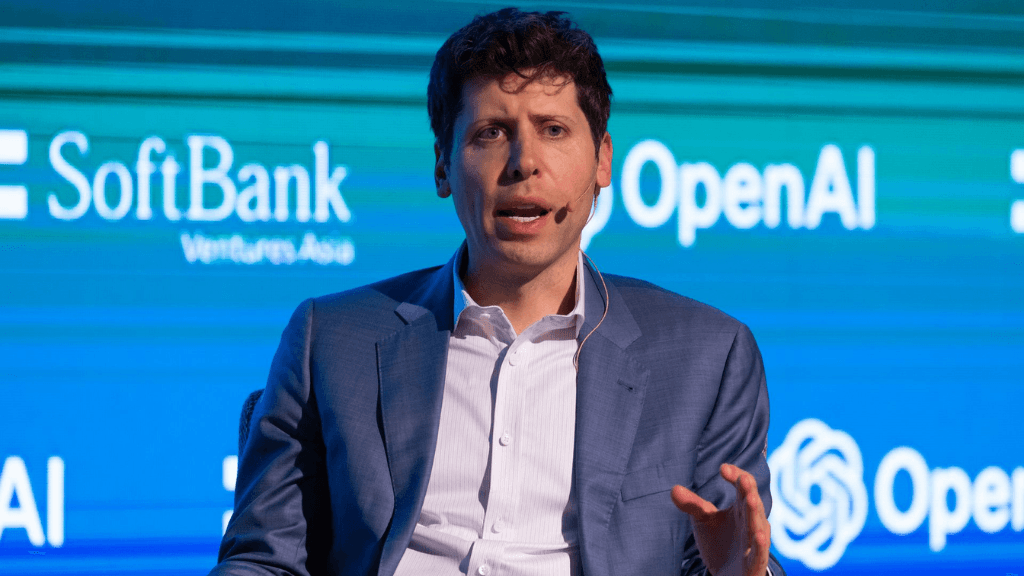
Sam Altman is the CEO of OpenAI, former president of Y Combinator, and the person most directly associated with bringing generative AI into the mainstream. He is also one of the most cognitively curious public figures in the technology industry — someone who has written publicly about how he thinks, what he reads, and what patterns he notices. Taking an IQ test and comparing your score to his is a natural impulse for anyone following the AI revolution he has helped accelerate. The honest answer, however, requires untangling what is documented from what is invented — and what the available evidence actually supports.
The Online Numbers Have No Source
No verified, publicly documented IQ score exists for Sam Altman. He has never disclosed a score from a standardized clinical battery, and no such result has ever been traceable to a legitimate psychometric source. The most frequently cited online estimate places Altman's IQ at approximately 170 — a figure attributed to a source called "DgFresh" that has no identifiable methodological basis whatsoever. A score of 170 would place someone in the top 0.003% of the population — a range where standard psychometric instruments have almost no reliable norming data and where the score is essentially unverifiable even with a formal test. The 170 figure circulating for Altman is in the same category as the fabricated figures that follow every successful technology executive: wealth and influence are used as proxies for extreme cognitive ability, a specific number is invented to match the cultural status, and it spreads because it confirms what people already want to believe. No official IQ score has been released, and Sam Altman's IQ is not publicly documented. What the available evidence can support is considerably more grounded — and more specific — than any invented number.
What the Documented Record Shows
Altman's academic and early career record is thinner as a proxy evidence base than most other tech founders analyzed in this series — which itself is a meaningful data point for any honest estimate.
He attended John Burroughs School, a prestigious private preparatory school in the St. Louis metropolitan area — a selective institution that requires strong academic performance for admission and maintenance. He then enrolled at Stanford University in 2003 to study computer science, spending time in the university's AI lab, a detail that makes his eventual OpenAI role less surprising in hindsight. He left after approximately two years — his sophomore year, age 19 — when Y Combinator selected Loopt for its inaugural Summer Founders Program in 2005.
Altman later said that he had learned more playing poker with classmates than attending lectures, and that poker taught him "how to notice patterns in people over time, how to make decisions with very imperfect information". This self-description is cognitively interesting — it reflects a specific value orientation toward inductive pattern detection and probabilistic reasoning under uncertainty — but it is also a partial deflection from what his Stanford record would otherwise tell us. Unlike Bezos's Princeton summa cum laude or Gates's Harvard Law Review presidency, Altman left Stanford before producing any documented academic distinction.
What the Stanford enrollment does confirm is that Altman cleared the cognitive selection threshold of one of the world's most competitive computer science programs — Stanford CS admission at that time required performance at the very top of the high school student distribution on standardized measures. In 2005, at age 19, he dropped out, secured more than $30 million in venture capital, and launched Loopt, a location-sharing application that predated Foursquare by four years and Facebook Places by five.
The Pattern-Recognition Signal: From Y Combinator to OpenAI
The most specific cognitive evidence in Altman's record is not academic — it is organizational. His tenure as president of Y Combinator from 2014 to 2019, and his navigation of OpenAI from a non-profit research lab to a company valued at over $300 billion, both reflect a specific type of applied cognitive intelligence that is legible through its outcomes.
Y Combinator under Altman grew substantially in both deal volume and prestige, with the accelerator's portfolio companies accumulating billions in valuation. His role required the simultaneous evaluation of hundreds of early-stage companies — assessing founder quality, market opportunity, technical feasibility, and competitive dynamics across radically different domains — under time pressure, with highly incomplete information. This is precisely the kind of multi-variable probabilistic reasoning that fluid intelligence research identifies as one of the most g-loaded real-world tasks. The poker-playing description Altman himself offered maps directly onto this: identifying patterns in founders over time, making decisions with very imperfect information, and managing the variance that comes from operating in genuinely uncertain environments.
The OpenAI trajectory is the more consequential signal. Altman co-founded OpenAI in 2015 alongside Elon Musk and others, navigated a governance crisis in November 2023 that temporarily removed him as CEO and resulted in his reinstatement within days, and has since guided the organization through the most rapid commercial scaling of any AI company in history. ChatGPT's release in late 2022 set off the generative AI boom, and Altman's ability to simultaneously manage OpenAI's research agenda, its commercial partnerships (including Microsoft's multi-billion dollar investment), its regulatory positioning across multiple governments, and its internal organizational culture reflects a cognitive bandwidth that is difficult to explain without assuming high general intelligence. Altman has also demonstrated the forecasting accuracy that Cogn-IQ research identifies as a marker of high fluid intelligence. He has observed that AI capabilities have been improving approximately one standard deviation in IQ terms per year — a framing that reflects genuine familiarity with psychometric concepts rather than superficial AI hype. His public prediction that AGI capable of matching or surpassing human cognitive performance will likely be achieved by 2030 is either bold or accurate — and the track record of the AI field's progress since ChatGPT's release has moved more in the direction of accurate than overconfident.
The Cognitive Profile That Emerges
What Altman's record most clearly supports is a specific cognitive profile rather than a specific score. The poker-and-pattern-detection self-description, the YC evaluation methodology, the OpenAI governance navigation, and the long-horizon forecasting all point toward the same cognitive cluster: strong fluid inductive reasoning, high probabilistic calibration, rapid multi-variable assessment, and the working memory bandwidth required to hold complex organizational situations in mind and act on them.
What the record does not support is the extreme mathematical profile suggested by a score of 170. Altman is not a theoretical physicist, a research mathematician, or a computer scientist with a documented record of original technical contributions. His computational background — Stanford CS, AI lab exposure, software development in his teens — is real and meaningful, but it reflects applied technical competence rather than the kind of domain-specific mathematical genius that would anchor an extreme upper-tail estimate.
The profile that emerges is closer to the strategic intelligence cluster documented in the CEO IQ literature: high enough general cognitive ability to handle the analytical demands of his role, with specific strengths in probabilistic reasoning, organizational pattern detection, and long-horizon systems thinking. This is a profile that the research consistently places in the 130–145 range for individuals who demonstrate it at the level Altman has — well within the genuinely gifted tier, without approaching the rarefied mathematical brilliance suggested by 170.
A Reasonable Estimate
Using the same proxy-based methodology applied across this series:
The floor established by Stanford CS admission and the organizational evidence of YC and OpenAI performance places Altman at or above the 99th percentile on cognitive measures — corresponding to an IQ floor of approximately 135.
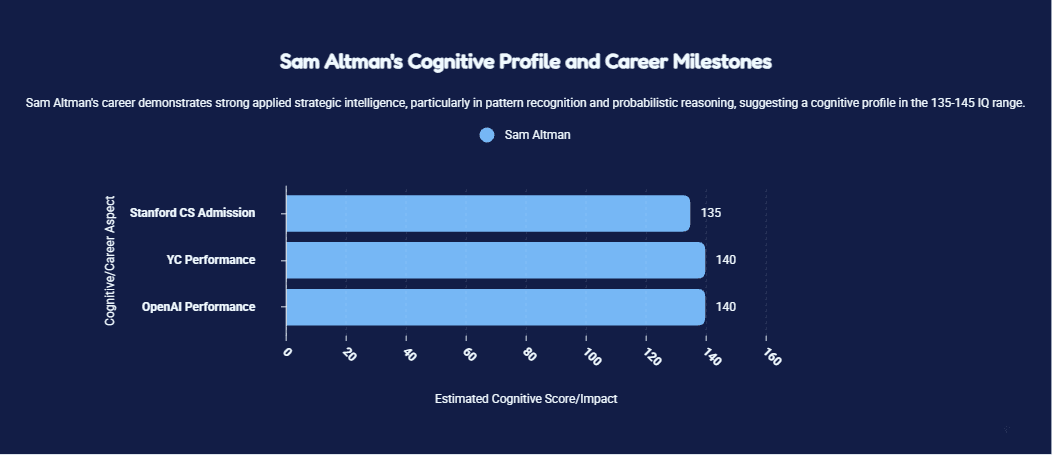 The ceiling is bounded by the absence of the extreme mathematical or academic distinction evidence that would support a much higher estimate. Altman left Stanford without graduating, without any published academic work, and without documented performance on the most demanding upper-level coursework that would signal performance in the 150+ range.
The most defensible central estimate places Altman most likely in the 135–145 range — genuinely gifted, consistent with the organizational and strategic cognitive profile his career reflects, and considerably more grounded than the 170 that circulates online. The uncertainty band is wider than for figures with stronger academic records — it could plausibly extend from 130 to 150 — but the central estimate is defensible from the available evidence in a way that the viral 170 is not.
A Note on Altman's Own Thinking About IQ
One of the more unusual features of Altman's public profile is that he is, by professional necessity, one of the most cognitively self-aware executives alive — his entire career since 2019 has required him to reason carefully about what intelligence is, how it is measured, and what it predicts. His own framing of AI progress in IQ terms — "we move one standard deviation per year" — reflects direct engagement with the psychometric literature. And his consistent public position that AGI represents "any intellect that greatly exceeds the cognitive performance of humans in virtually all domains" shows sophisticated familiarity with how intelligence researchers actually define the construct.
This cognitive self-awareness is itself a signal. People who think carefully and accurately about intelligence — who understand what IQ measures, what it predicts, and where it falls short — tend to be operating at higher levels of the construct they are discussing. The Dunning-Kruger literature makes this point from the other direction: those who misunderstand intelligence most dramatically are typically those with the least of it. Altman's public engagement with these ideas is another piece of proxy evidence pointing toward the gifted range, without anchoring a specific number.
The Takeaway
Sam Altman's IQ is unknown. The figure of 170 that circulates online has no identifiable source, no psychometric basis, and represents a level of cognitive ability so extreme that standard tests cannot reliably measure it. The most defensible estimate, derived from Stanford CS admission, the organizational evidence of YC and OpenAI performance, and the probabilistic reasoning profile his career reflects, places Altman most likely in the 135–145 range — genuinely gifted, and consistent with the applied strategic intelligence that building and leading the world's most consequential AI organization requires.
What his career most clearly illustrates is not a specific IQ score but a specific cognitive style: pattern detection under uncertainty, long-horizon systems thinking, and the organizational bandwidth to hold extraordinarily complex multi-stakeholder situations in mind and navigate them effectively. Those capacities are real, measurable in principle, and considerably more interesting than any single number.
If you want to understand where your own cognitive profile sits — across the fluid reasoning, pattern recognition, and probabilistic calibration domains that Altman's record most directly reflects — the RIOT gives you a domain-level picture that goes considerably further than any celebrity estimate.
References
Britannica Money. (2026). Sam Altman — Biography, OpenAI, ChatGPT & Microsoft — poker and pattern recognition self-description. https://www.britannica.com/money/Sam-Altman Built In. (2026). Who Is Sam Altman? A Guide to the OpenAI CEO's Career — Stanford CS dropout, Loopt, YC, OpenAI trajectory. https://builtin.com/articles/sam-altman AdwaitX. (2026). Sam Altman Left Stanford at 19 and Raised $30M: The Loopt Story — Stanford AI lab, YC inaugural cohort. https://www.adwaitx.com/sam-altman-stanford-dropout-loopt/ Meet Jamie / DgFresh Attribution. (2025). Decoding Success: Sam Altman's Revolutionary Path — 170 estimate and its source. https://www.meetjamie.ai/blog/sam-altman Artificial Intelligence Blog. (2025). What Is Sam Altman's IQ? — no verified score documented. https://www.artificial-intelligence.blog/ai-news/what-is-sam-altmans-iq TechCrunch. (2025). Why IQ Is a Poor Test for AI — Altman's one-standard-deviation-per-year framing. https://techcrunch.com/2025/02/05/why-iq-is-a-poor-test-for-ai/ TIME. (2026). How OpenAI's Sam Altman Is Thinking About AGI and Superintelligence — Bostrom reference and intelligence definition framing. https://time.com/7205596/sam-altman-superintelligence-agi/ Wikipedia. Sam Altman — biographical record, Stanford enrollment, OpenAI co-founding. https://en.wikipedia.org/wiki/Sam_Altman
Take our professional IQ test
Want to know your IQ? Try the first ever professional online IQ test.
AuthorDr. Russell T. WarneChief Scientist
