Napoleon's IQ was never tested. Catharine Cox's 1926 Stanford study estimated Napoleon's IQ at 135 to 140 from records. See how and why it is only a guess.
Dr. Russell T. WarneChief Scientist
Share
Napoleon Bonaparte's IQ was never tested. He died in 1821, 84 years before the first intelligence test appeared in 1905, so no score for him can exist. The only citable figures come from Catharine Cox's 1926 Stanford study, which estimated his IQ at 135 for childhood and 140 for ages 17 to 26 by having raters read his biographical records, a method called "historiometry." The 145-plus numbers on celebrity IQ sites have no documented source. This article walks through what Cox's file on Napoleon actually says, where the inflated figures come from, and what an estimate like this can and cannot tell you.
Why no real score can exist
IQ testing began with Alfred Binet's 1905 scale, developed for Parisian schoolchildren three generations after Napoleon's death; our history of IQ testing covers the timeline. Anything more precise than a researcher's estimate is therefore invented. The estimates that do exist were made a century after the fact, from school anecdotes and teachers' recollections, and their authors said so plainly.
Inside Cox's 1926 estimate
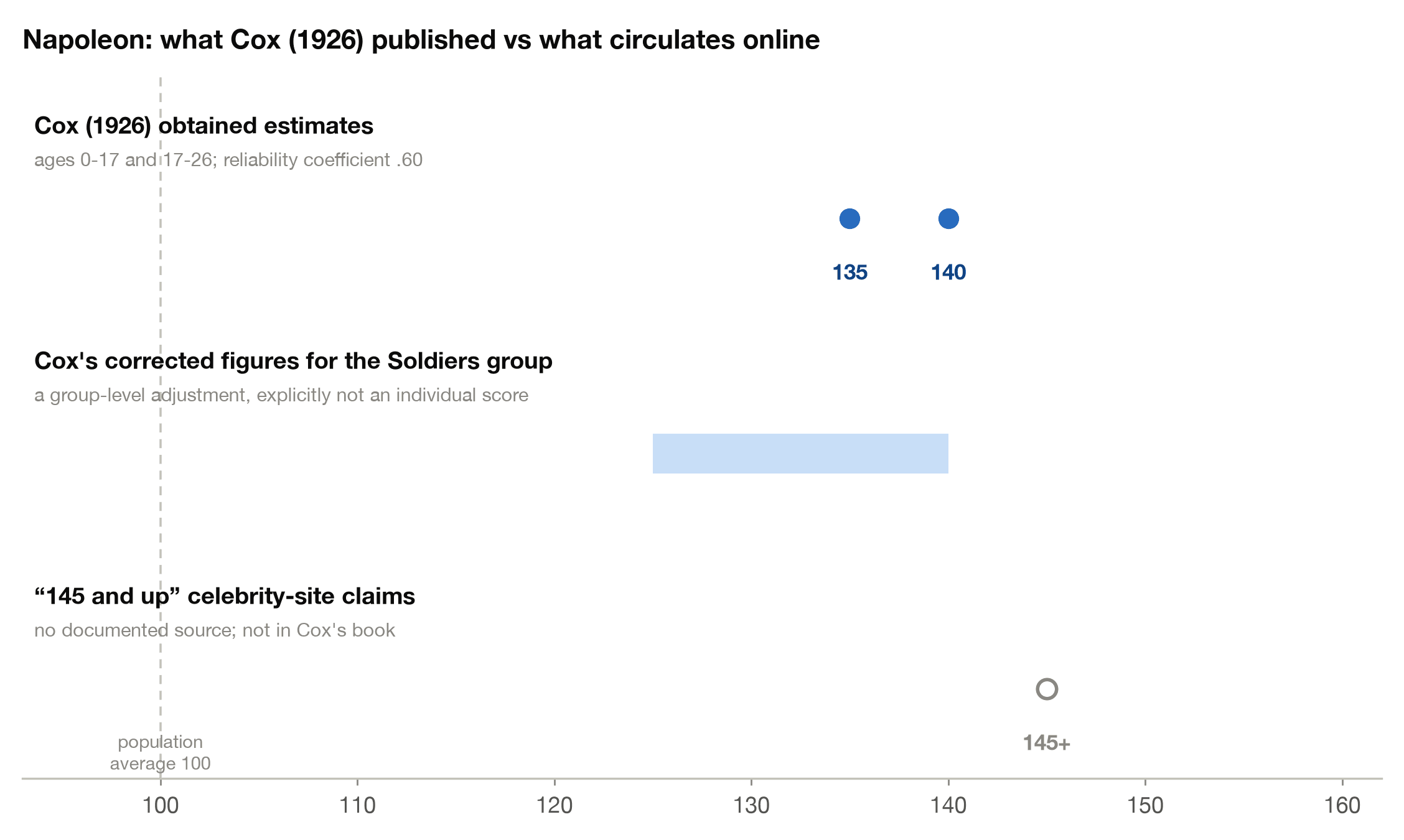
Cox's Genetic Studies of Genius, Volume II, assigned estimated IQs to 301 eminent historical figures. Three raters read each subject's recorded early achievements and judged what IQ would typically produce them, yielding an "AI" estimate for birth to age 17 and an "AII" estimate for ages 17 to 26. Napoleon's case study is headed: AI IQ 135, AII IQ 140, with a data-reliability coefficient of .60, relatively high for the study. That places him almost exactly at the average of Cox's 301 geniuses, whose group means were 135 and 145.
The file behind the number is vivid and mixed. "Napoleon never learned to spell correctly, his pronunciation of French was often peculiar, and his penmanship abominable, but he learned quickly and at Autun he was recognized as an able student." His strengths tilted hard toward mathematics and facts: "in mathematics he held the first place and even as early as his 12th year he was chosen to exhibit his work in geography," while his Latin and German were poor. His literature professor called his rhetoric "granite heated by a volcano," and an instructor wrote "he will go far if circumstances favor" on the back of a school exercise. At 16 he graduated 42nd in rank, was commissioned a second lieutenant, and read voraciously at Brienne: Polybius, Plutarch, hours over the atlas. Cox's raters distilled all of that into 135 and 140. The estimate is a judgment call over exactly this kind of anecdote, made a century later.
Where the higher numbers come from
Cox also published "corrected" estimates, adjusted for the incompleteness of historical records, and this is where the inflated Napoleon figures originate. The corrections were group-level: for his professional group, the Soldiers, the obtained averages of 115 and 125 were corrected to 125 and 140. Cox never published an individual corrected score of 145 for Napoleon, and she warned against reading the corrections that way: "the purpose of the corrected estimates is not to furnish exact values for the score of an individual or even of a group." The 145s and fantasy 180s on celebrity-IQ sites are extrapolations with no documented source. It is worth noting that the Soldiers were the lowest-rated professional group in the entire study, which says more about what soldiers' childhood records look like than about soldiers.
What an estimate can and cannot tell you
Cox flagged the method's central bias herself: "The more complete the record the higher the average IQ for any considerable group in our study... sufficient evidence is not available to corroborate the highest estimate possible in a given case." Historiometric estimates rate the recorded childhood rather than the person. Two technical notes matter as well: Cox-style IQs are ratio-style estimates with a standard deviation of 16, so they are not directly comparable to modern deviation IQs with a standard deviation of 15, and a 135 to 140 would be roughly the top 1 to 2 percent if it were a score. It is not a score. The same caution applies across the genre, from our ranking of US presidents by IQ to the famous case of Albert Einstein's IQ, which was likewise never tested.
The verdict on Napoleon's intelligence
The documented record shows a rapid learner with sharp quantitative and spatial strengths, an uneven schoolroom profile, and an appetite for books that his instructors found remarkable. What made him Napoleon was how those abilities combined with organization, decisiveness, and ambition on an operational scale no test measures. A single number cannot capture that, and the honest ones never claimed to.
Frequently asked questions
What was Napoleon's IQ?
Napoleon never took an IQ test; the first one appeared in 1905, long after his death in 1821. The only citable figures are Cox's 1926 historiometric estimates: 135 for his childhood record and 140 for ages 17 to 26.
Is it true Napoleon had an IQ of 145 or higher?
No document supports it. Cox's published estimates for Napoleon are 135 and 140. Her "corrected" figures were group-level adjustments, and she explicitly warned they were not exact individual values.
Was Napoleon a good student?
Uneven. Cox's records show he was first in mathematics and excellent at geography, but poor at Latin and German, never learned to spell correctly, and graduated 42nd in rank from the military school in Paris at 16.
How can anyone estimate the IQ of someone born in 1769?
Through historiometry: trained raters read biographical records of early achievements and estimate what IQ would typically produce them. The result is a judgment about the record, not a measurement of the mind.
How does Napoleon compare with others in Cox's study?
His 135 to 140 sits near the average of Cox's 301 geniuses and above her Soldiers group, the lowest-rated profession in the study. Rankings within the study largely track how complete each biography was.
Would Napoleon score high on a modern IQ test?
Nobody can know. His documented strengths in mathematics, geography, and rapid learning suggest strong quantitative reasoning, but a modern full-scale test measures abilities his biographers never recorded. That is exactly why estimates are not scores.
The takeaway
Every Napoleon IQ figure descends from one 1926 study that described itself as an estimate of a paper trail. The record shows real brilliance; the number attached to it is a scholarly guess. If you want a figure that is actually a measurement, the Reasoning and Intelligence Online Test reports modern deviation scores with stated precision, and the free RIOT IQ test is the place to start.
References
1. Cox, C. M. (1926). Genetic studies of genius: Vol. II. The early mental traits of three hundred geniuses. Stanford University Press. archive.org
2. Cox, C. M. (1926). Genetic studies of genius: Vol. II [alternate full scan]. Stanford University Press. archive.org
3. Simonton, D. K. (2006). Presidential IQ, openness, intellectual brilliance, and leadership: Estimates and correlations for 42 U.S. chief executives. Political Psychology, 27(4), 511-526. acsu.buffalo.edu
4. Simonton, D. K. (2021). Versatility in genius: A history of historiometric studies of historic creators.simonton.faculty.ucdavis.edu
5. Warne, R. T. (2020). In the know: Debunking 35 myths about human intelligence. Cambridge University Press. doi.org/10.1017/9781108593298
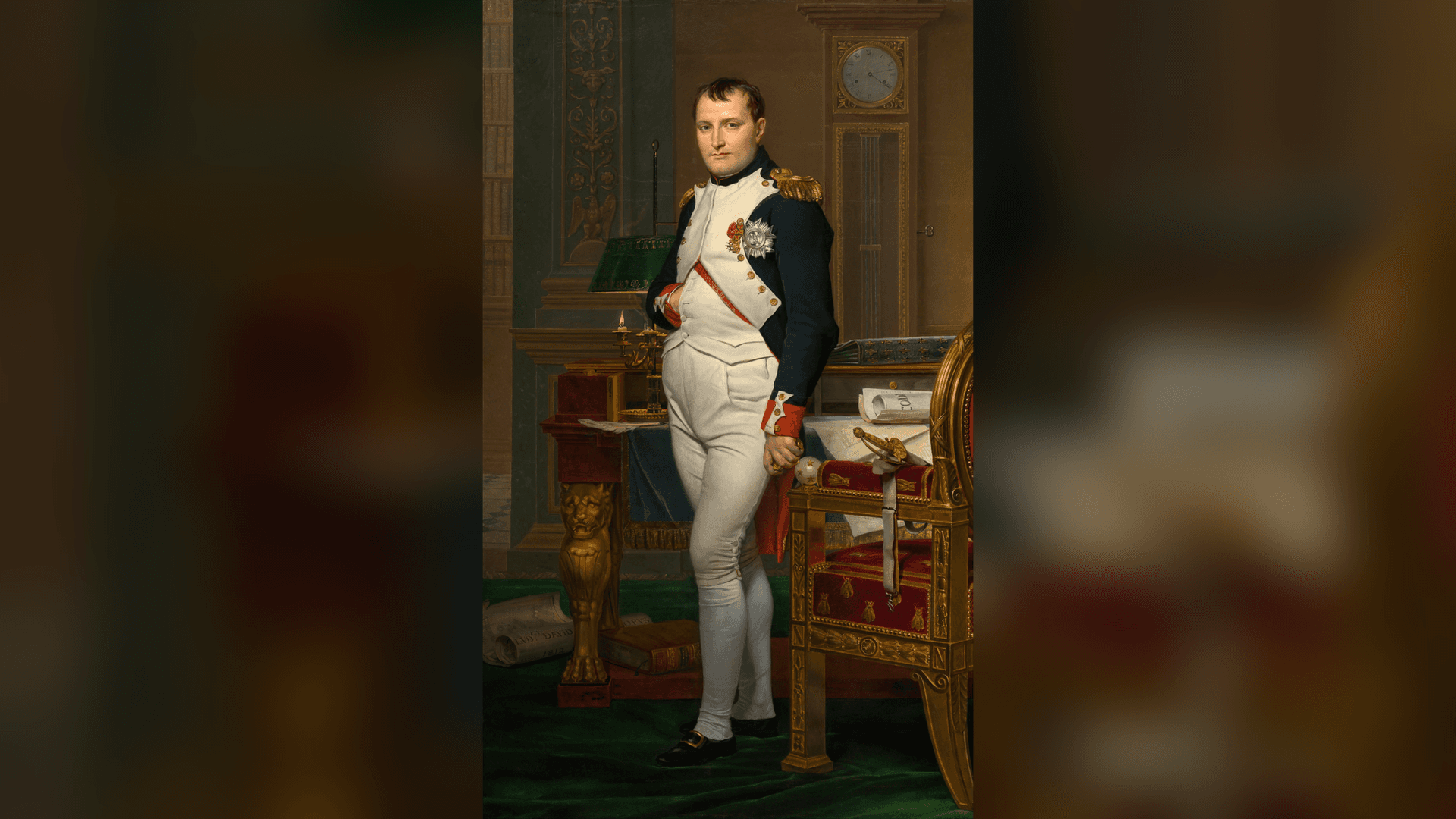
Hero image: Jacques-Louis David, public domain, via Wikimedia Commons.
Take our professional IQ test
Want to know your IQ? Try the first ever professional online IQ test.