Benjamin Franklin's IQ was never tested. Catharine Cox's 1926 Stanford study estimated Benjamin Franklin's IQ at 145. Here is where the 160 claim came from.
Dr. Russell T. WarneChief Scientist
Share
Benjamin Franklin's IQ was never tested; he died in 1790, more than a century before the first intelligence test existed. The only citable figure is Catharine Cox's 1926 Stanford estimate of 145, assigned by raters who read his childhood records, and the "Franklin IQ 160" that circulates online is an extrapolation from her group-level corrections rather than a rating of Franklin himself. This article explains how the 145 was produced, where the 160 claim comes from, and why Franklin's documented life is better evidence than either number.
Why Franklin has no real score
Intelligence testing began with Binet's 1905 scale, 115 years after Franklin's death; the whole story is in our history of IQ testing. Every Franklin IQ number online therefore descends from a single source, Cox's 1926 study, or from embellishments of it. Knowing how that study worked is the entire game.
Inside Cox's 1926 estimate of 145
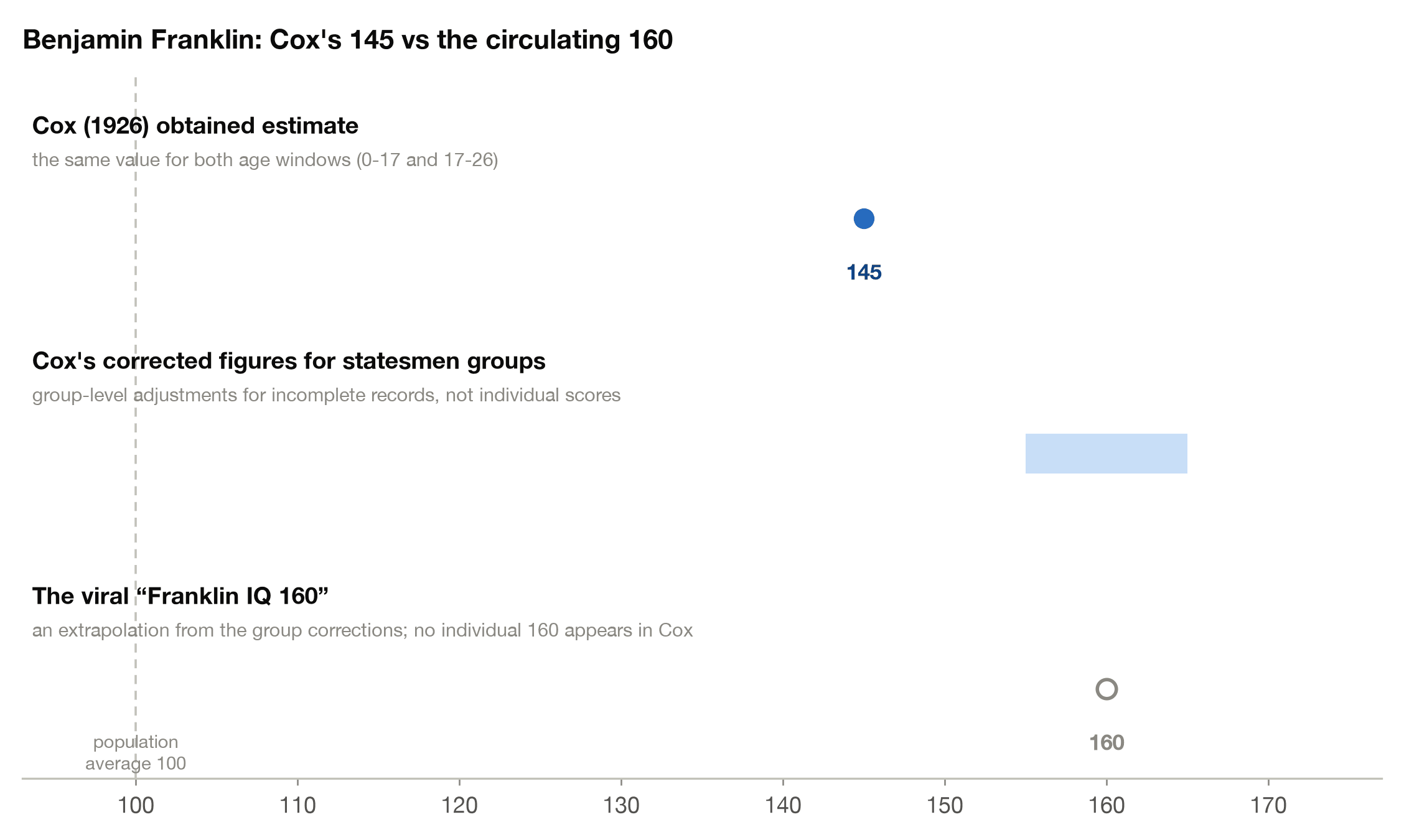
Cox's Genetic Studies of Genius, Volume II, estimated IQs for 301 eminent historical figures. Three raters read each person's recorded early accomplishments and judged what IQ a child would need to produce them, generating an "AI" estimate for birth through age 17 and an "AII" estimate for ages 17 to 26. Franklin's case file carries the same value for both windows: 145. That placed him among the higher childhood ratings in the study, whose group averages were 135 and 145.
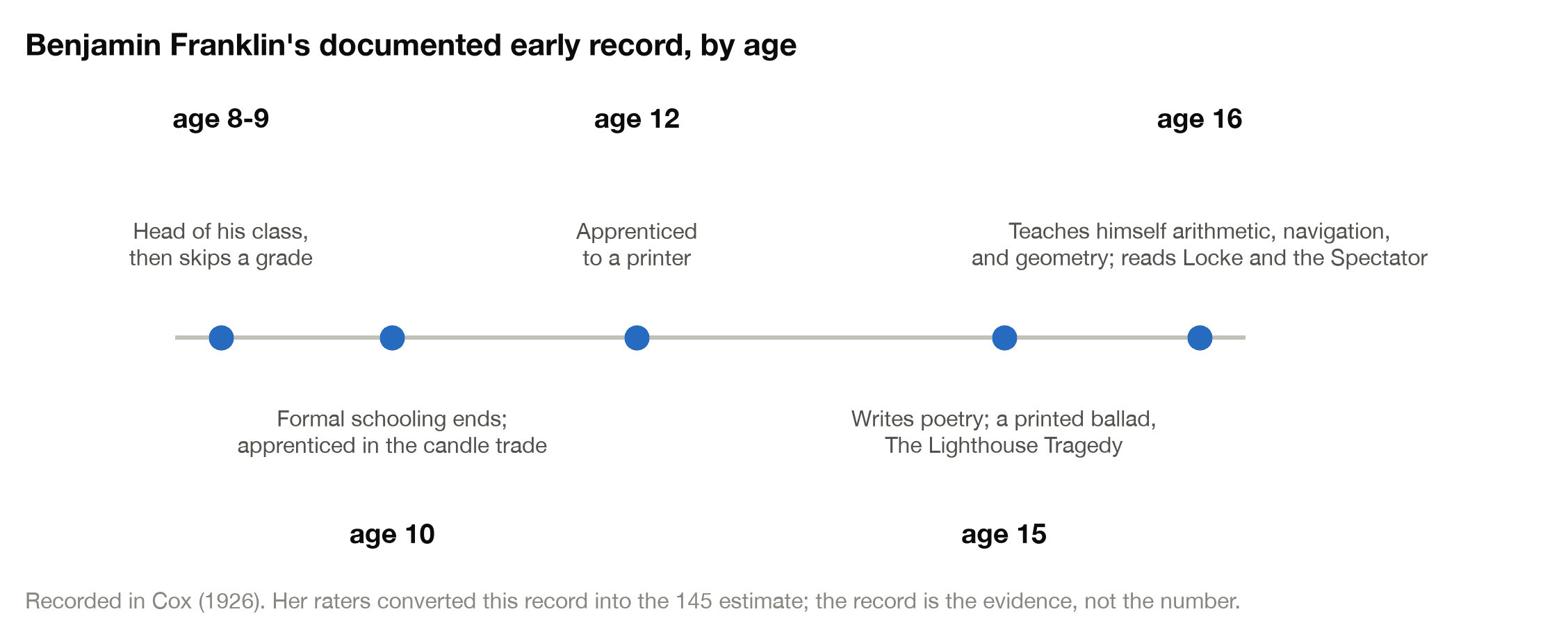
The record his 145 was built on is remarkable. He "could not remember the time when he could not read." At school, aged 8 to 9, he rose from the middle of his class to its head, then skipped a grade. Formal schooling ended around age 10 for cost reasons; he was apprenticed in the family candle trade and then, at 12, to a printer. At 15 he was writing poetry, including a printed ballad, The Lighthouse Tragedy. At 16, ashamed of having failed arithmetic at school, he worked through an arithmetic text and two books of navigation with ease, learned the geometry they contained, read Locke, adopted the Socratic method in argument, and trained his prose style on the Spectator. As a boy he was "apt also to make ingenious inventions, such as pallets for rapid swimming, or a kite for accelerating progress through the water." Two years of school, and a lifetime of self-teaching: that is what Cox's raters converted into 145.
Where the "Franklin IQ 160" claim comes from
No individual 160 appears anywhere in Cox's book. What she did publish were "corrected" estimates, group-level adjustments meant to compensate for incomplete records: her Statesmen group corrected from 135 to 155 and from 142 to 165 across the two age windows, the Revolutionary Statesmen from 140 to 160, and the American subgroup to 160. The circulating "Franklin 160" is an extrapolation from those group corrections. Cox's own warning could not be clearer: "the purpose of the corrected estimates is not to furnish exact values for the score of an individual or even of a group." The citable estimate is 145; the 160 is a derived region, unverified as a figure for Franklin himself.
The fine print on historiometric IQs
Cox acknowledged that her method tracks paperwork: "The more complete the record the higher the average IQ for any considerable group in our study... sufficient evidence is not available to corroborate the highest estimate possible in a given case." Franklin's Autobiography gave her raters an unusually rich record, which plausibly helped his estimate relative to thinly documented peers; Washington, with sparse schooling records, was rated 125. Two more notes for calibration. Cox-style IQs use a standard deviation of 16, slightly different from the 15 of modern deviation IQs, and if 145 were a modern score it would sit around the top 0.2 to 0.5 percent, the territory covered in our guide to genius IQ scores. But it is an estimate with wide, unquantifiable error bars, and it should be quoted with the method attached.
Genius without a number
Franklin's documented achievements carry the argument on their own: a leading 18th-century electricity researcher (the kite experiment, the lightning rod), an inventor (bifocals, the Franklin stove), founder of the American Philosophical Society, and a celebrated writer and diplomat. The record is the evidence; 145 is one team's 1926 attempt to summarize it. That is the right way to read every historical IQ claim, from our ranking of US presidents by IQ to the sister case of Albert Einstein's IQ, another mind whose famous number never came from a test.
Frequently asked questions
What was Benjamin Franklin's IQ?
Franklin never took an IQ test; none existed until 1905. The only citable figure is Cox's 1926 historiometric estimate of 145, based on raters reading his childhood records. It is an informed estimate, not a measurement.
Was Benjamin Franklin's IQ 160?
No individual 160 appears in Cox's book. Her estimate for Franklin was 145. The 160-area numbers online derive from her group-level "corrected" figures for statesmen, which she explicitly said were not exact values for individuals.
How could Franklin be a genius with only two years of school?
His formal schooling ended around age 10, but Cox's records show he taught himself arithmetic, navigation, and geometry at 16, read Locke, and trained his prose on the Spectator. Her raters treated that self-education as evidence of very high ability.
Who had a higher estimated IQ, Franklin or Washington?
In Cox's study, Franklin was rated 145 for both age windows while Washington was rated 125 and 135. Part of that gap likely reflects Franklin's far richer paper trail, including his Autobiography, since estimates rise with record completeness.
How accurate are IQ estimates for historical figures?
They are judgments rather than scores. Cox reported respectable agreement among her three raters, but warned that incomplete records bias estimates downward and that corrected figures indicate regions rather than exact values. Modern psychometricians treat them as historical curiosities.
What would Franklin score on a modern IQ test?
Unknowable. His documented verbal, quantitative, and mechanical accomplishments suggest he would do very well, but modern full-scale tests measure abilities under standard conditions that no biography can reconstruct.
The takeaway
Franklin needs no invented number; the self-taught polymath in the documented record is impressive enough. The 145 is a 1926 estimate, the 160 is an echo of a group correction, and neither is a score. If you are curious where you would land on a scale that is actually normed and measured, the Reasoning and Intelligence Online Test reports modern deviation scores with stated precision, starting with the free RIOT IQ test.
References
1. Cox, C. M. (1926). Genetic studies of genius: Vol. II. The early mental traits of three hundred geniuses. Stanford University Press. archive.org
2. Cox, C. M. (1926). Genetic studies of genius: Vol. II [alternate full scan]. Stanford University Press. archive.org
3. Simonton, D. K. (2006). Presidential IQ, openness, intellectual brilliance, and leadership: Estimates and correlations for 42 U.S. chief executives. Political Psychology, 27(4), 511-526. acsu.buffalo.edu
4. Simonton, D. K. (2021). Versatility in genius: A history of historiometric studies of historic creators.simonton.faculty.ucdavis.edu
5. Warne, R. T. (2020). In the know: Debunking 35 myths about human intelligence. Cambridge University Press. doi.org/10.1017/9781108593298