Isaac Newton never took an IQ test; testing arrived 178 years after he died. Where the famous 190 estimate comes from, and what his record really shows.
Dr. Russell T. WarneChief Scientist
Share
Isaac Newton never took an IQ test. He died in 1727, and the first practical intelligence test appeared in 1905, 178 years later. Every "Newton IQ" you have seen, including the popular 190, is a retrospective estimate, and nearly all of them trace to a single 1926 study that graded historical geniuses from their biographies. Those estimates for Newton ranged from 130 to 190 depending on the method. The real measure of the man is not in that range; it is in what he actually did.
Why every Newton IQ number is an estimate
IQ is a comparison of a living person's test performance against contemporary norms. For anyone who died before testing existed, the best a researcher can do is "historiometry": reading the biographical record and estimating how able a person must have been to do what they did, at the age they did it. That method produces educated guesses with wide error bars, and its results depend heavily on how much childhood documentation survived. For Newton, a 17th-century farm boy from Lincolnshire, childhood records are thin.
The 1926 study behind the number
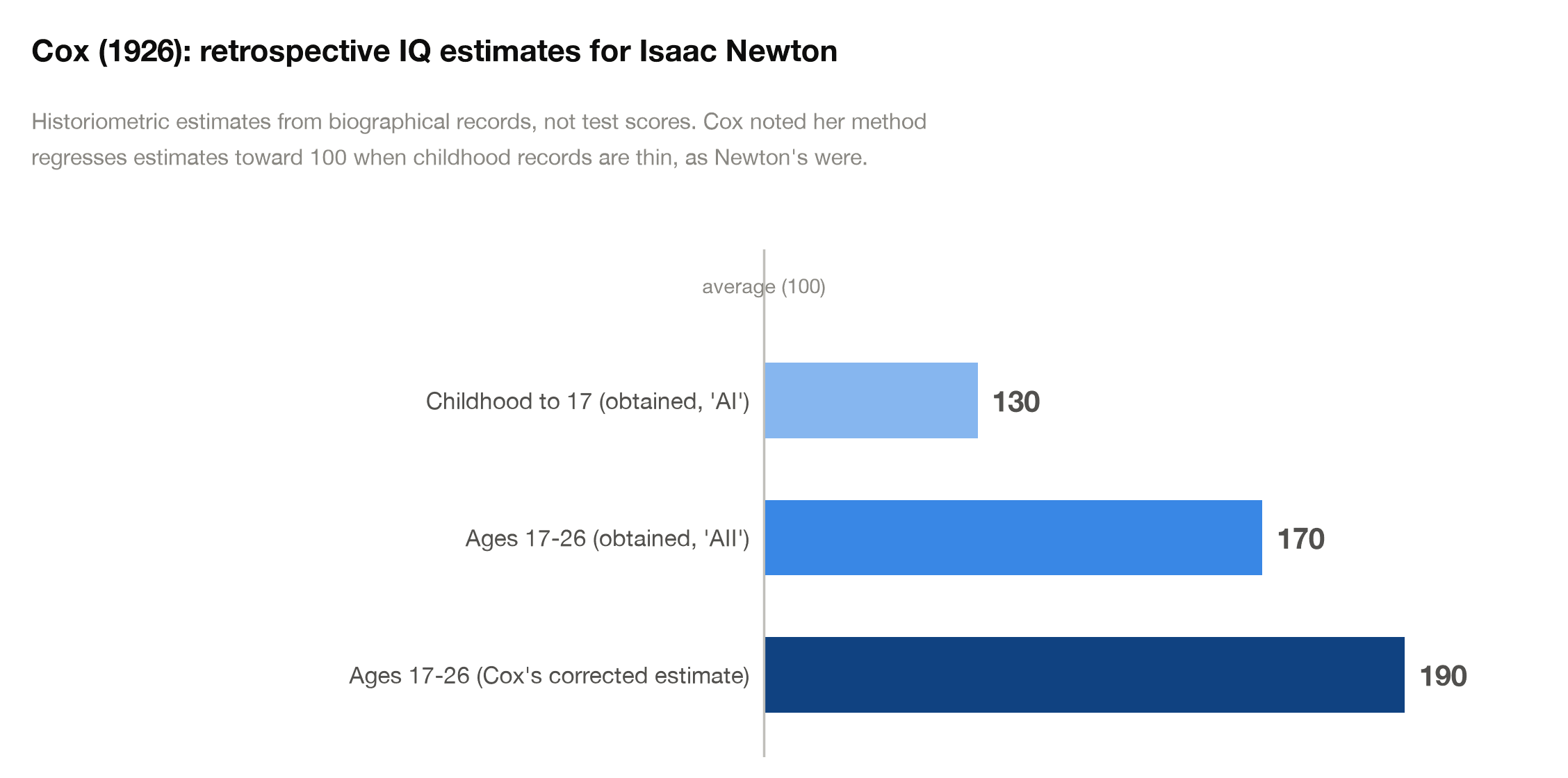
In 1926, psychologist Catharine Cox published estimated IQs for 301 eminent historical figures, as part of the Stanford "Genetic Studies of Genius" project. Trained raters read each figure's biography and estimated ability for two life periods. Newton's obtained estimates were 130 for childhood through age 17, where records were sparse, and 170 for ages 17 to 26, the decade of calculus, optics, and gravitation. Cox knew thin records dragged estimates toward 100, so she also computed corrected values; Newton's corrected figure, 190, is the one the internet remembers.
Take our professional IQ test
Want to know your IQ? Try the first ever professional online IQ test.
Cox herself wrote that Newton discovered "the principle of the differential calculus before he was 24," then added epoch-making work in optics and gravitation, and she doubted her own scale reached high enough to hold him. Modern reanalyses, notably by Dean Keith Simonton, treat Cox's numbers as usable research data with serious limitations: estimates track record quality, raters knew who they were rating, and the whole exercise measures documented precocity, not tested intelligence.
What the record actually shows
• Lucasian Professor at 26: Newton assumed Cambridge's Lucasian chair of mathematics in October 1669, an extraordinary appointment for a man his age.
• The Principia, 1687: His mathematical physics unified terrestrial and celestial motion under one set of laws, arguably the most influential scientific book ever printed.
• Calculus: He developed his version in the mid-1660s, roughly a decade before Leibniz's independent invention, igniting the most famous priority dispute in science.
• President of the Royal Society: Elected in 1703, he presided over English science until his death in 1727, at 84.
Achievements like these are why Cox's raters pushed his estimate toward the top of their scale, and why the exact number matters so little. For a comparison case, see our article on Albert Einstein's IQ, another giant who never took an IQ test, and our guide to the IQ scale for what modern scores mean.
What historiometric estimates can and cannot do
Used carefully, retrospective estimates let researchers study questions the past cannot answer any other way; Simonton's reanalysis of Cox's sample, for instance, found that rated intelligence predicts eminence at about r = .25, a modest, real relationship. Used carelessly, the same numbers become trivia-list ammunition, quoted to one decimal as if Newton had sat for the WAIS on a Tuesday. A range of 130 to 190, labeled as an estimate from biography, is the honest way to report it.
Frequently asked questions
What was Isaac Newton's IQ?
No tested score exists. Cox's 1926 historiometric study estimated 130 for his data-poor childhood and 170 for ages 17 to 26, with a corrected estimate of 190. All are educated guesses from biography.
Who estimated Newton's IQ, and how?
Psychologist Catharine Cox, in the 1926 Stanford Genetic Studies of Genius, had raters read biographies of 301 eminent figures and estimate the ability their documented achievements implied.
Are historical IQ estimates reliable?
Only loosely. They depend on surviving records, raters were not blind to identity, and the scores are precocity ratings, not test results. Researchers treat them as rough research data, not facts about individuals.
Was Newton smarter than Einstein?
There is no measurement that could settle it; neither man took an IQ test. Both routinely top historiometric and expert rankings of scientific eminence, which is as much as the evidence supports.
What was Newton's education?
Grammar school in Grantham, then Trinity College, Cambridge, where he absorbed and quickly outran the curriculum, doing much of his foundational work during the plague years of 1665 to 1667 at his family farm.
The takeaway
Newton's 190 is a modern legend built on a careful but limited 1926 study; the honest version is a wide estimate range attached to an unarguably towering record. If you are curious where you stand on a scale that actually exists, the Reasoning and Intelligence Online Test from RIOT IQ measures reasoning against modern norms, which is something no historical figure can claim. For who tops today's conversations, see who is the smartest person in the world.
References
1. Cox, C. M. (1926). Genetic studies of genius: Vol. II. The early mental traits of three hundred geniuses. Stanford University Press. archive.org
2. Simonton, D. K., & Song, A. V. (2009). Eminence, IQ, physical and mental health, and achievement domain: Cox's 282 geniuses revisited. Psychological Science, 20(4), 429-434. doi.org
3. Simonton, D. K. (2020). Galton, Terman, Cox: The distinctive Volume II in Genetic Studies of Genius. Gifted Child Quarterly, 64(2), 100-114. doi.org
4. Smeenk, C., & Schliesser, E. (2021). Isaac Newton. Stanford Encyclopedia of Philosophy. plato.stanford.edu
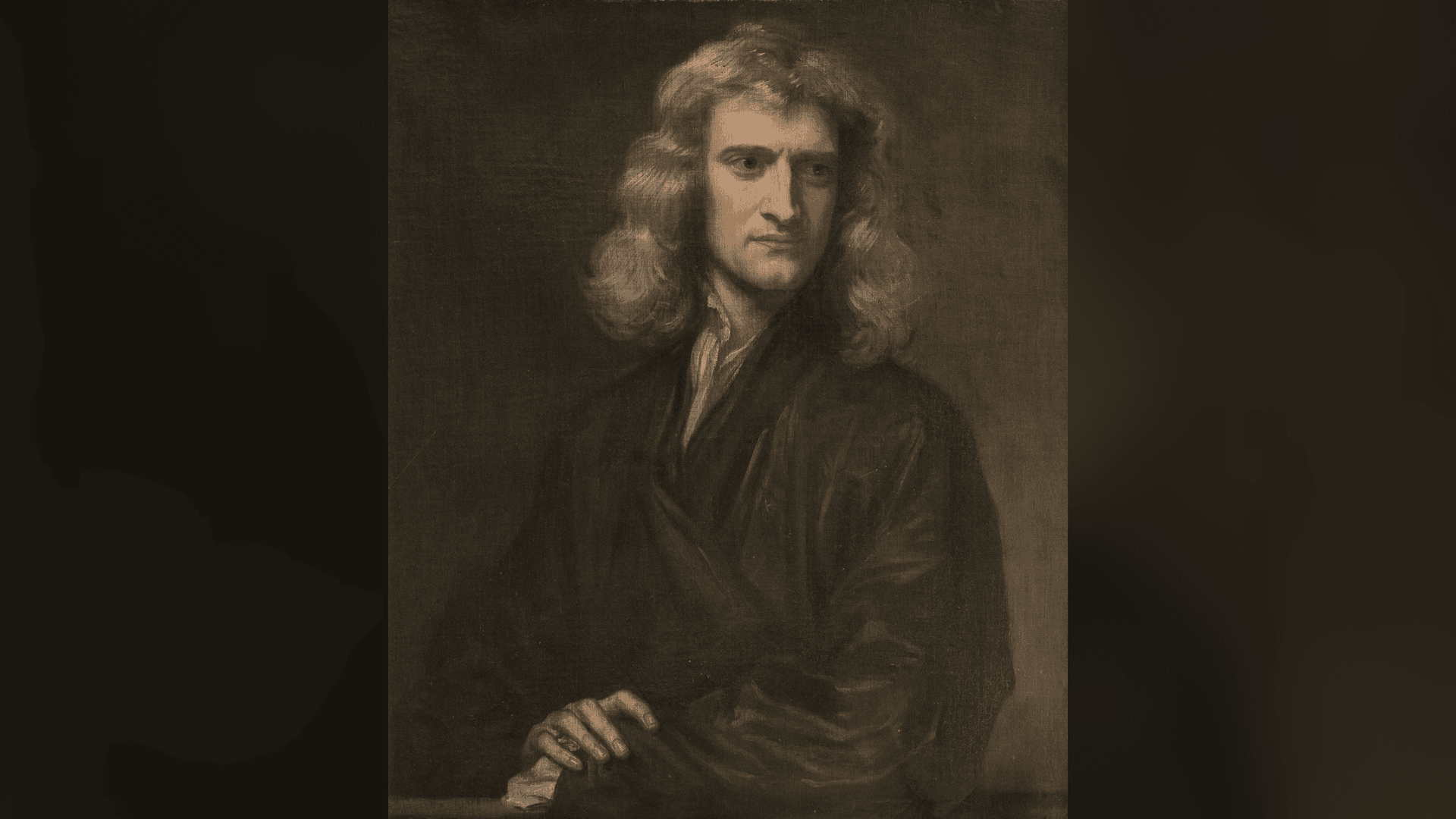
Hero image: Sir Isaac Newton by Godfrey Kneller, 1689. Public domain, via Wikimedia Commons.