What Is Judit Polgar's IQ? The Missing Score and the Documented Chess Record | Riot IQ
Nov 1, 2026·Famous People & IQ
What Is Judit Polgar's IQ? The Missing Score and the Documented Chess Record
Judit Polgar's IQ has never been published; the "170" figure online has no traceable source. Her record is documented: youngest GM in 1991, peak rating 2735.
Dr. Russell T. WarneChief Scientist
Share
Judit Polgar has never published an IQ score, and no interview, biography or chess federation record gives one, so the "Judit Polgar IQ 170" figure on celebrity lists has no traceable source. What is documented is her chess record: in 1991 she became the youngest grandmaster in history at 15 years and 4 months, breaking Bobby Fischer's record, and she reached a peak rating of 2735, the highest any woman has achieved. This article covers where the IQ number comes from, what the record shows, what her father's famous educational experiment can and cannot tell us about intelligence, and why a chess rating is not an IQ score.
Where the "170" figure comes from
Search for Judit Polgar's IQ and you will see 170 repeated across list articles about the smartest women or the strongest chess players. None of the pages I found names a test, a date, an examiner or a statement from Polgar herself. The number appears without a citation and is copied from one list to the next, which is the same pattern behind most celebrity IQ figures.
There is also no published childhood test score for her, unlike some prodigies whose scores were reported by researchers. Her official records are chess records. The FIDE rating profile, the International Chess Federation's database, lists her grandmaster title, her rating history and her world ranking, and nothing about intelligence testing. Any specific IQ attached to her name should be treated as invented until someone produces a source.
The documented chess record
The facts below come from FIDE and the World Chess Hall of Fame.
• Youngest grandmaster: Polgar earned the grandmaster title in 1991 at 15 years and 4 months, at the time the youngest anyone had done so, breaking a record Fischer had held for 33 years. (FIDE's rating profile lists the title under 1992.)
• Early rise: She entered the FIDE top 100 in January 1989 at age 12, ranked No. 55, the youngest player ever to do so.
• Peak strength: Her rating peaked at 2735 in 2005, and she reached No. 8 in the world. She is the only woman to have passed 2700 and the only woman ranked in the overall world top ten.
• Results against the best: FIDE's Commission for Women's Chess records that she defeated 11 current or former world champions in rapid or classical games, among them Garry Kasparov, Anatoly Karpov, Viswanathan Anand and Magnus Carlsen. In 2005 she competed in the world championship itself, and she remains the only woman to have reached that stage of the cycle.
• Longevity: She was the top-rated woman in the world from January 1989 until she announced her retirement from competitive chess on 13 August 2014. The World Chess Hall of Fame inducted her in 2021.
These numbers are precise, public and checkable. They describe chess performance against other players, which is a different thing from a score on a normed intelligence test.
The Polgár experiment: what one family can show
Judit's father, László Polgár, set out to show that exceptional ability can be produced by early, intensive education, and he used his own children to test the idea. He laid out the idea in his 1989 Hungarian book Nevelj zsenit! (Bring Up Genius!). He and his wife Klara, both teachers, educated Susan, Sofia and Judit at home, with chess as the specialist subject. A 1990 Education Week essay described the arrangement: the girls did not attend school but sat the required examinations, spent several hours a day on chess, and were coached by members of the Hungarian national team.
The results were remarkable. Susan and Judit both became grandmasters, and Sofia became an international master. Their story reached a new audience in 2026 with the Netflix documentary Queen of Chess.
It is tempting to read this as proof that genius is made. A single family cannot settle that question. The three sisters shared the same parents, so they shared about half their genes on average as well as the same home, the same coaches and the same thousands of hours of practice. Genes and environment rise and fall together in that design, and there is no comparison family whose daughters received the identical program without the Polgár parents' genes, or the reverse.
Large studies can pull those influences apart. In a sample of 11,000 twin pairs from four countries, Haworth and colleagues (2010) found that the heritability of general cognitive ability rose from 41% at age 9 to 66% at 17, while the share of differences explained by the "shared environment" (everything that makes children in the same family alike beyond their genes) fell from 33% in childhood to 16% in young adulthood. Plomin and Deary (2015) summarize the wider literature the same way: genetic influence on intelligence grows with age. Our article on whether IQ is genetic walks through that research.
None of that diminishes what the Polgár home achieved. It points to a narrower conclusion. Intensive early training can build extraordinary expertise in a specific domain, and the experiment shows that very clearly for chess. Whether it raised the sisters' general intelligence is a separate claim that the family's story cannot test.
What her achievements do and do not say about IQ
Grandmasters as a group score above average on cognitive tests, and reasoning ability helps players climb. Research reviewed in our article on whether chess makes you smarter shows the link is real but modest, strongest among young and developing players and weaker among elite ones. Practice matters a great deal: in a meta-analysis across domains, Macnamara, Hambrick and Oswald (2014) found that deliberate practice explained about 26% of the variance in performance in games such as chess. That leaves plenty of room for other factors, ability among them.
It is reasonable to infer that a player who beat world champions has strong abstract reasoning and an exceptional memory for chess patterns. It is not possible to convert that into a number. A rating such as 2735 ranks someone against other rated players; an IQ score places them against a representative sample of the general population. There is no formula connecting the two, a point our article on Magnus Carlsen's IQ covers in more detail.
Frequently asked questions
What is Judit Polgar's IQ?
No IQ score for Judit Polgar has ever been published. The 170 figure that circulates online has no named test, date or source.
How old was Judit Polgar when she became a grandmaster?
She earned the title in 1991 at 15 years and 4 months, the youngest at the time, breaking a record Bobby Fischer had held for 33 years.
What was Judit Polgar's highest rating?
Her peak FIDE rating was 2735, reached in 2005. No other woman has passed 2700, and she remains the only woman ranked in the overall world top ten.
Did László Polgár prove that geniuses are made, not born?
His daughters' success shows that intensive early training can produce world-class chess skill. Because the sisters shared both genes and environment, one family cannot separate the two, and twin studies find that the shared family environment explains a shrinking share of IQ differences with age.
Is Judit Polgar the strongest female chess player ever?
By rating and results, she is widely regarded as the strongest. The World Chess Hall of Fame calls her "universally recognized as the strongest female player of all time."
The takeaway
There is no Judit Polgar IQ score, and the popular 170 figure is unsourced. Her documented achievements are the better guide: the youngest grandmaster title at 15, a peak rating of 2735, and wins over 11 world champions. Her family's experiment shows how far focused training can take a gifted child in one domain, while leaving open how much it changed general intelligence. If you want a measured number for yourself, try a professionally developed IQ test that reports your score against a representative norm group.
3. World Chess Hall of Fame. (2021). Judit Polgar: Inducted 2021. [worldchesshof.org](. worldchesshof.org
4. Polgár, L. (1989). Nevelj zsenit! [Bring up genius!]. Interart. [openlibrary.org](. openlibrary.org
5. Tabachnick, S. (1990, June 13). The Polgar sisters and American education. Education Week. [edweek.org](. edweek.org
6. Webster, D. (2026, June 26). Dan Webster reviews "Queen of Chess." Spokane Public Radio. [spokanepublicradio.org](. spokanepublicradio.org
7. Haworth, C. M. A., Wright, M. J., Luciano, M., Martin, N. G., de Geus, E. J. C., van Beijsterveldt, C. E. M., Bartels, M., Posthuma, D., et al. (2010). The heritability of general cognitive ability increases linearly from childhood to young adulthood. Molecular Psychiatry, 15(11), 1112-1120. [doi.org/10.1038/mp.2009.55](. doi.org
8. Plomin, R., & Deary, I. J. (2015). Genetics and intelligence differences: Five special findings. Molecular Psychiatry, 20(1), 98-108. [doi.org/10.1038/mp.2014.105](. doi.org
9. Macnamara, B. N., Hambrick, D. Z., & Oswald, F. L. (2014). Deliberate practice and performance in music, games, sports, education, and professions: A meta-analysis. Psychological Science, 25(8), 1608-1618. [doi.org/10.1177/0956797614535810](. doi.org
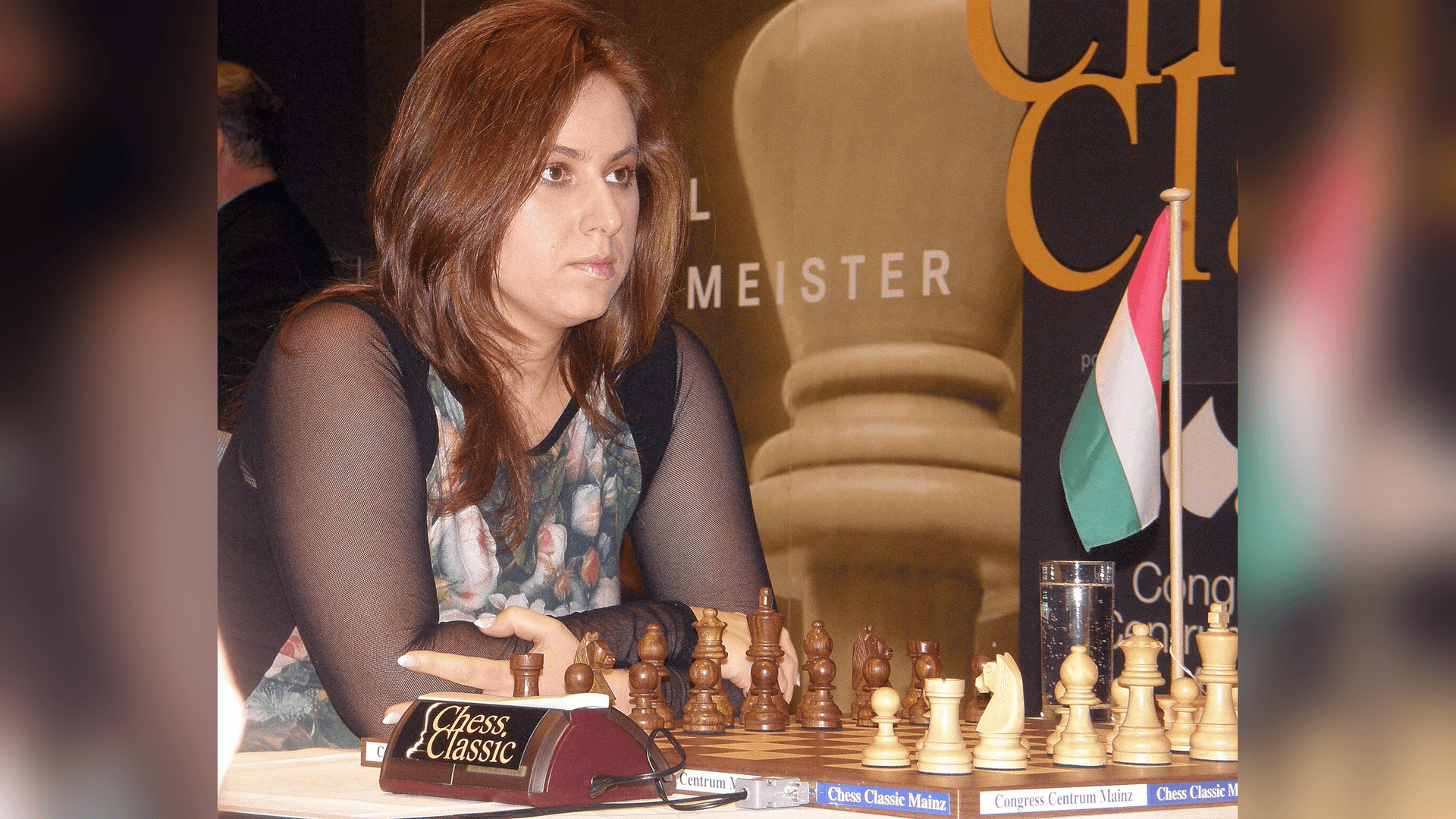
Hero image: Judit Polgar at the Chess Classic Mainz (2008), photo by Ygrek, CC BY 3.0. Via Wikimedia Commons.
Take our professional IQ test
Want to know your IQ? Try the first ever professional online IQ test.