Jul 16, 2026·Famous People & IQWhat Was Stephen Hawking's IQ?
Was Stephen Hawking's IQ really 160? Discover the truth behind the famous estimate and the science of his genius. Read the guide and try the RIOT test!
Dr. Russell T. WarneChief Scientist
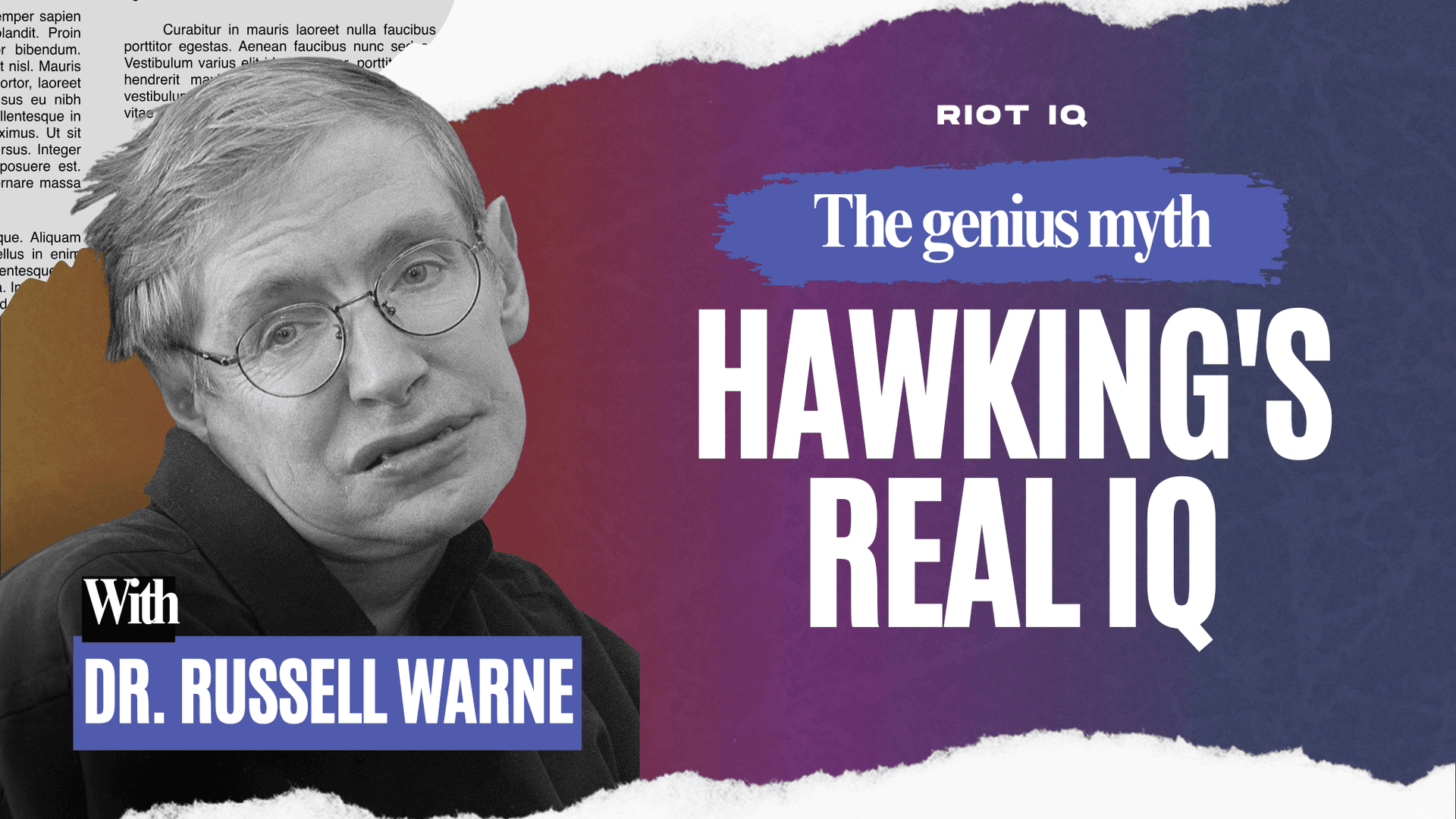
Few names in modern science carry the cultural weight that Stephen Hawking's does. His image — seated in a motorized wheelchair, communicating through a synthesized voice — became one of the most recognizable in the world, synonymous with the idea that a mind can operate at the outermost limits of human possibility while the body that carries it is almost entirely constrained. Taking an IQ test and comparing the result to someone like Hawking is a natural human impulse. The trouble is that the number most commonly associated with him — 160 — has no verified basis, and the true intellectual story of his life is both more nuanced and more interesting than any celebrity IQ figure conveys.
What We Don't Know: The 160 Figure Has No Source
Let me establish the foundational fact immediately. Stephen Hawking's IQ score was never publicly verified. He never disclosed a score, and no standardized clinical battery administered under controlled conditions was ever linked to him in the public record. The figure of 160 that circulates widely online is an estimate derived from historiometric analysis of his documented accomplishments — the same methodology used to estimate IQ for historical figures who never took formal tests — not from actual psychometric testing. Hawking himself addressed this directly. He reportedly said "I have no idea" when asked about his IQ, and described people who boast about their IQ as losers. The quote is characteristic of the man: dismissive of the question's framing, pointing instead toward the work itself. As a practicing psychometrician, I find that response more scientifically grounded than most IQ discussions — the number matters less than what the underlying capacity produces.
What the Academic Record Actually Documents
While no IQ score exists, the biographical record provides specific, verifiable evidence about Hawking's cognitive profile that is considerably more informative than a fabricated number. At University College Oxford, Hawking studied physics and by his own account estimated that he studied about 1,000 hours during his entire three years — roughly one hour per day. He found the first year and a half "ridiculously easy" and felt genuinely bored by the pace. His finals were nearly his undoing: because he had barely studied factual material, he decided to answer only theoretical physics questions rather than those requiring factual knowledge, a deliberate gamble on the superiority of his reasoning ability over his knowledge base. His results were borderline between first- and second-class honours. When asked at his viva to describe his plans, he told his examiners: "If you award me a First, I will go to Cambridge. If I receive a Second, I shall stay in Oxford, so I expect you will give me a First." They gave him the First.
 The Oxford episode is psychometrically interesting for what it reveals about his cognitive profile. The ability to achieve a First Class degree in physics while doing a fraction of the studying his peers did — and to do so specifically through theoretical reasoning rather than memorization — reflects a fluid intelligence profile that operates well above the work the curriculum was designed to challenge. This is precisely the pattern that historiometric analysis uses to infer exceptional cognitive ability: performance that substantially exceeds what the effort and inputs would predict in someone of average ability.
At Cambridge, Hawking obtained his PhD in applied mathematics and theoretical physics in March 1966, specializing in general relativity and cosmology. His thesis essay "Singularities and the Geometry of Space-Time" shared top honours with one by Roger Penrose to win that year's prestigious Adams Prize — a remarkable result for a first-year doctoral student. In 1979, he was elected Lucasian Professor of Mathematics at the University of Cambridge — a position previously held by Isaac Newton — and retained it for 30 years. He supervised 39 successful PhD students across his career.
What Hawking Radiation Implies About His Reasoning
The intellectual achievement that most directly speaks to Hawking's cognitive level is also his most famous: the theoretical prediction that black holes emit radiation — now called Hawking radiation — first announced in 1974.
To understand what this discovery required cognitively, it helps to know what problem it solved. At the time, black holes were understood through general relativity — Einstein's theory of gravity — as regions from which nothing, not even light, could escape. Quantum mechanics, the other major pillar of modern physics, operated on entirely different principles and had never been successfully reconciled with general relativity. Hawking was the first to set out a theory of cosmology explained by a union of the general theory of relativity and quantum mechanics — a synthesis that the rest of theoretical physics had not managed. The cognitive operation required to discover Hawking radiation was not retrieval of stored knowledge. It was the simultaneous application of two mathematically incompatible theoretical frameworks to a single physical system — black holes — and the identification of a novel consequence that neither framework predicted independently. This is fluid reasoning of an order that no IQ test item can adequately represent, because no IQ test item requires you to synthesize general relativity and quantum field theory to reach a novel conclusion. The scale of cognitive operation is categorically different from what standardized batteries assess.
This is one reason why the 160 figure — wherever it came from — is both plausible and insufficient as a description of Hawking's intellect. An IQ of 160 sits at the 99.997th percentile of the population. But the cognitive achievement that produced Hawking radiation required something that the psychometric framework underlying that number wasn't designed to measure: deep expert synthesis across two maximally complex theoretical systems, producing a genuinely novel and initially counterintuitive physical prediction that took years for the wider community to accept. The number doesn't capture the nature of the operation.
ALS and the Cognitive Adaptation Question
One aspect of Hawking's intellectual life that is scientifically unusual and worth addressing directly is the question of how his cognitive functioning was affected by ALS — and whether it was.
Motor neurone disease of the type Hawking had primarily affects the motor neurons controlling voluntary muscle movement. It does not directly attack the neurons responsible for higher cognitive functions. Despite being diagnosed with a rare early-onset slow-progressing form of motor neurone disease that gradually paralysed him, Hawking pursued his research vigorously for over half a century. This is not a trivial observation. Losing the ability to write, to use a keyboard, and eventually to produce any voluntary movement except eye movements forced Hawking into a mode of mathematical cognition that most physicists never have to develop: working out complex equations in his head, holding extended chains of mathematical reasoning in working memory without the external scaffolding of notation, and communicating conclusions rather than derivations. Limitation can sharpen certain forms of focus by forcing attention inward — and in Hawking's case, the evidence of his continued productivity after losing nearly all motor function suggests that whatever cognitive resources ALS could not touch, it didn't. His former graduate student and collaborator Don Page noted that Hawking's ability to perform complex calculations mentally improved over time as his physical writing ability declined — a remarkable adaptation, and one consistent with the neuroplasticity research on how sustained cognitive demands reshape the neural resources available for a task. Hawking appears to have developed an unusually powerful capacity for mental mathematical representation as a compensatory adaptation to his condition.
What a Reasonable Estimate Looks Like
Using the same proxy-based framework I've applied across other celebrity IQ articles in this series — inferring from documented behavioral and academic indicators rather than fabricating precision — what does the available evidence actually support?
The Oxford episode: borderline First Class degree in physics while studying roughly one hour per day, achieved through theoretical reasoning rather than knowledge retention. This profile is consistent with exceptional fluid intelligence — likely well above 130.
The Cambridge PhD: a thesis that shared the Adams Prize with one by Roger Penrose, one of the most celebrated mathematical physicists of the 20th century, submitted in 1966 by a doctoral student in his mid-20s. This is an extraordinarily high standard of achievement.
The Lucasian Professorship: Newton's chair, held for 30 years. Selection for this position reflects the judgment of the most rigorous peer community in theoretical physics.
Hawking radiation: a theoretical prediction that synthesized two incompatible frameworks to reach a novel physical conclusion that has not been directly falsified despite decades of subsequent scrutiny and is now widely considered one of the most important results in 20th-century theoretical physics.
The historiometric evidence consistently points to cognitive ability operating well above the 99th percentile. Whether that maps to a specific IQ number of 160, or 155, or 165, the available methodology cannot determine — and the precision implied by any specific figure is false. The 160 estimate is plausible but unverified, and scores above 145 occur in roughly 1 in 1,000,000 people — a range where the psychometric instruments used in population studies have limited norming data and correspondingly wide margins of error.
The Takeaway
Stephen Hawking's IQ is unknown. The figure of 160 that circulates online is an estimate derived from the complexity of his documented work and accomplishments — an inference, not a measurement. His own response to questions about his IQ score — dismissal, combined with the suggestion that people who boast about IQ are losers — reflects both intellectual self-confidence and genuine scientific insight about what the number does and doesn't tell you.
What the documented record supports is a cognitive profile that operated at an exceptional level across the specific abilities most relevant to theoretical physics: fluid reasoning of the highest order, working memory sufficient to hold and manipulate complex mathematical structures without external notation, and the conceptual synthesis capacity to combine incompatible theoretical frameworks into novel physical predictions. These are real, measurable cognitive dimensions. The specific number attached to them is not.
If you want to understand where your own cognitive profile sits — across the fluid reasoning, working memory, and processing speed domains that make Hawking's intellectual biography so compelling to examine — the RIOT gives you a domain-level measurement that reveals the shape of your profile, not just a single number.
References
ACIS IQ. (2026). Stephen Hawking IQ: Was It 160? No Verified Score. https://acisiq.com/stephen-hawking-iq Core Brain. (2026). Stephen Hawking IQ — Estimated Score & Cognitive Profile. https://corebrain.app/famous-iq/stephen-hawking/ Wikipedia. Stephen Hawking — Biography, Career, and Scientific Contributions. https://en.wikipedia.org/wiki/Stephen_Hawking University of Cambridge. Professor Stephen Hawking — Official University Profile. https://www.cam.ac.uk/stephenhawking New World Encyclopedia. Stephen Hawking — Academic career and doctoral work. https://www.newworldencyclopedia.org/entry/Stephen_Hawking IQMean Institute. (2026). Stephen Hawking — IQ Profile and Cognitive Legacy. https://iqmean.com/iq-profile/stephen-hawking/ BrainManager.io. (2025). Stephen Hawking's IQ: How Intelligent Was the Genius Physicist Really? https://brainmanager.io/blog/cognitive/stephen-hawking-iq World Brain Mapping Society. Stephen Hawking — Scientific legacy and cognitive contribution. https://www.worldbrainmapping.org/stephen-hawking/
Take our professional IQ test
Want to know your IQ? Try the first ever professional online IQ test.
AuthorDr. Russell T. WarneChief Scientist
