Jul 1, 2026·Famous People & IQWhat Is Cristiano Ronaldo's IQ? What the Science Actually Says
Wondering what Cristiano Ronaldo's real IQ score is? We debunk the fake numbers and explore his elite cognitive profile. Read more and try the RIOT test!
Dr. Russell T. WarneChief Scientist
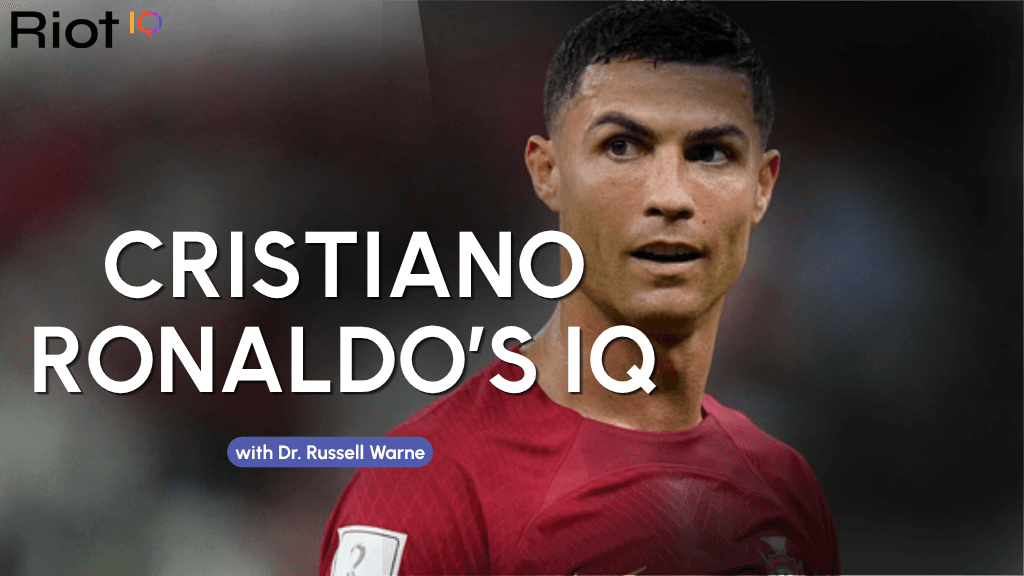
On June 23, 2026, at Houston Stadium, Cristiano Ronaldo made history again. At 41 years old, the Portugal captain scored twice against Uzbekistan in a 5-0 dismantling to become the first player in the history of football to score in six different World Cup tournaments. He surpassed Eusébio as Portugal's all-time leading World Cup scorer with 10 goals. He is now the second-oldest player to score at a World Cup and the oldest to record a multi-goal game in the competition's history. In a tournament full of extraordinary performances, Ronaldo's remains among the most implausible. Critics had questioned whether he still belonged on the pitch after a goalless opener against DR Congo. His response, characteristically, was statistical and irreversible.
"After 23 or 24 years in football, I know how to deal with criticism," he told reporters. "I always arrive. Sooner or later, I'm there."
The question his career has always provoked, “How does someone sustain this level of performance for this long?” has a cognitive dimension that the research literature has started to answer rigorously. So does the parallel question that inevitably follows: what does science actually say about Ronaldo's intelligence? Are there any recorded IQ tests in which his IQ score is revealed? Let me be precise about what the evidence supports and what it doesn't.
The Numbers Online Are Not Real
Cristiano Ronaldo's actual IQ score has never been publicly disclosed or verified through any standardized clinical assessment. No credible source has ever confirmed a specific number. Despite numerous online claims suggesting Ronaldo has an IQ of 160 or higher, placing him in the genius category alongside theoretical physicists, these figures are either fabricated, generated by unvalidated online tools, or extrapolated from behavioral observation with no psychometric basis. While his demonstrated abilities both on and off the field suggest remarkable cognitive capabilities, without verified testing results, such claims remain speculative and should be viewed skeptically.
Other sites assign him scores of 141, 144, or 130. These don't agree with each other, were not produced by validated instruments administered under controlled conditions, and carry no scientific weight. I raise this not to dismiss the question but because I think the public deserves honesty about where the science actually starts and where internet mythology ends. Treating celebrity IQ figures as real data — for Ronaldo, Messi, or anyone else — misrepresents what IQ tests measure and how psychometric evidence works.
What the evidence can support is something considerably more interesting: an examination of the specific cognitive capacities that Ronaldo's documented performance implies, grounded in peer-reviewed research rather than guesswork.
The Dark Room Experiment
One of the most compelling demonstrations of Ronaldo's cognitive processing came not from a football match but from a controlled experiment conducted for the Castrol "Tested to the Limit" documentary. Sports scientists at a Madrid facility asked Ronaldo to head a crossed ball into goal, with the lights turned off mid-flight, before the ball reached him.
The experiment revealed something that no match statistic could capture cleanly. When the cross is made, Ronaldo's eyes register the ball's trajectory and speed in mere moments. This visual data gets stored in his brain's spatial-visual working memory, which processes and estimates the ball's landing point. This information travels through neural pathways to the cerebellum, or the brain's coordination hub, before the motor cortex directs the muscles. In a separate eye-tracking phase of the same experiment, scientists found that Ronaldo looked primarily at his opponent's hips and surrounding space, allowing him to determine possible movement and escape routes — while a less skilled comparison player spent most of his visual attention on the ball and feet, which Ronaldo was moving so rapidly that tracking them was largely uninformative.
Researchers have since debated the exact mechanism behind the dark-room performance. One interpretation emphasizes predictive control — the hypothesis that Ronaldo's brain stores detailed spatial-temporal models from past experience that allow it to complete a 3D trajectory when direct visual input is removed. An alternative interpretation from motor learning researchers emphasizes prospective, online control: rather than using stored predictions, Ronaldo uses body-language cues from the kicker in the moment before lights out to initiate movement, then executes based on biomechanical laws rather than memory retrieval. Even in the dispute over mechanism, both frameworks agree on the core finding: Ronaldo's visual-spatial processing and anticipatory motor system operate at a level measurably beyond what novice and even skilled amateur players can replicate.
The Cognitive Architecture Behind Sustained Elite Performance
What makes Ronaldo's 2026 World Cup performances at 41, across his sixth tournament, particularly interesting from a cognitive science standpoint isn't the goals themselves. It's what the sustained excellence implies about how his cognitive architecture has adapted over two decades of elite-level play.
The research on expertise and cognitive aging is relevant here. Elite athletes in open-skill sports involving dynamic, unpredictable environments don't maintain performance by preserving the raw processing speed of their 20-year-old selves. They maintain it by shifting the cognitive basis of their performance toward systems that age more slowly. The science here is specific: even players like Ronaldo have trained their brains through thousands of hours of practice, sharpening their mental skills to the point where they can literally score goals with their eyes shut. Football is a game of anticipation and high-speed decision making, and the best players stand out because they can read the game faster and make better decisions under pressure, which are capacities built through deliberate practice rather than innate ability alone.
Ronaldo's own publicly described approach to cognitive maintenance is unusually systematic for a professional athlete. He employs neurofeedback to enhance mental agility, decision-making, and concentration. He uses visualization and imagery as core components of his mental preparation, vividly constructing successful outcomes before they occur. These aren't superstitions or marketing content. They are documented cognitive training methods with empirical support in the sport psychology literature.
What the Elite Player Research Predicts About His Profile
The most comprehensive peer-reviewed data on elite footballer cognitive profiles comes from a landmark 2025 study published in PNAS, which used artificial neural networks on 204 elite players from Brazil and Sweden. Elite soccer players were found to demonstrate heightened planning and memory capacities, enhanced executive functions, especially cognitive flexibility, and were distinguishable from the general population with 97% accuracy based solely on cognitive and personality features. Ronaldo does not merely belong to that elite cohort; he sits at its historically unprecedented extreme. Both Ronaldo and Messi were the subjects of a peer-reviewed analysis in Chronobiology International titled "Mastery in Goal Scoring, T-Pattern Detection, and Polar Coordinate Analysis of Motor Skills Used by Lionel Messi and Cristiano Ronaldo," which concluded that both players better anticipate the actions of their opponents, resulting in higher success rates in attacking with the dynamic nature of superior skill distinguishing the elite athlete because the player needs to perform the right action at the right time.
The cognitive dimensions underpinning this — working memory, inhibitory control, processing speed, and spatial anticipation — are partially but not fully captured by standard IQ batteries. Executive functions correlate with each other but correlate less with general IQ, which is why the predictive relationship between football performance and cognitive ability is better expressed through executive function measures than through a Full Scale IQ score. What Ronaldo demonstrates is domain-specific cognitive mastery operating at a level that a traditional IQ test was never designed to assess.
The Adaptability Question: A Cognitive Signal in Its Own Right
There is one aspect of Ronaldo's career that I think carries particularly strong cognitive implications and is often underframed as purely physical: his adaptability across playing styles, leagues, and roles over two decades.
Ronaldo has evolved from a speedy right winger at Manchester United, relying heavily on raw pace and dribbling, to a clinical central striker at Real Madrid and Juventus relying on timing, positioning, and finishing precision, to his current role at the 2026 World Cup, where he functions more as a focal point and positional striker than as a high-press participant. Each transition required not just physical recalibration but cognitive reconfiguration: learning new movement patterns, updating his spatial heuristics, internalizing new tactical systems, and maintaining goal-scoring effectiveness with diminishing physical resources.
His linguistic profile reflects a similar adaptive capacity. Ronaldo is fluent in Portuguese, Spanish, English, and Italian, with reported comprehension of Arabic developing during his time at Al Nassr. This multilingual capacity — particularly maintained and expanded at elite level across different phases of his career — indicates strong cognitive flexibility and learning capability. The relationship between multilingualism and executive function is well-documented in the cognitive science literature, with bilingual and multilingual individuals consistently showing advantages on certain executive control tasks, particularly cognitive flexibility and attention switching.
What We Can and Cannot Conclude
Here is where I want to be precise, because the gap between what Ronaldo demonstrably does cognitively and what a traditional IQ score would capture is meaningful and should not be glossed over.
Standard IQ batteries assess performance across verbal comprehension, fluid reasoning, working memory, processing speed, and visual-spatial reasoning under controlled, rule-governed conditions. What Ronaldo demonstrates on a football pitch is a specific and extraordinary form of real-world cognitive performance: visual-spatial computation under extreme time pressure, anticipatory motor planning with minimal sensory input, executive function deployed in a dynamic and unpredictable environment, and the capacity to adapt a complex skill set across changing physical constraints over 25 years.
Some of those capacities map directly onto what a professional IQ battery measures. Others, such as the anticipatory motor planning, the contextual adaptability, the emotional regulation under public scrutiny across decades, do not. This means that knowing Ronaldo's cognitive football profile tells us something real and meaningful about his cognitive strengths, but it doesn't allow us to derive a specific IQ number with any confidence.
What we can say, grounded in the research: Ronaldo's performance profile is consistent with well-above-average executive function capacities, exceptional domain-specific visual-spatial processing, and a cognitive flexibility that has sustained elite performance under conditions such as age, competitive pressure, physical transition that end most careers a decade earlier.
The Takeaway
Cristiano Ronaldo's IQ score is unknown. The figures that circulate online have no verified psychometric basis and should be treated as the speculative mythology they are. What is documented, through controlled experiments, peer-reviewed research, and the unambiguous evidence of a 25-year elite career now extending into his seventh World Cup squad, is a cognitive profile that operates at the outer edge of what football science has studied.
At 41, becoming the first player in World Cup history to score in six tournaments is not a physical achievement alone. It reflects the kind of cognitive adaptability that the intelligence research literature is increasingly able to describe, even when it cannot reduce it to a single number.
If you want to understand where your own cognitive profile sits across the executive function, processing speed, and visual-spatial domains that overlap with what sustained elite performance requires, the RIOT gives you a systematic, evidence-based answer that a celebrity IQ list never will.
References
Sports Brain Blog. (2023). Cristiano Ronaldo's Brain: The Power of the Executive System. https://www.sportsbrain.blog/ronaldos-executive-system/ PubMed Central / PNAS. (2025). Decoding the elite soccer player's psychological profile. https://pmc.ncbi.nlm.nih.gov/articles/PMC11760505/ The Set Pieces / Neuroscience. (2016). The Athletic Brain — How Neuroscience Is Revolutionising Sport. https://thesetpieces.com/latest-posts/athletic-brain-neuroscience-revolutionising-sport/
Take our professional IQ test
Want to know your IQ? Try the first ever professional online IQ test.
AuthorDr. Russell T. WarneChief Scientist
