Who Is Chris Langan? The Story Behind 'The Smartest Man in America'
Chris Langan, a former bouncer with a reported IQ near 200, became famous as the smartest man in America. Here is what is documented, and what is not.
Dr. Russell T. WarneChief Scientist
Share
Chris Langan is an American autodidact whom a 1999 Esquire profile made famous as "the smartest man in America," reporting an IQ "measured at 195, give or take a few points." What is actually documented is thinner than the legend: a magazine figure, a televised test he maxed out without a published score, and an unsupervised mail-in exam. His story is a case study in how far a single number can travel, and how little it can carry.
The profile that made him famous
Langan was born in San Francisco in 1952 and grew up partly in Bozeman, Montana, in difficult circumstances. He briefly attended Reed College and Montana State University, dropped out, and spent roughly twenty years working as a bouncer on Long Island while reading physics and philosophy on his own. Mike Sager's November 1999 Esquire profile, "The Smartest Man in America," introduced him to the country along with the 195 figure and the claim that such IQs occur in roughly one person in a hundred million.
A month later, ABC's 20/20 arranged for a neuropsychologist to test him on camera. The broadcast reported that in 25 years of testing he had never seen such results: Langan's score was, in the program's words, literally off the charts and could not be measured by the test. Note what that sentence does and does not say. Hitting a test's ceiling means "above this instrument's range." It does not produce a number, and no standardized, supervised score for Langan has ever been published.
What a score near 200 would actually mean
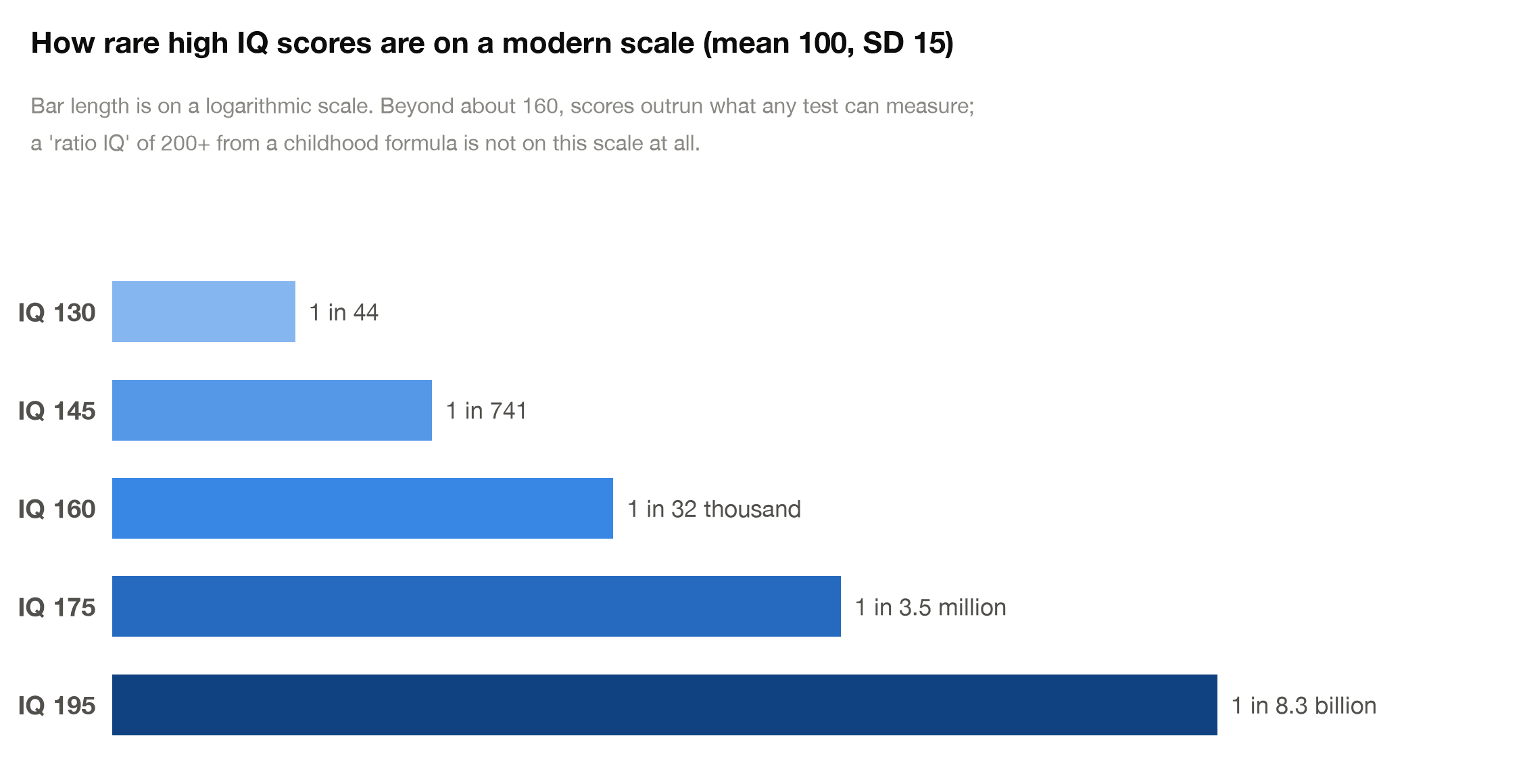
Modern IQ tests report "deviation scores" on a bell curve with mean 100 and standard deviation 15, and the major clinical instruments stop reporting around 160. Past that point there are not enough people in any norming sample to say what a score means. The arithmetic below is why psychologists treat claims near 200 as decoration rather than data.
A deviation IQ of 195 would imply a rarity of roughly one in eight billion, about one person on Earth. No test has ever been normed on a sample remotely large enough to support such a claim, which is why the often-quoted "one in a hundred million" line attached to Langan is journalism, not psychometrics. The scores that do exist for him beyond the TV ceiling come from the Mega Test, an untimed, unsupervised mail-in instrument whose scoring professional psychologists have criticized; secondary accounts add that he took it twice, the second time under a pseudonym. Unsupervised high-range tests, retakes, and self-selection all push extreme scores upward, and "regression to the mean" predicts an extreme first score falls on a proper retest. Our article on the highest possible IQ walks through the ceiling problem in detail.
The unusual life path
Langan's biography is genuinely uncommon. He developed a self-published metaphysical framework he calls the "Cognitive-Theoretic Model of the Universe," or CTMU, which has circulated outside mainstream physics and philosophy venues. In 2008 he won $250,000 on the NBC game show 1 vs. 100 and used the money to buy a horse farm in Missouri, where he lives with his wife, clinical neuropsychologist Gina LoSasso. Malcolm Gladwell's Outliers made him its central case study in why towering measured ability, without opportunity and support, does not convert into conventional achievement. In later years his online commentary has drawn documented criticism for conspiracist and prejudiced statements, a matter of public record separate from any question about his tested ability.
What one number cannot capture
• A ceiling is not a score: The one supervised test on record ran out of headroom and produced no number. Everything past that is estimate and anecdote.
• Norms are the whole game: A score means "where you stand among people like you." With no norm group at the extreme, there is nothing for a 195 to mean.
• Outcomes need more than ability: Gladwell's point stands regardless of the exact number: environment, timing, and support decide what ability becomes.
No verified standardized score exists. Esquire reported "measured at 195, give or take"; a televised 1999 test ended at the instrument's ceiling with no published number; his other scores come from the unsupervised Mega Test.
Is Chris Langan the smartest man in America?
The label is a magazine headline, not a measurement. No instrument exists that could reliably identify a single smartest person; tests lose precision well before scores reach the levels attributed to him.
What is the CTMU?
The "Cognitive-Theoretic Model of the Universe" is Langan's self-developed metaphysical theory of reality. It has an online following but has not entered mainstream peer-reviewed physics or philosophy.
Did Chris Langan go to college?
Briefly. He attended Reed College and later Montana State University, left both, and is otherwise self-taught, a path Malcolm Gladwell's Outliers examines at length.
Are high-range IQ tests like the Mega Test valid?
Mainstream psychometricians say no: they are unsupervised, self-selected, and lack the norming and reliability evidence that clinical tests require, which is why their scores are not comparable to standard IQs.
The takeaway
Langan is plainly a person of unusual ability, and exactly how unusual is unknowable, because no instrument with real norms has ever pinned it down. That is the honest limit of IQ measurement at the extreme. Within the range where tests are actually precise, a modern, properly normed assessment such as the Reasoning and Intelligence Online Test from RIOT IQ reports scores with stated confidence intervals, which is what separates measurement from mythology.
References
1. Sager, M. (1999, November 1). The smartest man in America. Esquire. classic.esquire.com
2. ABC News 20/20. (1999, December 9). An official genius: Bouncer's IQ rating is off the charts.abcnews.go.com
3. Ward, J. (2019, March 18). More smarter. The Baffler. thebaffler.com
4. Gladwell, M. (2008). Outliers: The story of success. Little, Brown. gladwellbooks.com
5. Feldman, D. H. (1984). A follow-up of subjects scoring above 180 IQ in Terman's "Genetic Studies of Genius." Exceptional Children, 50(6), 518-523. doi.org
Hero image: Chris Langan at his Missouri ranch, 2014. Photo: TeaFoam, CC BY 2.0, via Wikimedia Commons.
Take our professional IQ test
Want to know your IQ? Try the first ever professional online IQ test.