What is Bill Clinton's IQ? No verified score exists. The 182 figure is a hoax. See his Rhodes Scholarship, Yale Law record, and expert IQ estimates.
Dr. Russell T. WarneChief Scientist
Share
Bill Clinton's IQ is unknown in the only sense that matters: no verified score from a professionally administered test has ever been made public. The "182" that circulates online comes from a documented 2001 e-mail hoax, and the "159" sometimes quoted is the top end of four statistical estimates published in a 2006 academic study rather than a test result. His documented record (a Georgetown degree, a Rhodes Scholarship, and Yale Law) supports "well above average" without supporting any precise number. This article separates the hoax, the estimates, and the record.
The 182 hoax: the Lovenstein Institute
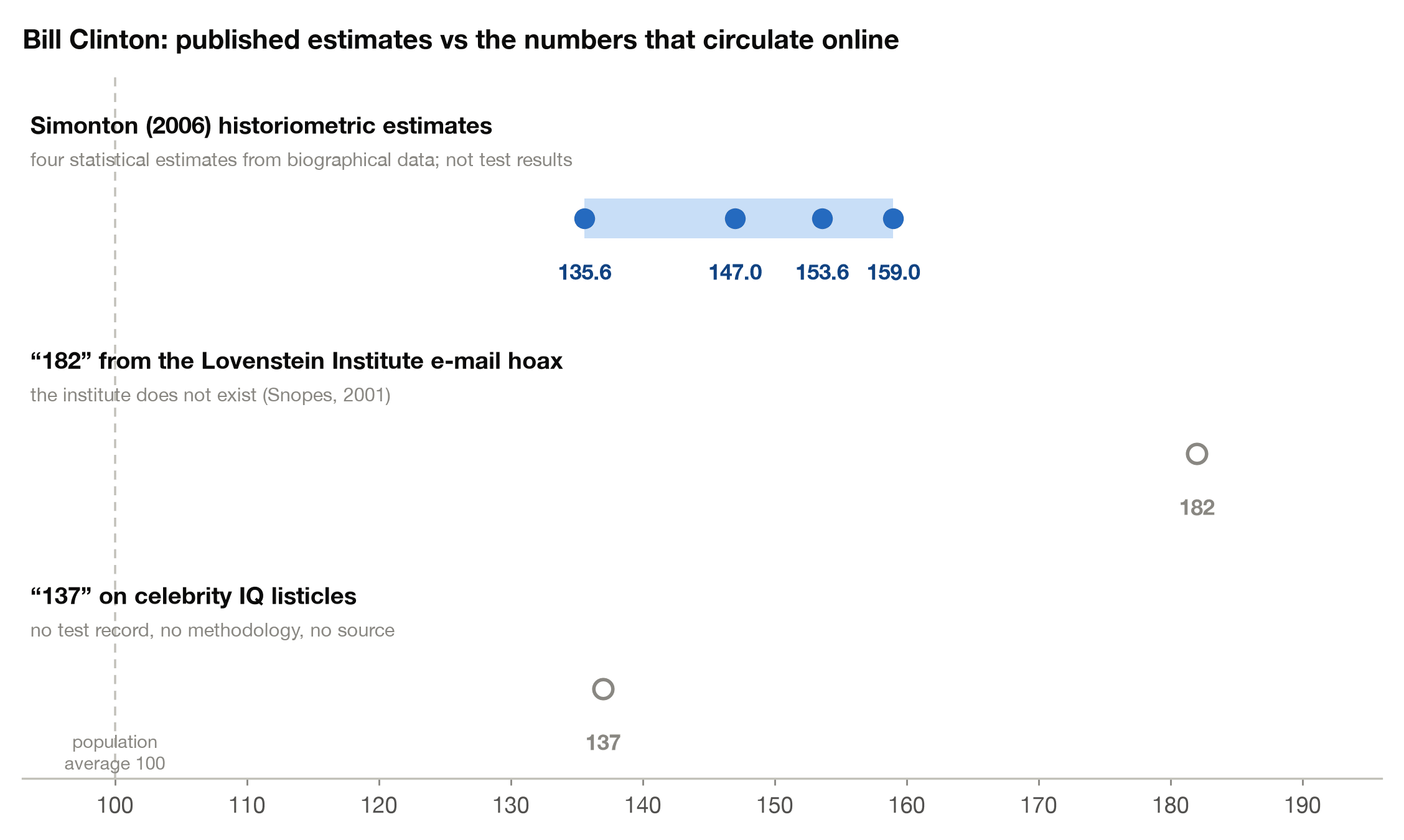
In July 2001, a chain e-mail began circulating that attributed a presidential IQ study to the "Lovenstein Institute" of Scranton, Pennsylvania. It assigned Clinton an IQ of 182, the highest on its list, and George W. Bush a 91, the lowest. Snopes investigated and found that no Lovenstein Institute exists in Scranton or anywhere else in the United States, and that none of the researchers quoted in the story exist either; the list was a spoof taken too seriously. Snopes also flagged the arithmetic giveaway: Clinton's 182 was listed as exactly twice Bush's 91.
The hoax spread because it told a tidy story with precise-looking numbers. Precise-looking is different from measured, and neither figure has any connection to a test either man took.
What scholars actually estimate
The only peer-reviewed estimates of Clinton's IQ come from psychologist Dean Keith Simonton's 2006 study in Political Psychology, which estimated IQs for all 42 presidents from Washington through George W. Bush. The method is "historiometric": it applies missing-values statistics to earlier published assessments, including Catharine Cox's 1926 ratings of historical figures, an Intellectual Brilliance measure, and personality ratings of Openness to Experience. For Clinton the study produced four estimates, depending on the age window and a reliability correction: 135.6, 147.0, 153.6, and 159.0.
That is where the internet's "159" comes from: it is the highest of the four, quoted alone. The paper itself treats the numbers as estimates that carry error, and the underlying Cox-style scores were built on an older scale with a standard deviation of 16. What the study supports is a range in the gifted region, produced by statistics rather than by Clinton sitting for a test. Simonton pointed to the biographical signals behind the high estimates: Clinton's Rhodes Scholarship, his Yale Law degree, his demonstrated capacity for mastering complex and detailed information, and his verbal fluency.
The documented academic record
Clinton graduated from Georgetown University in 1968 and won a Rhodes Scholarship to Oxford that same year. He attended Oxford from 1968 to 1970 and earned his law degree from Yale in 1973. The Rhodes is a nationally competitive academic and leadership award, and Yale Law is among the most selective law schools in the country, so the record supports an inference of well above average cognitive ability.
It cannot support more than that. Selective awards and degrees screen on many things at once (grades, essays, leadership, interviews), so they bound a person's likely ability loosely. Standardized test scores are the strong proxy, because tests like the SAT correlate heavily with general cognitive ability, and Clinton's SAT and LSAT results have never been made public. There is also no primary evidence that Clinton ever publicly stated a personal IQ score.
Why precise celebrity IQs are almost always fake
• No test, no number: A real IQ comes from a normed instrument administered under standard conditions. For Clinton, no such administration is on the public record.
• Listicle numbers have no provenance: The "137" that appears on celebrity IQ sites cites no test, no date, and no source of any kind.
• Estimates are routinely misquoted: Quoting Simonton's 159 alone drops the other three estimates and the study's own caveats, turning a bounded academic range into a fake precision.
No. The 182 comes from the 2001 "Lovenstein Institute" e-mail hoax, which invented IQ scores for twelve presidents. Snopes documented that neither the institute nor the researchers quoted exist.
Has Bill Clinton ever taken an IQ test?
No professionally administered IQ test result for Clinton has ever been made public, and there is no evidence he ever announced a score. The specific numbers online are hoaxes, unsourced listicles, or academic estimates.
What do experts estimate Bill Clinton's IQ to be?
The only peer-reviewed estimates come from Simonton's 2006 historiometric study, which produced four figures for Clinton ranging from about 136 to 159. They are statistical reconstructions from biographical data rather than test scores.
Was Bill Clinton a Rhodes Scholar?
Yes. He graduated from Georgetown University in 1968, won a Rhodes Scholarship to Oxford the same year, attended Oxford from 1968 to 1970, and earned his law degree from Yale in 1973.
Was Bill Clinton smarter than George W. Bush?
On Simonton's estimates, Clinton scores about 20 points higher than George W. Bush, but both fall well above the population average of 100, and the estimate ranges carry real uncertainty, so precise gap claims should be treated cautiously.
The takeaway
Bill Clinton's documented record places him well above average, and everything more specific than that is either an academic estimate with stated caveats or internet folklore. That distinction, between a measured score and a plausible guess, is the whole subject of IQ testing. If you want a measured number for yourself, a properly normed assessment such as the Reasoning and Intelligence Online Test reports modern deviation scores with stated precision. You can start with the free IQ test from RIOT IQ.
References
1. Mikkelson, D. (2001, July 18). Presidential IQ hoax. Snopes. snopes.com
2. Simonton, D. K. (2006). Presidential IQ, openness, intellectual brilliance, and leadership: Estimates and correlations for 42 U.S. chief executives. Political Psychology, 27(4), 511-526. doi.org/10.1111/j.1467-9221.2006.00524.x
4. Miller Center, University of Virginia. (n.d.). Bill Clinton.millercenter.org
5. Frey, M. C., & Detterman, D. K. (2004). Scholastic assessment or g? The relationship between the Scholastic Assessment Test and general cognitive ability. Psychological Science, 15(6), 373-378. doi.org/10.1111/j.0956-7976.2004.00687.x
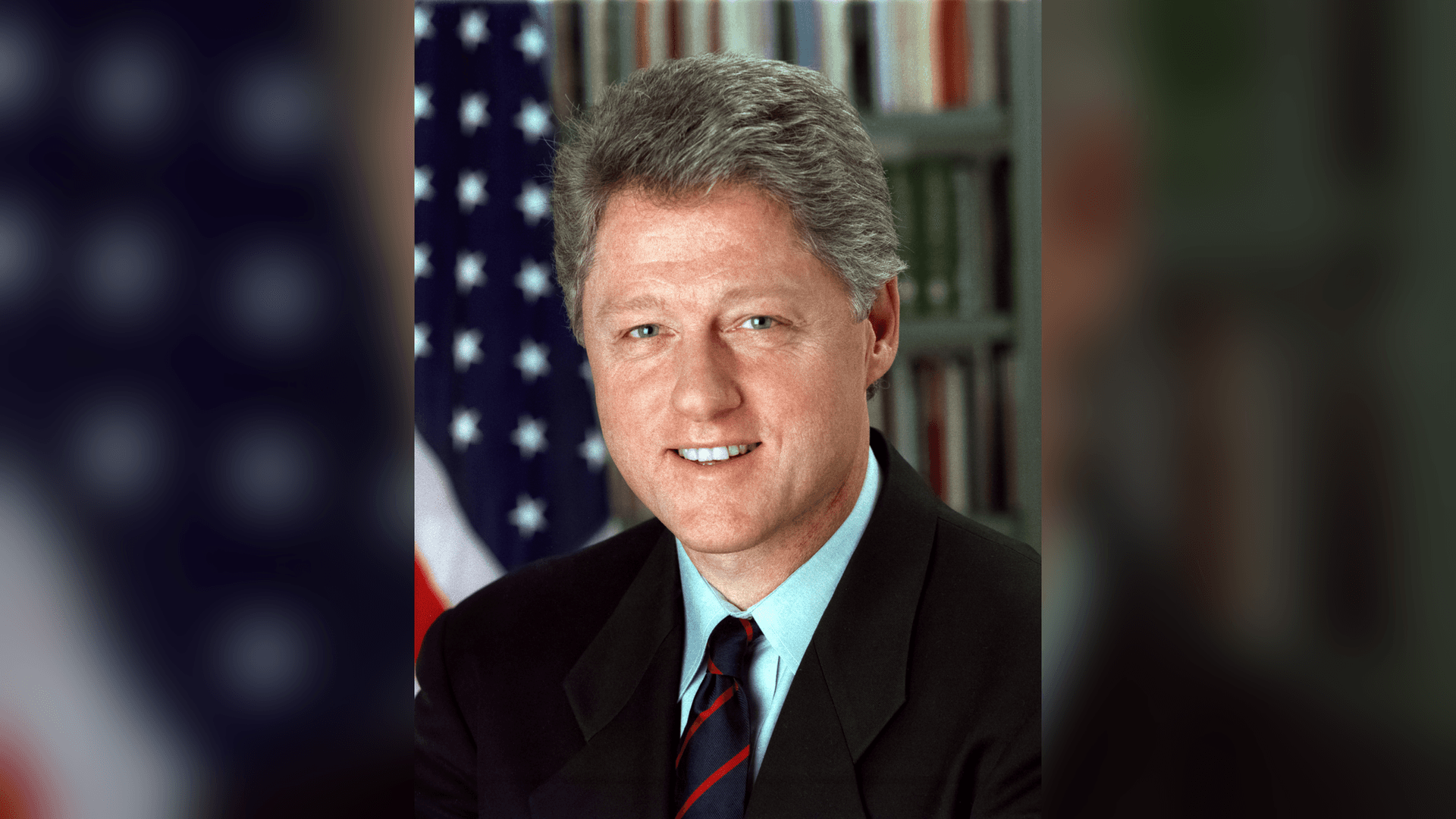
Hero image: official White House photo of President Bill Clinton by Bob McNeely, 1993. Public domain, via Wikimedia Commons.
Take our professional IQ test
Want to know your IQ? Try the first ever professional online IQ test.