Terence Tao's IQ is commonly cited at 220 to 230, a childhood extrapolation rather than a real test score. His documented record is even more striking.
Dr. Russell T. WarneChief Scientist
Share
Terence Tao's IQ is commonly quoted at 220 to 230, and the first thing to know about that figure is that it is not a documented test score. It is an extrapolated childhood estimate, in the old mental-age style, inferred from feats like scoring 760 on the SAT math section at age 8. Tao's verified record needs no inflation: he is the youngest medalist in International Mathematical Olympiad history, won the Fields Medal at 31, and is widely regarded as one of the greatest living mathematicians.
Where the 220 to 230 figure comes from
Tao, born in Adelaide, Australia, in 1975, was studied intensively as a child by gifted-education researchers, including Julian Stanley's Study of Mathematically Precocious Youth and Miraca Gross's Australian research on exceptionally gifted children. The 220-230 figure circulating online is an extrapolation from that era: researchers projected a ratio-style IQ from performances like his SAT result, using instruments and arithmetic that modern deviation-scored tests no longer use. No verified adult IQ score for Tao has ever been published, and scores above about 160 are not measurable on today's standardized tests in any case.
The documented prodigy record
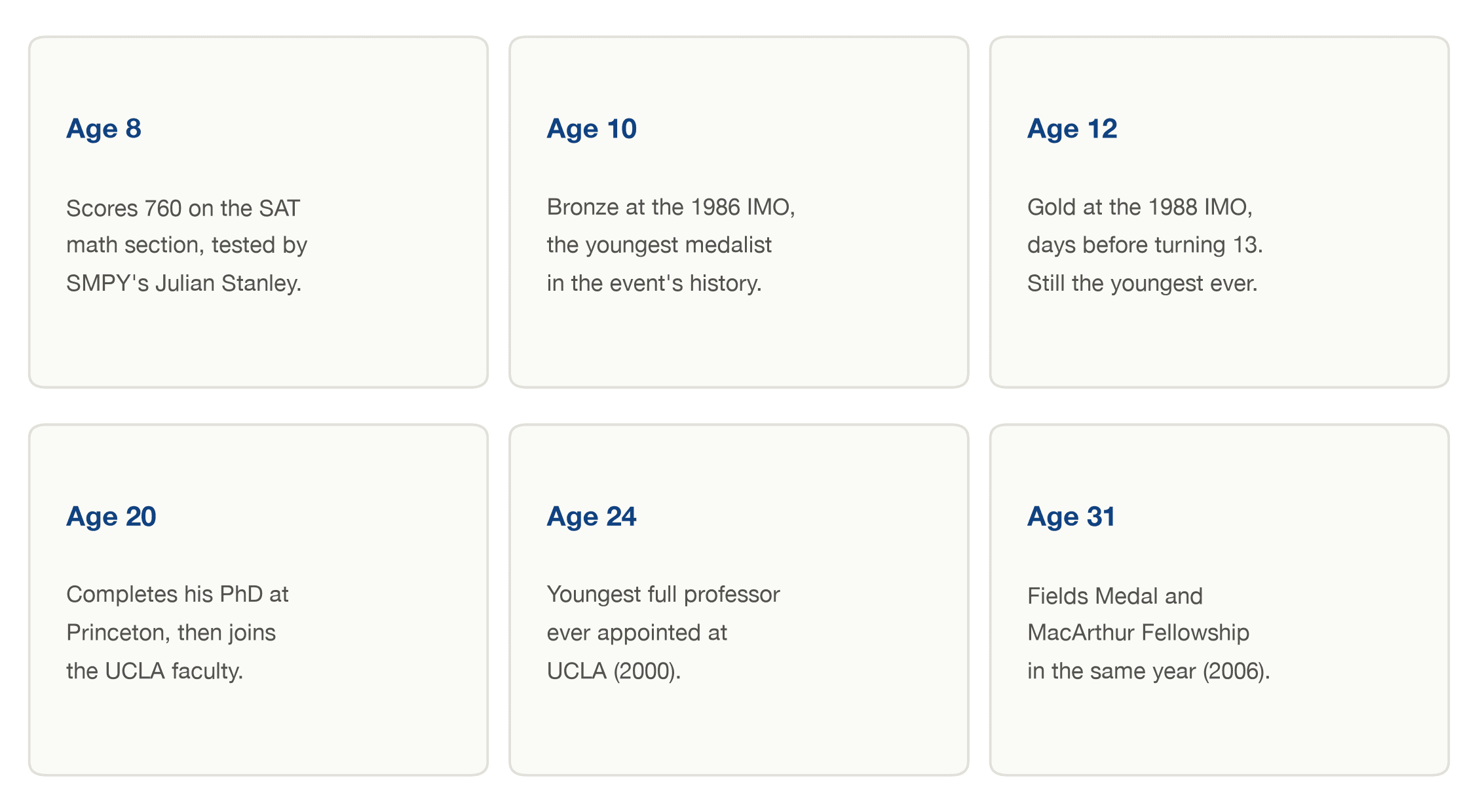
What is on the record is more impressive than the folklore. Stanley reported that at age 8 Tao scored 760 on the SAT math section, a score few college-bound 17-year-olds reach. At the International Mathematical Olympiad he won bronze in 1986 at age 10, silver in 1987, and gold in 1988, days before his 13th birthday, still the youngest gold medalist the competition has ever had.
From prodigy to Fields Medal
Unlike many prodigies, Tao converted early promise into a sustained scientific career. He completed his PhD at Princeton at 20 and joined the UCLA faculty the same year; at 24 UCLA made him the youngest full professor in its history. In 2006 he received the Fields Medal, mathematics' highest honor, cited for contributions to partial differential equations, combinatorics, harmonic analysis, and additive number theory, and a MacArthur Fellowship arrived the same year. Colleagues call him the "Mozart of Math," and his blog and collaborations have made him one of the most productive and generous figures in the field.
Why mathematicians resist the number
People who work with Tao rarely reach for IQ figures, and the psychometrics explains why. Modern tests report "deviation IQs" against age-group norms, with a practical ceiling near 160; a deviation score of 230 would imply a rarity beyond any population that has ever existed. Childhood ratio-style estimates measure precocity, how far ahead of age peers a child is, which is a different quantity from adult standing. And single numbers flatten what actually distinguishes a career like Tao's: taste in problems, stamina, collaboration, and decades of sustained work. The reasoning ability tests do measure is real, and it matters; see our article on fluid intelligence for what that ability is. It is simply not the whole story. For another case of a famous mind and a shaky number, see Magnus Carlsen's IQ.
Frequently asked questions
What is Terence Tao's IQ?
No verified test score exists. The circulating 220-230 figure is a childhood-era extrapolation from feats like his SAT math 760 at age 8, not a documented modern test result.
Is Terence Tao the smartest person alive?
He is a frequent answer to the question, and the honest reply is that no test can rank individuals at that level. His documented record makes him a defensible candidate by achievement, which is the only measurable standard. See our full article on the smartest person in the world.
What did Tao do as a child prodigy?
Documented feats include SAT math 760 at 8, IMO bronze at 10, silver at 11, and gold days before turning 13, followed by a Princeton PhD completed at 20.
What is the Fields Medal?
Mathematics' most prestigious prize, awarded every four years to mathematicians under 40. Tao won in 2006, the same year Grigori Perelman famously declined his.
Does a high IQ make someone a great mathematician?
It helps and it is not sufficient. Reasoning ability predicts STEM success, but sustained achievement also depends on training, opportunity, persistence, and creative judgment that no single score captures.
The takeaway
Tao's case is the clearest example of the pattern that runs through every famous IQ claim: the legend quotes a number no test produced, while the documented record, which needs no embellishment, does all the work. If you want a number of your own that is actually a measurement, the Reasoning and Intelligence Online Test from RIOT IQ reports modern deviation scores with stated precision, on the scale where scores mean something.
References
1. Muratori, M. C., Stanley, J. C., Ng, L., Ng, J., Gross, M. U. M., Tao, T., & Tao, B. (2006). Insights from SMPY's greatest former child prodigies. Gifted Child Quarterly, 50(4), 307-324. doi.org
2. Clements, M. A. (1984). Terence Tao. Educational Studies in Mathematics, 15(3), 213-238. doi.org
3. International Mathematical Olympiad. Contestant results: Terence Tao.imo-official.org
4. International Mathematical Union. (2006). Fields Medals 2006.mathunion.org
5. UCLA Newsroom. (2006, August 22). Terence Tao, "Mozart of Math," is first UCLA math prof to win Fields Medal.newsroom.ucla.edu
6. MacArthur Foundation. (2006). Terence Tao, Class of 2006.macfound.org
Hero image: Terence Tao at Oberwolfach, 2012. Photo: Ivonne Vetter / MFO, CC BY-SA 2.0 DE, via Wikimedia Commons.
Take our professional IQ test
Want to know your IQ? Try the first ever professional online IQ test.