What Was Thomas Edison's IQ? What the Record Shows | Riot IQ
Oct 31, 2026·Famous People & IQ
What Was Thomas Edison's IQ? What the Record Shows
Thomas Edison's IQ was never measured. He never took a test, he is not in Cox's 1926 genius study, and the numbers online have no traceable source.
Dr. Russell T. WarneChief Scientist
Share
Thomas Edison never took an IQ test, so nobody knows his IQ. He was born in 1847, more than half a century before the first practical intelligence test, and he does not appear among the 301 subjects of Catharine Cox's 1926 study, the source of nearly every citable IQ estimate for a historical figure, so the 145s and 160s attached to his name online have no traceable source.
What does exist is a well-documented life. Edison had only a few months of classroom schooling, read widely at home, lost most of his hearing in childhood and went on to receive 1,093 U.S. patents. Late in life he also wrote a famous test of his own. This page covers where the Edison IQ numbers come from, what the record shows about his schooling and his work, the 1921 Edison questionnaire, and what all of it can and cannot tell you about his intelligence.
Why there is no Edison IQ score
The first practical intelligence test was published by Alfred Binet and Théodore Simon in 1905, when Edison was already 58 and famous. No IQ score for him appears in his authorized biography or in the biography published by the Thomas A. Edison Papers project at Rutgers.
Most "historical IQs" that carry any scholarly weight come from Catharine Cox's Genetic Studies of Genius, Vol. II (1926). Cox and her raters read biographies of 301 eminent people born between 1450 and 1850 and estimated what IQ would produce the childhood achievements recorded for each one. Edison was born inside that window, but he is not one of her subjects: a search of the full scanned text finds no entry for him. Our article on Napoleon's IQ explains how Cox's method worked.
That leaves the numbers on celebrity-IQ lists, usually somewhere between 135 and 160. None of them names a rater, a method, or a document. They are guesses presented as facts, and they should be read that way.
The "addled" schoolboy: what the record shows
The most famous story about Edison's mind is that a teacher thought he was slow. The earliest detailed version comes from Edison: His Life and Inventions (1910), an authorized biography by Frank Lewis Dyer, general counsel to the Edison laboratory, and Thomas Commerford Martin, written with Edison's cooperation and drawing heavily on his own recollections. It says his mother was "hotly indignant upon hearing that the teacher had spoken of him to an inspector as 'addled.'" The same book says that the Port Huron public school gave him "all the regular scholastic instruction he ever enjoyed--just three months," and that by his own recollection he was "at the foot of the class."
Those details rest on Edison's and his family's recollections, recorded more than 50 years later. The Edison Papers, which work from surviving documents, give a slightly different outline: Edison attended the private school of the Rev. George Engle in 1854 and later the Port Huron Union School in 1859 and 1860, "but was largely taught at home by his mother," Nancy, who had worked as a teacher.
A popular internet version goes much further. In it, the school sends a letter calling the boy addled, and his mother reads it aloud as saying he is a genius the school is too small for. Snopes traced that tale and rated it mostly false: there is no evidence of any such letter or of the mother hiding the teacher's opinion from her son. The documented core is simply that a teacher thought little of him and his mother took over his education.
Under her teaching he read a great deal. Dyer and Martin list Gibbon's Decline and Fall of the Roman Empire, Hume's History of England and Burton's Anatomy of Melancholy among the books he had read with her help before age 12, along with an attempt at Newton's Principia whose mathematics defeated them both. Edison credited her directly: "My mother taught me how to read good books quickly and correctly," he said, as quoted by the Edison Papers.
Deafness, newspapers and the telegraph
At about 12, Edison went to work selling newspapers and candy on the Grand Trunk Railroad, and in 1862 he printed his own small newspaper on the train. By 1862 he had learned enough telegraphy to work as an operator, and from 1863 to 1867 he moved around the Midwest as an itinerant telegrapher, reading widely and experimenting with telegraph equipment.
His hearing loss also began in these years. Edison told more than one origin story, including a trainman lifting him by the ears and a conductor boxing his ears after his chemicals set a baggage car on fire. The physician and historian Howard Markel notes that Edison Papers director Paul Israel suspects childhood ear infections, and perhaps scarlet fever, as likelier causes. Edison later described his near-total deafness as an advantage, saying it let him concentrate in a noisy telegraph office.
None of this records a test score. It does record a boy who learned difficult technical skills quickly, mostly on his own, and who read far beyond what a few months of school would predict.
What 1,093 patents do and do not say about IQ
By the Edison Papers' count, Edison received 1,093 U.S. patents, a record in his day, covering "key innovations and minor improvements" in telegraphy, electric power, sound recording, motion pictures, batteries, mining and cement. The phonograph (1877), a carbon telephone transmitter and a complete electric lighting system came out of his Menlo Park laboratory, which historians credit as an early industrial research laboratory.
That output is extraordinary, and it almost certainly required high general ability. Two features of it argue against reading a precise IQ off it. First, it was a team product. Edison hired university-trained researchers, such as the mathematician Francis Upton, and he told a friend, by Dyer and Martin's account, "I can always hire some mathematicians, but they can't hire me." Second, Edison himself credited effort over brilliance, in the remark his biographers quote: "Genius is 1 per cent. inspiration and 99 per cent. perspiration."
IQ predicts achievement well across large groups, but at the level of one inventor the link between test score and output runs through knowledge, persistence, money, timing and the people around him. The contrast is often drawn with his rival, whose own record we cover in Nikola Tesla's IQ.
Edison's own "intelligence test" of 1921
Edison's real link to the history of mental testing runs the other way: he gave a test. In early 1921, according to the writer Paul Collins, people who answered an anonymous job advertisement were sent to Edison's laboratory in West Orange, New Jersey, and handed a written questionnaire of 163 questions. The New York Times printed a 146-question version on May 11, 1921. Its questions included "Where is Copenhagen?", "Who invented logarithms?" and "What causes the tides?"
Edison was disappointed with the results. "Men who have been to college I find to be amazingly ignorant," he told the Times. Collins reports that of 718 men who took the test, only 57 scored above the 70 per cent pass mark. When reporters in Boston asked Albert Einstein a question of the same kind, the speed of sound, he said he did not know it offhand, and the headlines claimed he had failed the Edison test.
Psychologists were unimpressed. The Harvard psychologist A. A. Roback argued that "it would be more sensible in testing a man's intelligence to ask how he would go about finding the answers to such questions." In modern terms, Edison's questionnaire sampled stored general knowledge, part of what psychologists call crystallized intelligence. It had no norms and no reasoning items, which is why it does not count as an IQ test even though the newspapers treated it like one.
Frequently asked questions
What was Thomas Edison's IQ?
Nobody knows. Edison never took an IQ test, he is not among Cox's 301 historical geniuses, and the figures of 135 to 160 found online have no documented source.
Is Thomas Edison in Cox's 1926 study of geniuses?
No. Cox's 301 subjects were born between 1450 and 1850, and Edison (born 1847) falls inside that range, but he was not selected and has no entry in the published volume.
Did a teacher really call Edison "addled"?
His 1910 authorized biography says a teacher described him to a school inspector as "addled," which angered his mother. The popular story about a letter his mother pretended to read as praise has no supporting evidence.
How much school did Edison have?
Very little. His authorized biography says three months at the Port Huron public school; the Edison Papers record two short periods of schooling in Port Huron and say he was largely taught at home by his mother.
Did Einstein fail Edison's test?
Reporters in Boston asked Einstein a question of the same kind in 1921, the speed of sound, and he said he did not know it offhand. That single answer is the whole basis of the claim, and the questionnaire itself tested trivia and recall more than reasoning.
How many patents did Edison have?
The Thomas A. Edison Papers count 1,093 U.S. patents, which the project describes as a record.
The takeaway
Edison's IQ was never measured, and no scholarly estimate exists for it. The record shows a largely home-schooled, voracious reader who mastered telegraphy as a teenager and went on to receive 1,093 patents, though his habit of retelling his childhood in more than one version has blurred some of the details. If you want a number that is an actual measurement of your own reasoning, rather than a guess about someone else's, take a full-length online IQ test.
References
1. Binet, A., & Simon, T. (1905). Méthodes nouvelles pour le diagnostic du niveau intellectuel des anormaux. L'Année Psychologique, 11, 191-244. [doi.org/10.3406/psy.1904.3675](. doi.org
2. Cox, C. M. (1926). Genetic studies of genius: Vol. II. The early mental traits of three hundred geniuses. Stanford University Press. [archive.org](. archive.org
3. Thomas A. Edison Papers. (n.d.). Biography. Rutgers, The State University of New Jersey. [edison.rutgers.edu](. edison.rutgers.edu
4. Thomas A. Edison Papers. (n.d.). Detailed biography. Rutgers, The State University of New Jersey. [edison.rutgers.edu](. edison.rutgers.edu
5. Thomas A. Edison Papers. (n.d.). Education of an inventor. Rutgers, The State University of New Jersey. [edison.rutgers.edu](. edison.rutgers.edu
6. Dyer, F. L., & Martin, T. C. (1910). Edison: His life and inventions. Harper & Brothers. [gutenberg.org](. gutenberg.org
7. Kasprak, A. (2016). Did Thomas Edison's mother lie about a letter expelling him from school? Snopes. [snopes.com](. snopes.com
8. Markel, H. (2018). The medical mystery that helped make Thomas Edison an inventor. PBS NewsHour. [pbs.org](. pbs.org
9. Collins, P. (2010). Looking back: 163 ways to lose your job. The Psychologist. British Psychological Society. [bps.org.uk](. bps.org.uk
10. Most, D. (n.d.). Thomas Edison's intelligence test (reprinting The New York Times, May 11, 1921). American Experience, PBS. [pbs.org](. pbs.org
11. National Park Service. (n.d.). The Edison test. Thomas Edison National Historical Park. [nps.gov](. nps.gov
12. Warne, R. T. (2020). In the know: Debunking 35 myths about human intelligence. Cambridge University Press. [doi.org/10.1017/9781108593298](. doi.org
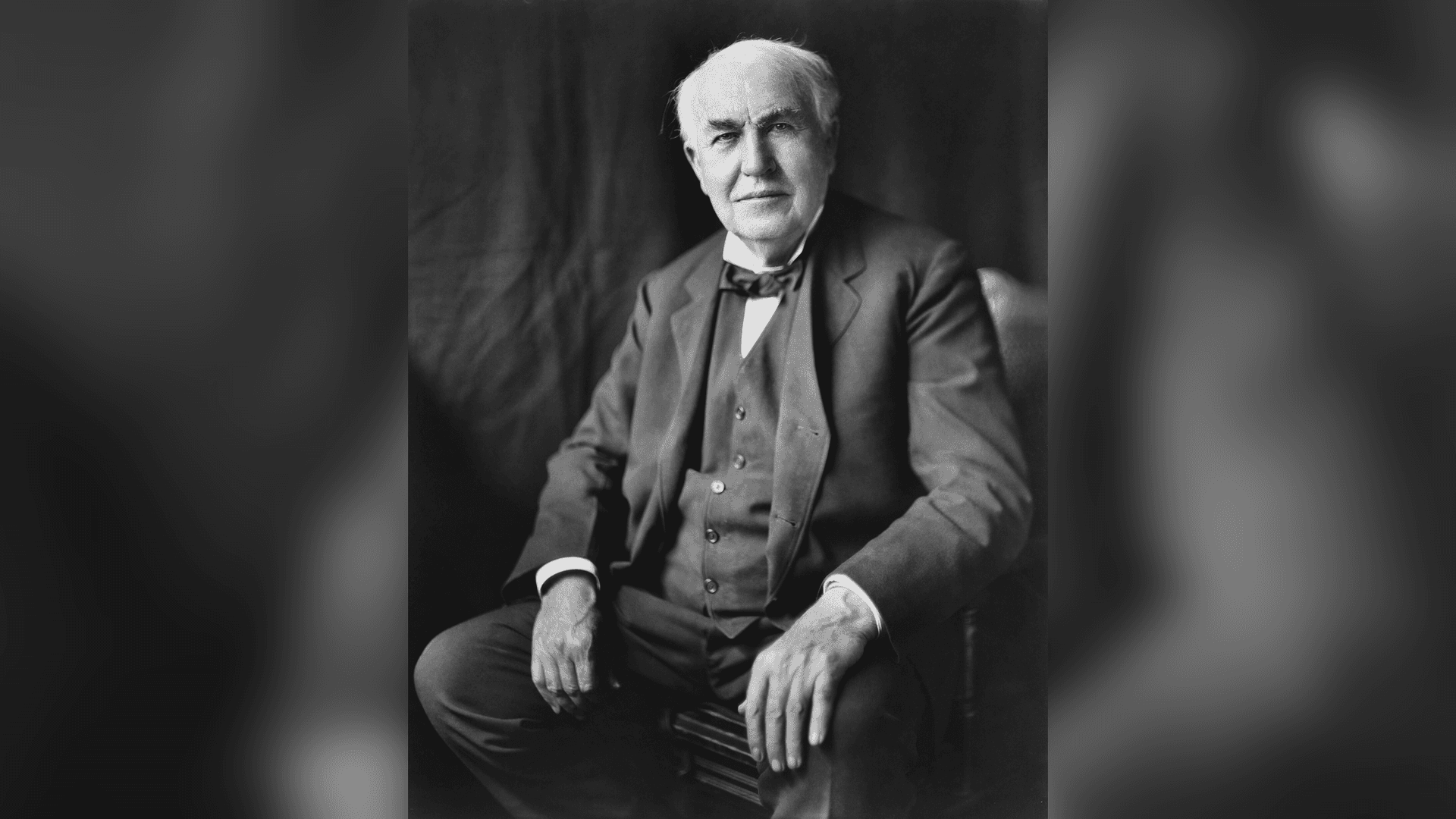
Hero image: Thomas Edison, by Louis Bachrach, Bachrach Studios (restored by Michel Vuijlsteke), public domain. Via Wikimedia Commons.
Take our professional IQ test
Want to know your IQ? Try the first ever professional online IQ test.