What Was Beethoven's IQ? Cox's 1926 Estimate and the Record Behind It | Riot IQ
Oct 31, 2026·Famous People & IQ
What Was Beethoven's IQ? Cox's 1926 Estimate and the Record Behind It
Beethoven's IQ was never tested. Catharine Cox's 1926 Stanford study estimated it at 135 for childhood and 140 for ages 17 to 26, from biographies.
Dr. Russell T. WarneChief Scientist
Share
Ludwig van Beethoven never took an IQ test: he died in 1827, 78 years before Alfred Binet published the first intelligence scale in 1905. The only citable Beethoven IQ figures come from Catharine Cox's 1926 Stanford study, which estimated his IQ at 135 for childhood and 140 for ages 17 to 26 by having raters read his biographical records, and those estimates rest on some of the thinnest data in her study.
The 165 that circulates online also comes from Cox: it is her statistically corrected estimate for ages 17 to 26, printed in her master table of ratings. This article covers what Cox's file on Beethoven actually says, where the 165 comes from, what the documented record shows about his schooling and his famously weak arithmetic, and why a composer's achievements make a poor ruler for IQ.
Cox's 1926 estimate for Beethoven
Cox's Genetic Studies of Genius, Volume II assigned estimated IQs to 301 eminent people born between 1450 and 1850. Raters read what biographies recorded about each subject's early life and judged what IQ would typically produce that record, yielding an "AI" estimate (birth to 17) and an "AII" estimate (17 to 26). Our article on Napoleon's IQ walks through the method in detail.
Beethoven's case study, on pages 386 to 388, is headed AI IQ 135 and AII IQ 140. Each estimate carries a "reliability coefficient of data," Cox's rating of how adequate the records were, and for Beethoven both are .43, below the averages for the whole study (.46 and .54). The file is almost entirely about music. Under reading, Cox's entry says only: "No record is preserved of reading, other than music."
Within Cox's 11 composers, Beethoven sits in the middle. Handel and Mendelssohn were rated 155 for ages 17 to 26, Bach and Haydn 140 like Beethoven, and Gluck 115. Dean Keith Simonton, a leading researcher in this field, summarized it the same way: Beethoven "fell in the middle of the pack." Cox's own conclusion helps explain why a middling estimate fits a towering reputation: "high but not the highest intelligence, combined with the greatest degree of persistence, will achieve greater eminence than the highest degree of intelligence with somewhat less persistence."
Where the "Beethoven IQ 165" comes from
Cox also calculated "corrected" estimates to offset the downward pull of thin records. Her formula raises each obtained score toward the average of the person's professional group, more so when the data are less reliable. For her Musicians, the obtained averages of 130 and 140 were corrected to 145 and 160.
Cox applied the same correction to each individual, and her master table of ratings (Table 12A, facing page 60) prints Beethoven's corrected estimates as 150 for childhood and 165 for ages 17 to 26. That is the source of the widely repeated 165. No rater gave him that number. The three main raters scored his later record at 160, 140 and 125, which average to the published 140, and the 165 is the formula's adjustment of that average for his thin records. The case study itself, on pages 386 to 388, is headed only with 135 and 140, and Cox warned that "the purpose of the corrected estimates is not to furnish exact values for the score of an individual or even of a group." Figures above 165 have no traceable source at all.
What the documented record shows
The detailed record comes mainly from Alexander Wheelock Thayer's multivolume biography, the source Cox herself used.
• Schooling: Beethoven's father wanted a "marketable" musical prodigy and gave him only elementary schooling, at a Latin school where, Thayer notes, "arithmetic and writing are said to have been excluded." A schoolmate, later president of a regional court, recalled that not a sign was to be found "of that spark of genius." That schoolmate entered the gymnasium in 1781 and Beethoven did not, which Thayer takes as the point when other studies were dropped for music, at about age 10.
• Musical precocity: Cox records a first public concert at 7, published keyboard variations by 12, and charge of the court organist's duties at about 11 and a half. His teacher Christian Gottlob Neefe wrote in 1783 that the boy played Bach's Well-Tempered Clavier and "would surely become a second ... Mozart were he to continue as he has begun." At 13 he was appointed assistant court organist.
• Adult study: He moved to Vienna in 1792 and took lessons from Haydn, Albrechtsberger and Salieri, and by his mid-20s he was famous in Vienna as a pianist and improviser.
The arithmetic story
You may have read that Beethoven could not multiply. The documentary core is real. Thayer writes that "in orthography, the use of capital letters, punctuation and arithmetic he was sadly deficient all his life long," and he describes a conversation book from December 1826, months before Beethoven's death, filled with simple multiplication tables and a written explanation from his nephew Karl: "Multiplication is a simplified form of addition." The vivid detail that he multiplied by writing a number out dozens of times and adding the column comes from popular retellings, which credit Jan Swafford's 2014 biography; treat that specific example as anecdotal.
The story says less about intelligence than it seems to. Arithmetic is taught, and Beethoven's schooling stopped at about 10 and may have skipped arithmetic entirely. An IQ test samples reasoning across many kinds of problems, and an adult who was never drilled in multiplication tables would lose points on arithmetic items for reasons that have nothing to do with the rest of his reasoning ability.
Deafness
Beethoven's hearing loss began in his late 20s, well after his education and musical training. In a June 1801 letter to his friend Franz Wegeler he wrote that his hearing had "grown steadily worse for three years." In the Heiligenstadt Testament of October 1802 he described his despair. From 1818 visitors wrote their side of conversations in notebooks, the "conversation books" that now serve as a running record of his last decade. He composed the Ninth Symphony, first performed in May 1824, while profoundly deaf. For what research shows about IQ and hearing loss today, including how poor hearing can make a test score look lower than a person's real ability, see our separate article.
Why historiometric estimates are shaky
Cox was candid about the limits. Her raters scored records, and a record that says nothing about reading, languages or schoolwork leaves them little to work with besides musical feats. A boy who played Bach at 12 clearly learned fast, but the raters had to decide how much musical precocity says about general intelligence, and a different panel could reasonably have decided otherwise. Simonton argues that later research has supported Cox's approach at the group level, but he also quotes Lewis Terman, who directed the project, on the individual figures: "IQ estimates of this kind are not to be taken too literally."
Modern genetics does not settle the question either. In 2023 researchers sequenced Beethoven's genome from authenticated locks of his hair, and the next year a team calculated his "polygenic score," a summary of many small genetic effects, for beat synchronization, a trait linked to musicality. Beethoven ranked at only the 9th to 11th percentile of modern reference samples. The authors used the result to show that such scores cannot predict an individual's abilities, and the same limit applies to any attempt to read an IQ off a genome.
What Beethoven's music does and does not say about IQ
General intelligence predicts how quickly people learn complex material, and Beethoven absorbed counterpoint, form and orchestration at a remarkable pace. That is consistent with high ability. The research on IQ and musicians shows that people with more music training score a little higher on average, mostly because brighter children are more likely to take lessons and stick with them. Musical achievement also depends on years of practice, a musical family, specific musical abilities and the kind of persistence Cox emphasized. None of that converts into a number. The fairest summary is that Beethoven was very probably well above average in general ability, and that his genius lay in an area IQ tests were never designed to measure.
Frequently asked questions
What was Beethoven's IQ?
Nobody knows, because he died in 1827 and IQ tests began in 1905. Catharine Cox's 1926 historiometric study estimated 135 for his childhood and 140 for ages 17 to 26.
Did Beethoven have an IQ of 165?
Only as an adjusted estimate. Cox's master table (Table 12A) prints 165 as Beethoven's corrected estimate for ages 17 to 26, a statistical adjustment of his rated 140, and she warned that corrected figures were not exact values for any individual.
Was Beethoven bad at math?
His arithmetic was weak all his life, according to his biographer Thayer, and a conversation book from December 1826 shows his nephew explaining multiplication to him. That reflects schooling that ended at about 10, so it says little about his reasoning ability.
How did Beethoven compare with other composers in Cox's study?
He was in the middle. His 140 for ages 17 to 26 equals Bach's and Haydn's, trails Handel's and Mendelssohn's 155, and is well above Gluck's 115.
Did Beethoven's deafness affect his intelligence?
Nothing in the record suggests his reasoning declined. His hearing loss began in his late 20s, and he went on to write some of his most complex works, including the Ninth Symphony, while profoundly deaf.
The takeaway
Every Beethoven IQ figure traces back to one 1926 study whose raters had little more than a musical childhood to work with, and Cox herself rated those records below average in adequacy. The 135 and 140 are informed guesses about a paper trail, and the 165 is Cox's own statistical adjustment stacked on top of them. If you want a number that is an actual measurement of your own reasoning, you can take a full-length online IQ test that reports modern scores with stated precision.
References
1. Cox, C. M. (1926). Genetic studies of genius: Vol. II. The early mental traits of three hundred geniuses. Stanford University Press. [archive.org](. archive.org
2. Thayer, A. W. (1921). The life of Ludwig van Beethoven (Vol. 1; H. E. Krehbiel, Ed. & Trans.). The Beethoven Association. [gutenberg.org](. gutenberg.org
3. Thayer, A. W. (1921). The life of Ludwig van Beethoven (Vol. 3; H. E. Krehbiel, Ed. & Trans.). The Beethoven Association. [gutenberg.org](. gutenberg.org
4. Simonton, D. K. (2009, December 3). Looking back: Creative genius in classical music. The Psychologist. British Psychological Society. [bps.org.uk](. bps.org.uk
5. Albrecht, T. (Ed.). (2018). Beethoven's conversation books: Vol. 1. Nos. 1 to 8 (February 1818 to March 1820). Boydell & Brewer. [doi.org/10.1017/9781787442412](. doi.org
6. Begg, T. J. A., Schmidt, A., Kocher, A., Larmuseau, M. H. D., Runfeldt, G., Maier, P. A., ... Krause, J. (2023). Genomic analyses of hair from Ludwig van Beethoven. Current Biology, 33(8), 1431-1447. [doi.org/10.1016/j.cub.2023.02.041](. doi.org
7. Wesseldijk, L. W., Henechowicz, T. L., Baker, D. J., Bignardi, G., Karlsson, R., Gordon, R. L., Mosing, M. A., Ullén, F., & Fisher, S. E. (2024). Notes from Beethoven's genome. Current Biology, 34(6), R233-R234. [doi.org/10.1016/j.cub.2024.01.025](. doi.org
8. Warne, R. T. (2020). In the know: Debunking 35 myths about human intelligence. Cambridge University Press. [doi.org/10.1017/9781108593298](. doi.org
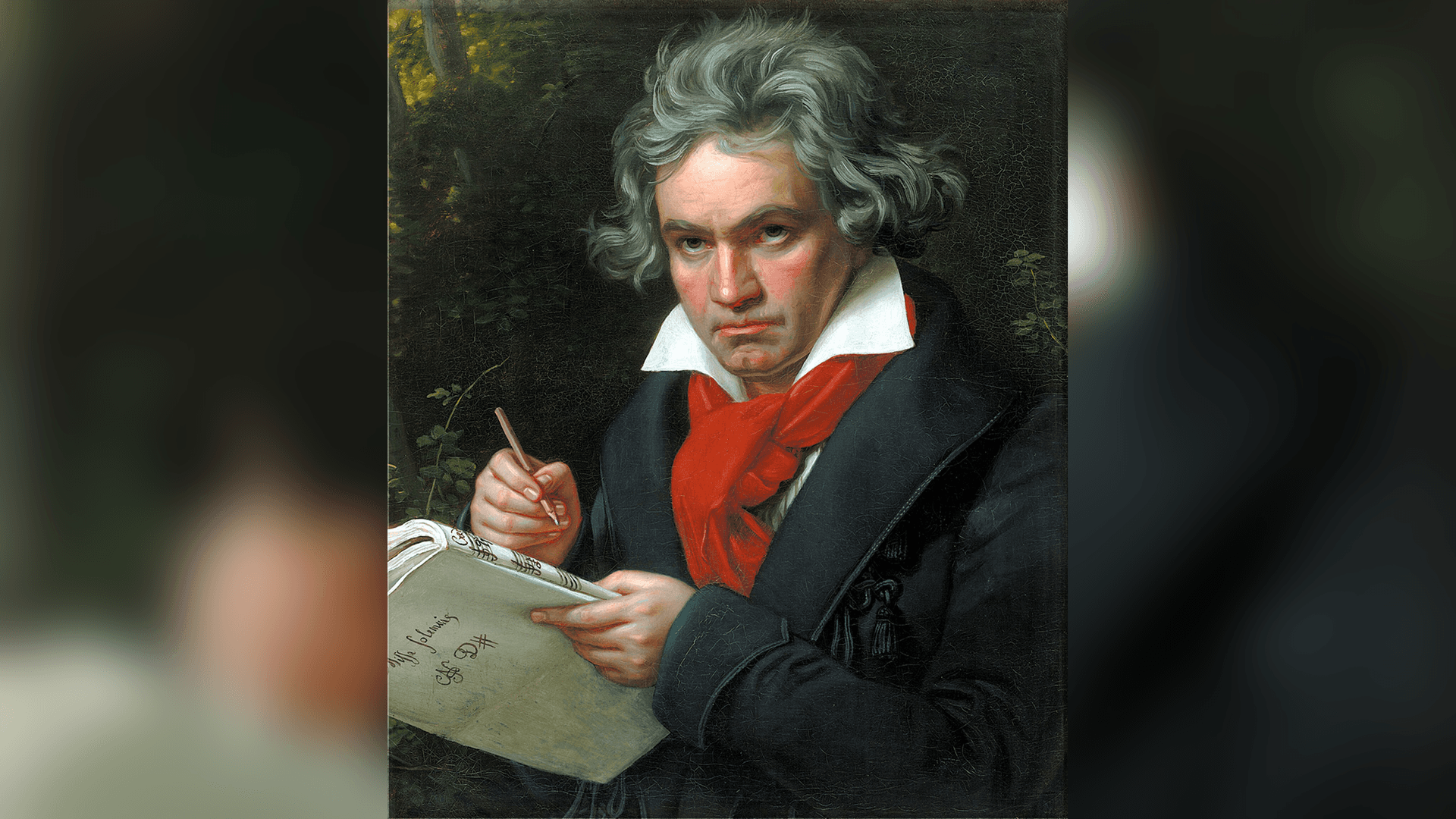
Hero image: Joseph Karl Stieler, 1820, public domain, via Wikimedia Commons.
Hero image: Ludwig van Beethoven, by Joseph Karl Stieler (1820), public domain. Via Wikimedia Commons.
Take our professional IQ test
Want to know your IQ? Try the first ever professional online IQ test.