Jordan Peterson said his IQ was tested at "in excess of 150." What is Jordan Peterson's IQ, what did he actually say, and what would a 150 score mean?
Dr. Russell T. WarneChief Scientist
Share
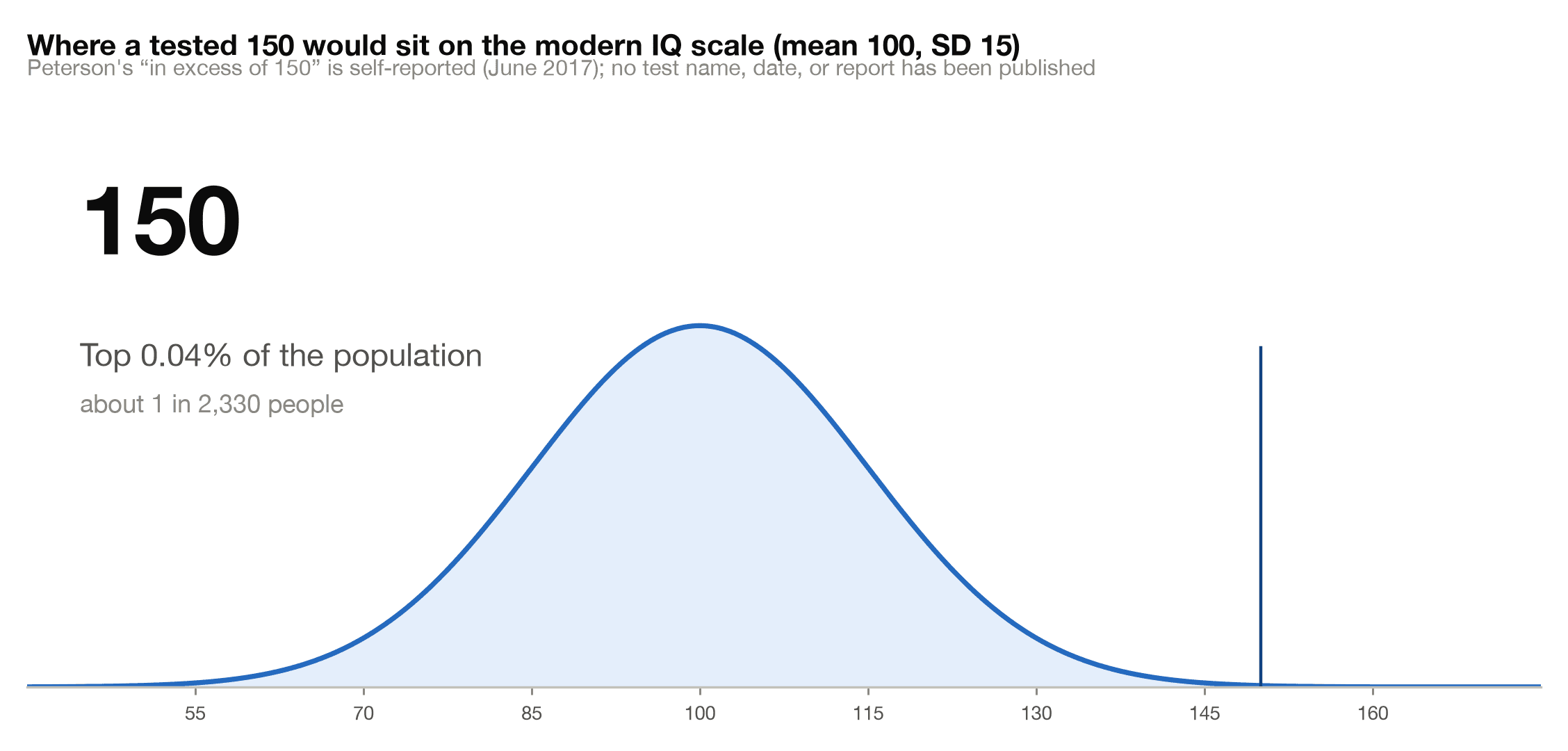
Jordan Peterson's IQ has exactly one source: Jordan Peterson. In a June 2017 question-and-answer video on his own YouTube channel, the psychology professor said, "I had it tested at one point, it's in excess of 150, but I don't know exactly where it lands now." He named no test, no date, and no examiner, and he opened the answer by saying "I don't know what my IQ is." The number is self-reported and has never been documented. What makes his claim unusual among celebrity IQ stories is how carefully he qualified it, in ways any psychometrician would recognize. Here is what he actually said, and what a tested 150 would mean.
What Jordan Peterson actually said about his IQ
The claim comes from a Q&A he published on June 1, 2017. Asked about his IQ, he began with the caveats rather than the number: "It's less than it used to be, because it declines as you age, you know, quite a lot." Then came the figure: "I don't know what my IQ is. I had it tested at one point, it's in excess of 150, but I don't know exactly where it lands now."
That is the entire documentary record. He did not say which test he took, when, or who administered it, and no score report has ever been published. A widely shared standalone clip of the answer matches the original video word for word, so the quote itself is not in dispute; the score behind it simply cannot be checked.
Is "in excess of 150" believable?
On the modern scale, IQ scores sit on a bell curve with a mean of 100 and a "standard deviation" (a measure of how spread out scores are) of 15. A 150 is 3.3 standard deviations above average: roughly the top 0.04% of the population, about 1 person in 2,330. We walk through that arithmetic in our guide to the IQ bell curve.
Is that plausible for Peterson? His verified academic record is genuinely strong. He earned a PhD in clinical psychology from McGill University, taught at Harvard in the 1990s as an assistant professor of psychology (the Harvard Crimson was covering his popular personality course by 1995), joined the University of Toronto's psychology department in 1998, and is now a professor emeritus there. By his own site's count he has published more than a hundred scientific papers. Research faculty at elite universities score far above the mean as a group, so a tested 150 for someone with this record is not statistically absurd. Plausible is still not verified: an undated self-report from an unnamed test is an anecdote, and it falls short of the range covered in our guide to what counts as a genius IQ score in one decisive way: nobody can look it up.
Verbal versus quantitative: what his GRE story reveals
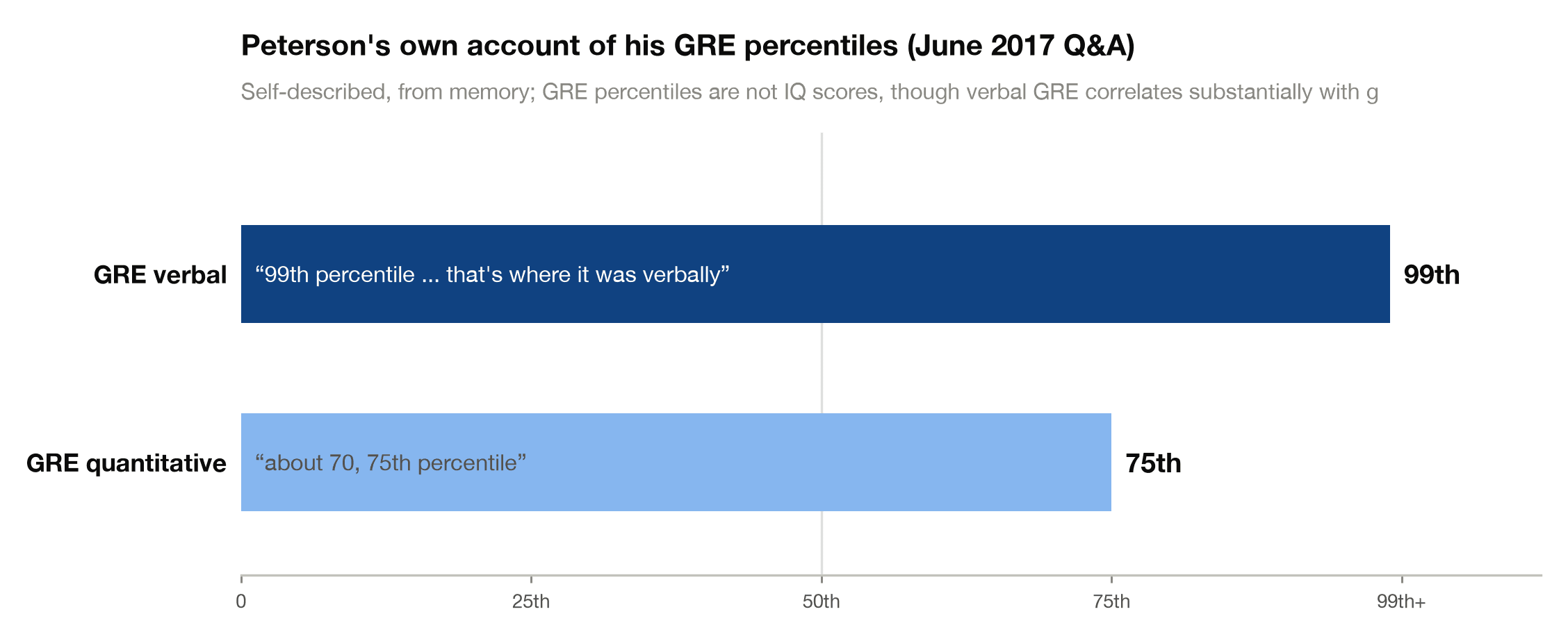
The most interesting part of his answer was the caveat about profile. Peterson volunteered that he is "not overwhelmingly intelligent from a quantitative perspective," estimating his GRE quantitative score at "about 70, 75th percentile," while his verbal score sat near the 99th: "there's a big difference between 75th percentile and 99th percentile, and I think that's where it was verbally."
He added a genuinely psychometric observation: "as your intelligence increases, the scatter between the different subtypes of intelligence increases, so you might say that there's only one way to be stupid, but there's many ways to be intelligent." That matches a documented finding known as "Spearman's law of diminishing returns": general ability explains less of the variation among specific abilities at higher ability levels, so larger gaps between domains become more common near the top. A 2017 meta-analysis in the journal Intelligence confirmed the effect. Two cautions apply, and Peterson himself gestured at both: GRE percentiles are recollections here, and a GRE percentile is not an IQ score, although verbal GRE performance correlates substantially with general ability.
Does IQ really decline with age, as he claimed?
Partly, and his framing was roughly right. "Fluid" abilities, such as novel reasoning and processing speed, begin declining surprisingly early in adulthood; Timothy Salthouse's well-known research places the onset in the twenties for several measures. "Crystallized" knowledge, such as vocabulary and accumulated facts, holds steady or improves for decades. An IQ score is age-normed, meaning it compares you with people your own age, so a stable score means keeping pace with your age group even as raw fluid performance falls. When Peterson said a decades-old score might not describe him now, he was applying the science correctly, which is more caution than most celebrity IQ claims ever attract.
Why the number still cannot be verified
• No documentation exists: No test name, administration date, examiner, or score report has ever been made public.
• Self-reports are unfalsifiable: A number with no paper trail cannot be confirmed or contradicted, whoever reports it, and secondary sites simply recycle the quote with varying numbers attached.
• A real score is a documented administration: It names the instrument, the norms, and the precision, on a report a psychologist actually issued.
Peterson's claim is best in class as celebrity self-reports go: specific, on camera, and hedged like a professional. It remains a self-report. For a contrasting case with the same documentary status, see our article on Kanye West's IQ, another famous number that traces to a single on-camera statement.
How to get an IQ score that actually counts
A defensible IQ number is one you can point to: a professionally normed test, taken under standard conditions, reported with its precision. The Reasoning and Intelligence Online Test from RIOT IQ reports modern deviation scores with stated confidence intervals, and you can take the free RIOT IQ test here. Unlike a remembered number from an unnamed test, the result comes with its evidence attached.
Frequently asked questions
What did Jordan Peterson say his IQ is?
In a June 2017 Q&A on his own YouTube channel he said "I had it tested at one point, it's in excess of 150, but I don't know exactly where it lands now." He named no test or date and added that he does not know his current IQ. The number is self-reported and has never been documented.
Is Jordan Peterson's IQ of 150 verified?
No. No test report, test name, or testing date has ever been published. The only source is Peterson's own on-camera statement, which by psychometric standards is an anecdote rather than a score.
Is an IQ over 150 realistic for a professor like Peterson?
It is statistically plausible. A 150 is roughly 1 person in 2,330, and research faculty at elite universities score far above average as a group. A McGill PhD, a Harvard assistant professorship, and more than a hundred published papers are consistent with very high ability, without pinning any exact number.
What did Peterson say about his verbal versus math ability?
He estimated his GRE quantitative score at about the 70th to 75th percentile and his verbal score near the 99th, adding that "there's only one way to be stupid, but there's many ways to be intelligent." Larger gaps between domains at high overall ability are a documented phenomenon.
Does IQ really decline with age, as Peterson claimed?
Fluid abilities such as novel reasoning do begin declining in early adulthood, while crystallized knowledge holds up for decades. Because IQ is age-normed, a stable score means keeping pace with your age group; Peterson was referring to the decline in raw fluid performance.
Where did Jordan Peterson teach?
After his PhD at McGill University he was an assistant professor of psychology at Harvard in the 1990s, then joined the University of Toronto's psychology department in 1998, where he is now professor emeritus.
References
1. Peterson, J. B. (2017, June 1). Q & A 2017 06 June [Video]. YouTube. youtube.com
2. The Harvard Crimson. (1995, April 26). Jordan Peterson.thecrimson.com
3. Independent Institute. (n.d.). Jordan B. Peterson [Biography].independent.org