John von Neumann never took a documented IQ test, so his IQ is unknown. Peers like Wigner, Teller, and Bethe still called his the fastest mind alive.
Dr. Russell T. WarneChief Scientist
Share
John von Neumann never took a documented IQ test, so his IQ is unknown, and every number attached to him online is a guess invented after his death in 1957. He may still be the best argument that the far right tail of human intelligence is real. The scientists who built the atomic bomb and twentieth-century physics said, on the record, that his mind outran them all. This article covers what his peers actually said, what he verifiably did, and why no test of his era, or ours, could have put a meaningful number on him.
No test, no number
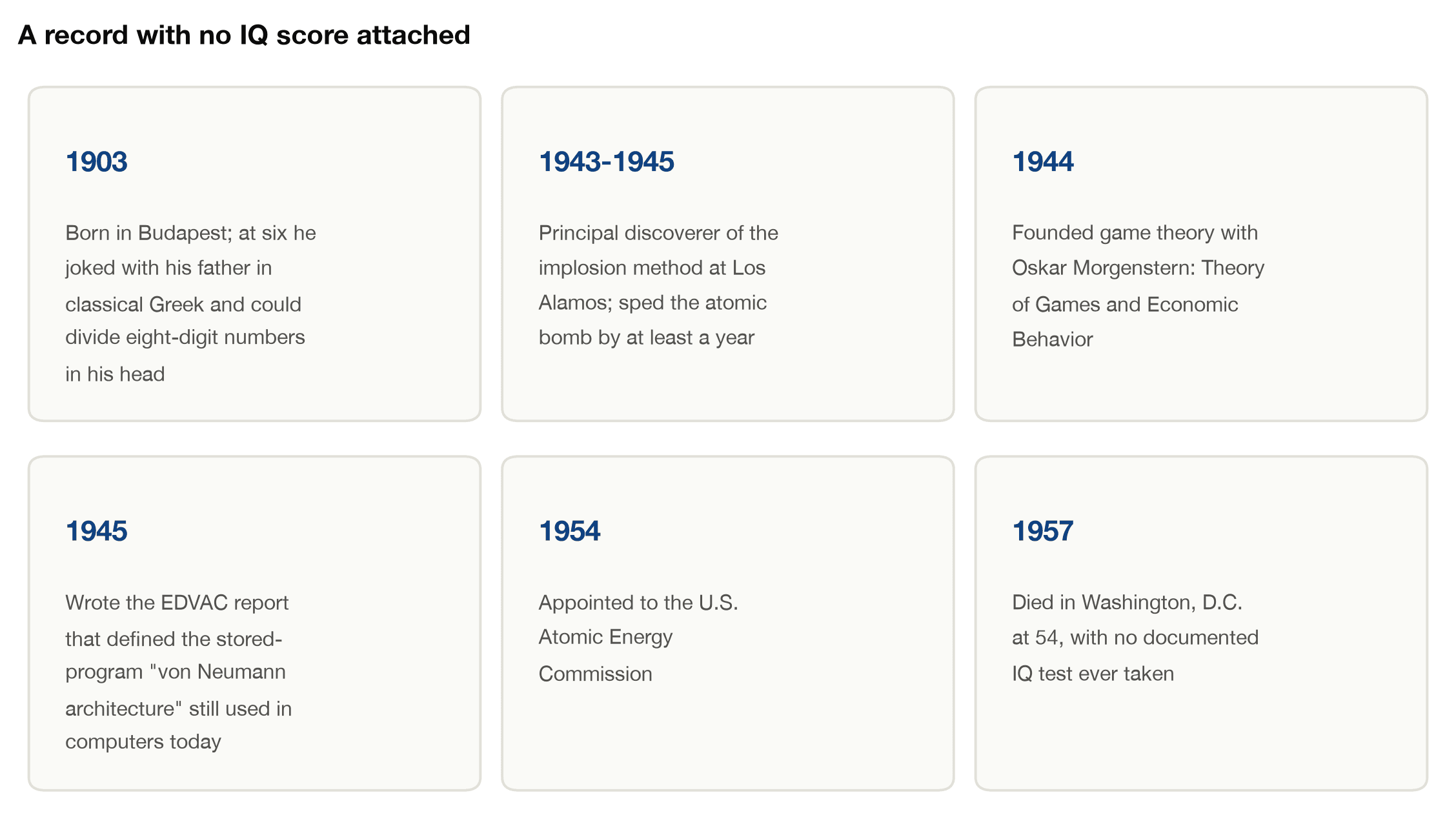
Von Neumann died in Washington, D.C. on February 8, 1957, at age 54, and no IQ test of him appears anywhere in the record. His major biographers, Norman Macrae in 1992 and Ananyo Bhattacharya in 2021, report no test. He predates the celebrity IQ industry entirely. The figures that circulate online, 180, 190, 200 and beyond, are posthumous inventions, produced by working backward from his reputation. Working backward from achievement is estimation, and estimation is not measurement, a distinction this site returns to often because the internet erases it constantly.
What his peers actually said
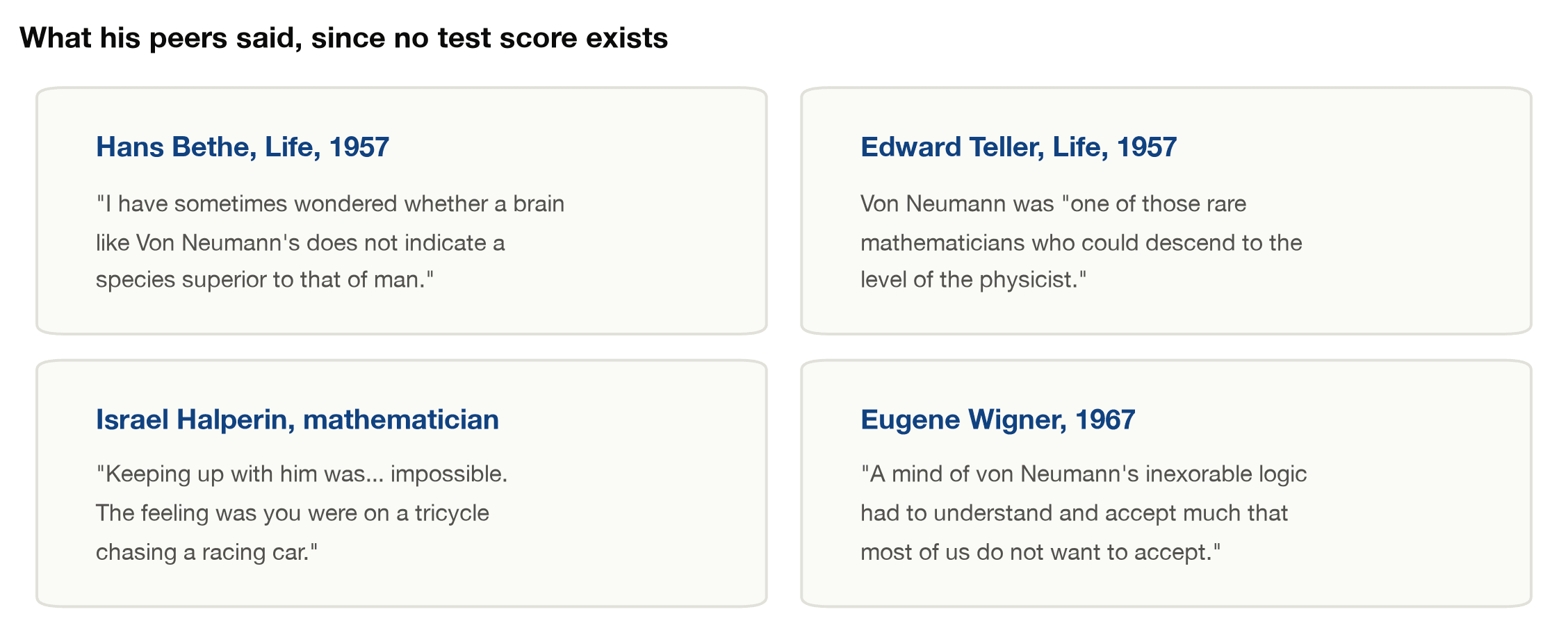
What exists instead of a score is peer testimony of a kind no other twentieth-century figure quite matches, from colleagues who were themselves among the most capable scientists alive. Hans Bethe, who directed the theoretical physics division at Los Alamos, said in Life magazine's 1957 profile: "I have sometimes wondered whether a brain like Von Neumann's does not indicate a species superior to that of man." Edward Teller, in the same article, called him with wry humor "one of those rare mathematicians who could descend to the level of the physicist."
The Nobel laureate Eugene Wigner, a lifelong friend, wrote in 1967 that "a mind of von Neumann's inexorable logic had to understand and accept much that most of us do not want to accept and do not even wish to understand." Wigner, who knew Planck, Heisenberg, and Einstein personally, also maintained in his late recollections that none of them had a mind as quick and acute as von Neumann's. The mathematician Israel Halperin put it more vividly: "Keeping up with him was... impossible. The feeling was you were on a tricycle chasing a racing car." One caution on sourcing: Teller's often-quoted line about von Neumann talking to his three-year-old son as an equal comes from his filmed reminiscences in a documentary, rather than from the Life article where it is usually placed.
The record behind the legend
A prodigy in Budapest
Born in Budapest on December 28, 1903, von Neumann was exchanging jokes with his father in classical Greek at age six, and Life's profile adds that at the same age he could divide eight-digit numbers in his head. The family sometimes entertained guests with demonstrations of his ability to memorize pages of phone books.
Los Alamos and implosion
At Los Alamos, von Neumann was the principal discoverer of the implosion method, contributing the concept and design of the explosive lenses used in the implosion bombs, and he showed that the implosion design later used in the Trinity and Fat Man devices would be faster and more efficient than the gun design. Life's 1957 profile credited his development of the idea with speeding the atomic bomb by at least a full year. In 1954 he was appointed to the Atomic Energy Commission.
Game theory and the computer in front of you
With the economist Oskar Morgenstern, he wrote Theory of Games and Economic Behavior in 1944, the founding text of game theory. In June 1945 he wrote the "First Draft of a Report on the EDVAC," the document that defined the stored-program computer design now called the von Neumann architecture, which still describes essentially every computer in use today.
Why no test could have contained him
Suppose von Neumann had sat for a full-scale IQ battery. Standard tests have score ceilings, typically around 160 on modern instruments, because a test can only rank you against the people in its "norming sample," and there are too few people at the extreme to norm against. A test can tell you reliably that someone is rarer than 1 in 10,000; it cannot distinguish 1 in 10,000 from 1 in 100 million. Von Neumann's documented feats sit beyond the range where tests separate people reliably, which is exactly why his peers reached for metaphors, species and racing cars, instead of numbers.
Estimates versus measurements
So what is a posthumous claim that von Neumann had an IQ of 190? It is an estimate dressed as a datum: someone's opinion of his eminence converted into psychometric clothing. The same pattern produced the invented scores attached to Albert Einstein, and it fuels every ranking of the smartest person in the world. The honest statement is short: von Neumann's IQ is unknown, his documented record is extraordinary, and the second fact does not generate the first number. For a modern contrast, the mathematician Terence Tao was actually tested as a child, which is why his case reads so differently from the legends.
Frequently asked questions
What was John von Neumann's IQ?
Nobody knows. Von Neumann died in 1957 without ever taking a documented IQ test, so every number you see online is a posthumous guess. What we have instead is peer testimony from Nobel-class scientists who considered his mind the fastest they had ever encountered.
Why do people say von Neumann was smarter than Einstein?
Because colleagues who knew both said things in that spirit. Eugene Wigner, who knew Planck, Heisenberg, and Einstein personally, maintained that none had a mind as quick and acute as von Neumann's. That is testimony about speed and range, and neither man has a verified IQ score.
What was von Neumann famous for?
Founding game theory with Oskar Morgenstern in 1944, the implosion design used in the first atomic bombs at Los Alamos, and the 1945 EDVAC report that defined the stored-program computer, the von Neumann architecture still used in essentially every computer today.
Was von Neumann a child prodigy?
Yes, by every account. At six he joked with his father in classical Greek and could divide eight-digit numbers in his head, and the family entertained guests with his ability to memorize pages of phone books.
Could an IQ test have measured von Neumann?
Probably not meaningfully. Standard IQ tests have score ceilings around 160 because there are too few people at the extreme to norm against. His documented feats put him beyond the range where tests distinguish reliably, which is exactly why his peers reached for metaphors instead of numbers.
The takeaway
Von Neumann is the cleanest case in the whole celebrity IQ genre: a mind almost everyone agrees was extreme, and a number that simply does not exist. Estimates built from reputation are not scores, no matter how confidently a website lists them. Within the range where tests actually measure well, which covers nearly everyone, a properly normed instrument tells you where you stand. The Reasoning and Intelligence Online Test from RIOT IQ offers a free IQ test with modern norms and stated precision, which is what a real answer to an IQ question looks like.
References
1. Blair, C., Jr. (1957, February 25). Passing of a great mind. Life, 89-104. Full-text reproduction: qualiacomputing.com
2. O'Connor, J. J., & Robertson, E. F. (2003). John von Neumann. MacTutor History of Mathematics Archive, University of St Andrews. mathshistory.st-andrews.ac.uk
3. National Museum of Nuclear Science & History. (n.d.). John von Neumann. Atomic Heritage Foundation. ahf.nuclearmuseum.org
4. von Neumann, J. (1945). First draft of a report on the EDVAC. Moore School of Electrical Engineering, University of Pennsylvania. web.mit.edu
5. Wikiquote. (2026). John von Neumann [sourced quotes].wikiquote.org
6. Macrae, N. (1992). John von Neumann. Pantheon Books. archive.org
7. Warne, R. T. (2020). In the know: Debunking 35 myths about human intelligence. Cambridge University Press. doi.org
Hero image: John von Neumann's Los Alamos identity badge photo, ca. 1943-1947. Los Alamos National Laboratory, via Wikimedia Commons.
Take our professional IQ test
Want to know your IQ? Try the first ever professional online IQ test.