What was Abraham Lincoln's IQ? He never took an IQ test, but historiometric research estimates his intelligence at roughly 125 to 150. Here is the evidence.
Dr. Russell T. WarneChief Scientist
Share
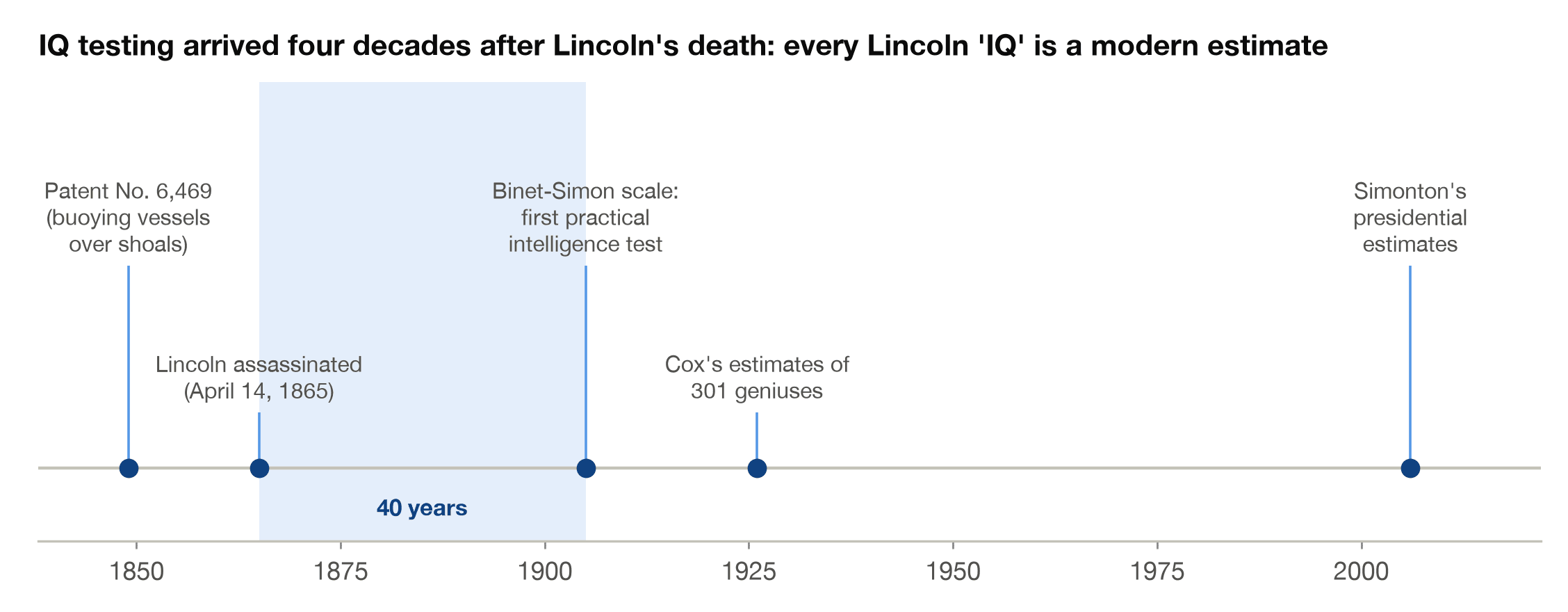
Abraham Lincoln never took an IQ test, so he has no real IQ score. The first practical intelligence test, the Binet-Simon scale of 1905, appeared four decades after his assassination at Ford's Theatre on April 14, 1865. The numbers that circulate online, usually somewhere between 125 and 150, are "historiometric" estimates: inferences drawn from biographical records, chiefly in Dean Keith Simonton's 2006 study of presidential intelligence. This article explains where those numbers come from, what evidence stands behind them, and how much weight they can bear.
An estimate, not a score
An IQ score is the output of a standardized test administered under controlled conditions. Lincoln died in 1865 and the Binet-Simon scale arrived in 1905, so no such measurement of him can exist. What researchers can do is study the documentary record of his life and ask how able a person would need to be to produce it. That method is called "historiometrics," the statistical analysis of historical and biographical data, and it yields estimates with real uncertainty attached rather than test results.
Where the Lincoln IQ numbers come from
Cox's 1926 study of 301 geniuses
The numbers trace to Catharine Cox's 1926 volume in the Genetic Studies of Genius series, which estimated the intelligence of 301 eminent historical figures. Cox compiled chronologies of childhood and adolescent achievements and looked for signs of intellectual precocity relative to the opportunities each person had. Lincoln was one of only eight presidents famous enough to make her sample.
Simonton's 2006 presidential estimates
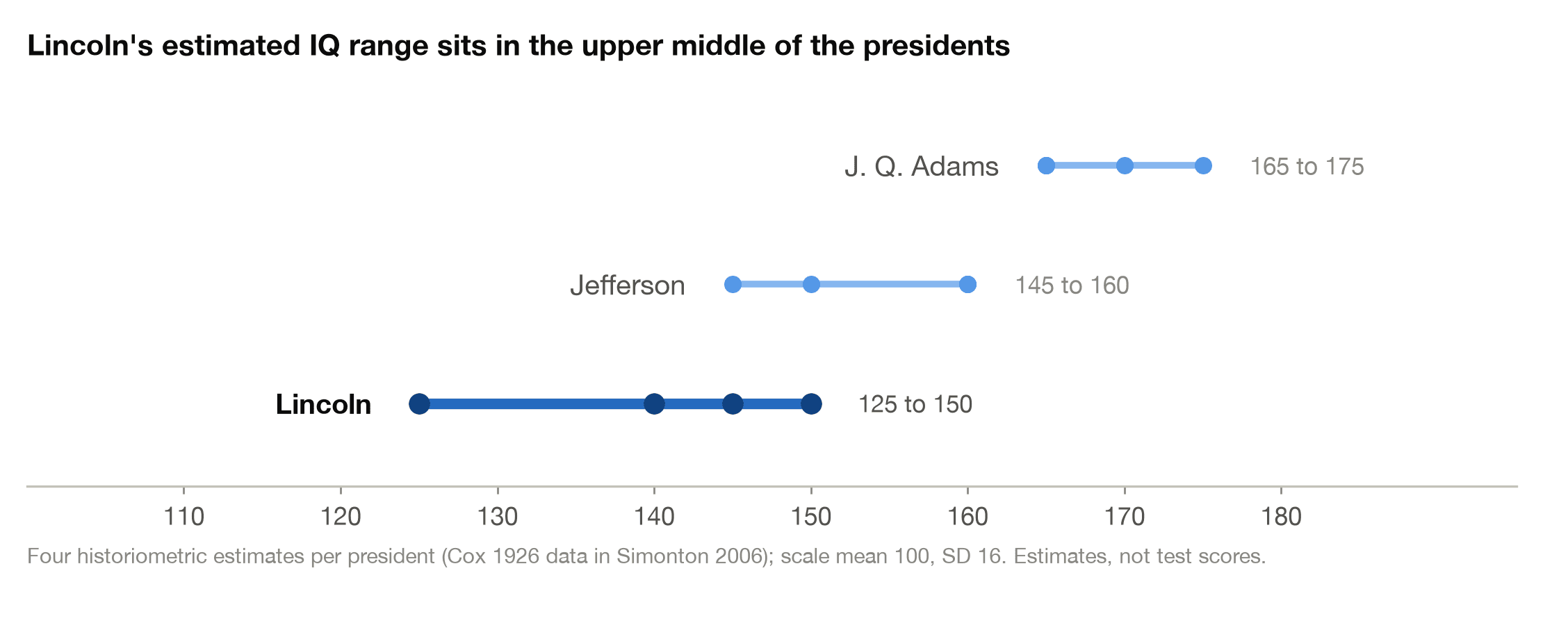
In 2006, the psychologist Dean Keith Simonton carried Cox's figures into a study of all 42 chief executives to that point, published in Political Psychology. His table reports four estimates for Lincoln: 125, 145, 140, and 150, on a scale with a mean of 100 and a standard deviation of 16. The four numbers cover two biographical periods (birth to age 17, and ages 18 to 26), each in an uncorrected version and a version statistically corrected for the reliability of the data. Simonton himself flags that the corrected figures "might be too high," which means the honest summary is a range of roughly 125 to 150, with the upper end the least certain part.
The evidence behind the estimate
Less than one year of schooling
What makes Lincoln's case remarkable is how little formal education sits underneath the record. In an 1860 autobiographical statement he reported that "the aggregate of all his schooling did not amount to one year," and that he was never a student in a college or academy. In an 1859 letter he put it plainly: when he came of age he could "read, write, and cipher to the Rule of Three," and nothing more. Everything beyond that was self-taught.
Euclid at midlife, and a patent
The self-education did not stop at law books. By his own account, he "studied and nearly mastered the six books of Euclid" after entering Congress, working through classical geometry as a sitting politician in his late thirties. In 1849 he received U.S. Patent No. 6,469 for a device for buoying vessels over shoals, and he is often described as the only president to hold a patent. Cox's method rewards exactly this pattern: unusual intellectual attainment relative to almost nonexistent opportunity is the signal her estimates were built to detect.
How Lincoln compares with other presidents
Within Simonton's table, Lincoln sits in the upper middle of the presidential distribution rather than at the top. John Quincy Adams carries the highest estimates (165 to 175), with Jefferson next (145 to 160). Lincoln's "Openness" score of 95 on a 0 to 100 scale, a personality dimension tied to intellectual curiosity, ranks third among the presidents, behind Jefferson (99.1) and John Quincy Adams (98). Our companion article on US presidents ranked by IQ walks through the full table and its limits.
What estimates like this can and cannot tell you
Historiometric estimates are serious scholarship, but they are not IQ tests. There is no standardized administration, the inputs are whatever biographers happened to record, and the corrected versions rest on modeling assumptions their own author questions. Listicle claims that "Lincoln's IQ was 140" take a single number out of this machinery and present it as a measurement, which it is not. The defensible conclusion is qualitative: converging evidence of well above average general ability, with no precise score. The same pattern holds for other historical figures, as our article on Albert Einstein's IQ shows, and our history of IQ tests explains why nobody born before the 20th century has a real score.
Frequently asked questions
What was Abraham Lincoln's IQ?
He never took an IQ test, so no real score exists. The most cited scholarly estimates, from Simonton's 2006 study building on Cox's 1926 work, put him at roughly 125 to 150 on a mean-100, SD-16 scale, depending on the estimation method.
Did Lincoln ever take an intelligence test?
No. The first practical intelligence test appeared in 1905, and Lincoln was assassinated in April 1865. Every number attached to him is a retrospective estimate built from biographical records.
Was Abraham Lincoln a genius?
His estimated range spans bright to gifted territory, and the qualitative record is extraordinary: under one year of schooling, self-taught law, and Euclid mastered in adulthood. Researchers treat him as clearly well above average, though estimates place John Quincy Adams and Jefferson higher.
How much schooling did Lincoln have?
By his own account, the total of all his formal schooling "did not amount to one year." He wrote that when he came of age he could read, write, and cipher to the Rule of Three, and that he never attended college.
Which president had the highest estimated IQ?
In Simonton's 2006 table, John Quincy Adams has the highest estimates (165 to 175), with Jefferson next (145 to 160). Lincoln's 125 to 150 places him in the upper middle of the presidential distribution.
The takeaway
Lincoln's intelligence needs no invented score. A man with under a year of schooling who taught himself law, geometry, and statecraft is strong evidence all by itself, and the scholarly estimates simply put cautious numbers on that evidence. If you want a number for yourself that is a measurement rather than an inference, a modern, properly normed assessment such as the Reasoning and Intelligence Online Test is the way to get one; you can take the RIOT IQ test here.
References
1. Simonton, D. K. (2006). Presidential IQ, openness, intellectual brilliance, and leadership: Estimates and correlations for 42 U.S. chief executives. Political Psychology, 27(4), 511-526. doi.org
2. Cox, C. M. (1926). Genetic studies of genius: Vol. 2. The early mental traits of three hundred geniuses. Stanford University Press. archive.org
3. National Park Service. (n.d.). Abraham Lincoln's autobiographies. Abraham Lincoln Birthplace National Historical Park. nps.gov
4. Lincoln, A. (1849). Buoying vessels over shoals (U.S. Patent No. 6,469). patents.google.com
5. Binet, A., & Simon, T. (1916). The development of intelligence in children (the Binet-Simon Scale) (E. S. Kite, Trans.). Williams & Wilkins. archive.org
6. Warne, R. T. (2020). In the know: Debunking 35 myths about human intelligence. Cambridge University Press. doi.org
Hero image: Abraham Lincoln by Alexander Gardner, November 8, 1863. Public domain, via Library of Congress / Wikimedia Commons.
Take our professional IQ test
Want to know your IQ? Try the first ever professional online IQ test.