What Was Leonhard Euler's IQ? Why Cox Skipped Him and What the Record Shows | Riot IQ
Nov 1, 2026·Famous People & IQ
What Was Leonhard Euler's IQ? Why Cox Skipped Him and What the Record Shows
Leonhard Euler's IQ was never tested, and he is not in Cox's 1926 genius study. The 180-to-200 figures online have no traceable source. Here is the record.
Dr. Russell T. WarneChief Scientist
Share
Leonhard Euler never took an IQ test, and no scholarly IQ estimate exists for him, because he is not among the subjects rated in Catharine Cox's 1926 study of historical geniuses. The figures of 180 to 200 that circulate online have no traceable source. Euler died in 1783, more than a century before Alfred Binet's first intelligence scale in 1905, so any number attached to him is a guess. This article explains why Cox left him out, what the documented record of his schooling and work shows, where the famous stories about his memory come from, and what his achievements can and cannot tell us about intelligence.
Is Euler in Cox's 1926 genius study?
No. For people born between 1450 and 1850, the usual citable IQ estimate comes from Cox's Genetic Studies of Genius, Volume II, in which raters read records of each subject's childhood and youth and judged what IQ would typically produce those achievements. Our article on Napoleon's IQ explains how that method, "historiometry," works.
Euler, born in Basel in 1707, met Cox's date rule. He is still absent from her master table of individual ratings (Table 12A), which runs from Erasmus to Etienne and then to Faraday, and he has no entry in the book's index of subjects. His name appears in the volume only as an author that other subjects read: John Stuart Mill was "studying Euclid and Euler" before age 9, and François Arago worked through Euler's books at 16.
The likely reason is a cutoff. Cox took her subjects from James McKeen Cattell's 1903 ranking of the 1,000 most eminent people in history, which measured eminence by the space each person received in biographical dictionaries. She dropped the hereditary aristocracy and anyone born before 1450, then struck out every name beyond the 510th place on Cattell's list. By our count of the published list, Euler sits right around the 510th place, at or just past that line. Cox never comments on him individually, so this explains his absence without implying any judgment about his ability.
Where the 180-to-200 numbers come from
I could not find a study, biography or historiometric paper that assigns Euler an IQ of 180, 190 or 200. These numbers appear on list-style websites and in online answers without citations, and they are copied from one list to the next. Some lists borrow the authority of Cox's study, but since Cox never rated Euler, no figure can come from her.
Numbers in the high 100s also mix up two different kinds of IQ. Cox's estimates used a "ratio IQ," mental age divided by actual age and multiplied by 100, which can produce very large values for children who were far ahead of their peers. Modern tests report "deviation IQs," which place a person relative to others of the same age on a bell curve with a mean of 100 and a standard deviation of 15. On that scale, 190 would be six standard deviations above the mean, a rarity that no test's norm sample can measure. Our explainer on what counts as a genius IQ score covers why scores at that height are not meaningful.
What the documented record shows
Euler's early life is well documented through his own short autobiography of 1767 and later biographies, summarized by Walter Gautschi (2008) and the MacTutor History of Mathematics archive.
• Home teaching: His father, Paul Euler, a Protestant minister who had attended Jakob Bernoulli's lectures, gave him his first lessons in mathematics. The Latin school in Basel was poor, so the family hired a private tutor who loved mathematics.
• University at 13: He enrolled at the University of Basel in October 1720, at 13, an age Gautschi notes was not unusual at the time. Johann Bernoulli declined to give him private lessons but told him to work through difficult books alone and offered him a weekly visit to clear up problems.
• Master's degree at 16: In 1723 he completed a master's degree with a public lecture comparing the natural philosophy of Descartes and Newton.
• Early recognition: By 1726 he had a paper in print, and his 1727 essay on the placement of ships' masts earned second place in the Paris Academy's prize competition. In April 1727, days before his 20th birthday, he left Basel for the St Petersburg Academy of Sciences.
• The Basel problem: In 1735 he found the exact sum of the reciprocals of the squares, π²/6, a problem that had defeated the Bernoullis and Leibniz.
• Work through blindness: His sight declined from the late 1730s, and after a failed cataract operation in 1771 he was almost entirely blind. About half of his scientific output was published or originated in his final St Petersburg period, from 1766 to 1783, with help from assistants and his son Johann Albrecht.
The scale of the output is documented too. The Swiss National Science Foundation described him in 2016 as "regarded as the most prolific mathematician ever to have lived," with two dozen books and almost 900 essays, and his collected works, the Opera omnia, have run to more than 70 large volumes since 1911.
The memory stories and where they come from
Several famous anecdotes about Euler's memory have a known source: the eulogy that the Marquis de Condorcet wrote for the Paris Academy of Sciences after Euler's death in 1783. Condorcet wrote that Euler knew Virgil's Aeneid by heart, and that a line of the poem gave him the first idea for a paper on mechanics. He also wrote that two of Euler's students, having summed 17 terms of a complicated converging series, disagreed by one unit in the 50th digit, and that Euler redid the entire calculation in his head and settled the dispute correctly.
These are eulogy stories told by admirers, so they deserve some caution. Gautschi points out one telling discrepancy. Nicolas Fuss, Euler's assistant and grandson-in-law, said Euler mentally worked out the first six powers of every number below 20 during a sleepless night. In Condorcet's version the table covers every number from 1 to 100. The core claim, an exceptional memory for numbers, appears in both accounts, while the details grew in the retelling.
What Euler's achievements do and do not say about IQ
Euler's work required abstract reasoning of the highest order, and the accounts of his memory appear in more than one contemporary source. It is reasonable to infer that he would have scored far above average on a modern test of general reasoning. Spearman's 1904 finding that performance across different kinds of mental tasks tends to correlate positively fits a man who did important work in number theory, mechanics, optics and astronomy alike.
A specific number is another matter. Historiometric estimates rate the surviving documents more than the person, and Cox herself found that subjects with fuller records received higher estimates. Euler's output also depended on things an IQ test does not measure, including nearly six decades of steady work, supportive academies in St Petersburg and Berlin, and capable assistants in his blind years. The same caution applies to his younger contemporary Carl Friedrich Gauss, who is also missing from Cox and also attracts invented scores. IQ tests compare a person with others of the same age who took the same test, so ranking the great minds of past centuries against each other is outside what any test can do.
Frequently asked questions
What was Leonhard Euler's IQ?
Nobody knows. Euler was never tested, and he is not among the subjects Cox rated in her 1926 study, the usual source for historical IQ estimates. No scholarly work assigns him a number.
Is Euler in Cox's study of 300 geniuses?
No. Cox kept only names within the first 510 of Cattell's 1903 eminence list, and by our count Euler falls right around that cutoff. He appears in her book only as an author that other subjects, such as John Stuart Mill, read as children.
Was Euler really blind when he did much of his work?
He lost most of his sight after a cataract operation in 1771 and was nearly blind for his last 12 years. About half of his scientific output dates from his final St Petersburg period, with assistants writing out his work.
Did Euler really know the *Aeneid* by heart?
His eulogist Condorcet said so in 1783, and Euler's assistant Nicolas Fuss also described his remarkable memory. The story is plausible but comes from admirers writing after his death.
How old was Euler when he went to university?
He enrolled at the University of Basel in October 1720 at 13 and completed a master's degree in 1723.
The takeaway
Euler is one of the most productive mathematicians in history, and he has no scholarly IQ estimate at all: Cox's cutoff fell just before his name, so every Euler IQ number online is invented. The documented record, from a university place at 13 to decades of work through blindness, says more about him than a three-digit figure could. If you want a score that comes from measurement rather than legend, try an online IQ test built by psychometricians.
References
1. Cox, C. M. (1926). Genetic studies of genius: Vol. II. The early mental traits of three hundred geniuses. Stanford University Press. [archive.org](. archive.org
2. Cattell, J. M. (1903). A statistical study of eminent men. Popular Science Monthly, 62, 359-377. [en.wikisource.org](. en.wikisource.org
3. Gautschi, W. (2008). Leonhard Euler: His life, the man, and his works. SIAM Review, 50(1), 3-33. [doi.org/10.1137/070702710](. doi.org
4. Condorcet, J.-A.-N. de Caritat, marquis de. (1847). Éloge de M. Euler. In A. Condorcet O'Connor & F. Arago (Eds.), Oeuvres de Condorcet (Vol. 3, pp. 1-42). Firmin Didot. [archive.org](. archive.org
5. O'Connor, J. J., & Robertson, E. F. (1998). Leonhard Euler. MacTutor History of Mathematics Archive, University of St Andrews. [mathshistory.st-andrews.ac.uk](. mathshistory.st-andrews.ac.uk
6. Plüss, M. (2016, June 20). The Mozart of mathematics. Horizons, Swiss National Science Foundation. [snf.ch](. snf.ch
7. Spearman, C. (1904). "General intelligence," objectively determined and measured. The American Journal of Psychology, 15(2), 201-292. [doi.org/10.2307/1412107](. doi.org
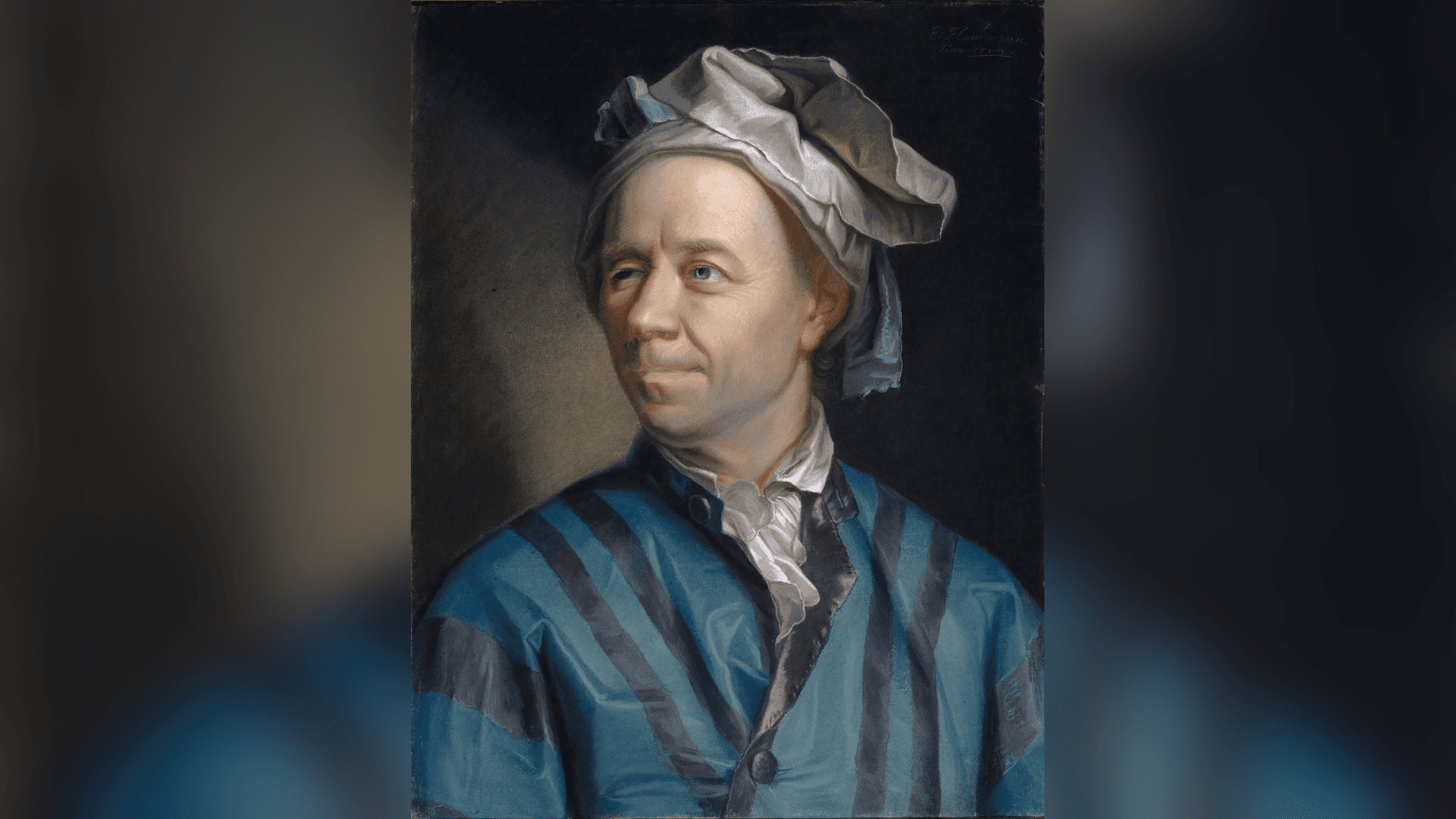
Hero image: Leonhard Euler by Jakob Emanuel Handmann (1753), Kunstmuseum Basel. Public domain, via Wikimedia Commons.
Take our professional IQ test
Want to know your IQ? Try the first ever professional online IQ test.