Robin Williams's IQ was never publicly tested or verified. The famous 140 figure has no primary source at all. Here is what we really know about his mind.
Dr. Russell T. WarneChief Scientist
Share
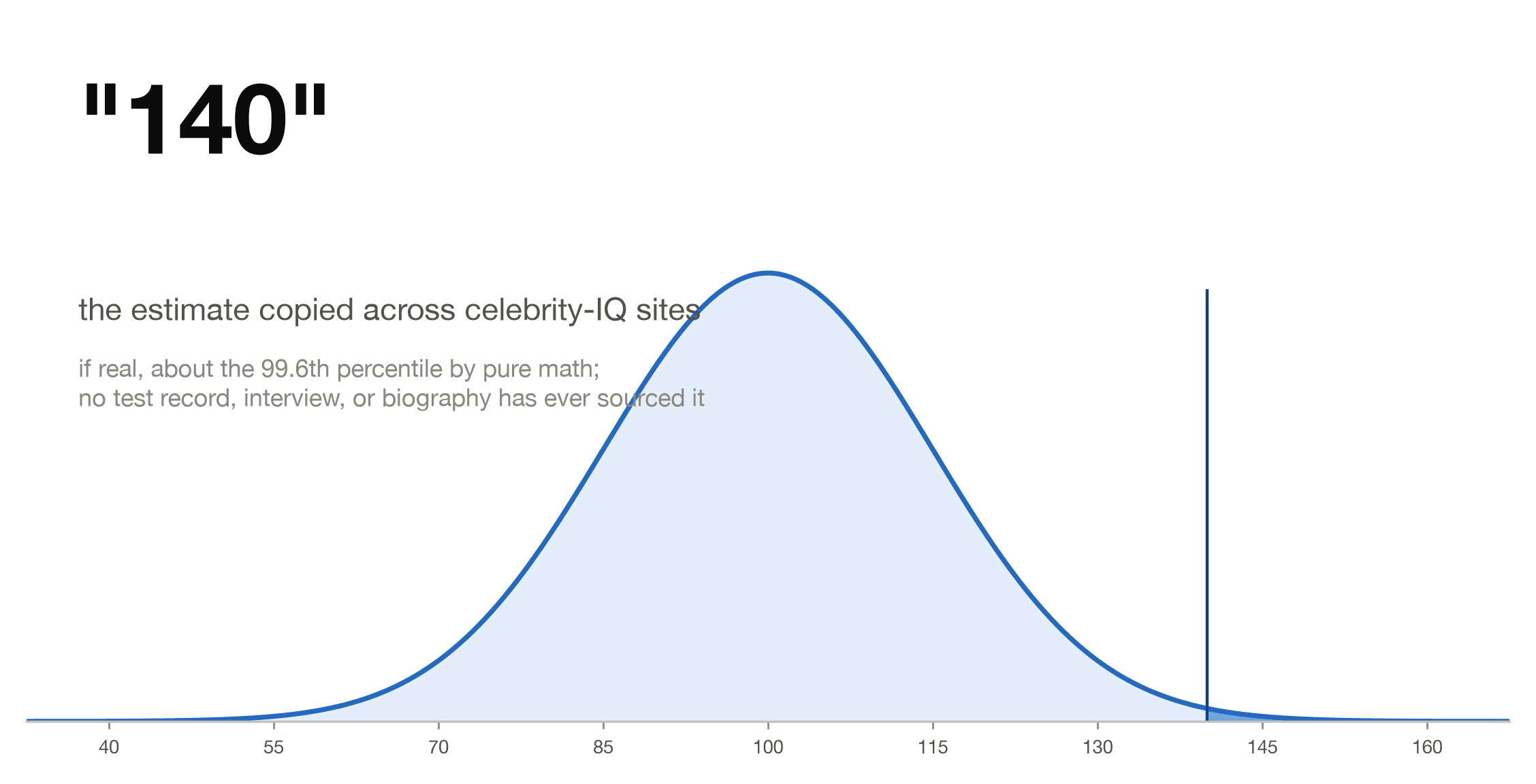
Robin Williams never took a publicly documented IQ test, so no verified IQ score for him exists. The figure of 140 that circulates on celebrity-IQ websites is an estimate, copied from site to site, and none of those sites has ever produced a test record, an interview, or a biography citation to back it. What is documented is better than a number: one of the most inventive comic minds of his era, trained at Juilliard, honored with an Oscar, and mourned by neurologists who later learned what had attacked it.
Where the "IQ of 140" claim comes from
Search his name alongside IQ and the 140 appears quickly, usually in the same hedged wording: it is "estimated" that he had an IQ of 140. The word estimated is doing all the work. No celebrity-IQ site names a test, a date, or a source, and the sites plainly copy one another, which is how an invented number acquires the look of a settled fact. Across four decades of interviews, no exchange has surfaced in which Williams reported a score.
Some versions bolster the number with a story that a teacher at Juilliard called him a genius. Even if such a compliment was paid, it is praise for talent, and praise is a different kind of fact from a percentile. "Genius" has no scientific definition and no IQ category carries the label; our article on what a genius IQ score means explains how the term drifted from psychology into publicity.
The documented brilliance of Robin Williams
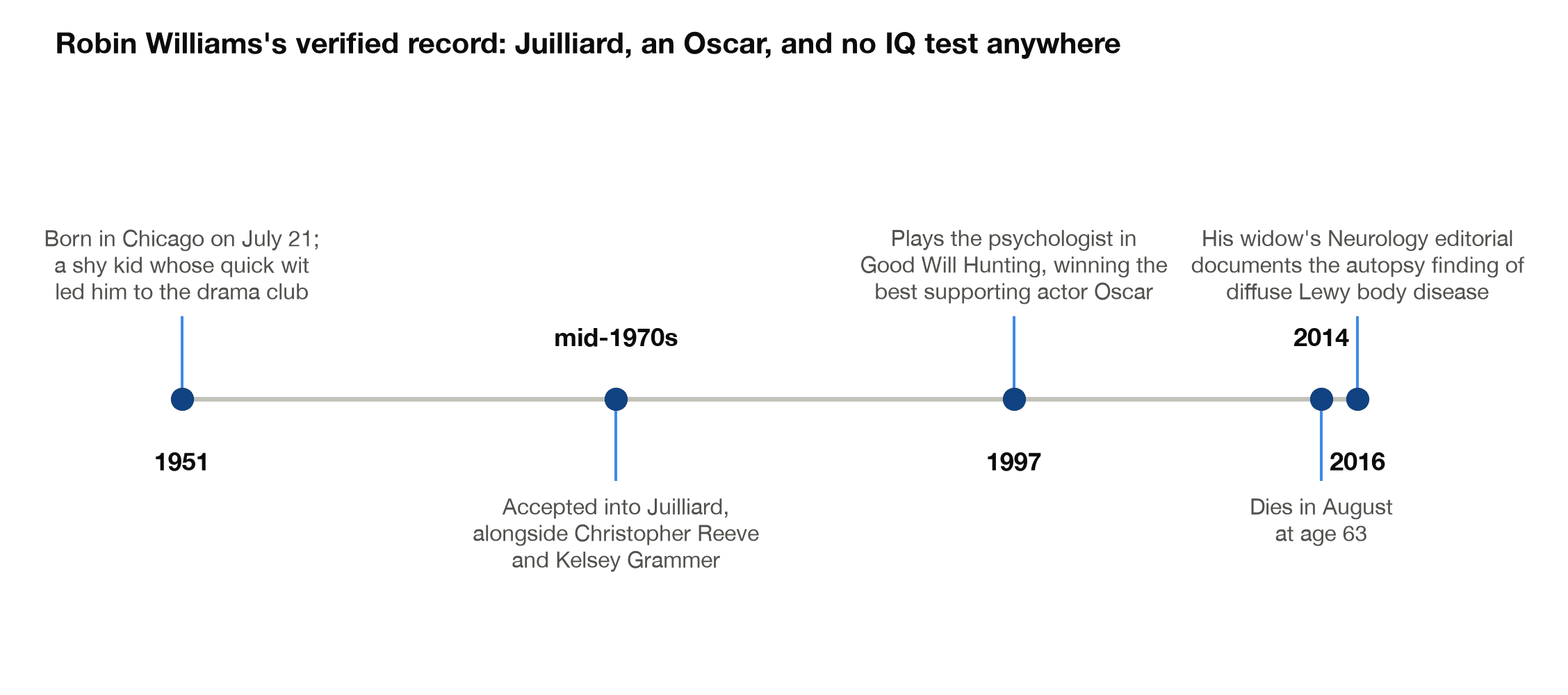
Born on 21 July 1951 in Chicago, Illinois, Williams developed a quick wit as a way of overcoming shyness and built his confidence in his school's drama club. In the mid-1970s he was accepted into New York's Juilliard School, where his contemporaries included Christopher Reeve and Kelsey Grammer and his teachers included the distinguished actor John Houseman.
His breakthrough came from a cameo on Happy Days as an alien called Mork, a part that inspired the spin-off Mork and Mindy. From there the record is familiar: stand-up sets and film roles powered by frenetic energy, quick-fire improvisation, and an ability to mimic almost anyone. Formal recognition arrived with the best supporting actor Oscar for his performance as a sympathetic yet troubled psychologist in 1997's Good Will Hunting.
What science says about humor and intelligence
There is a real scientific reason people assume Williams's IQ was high. In a 2011 study in the journal Intelligence, Greengross and Miller found that people who produced funnier material also scored higher on intelligence measures, with the strongest link running through verbal intelligence. Humor production is cognitively demanding work: it requires generating remote associations quickly, modeling an audience, and editing in real time, which is a fair description of a Williams stand-up set.
A correlation licenses a direction, and no more. Funnier people score higher on average; it does not follow that any particular comedian holds any particular score. Improvisational speed of Williams's kind plausibly reflects high verbal ability, and that is as far as honest inference goes. Creativity and measured intelligence are related and distinct, a boundary we explore in our article on IQ versus creativity.
His final years: Lewy body disease, not lost intelligence
Williams died in August 2014, in an apparent suicide, at the age of 63. The autopsy found something his doctors had not diagnosed in life: diffuse Lewy body disease, a neurodegenerative condition that disrupts thinking, mood, movement, and perception. His widow, Susan Schneider Williams, described the ordeal in a 2016 editorial in the journal Neurology titled "The terrorist inside my husband's brain," written so that clinicians might recognize the disease sooner in other patients.
The diagnosis matters to this article for one reason: it concerns the final years of his life, and it concerns disease. It says nothing about the intelligence he displayed across his career, and it should never be read backward into it.
Why real IQ scores require real tests
Intelligence researcher Russell T. Warne draws the relevant line in his book In the Know: IQ is a reliable, valid measurement when an actual standardized test is administered, and retrospective "estimates" for people who never released scores are guesswork. Posthumous numbers are the weakest kind of all, since the one person who could sit for a test no longer can.
• An estimate is not a measurement: A real score comes from a named test, administered and scored under standard conditions. The 140 has none of that.
• Talent points, tests measure: Williams's verbal gifts make high ability plausible. Only an instrument with norms could have said how high.
• Unverified numbers stay unverified: Repetition across listicles adds copies, and adds nothing else. The same holds for Steve Jobs's IQ, another famous mind with no verified score.
For the living, the question is answerable. A properly normed instrument such as the Reasoning and Intelligence Online Test reports where a score stands against modern norms, with measurement error stated rather than hidden; RIOT IQ offers a free IQ test for anyone who prefers data to folklore.
Frequently asked questions
What was Robin Williams's IQ?
Robin Williams never took a publicly documented IQ test, so his IQ is unknown. The 140 that appears on celebrity-IQ sites is an estimate copied from site to site with no primary source. His verified record shows extraordinary comic and verbal talent, not a specific score.
Was Robin Williams a genius?
In the everyday sense, many colleagues and critics called him one, especially for his improvisation. In the psychometric sense, "genius" is not an official IQ category and no test score exists for him. Research does show that humor production correlates with measured intelligence, so his gifts likely reflected high verbal ability.
Did Robin Williams go to Juilliard?
Yes. In the mid-1970s he was accepted into New York's Juilliard School, where he studied alongside Christopher Reeve and Kelsey Grammer and was taught by the actor and producer John Houseman. He left before completing the program to pursue comedy.
What illness did Robin Williams have?
After his death in August 2014, an autopsy found diffuse Lewy body disease, a neurodegenerative condition that disrupts thinking, mood, movement, and perception. His widow described the diagnosis in a 2016 editorial in the journal Neurology. It was a late-life disease and says nothing about the intelligence he showed across his career.
Does being funny mean you have a high IQ?
There is a real association. A 2011 study in the journal Intelligence found that people who produced funnier material scored higher on intelligence measures, particularly verbal intelligence. Humor is not an IQ test, but quick, original wit of the kind Williams displayed draws on the same cognitive abilities.
The bottom line
Robin Williams's IQ was never measured in public, and the 140 attached to his name is an estimate with no source. The verified record is richer than the rumor: Juilliard, Mork, an Oscar, and a speed of invention that research on humor and intelligence suggests ran on formidable verbal ability. Some minds are best described by their work. His is one.
References
1. BBC News. (2014, August 12). Obituary: Robin Williams.bbc.com
2. Williams, S. S. (2016). The terrorist inside my husband's brain. Neurology, 87(13), 1308-1311. pubmed.ncbi.nlm.nih.gov
3. Greengross, G., & Miller, G. (2011). Humor ability reveals intelligence, predicts mating success, and is higher in males. Intelligence, 39(4), 188-192. doi.org
4. Warne, R. T. (2020). In the know: Debunking 35 myths about human intelligence. Cambridge University Press. doi.org
Hero image: Robin Williams performs at a USO holiday tour show at Camp Victory, Iraq, December 13, 2010. U.S. Army photo, public domain, via Wikimedia Commons.
Take our professional IQ test
Want to know your IQ? Try the first ever professional online IQ test.