Who Was William James Sidis? America's Forgotten Prodigy
William James Sidis entered Harvard at 11 and was said to have an IQ of 250 to 300. The story behind that number is stranger and sadder than the legend.
Dr. Russell T. WarneChief Scientist
Share
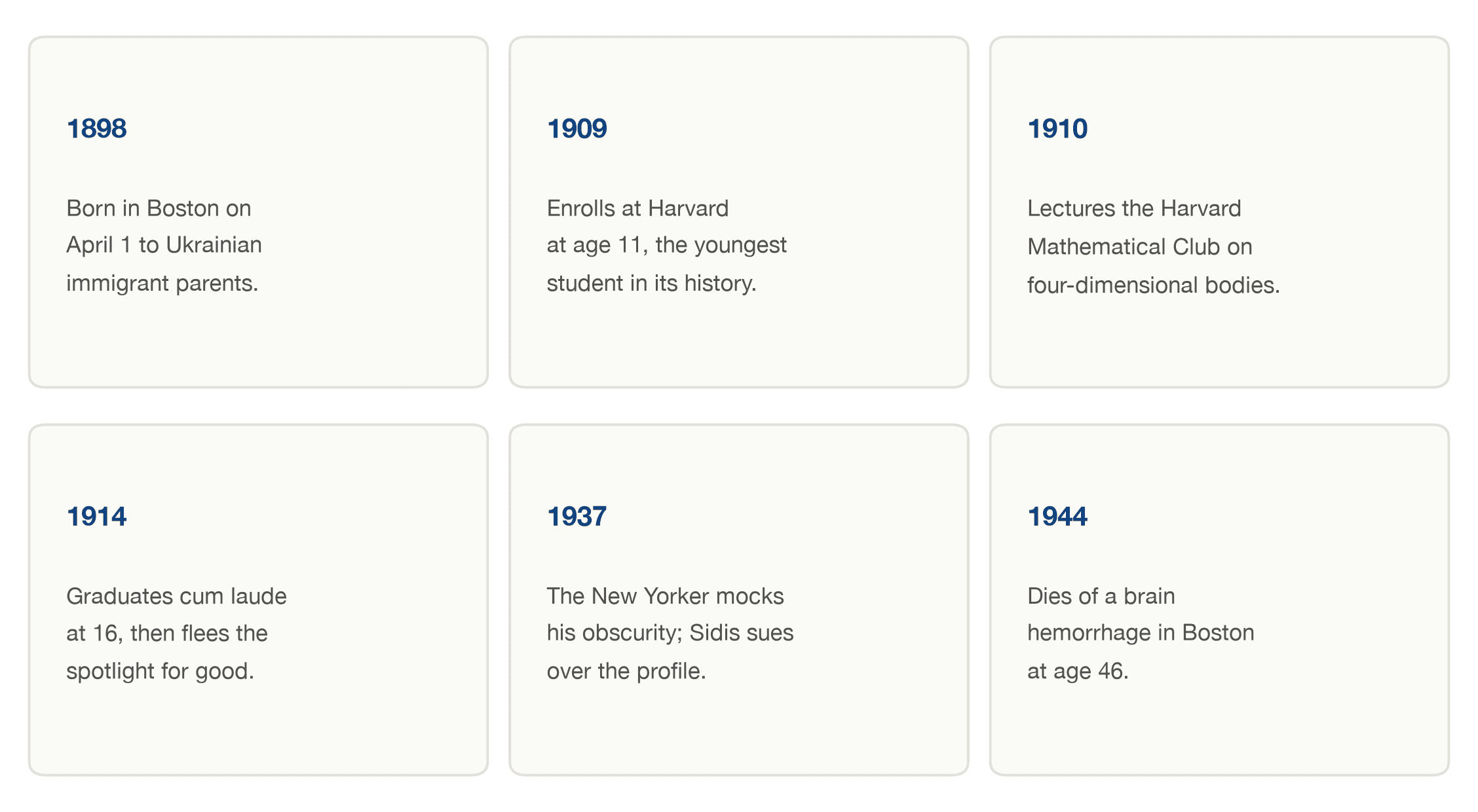
William James Sidis (1898-1944) was an American child prodigy who enrolled at Harvard in 1909 at age 11, the youngest student in the university's history at that time. The claim that he had "an IQ of 250 to 300" appeared two years after his death, in a 1946 book relaying secondhand family hearsay, and names no test, no date, and no examiner. Sidis's documented life needs no inflation: it is one of the most remarkable, and most cautionary, prodigy stories on record.
A childhood engineered for genius
Sidis was born in Boston on April 1, 1898, to Ukrainian Jewish immigrant parents. His father, Boris Sidis, was a Harvard-trained psychologist who believed early, intensive education could manufacture extraordinary ability, and he treated his son as the demonstration. The regimen worked, at least on its own terms: by the time William was eight he had reportedly worked through grade school in well under the usual time, and languages and mathematics came to him startlingly fast.
Harvard at eleven
In 1909, at age 11, Sidis enrolled at Harvard. In January 1910 he delivered a lecture on four-dimensional bodies to the Harvard Mathematical Club, an audience of roughly one hundred professors and advanced students, and the newspapers made him a national celebrity. He graduated with his bachelor's degree, cum laude, on June 18, 1914, at age 16.
What followed was not the career the headlines predicted. He taught mathematics briefly at Rice Institute in Texas, entered Harvard Law School, and withdrew. In 1919 he was arrested at a socialist May Day demonstration in Boston and sentenced to 18 months under the Sedition Act; his parents intervened to keep him out of prison. Afterward he chose obscurity deliberately, working clerical jobs, operating adding machines, and writing books under pseudonyms.
Where the 250 to 300 figure comes from
The famous number has exactly one source. In 1946, two years after Sidis died, psychologist Abraham Sperling published Psychology for the Millions, which relays a claim from Sidis's sister Helena that a psychologist had once told her William's IQ "would be between 250 and 300." No test is named, no date is given, and no record of any such administration exists. Researchers who have examined the family's accounts note a documented pattern of exaggeration; the most likely seed of the legend is a 1933 New York Civil Service exam on which Sidis's placement on the hiring list, 254th, appears to have been retold as an IQ of 254.
It is worth being precise about what an IQ in that range would even mean. On the modern scale, scores are anchored to a mean of 100 with a standard deviation of 15, and no standardized test measures beyond roughly 160; we explain why in our guide to genius IQ scores. A deviation score of 250 would be ten standard deviations above average, a rarity with no meaning in a species of eight billion. The number is folklore wearing a lab coat.
The retreat from fame
Sidis spent his adult life avoiding the spotlight that defined his childhood. When The New Yorker ran a mocking 1937 profile of his obscurity titled "April Fool!", he sued. The Second Circuit ruled against his privacy claim in 1940, holding that a former public figure remains newsworthy, a decision still cited in American privacy law; he later settled a related libel claim. He died of a brain hemorrhage in Boston in 1944, at 46, poor and largely forgotten.
His biographer Amy Wallace, whose 1986 book The Prodigy remains the standard account, found a man who never stopped thinking or writing, but who wanted no part of being a public specimen. Modern research on profoundly gifted children reads his case differently than the newspapers did: the failure was not in the child, but in an upbringing and a press that treated him as an exhibit.
What Sidis teaches about prodigy and measurement
• Documented feats beat undocumented numbers: Harvard at 11 and the 1910 lecture are contemporaneously recorded facts. The 250-300 IQ is postmortem hearsay. Only one of these tells you anything reliable.
• Extreme childhood precocity is not a life plan: Follow-up research on children with ratio IQs above 180 finds accomplished but recognizably ordinary adult lives far more often than world-historical eminence.
• A score is not a destiny: Sidis chose quiet work and private interests. By his own account that was the point, not the tragedy the newspapers wanted.
Unknown. No documented IQ test of Sidis exists. The 250-300 figure comes from secondhand family hearsay published in 1946, two years after his death, and names no test or examiner.
Was Sidis the smartest person ever?
There is no measurement that could establish that. His documented achievements place him among history's most precocious children, which is a different and better-founded claim.
What happened to Sidis as an adult?
He deliberately avoided publicity, worked clerical jobs, wrote under pseudonyms on subjects from streetcar transfers to Native American history, and died of a brain hemorrhage in 1944 at age 46.
How many languages did Sidis speak?
Contemporary accounts credit him with facility in many languages, with claims running to 25 or more. Like much Sidis lore these totals trace to family reports and should be treated as unverified.
Did Sidis regret his upbringing?
He never published a memoir, but his lifelong flight from fame, and his lawsuit against The New Yorker for profiling him, speak clearly enough about how he felt about life as a public prodigy.
The takeaway
Sidis's genuine story is extraordinary without the invented number attached to it. If there is a lesson in his life for anyone curious about their own ability, it is that real measurement beats legend: a properly normed instrument such as the Reasoning and Intelligence Online Test from RIOT IQ will tell you where you actually stand, with error bars, which is more than the Sidis legend can say for itself.
References
1. Montour, K. (1977). William James Sidis, the broken twig. American Psychologist, 32(4), 265-279. doi.org
2. Wallace, A. (1986). The prodigy: A biography of William James Sidis, America's greatest child prodigy. E.P. Dutton. archive.org
3. Sperling, A. P. (1946). Psychology for the millions. Frederick Fell. archive.org
4. NPR. (2011, January 23). Meet William James Sidis: The smartest guy ever? All Things Considered. npr.org
6. Feldman, D. H. (1984). A follow-up of subjects scoring above 180 IQ in Terman's "Genetic Studies of Genius." Exceptional Children, 50(6), 518-523. doi.org
Hero image: William James Sidis at his 1914 Harvard graduation. Public domain, via Wikimedia Commons.
Take our professional IQ test
Want to know your IQ? Try the first ever professional online IQ test.