JFK's IQ is one of the few presidential scores actually on record: he scored 119 on a school-administered test before Choate. Here is the documented story.
Dr. Russell T. WarneChief Scientist
Share
John F. Kennedy scored 119 on an intelligence test taken before he entered Choate, his preparatory school, according to biographer Thomas C. Reeves, who reviewed Kennedy's own school records. That makes JFK one of the very few American presidents with a genuinely documented IQ score. On a modern scale, 119 sits at about the 90th percentile, clearly above average. The far higher figure that circulates online, 159.8, is a statistical estimate published in 2006, and no test of any kind sits behind it. This article covers the documented score, what it means, and how the inflated number was manufactured.
The documented score: 119 before Choate
Almost every presidential IQ figure you will ever see is a guess. Kennedy is the exception. He entered Choate, in Wallingford, Connecticut, in the fall of 1931, after attending Riverdale Country School and spending a year at Canterbury, and a school-administered intelligence test from that period survives in his records. Reeves, author of the 1991 biography A Question of Character, put it plainly: "Kennedy was actually given an IQ test before entering Choate. His score was 119."
The test is widely reported as an Otis group intelligence test, an attribution that traces to Nigel Hamilton's 1992 biography JFK: Reckless Youth, which drew on the same school records. Whatever the exact instrument, the 119 is the rare presidential IQ number with actual paper behind it.
What a 119 actually means
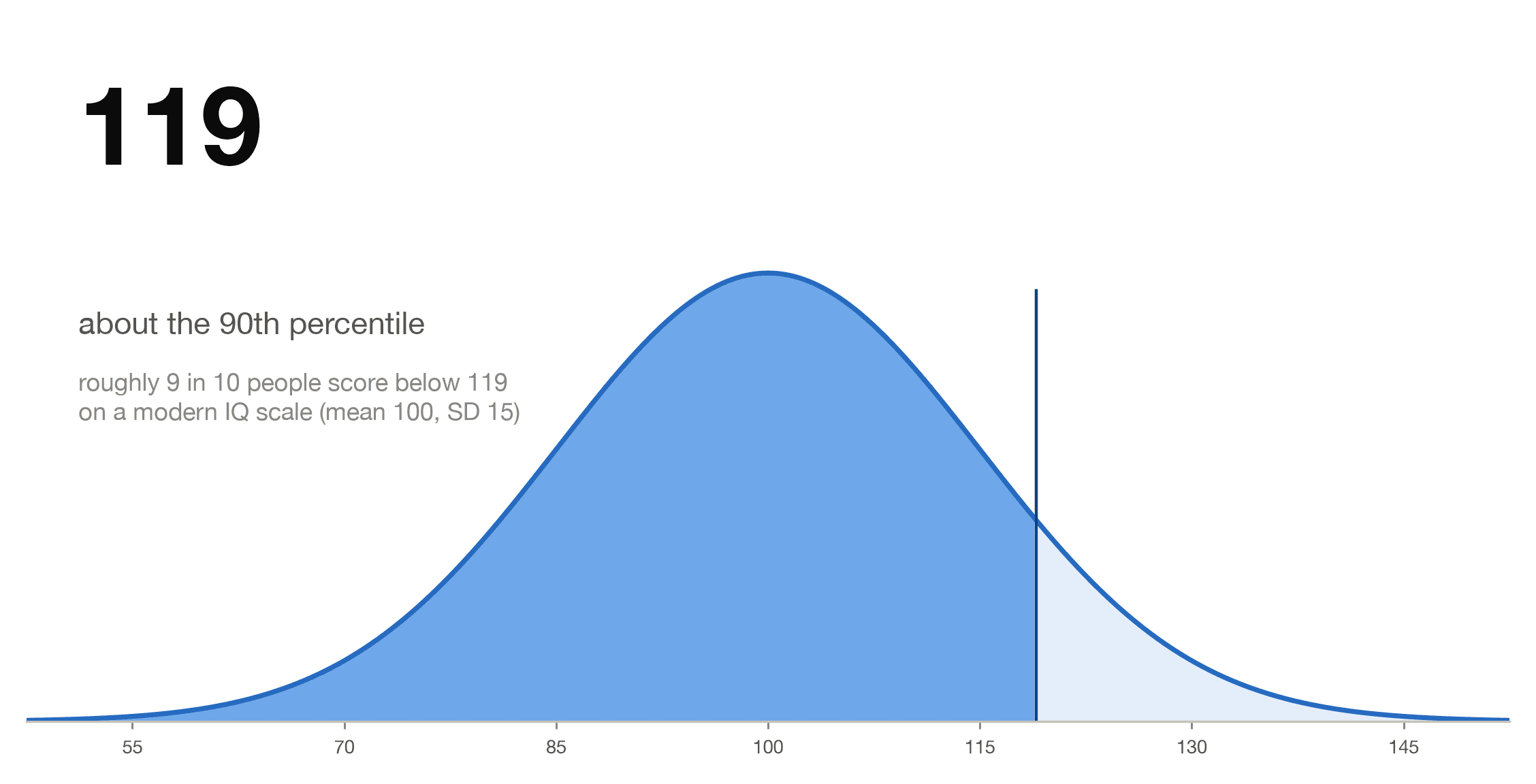
Modern tests report "deviation IQs," scores placed on a bell curve with a mean of 100 and a standard deviation of 15. On that scale, 119 lands around the 90th percentile: roughly nine in ten people score below it. It falls in the high average to superior band, typical of successful professionals, and entirely consistent with Kennedy's Harvard degree and Pulitzer-winning writing career. It is well short of the 130s and 140s discussed in our guide to genius IQ scores, and nothing about his record suggests it should have been otherwise.
The honest caveats cut both ways. This was one group-administered school test taken by a teenager around 1930 or 1931, cruder than a modern individually administered battery, and norms from that era differ from today's. Every single score also carries "measurement error," the small variation you would see across repeat testings. So read the 119 as a band, roughly high average to superior, rather than a precise lifelong number. It is still infinitely more evidence than any retrospective estimate.
Where the "JFK IQ 159.8" number comes from
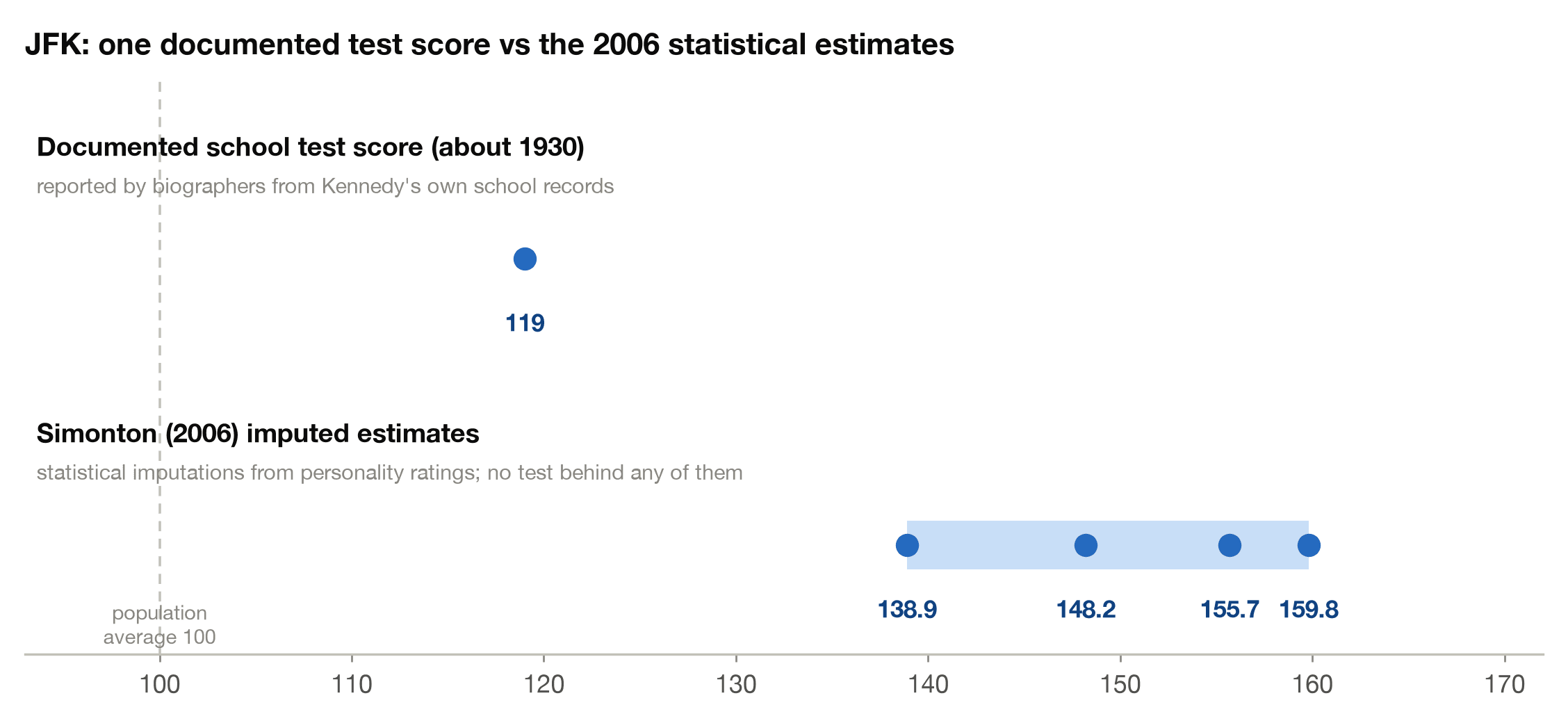
In 2006, psychologist Dean Keith Simonton published estimated IQs for all 42 then-serving-or-past chief executives in the journal Political Psychology. The method was statistical, applying "expectation-maximization" missing-data estimation to three published data sets: Catharine Cox's 1926 IQ estimates (which covered only 8 presidents), ratings of "Intellectual Brilliance," and biographer-rated Openness to Experience. Kennedy, born in 1917, was not in Cox's sample. All four of his values in Simonton's table (138.9, 148.2, 155.7, and 159.8) are imputed, meaning the model filled them in from the personality ratings. The famous 159.8 is the most derived number in the whole table, resting mainly on Kennedy's rated brilliance and Openness rather than on anything he ever answered under test conditions. The scale also uses a standard deviation of 16, slightly different from modern tests.
The biographer who checked the records rejected the estimate directly. Reeves wrote: "There is no evidence to support the claim that his score should have been more than 40 points higher." Of the estimation enterprise as a whole he added, "In my judgment, this study has little if any value."
Tested scores vs historiometric estimates
The 2006 study belongs to a field called "historiometry," which applies statistical methods to retrospective biographical data. Its founding document is Cox's 1926 Stanford study, which estimated IQs for 301 eminent historical figures by having raters read their childhood records. Cox herself flagged the method's central bias: "The more complete the record the higher the average IQ for any considerable group in our study." An estimate tracks the paper trail as much as the person. Our ranking of US presidents by IQ covers the full Simonton table with these warnings attached, and our article on Albert Einstein's IQ shows the same pattern applied to science's most famous name. The house position is simple: a number without a documented test behind it is not a datum.
Does 119 fit the man?
Nothing in Kennedy's documented life argues with the score. A 90th-percentile teenager who reads voraciously, gets into Harvard, and matures into a Pulitzer-winning writer and wartime officer is a coherent story; it requires no secret 40 extra points. Reeves adds a striking aside from the same records review: Lee Harvey Oswald, Kennedy's assassin, once scored 118. Two men separated by one IQ point occupied utterly different places in history, which is the cleanest illustration you could ask for that an IQ score describes reasoning ability and decides nothing else about a life.
Frequently asked questions
What was JFK's IQ?
John F. Kennedy scored 119 on an intelligence test administered before he entered Choate, according to biographer Thomas C. Reeves, who reviewed his records. That is roughly the 90th percentile, and one of the very few documented presidential IQ scores.
Was JFK's IQ really 159.8?
No. The 159.8 comes from Simonton's 2006 study, where it is a statistical estimate imputed from personality ratings rather than a test result. Kennedy's documented school score was 119, and Reeves notes there is no evidence for a number 40 points higher.
Is an IQ of 119 good?
Yes. On modern tests, 119 falls around the 90th percentile, in the high average to superior range. It is typical of successful professionals and entirely consistent with Kennedy's Harvard degree and Pulitzer Prize.
Which president had the highest IQ?
Among estimates, Simonton's 2006 study put John Quincy Adams highest, at up to 175, but those are historiometric estimates rather than tests. Among documented scores, few presidents have any public record at all, which is why JFK's 119 stands out.
Did any other president take a real IQ test?
Almost all presidents either predate IQ testing or never released scores, which is why researchers fall back on estimates. JFK's 119 is the clearest documented presidential score reported by biographers from actual school records.
How accurate was an IQ test from the 1930s?
Group tests of that era were reliable enough for schools but cruder than modern individually administered batteries, and norms have shifted since. A single teenage group test should be read as a rough band, not a precise lifelong number.
The takeaway
Kennedy's 119 is worth more than every estimated presidential IQ combined, because it is the one number a test actually produced. If you want a number of your own with the same property, a modern, professionally built assessment such as the Reasoning and Intelligence Online Test reports deviation scores with stated precision. You can start with the free RIOT IQ test and get a result that, unlike 159.8, has a test behind it.
2. Simonton, D. K. (2006). Presidential IQ, openness, intellectual brilliance, and leadership: Estimates and correlations for 42 U.S. chief executives. Political Psychology, 27(4), 511-526. acsu.buffalo.edu
3. Reeves, T. C. (1991). A question of character: A life of John F. Kennedy. Free Press. archive.org
4. Hamilton, N. (1992). JFK: Reckless youth. Random House. archive.org
5. Cox, C. M. (1926). Genetic studies of genius: Vol. II. The early mental traits of three hundred geniuses. Stanford University Press. archive.org
6. Warne, R. T. (2020). In the know: Debunking 35 myths about human intelligence. Cambridge University Press. doi.org/10.1017/9781108593298
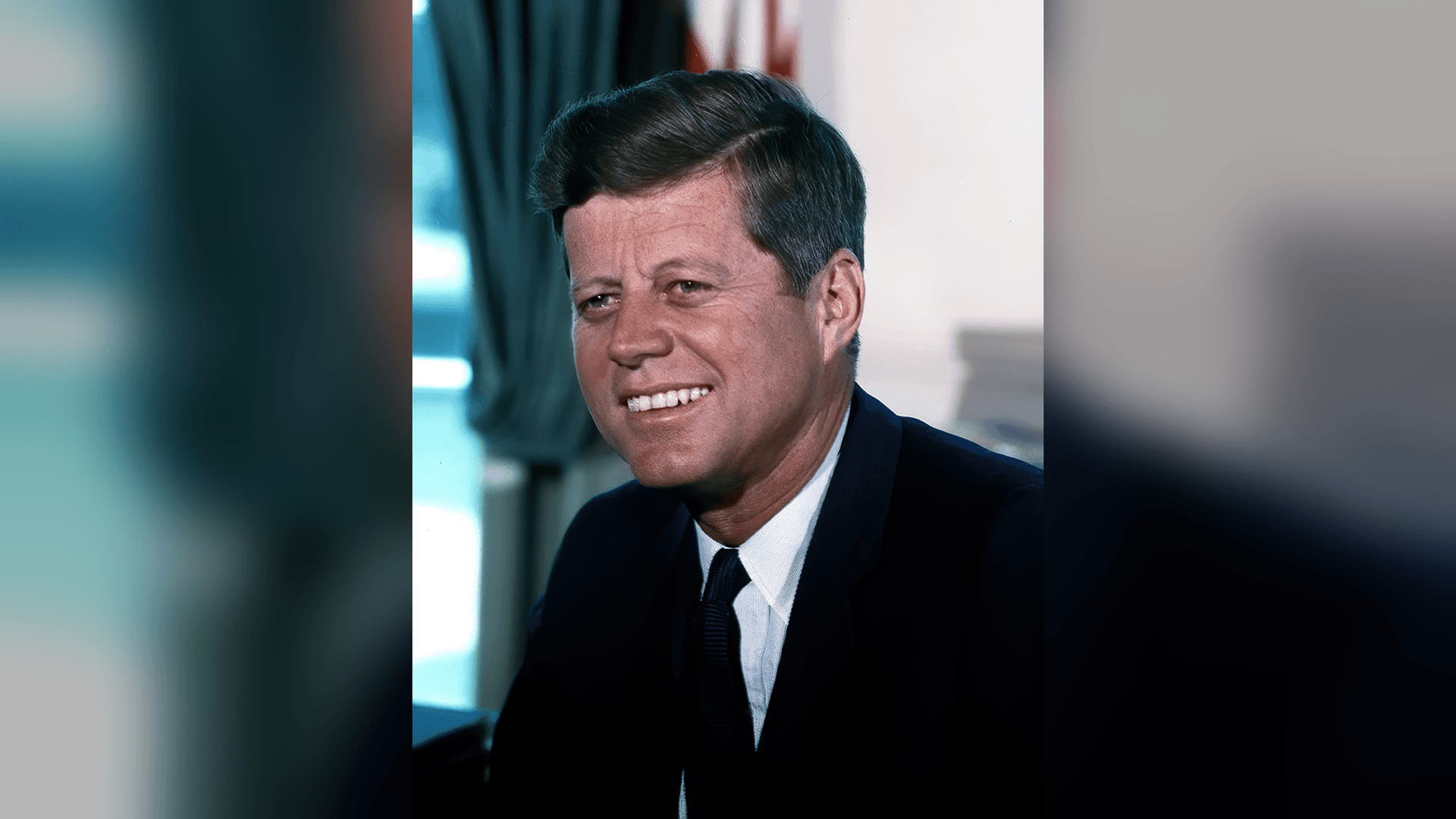
Hero image: Cecil Stoughton, White House, public domain, via Wikimedia Commons.
Take our professional IQ test
Want to know your IQ? Try the first ever professional online IQ test.