What Is Lady Gaga's IQ? The Truth About the "166" Rumor
Lady Gaga's IQ is often listed as 166, but no verified score exists. Here is what her NYU Tisch record really shows, and what the science of IQ says.
Dr. Russell T. WarneChief Scientist
Share
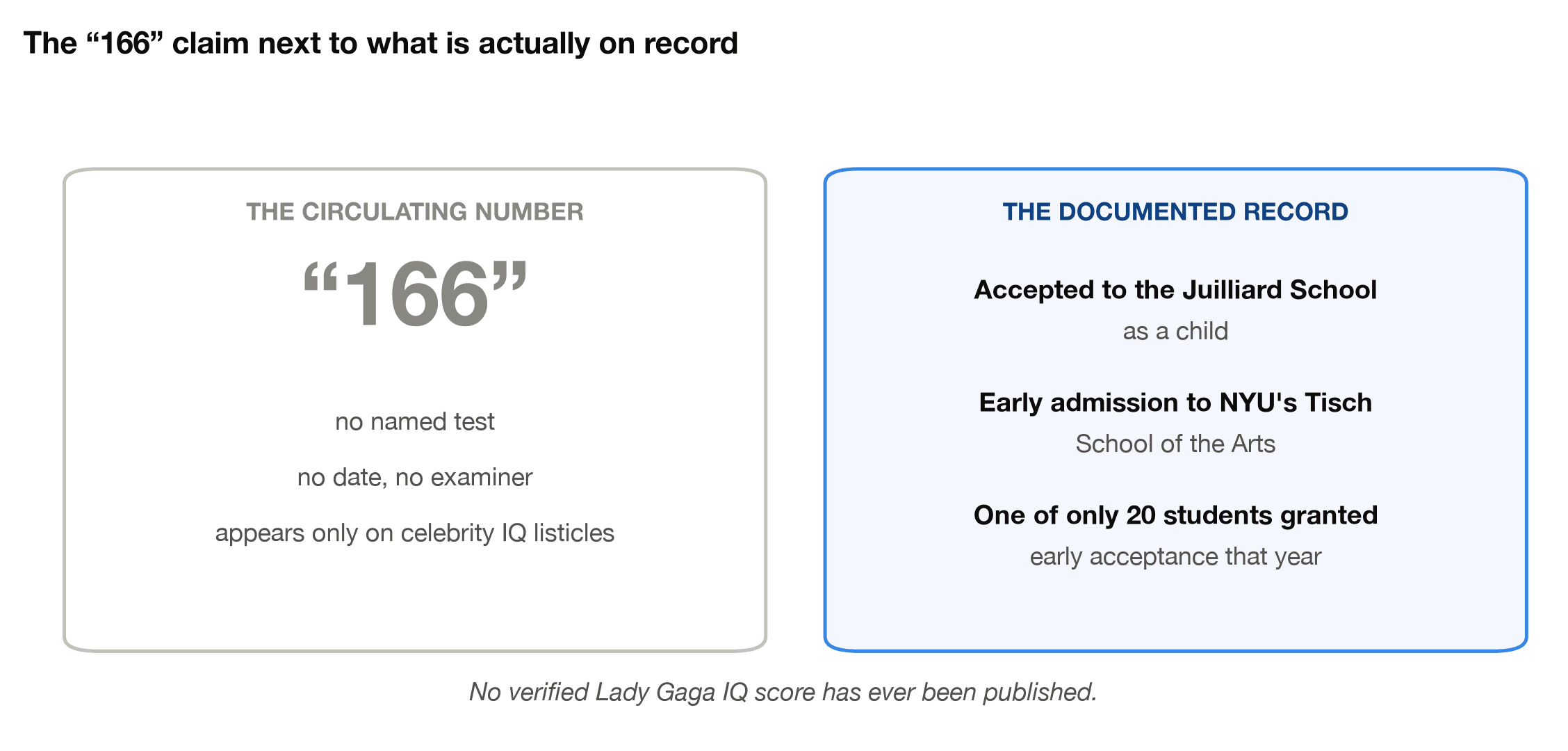
Lady Gaga's IQ has never been measured in public. No test record has ever been released by the singer, a school, or a psychologist, and the "166" that circulates online comes from celebrity IQ listicles that cite no test of any kind. Her documented record is strong without the invented number: born Stefani Joanne Angelina Germanotta in New York City on March 28, 1986, she was accepted to the Juilliard School as a child and later received early admission to New York University's Tisch School of the Arts, one of only 20 students in the world granted early acceptance that year. This article traces where the 166 rumor comes from, what her real academic history shows, and how a genuine IQ score would actually be produced.
The short answer: there is no verified Lady Gaga IQ score
Every claim about Lady Gaga's IQ that names a number is unsourced. Celebrity IQ sites list "166" with no test documentation, and even rumor-friendly coverage concedes that there are no valid sources or documented results of her taking an IQ test. Gaga herself has never publicly acknowledged or denied the figure. In measurement terms, that means there is nothing to evaluate: no instrument, no administration record, no score report.
Where the 166 number comes from
The figure follows a familiar pattern. In 2013, fake "Mensa celebrity IQ lists" spread widely online, and Mensa publicly denied releasing any list of members' names and scores. Numbers seeded that way get copied from listicle to listicle until they look like established facts. The same thing has happened to other pop stars; we cover a close parallel in our article on Taylor Swift's IQ.
What Lady Gaga's actual academic record shows
Juilliard acceptance and a Manhattan Catholic school
As a child, Germanotta was accepted to the Juilliard School, one of the most selective performing-arts conservatories in the world. Her family chose a private Catholic school in Manhattan instead, and she trained in piano and performance outside of school throughout her childhood.
Early admission to NYU Tisch, and why she left
She was granted early admission to New York University's Tisch School of the Arts, one of only 20 students in the world to receive that honor in her year. At NYU she studied music and worked on her songwriting. She later withdrew, by widely reported accounts partway through her degree, to pursue music full time. The decision worked out: within a few years she had released The Fame and become one of the best-selling artists of her generation.
Why a 166 is implausible on its face
Even setting aside the missing source, the number itself should raise eyebrows. Modern IQ tests report scores on a scale with a mean of 100 and a "standard deviation" (a measure of how spread out scores are) of 15. Mainstream instruments have a "ceiling," the highest score they can report reliably, of roughly 160, because norm samples run out of people at the extremes. A 166 attributed to no named test sits beyond the range most instruments can measure at all. We explain the ceiling problem in our guides to the highest possible IQ and what a genius IQ score means.
What education can and cannot tell you about IQ
Selective-program admission is real evidence of ability, and intelligence research backs the general connection: Deary and colleagues (2007) found a correlation of about 0.81 between general cognitive ability measured at age 11 and national exam performance at age 16. That is a group-level relationship. It cannot be run in reverse to assign a precise IQ to one person because she got into a competitive arts program. Admission committees weigh auditions, portfolios, and grades, none of which is an IQ test.
Her leaving college carries no information in the other direction either. Educational attainment correlates with intelligence across large groups, while individual career decisions reflect opportunity costs. Leaving a degree program to sign a record deal says something about her options, and nothing about her cognitive ability.
How real IQ scores are measured
A genuine IQ score requires a professionally developed, "normed" test, meaning one scored against a large, representative sample, such as the WAIS, the Stanford-Binet, or a validated online measure. If Lady Gaga ever wanted a real number, that is the only route; the same is true for anyone curious about their own score. The Reasoning and Intelligence Online Test from RIOT IQ is a normed, validated assessment, and you can start with the free IQ test to see where you stand on the scale that celebrity listicles only pretend to use.
Frequently asked questions
Is Lady Gaga's IQ really 166?
No. The 166 figure appears only on celebrity IQ listicles and fan sites, none of which cite an actual test. Lady Gaga has never published an IQ score, and no credible record of her taking a professionally administered test exists.
Did Lady Gaga go to college?
Yes. She was granted early admission to New York University's Tisch School of the Arts, one of only 20 students to receive early acceptance that year. She withdrew before finishing to pursue her music career full time.
Was Lady Gaga accepted to Juilliard?
She was accepted to the Juilliard School as a child but instead attended a private Catholic school in Manhattan, and later chose NYU's Tisch School of the Arts.
Does dropping out of college mean anything about IQ?
No. Educational attainment correlates with intelligence at the group level, but individual decisions do not lower or reveal a person's cognitive ability. Many high-ability people leave degree programs for opportunity-cost reasons, which is exactly what Gaga did.
How could Lady Gaga find out her real IQ?
Only by taking a professionally developed, normed test, such as the WAIS or a validated online assessment like the RIOT IQ test. Numbers on celebrity gossip sites are not measurements.
References
1. Biography.com Editors. (2021). Lady Gaga. A&E Television Networks. biography.com
2. Nichols, J. (2013, June 5). Shakira's IQ of 140 makes Colombian singer a 'genius,' Mensa International reports (update: Mensa denied releasing any list). HuffPost. huffpost.com
3. Warne, R. T. (2020). In the know: Debunking 35 myths about human intelligence. Cambridge University Press. doi.org/10.1017/9781108593298
4. Deary, I. J., Strand, S., Smith, P., & Fernandes, C. (2007). Intelligence and educational achievement. Intelligence, 35(1), 13-21. doi.org/10.1016/j.intell.2006.02.001
Hero image: Lady Gaga after performing the national anthem at Super Bowl 50, February 2016. Photo by Arnie Papp, CC BY 2.0, via Wikimedia Commons.
Take our professional IQ test
Want to know your IQ? Try the first ever professional online IQ test.