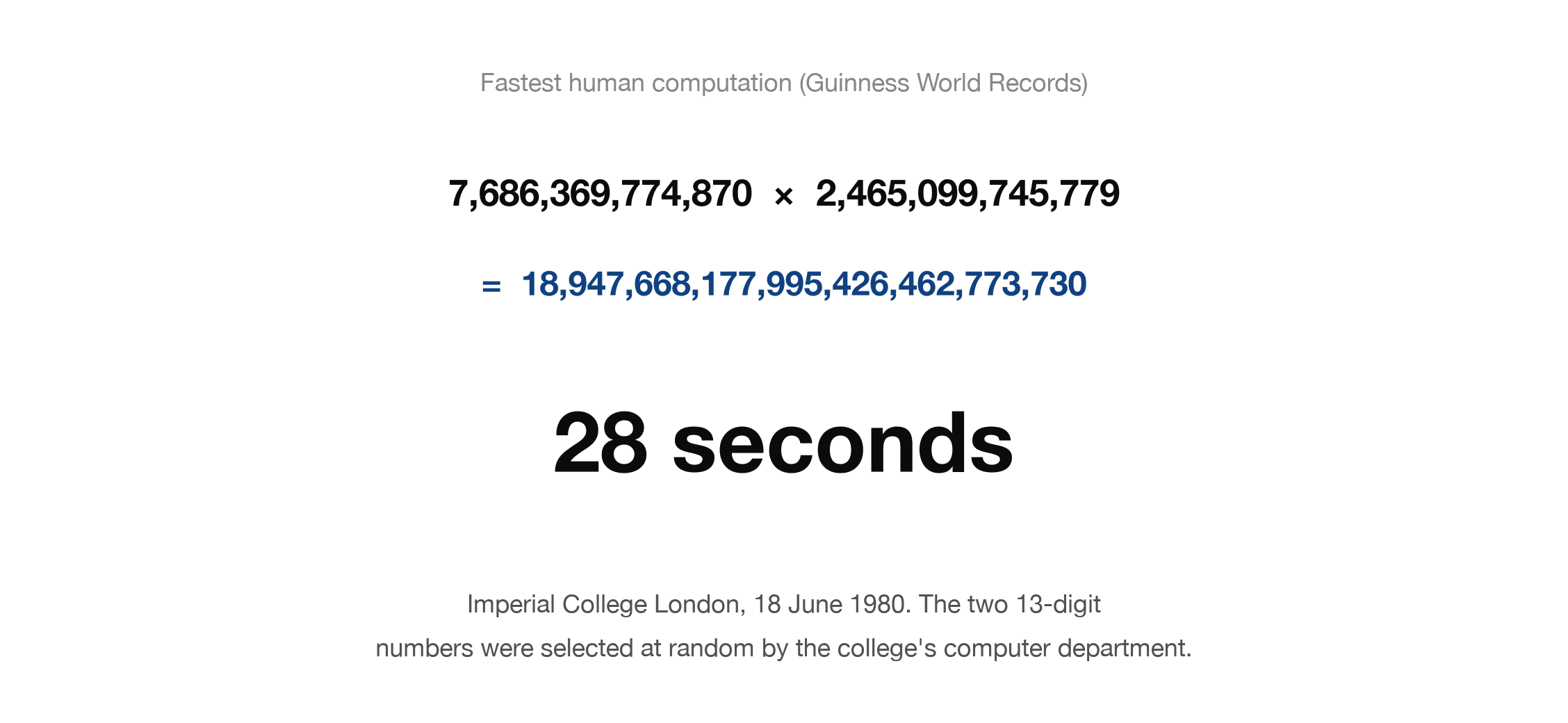
Shakuntala Devi multiplied two 13-digit numbers in 28 seconds. See what Arthur Jensen's testing of the human computer revealed about IQ and practice.
Dr. Russell T. WarneChief Scientist
Share
Shakuntala Devi (1929-2013) was an Indian mental calculator known around the world as the "human computer." On June 18, 1980, at Imperial College London, she multiplied two randomly selected 13-digit numbers in 28 seconds, a feat Guinness World Records still lists as the fastest human computation. She never attended school, and no verified IQ score for her has ever been published. What makes her story uniquely valuable is that she is the only calculating prodigy of her caliber ever studied closely by a major intelligence researcher, and what he found changes the question most people ask about her.
Who was Shakuntala Devi?
Devi was born on November 4, 1929, in Bangalore, India. Her father was a stage magician, and he discovered her ability when she was three, during card games: she beat him by memorizing the cards. By six she was giving public demonstrations at a university in Karnataka, and she spent her childhood supporting her family as a touring performer. She had no formal education of any kind.
The performing career lasted a lifetime, and it widened. She wrote popular books, including Fun with Numbers and Puzzles to Puzzle You, and ran a parallel career as an astrologer. Her repertoire went beyond arithmetic: given any date in the last century, she could instantly name the day of the week it fell on. She died in Bangalore on April 21, 2013, at age 83.
The 28-second Guinness record
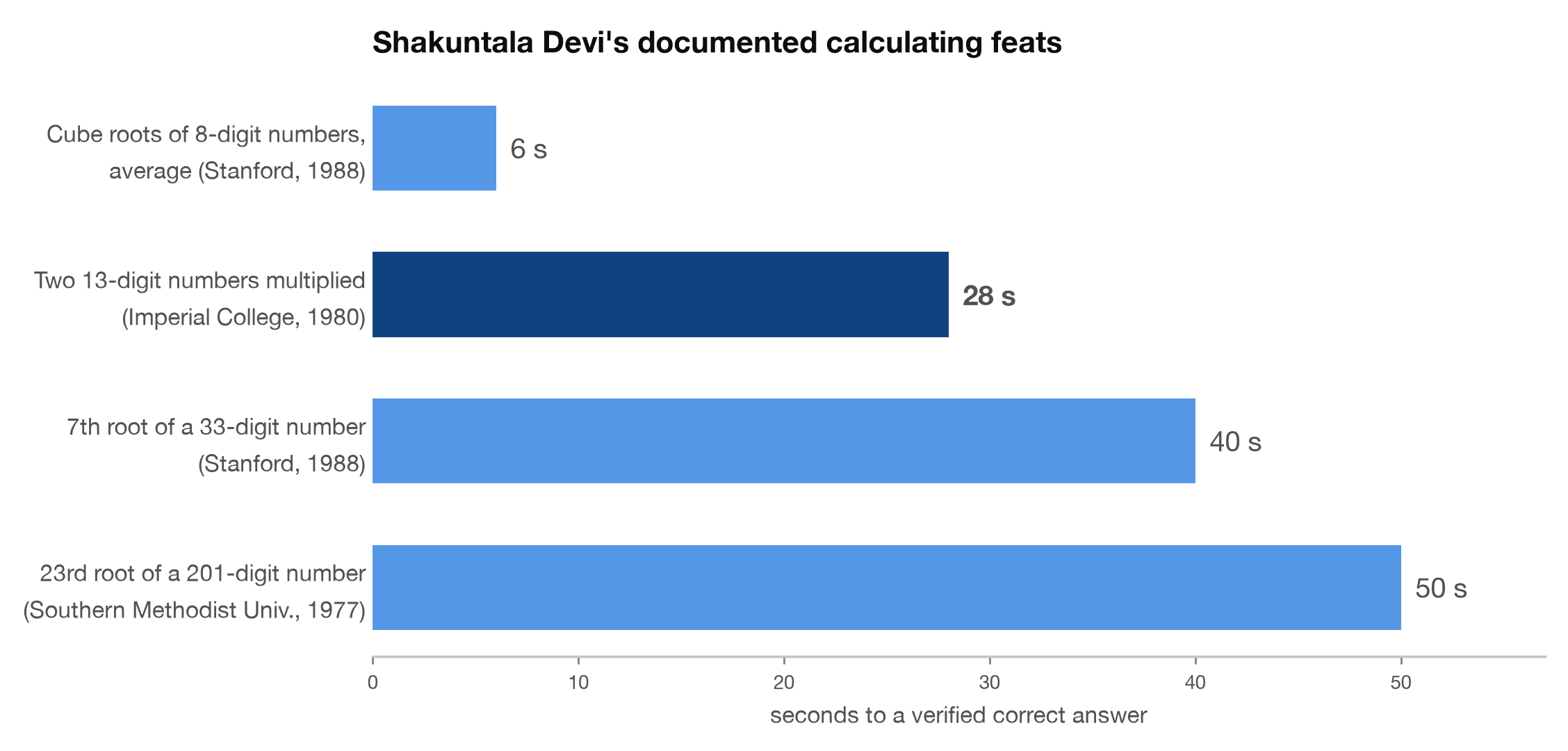
The record that made her famous has unusually good documentation. On June 18, 1980, the computer department of Imperial College London randomly selected two 13-digit numbers: 7,686,369,774,870 and 2,465,099,745,779. Devi multiplied them in her head in 28 seconds, giving the correct 26-digit answer, 18,947,668,177,995,426,462,773,730. Guinness World Records lists the feat as the fastest human computation.
It was one entry in a long ledger. At Southern Methodist University in 1977, she extracted the 23rd root of a 201-digit number in 50 seconds; her answer, 546,372,891, was confirmed by computer. The New York Times reported in 1976 that she added four numbers of 8 to 9 digits each and multiplied the sum by 9,878, correctly, in about 20 seconds.
When Arthur Jensen tested the human computer
In 1988, the intelligence researcher Arthur Jensen attended her demonstration at Stanford University and handed her problems himself. She extracted the cube root of 61,629,875 (answer: 395) and the 7th root of 170,859,375 (answer: 15). Across the cube-root items Jensen timed, her average was 6 seconds, with a range of 2 to 10. A harder item, the 7th root of a 33-digit number, took her 40 seconds. Jensen arrived wondering whether he would meet an autistic savant. He described instead a sociable, worldly, self-made performer.
What the reaction-time tests showed
Jensen then measured her in the laboratory on a battery of "elementary cognitive tasks," simple reaction-time measures of basic processing speed. Her reaction times were unexceptional, in the normal range when compared with college students and older adults on the same tasks. Her forward "digit span," the number of digits a person can repeat back in order, was superior, which Jensen tied to her phenomenal knowledge of numbers rather than to unusual raw capacity. We cover what span tasks measure in our guide to working memory.
Jensen's conclusion: memory, practice, and motivation
Jensen published the case in the journal Intelligence in 1990. His conclusion was that her skill "must depend largely on the automatic encoding and retrieval of a wealth of declarative and procedural information in long-term memory rather than on any unusual basic capacities." He added that a motivational factor sustaining enormous, prolonged practice probably matters more to performance at that level than psychometric "g," the general ability factor IQ tests measure, or the speed of elementary information processing.
What her case says about IQ
• A skill is not a score: Devi's calculating was real, timed, and verified. None of that produces an IQ number, because a spectacular domain-specific skill and general ability are different things, and the one measurement session on record found her basic processing speed ordinary.
• Expertise lives in long-term memory: Decades of daily practice from age three built a vast store of number facts and procedures she could retrieve automatically. That is how experts in every field work; hers was simply more visible than most.
• "What was her IQ?" has no answer: She never took a full IQ battery, and no serious researcher assigned her a number. Claims that record-setting performers must have record IQs misread how records and tests work, as we explain in our article on the highest IQ ever recorded.
Her case sits at the opposite pole from savant calculators, who pair narrow skills with developmental conditions: Devi combined her skill with typical, even gregarious, social functioning. For another prodigy whose fame outran measurement, see our article on Kim Ung-yong.
Frequently asked questions
What was Shakuntala Devi's IQ?
No verified IQ score for her has ever been published. The one time a psychometrician tested her, Arthur Jensen in 1988, he measured reaction times and memory span rather than a full IQ battery, and found her basic processing speed in the normal range.
What was Shakuntala Devi's Guinness World Record?
On June 18, 1980, at Imperial College London, she multiplied two randomly selected 13-digit numbers in 28 seconds, giving the correct 26-digit answer. Guinness still lists it as the fastest human computation.
How did Shakuntala Devi calculate so fast?
Jensen's 1990 case study concluded her speed came from automatic retrieval of an enormous store of number facts and procedures in long-term memory, built through lifelong practice from about age three, plus intense motivation.
Did Shakuntala Devi have any formal education?
No. She never attended school and was a stage performer from the age at which most children begin kindergarten. She later wrote several books, including math puzzle collections.
Was Shakuntala Devi autistic or a savant?
No. Jensen went to her 1988 demonstration open to that possibility and instead described a sociable, worldly performer. Her case is usually contrasted with savant calculators for exactly that reason.
The bottom line
Shakuntala Devi's genius was a highly practiced, domain-specific skill riding on ordinary cognitive machinery, which is arguably a more interesting fact than any IQ number would have been. Extraordinary performance does not require an extraordinary score, and a score cannot be inferred from performance. Measuring general ability takes a properly normed instrument: the Reasoning and Intelligence Online Test from RIOT IQ reports modern deviation scores with stated precision, and you can take the RIOT IQ test online.