What Was Charles Darwin's IQ? The Estimate, the Record, and Galton | Riot IQ
Oct 31, 2026·Famous People & IQ
What Was Charles Darwin's IQ? The Estimate, the Record, and Galton
Charles Darwin's IQ was never tested. Cox's 1926 study estimated 135 to 140 from his records, or 155 to 165 after correction. Here is what it means.
Dr. Russell T. WarneChief Scientist
Share
Charles Darwin never took an IQ test, because he died in 1882 and the first intelligence test appeared in 1905, so every Darwin IQ figure is an estimate. The best-sourced one comes from psychologist Catharine Cox's 1926 Stanford study, which estimated his IQ at 135 for childhood and 140 for ages 17 to 26 from his biographical records, and 155 and 165 after a statistical correction she applied to the whole sample.
The 165 figure that circulates online traces to that correction. This article covers where Cox's numbers come from, what Darwin's school record and his own autobiography actually say, how his cousin Francis Galton started the scientific study of intelligence, and why a number for Darwin tells you less than his work does.
Darwin's IQ in Cox's 1926 study
Cox's Genetic Studies of Genius, Volume II estimated IQs for 301 eminent people born between 1450 and 1850, using a method now called "historiometry," which means scoring historical figures from documentary evidence. Three raters (Cox, Lewis Terman, and Maud Merrill) read each person's recorded early development and judged what IQ would typically produce it. Each subject received an "AI" estimate for birth to age 17 and an "AII" estimate for ages 17 to 26. Scientists born later, such as Marie Curie, fall outside its window. Our article on Napoleon's IQ walks through the method in more detail.
Darwin's case study is headed AI IQ 135, AII IQ 140. Cox also gave a "reliability coefficient" for each estimate, a rating of how complete and trustworthy the underlying records were: .43 for Darwin's childhood and .53 for his young adulthood, both middling for the study. For comparison, the averages for Cox's main group of 282 geniuses were 135 and 145, so Darwin sits at the average for childhood and a little below it for his late teens and early twenties.
Her individual-ratings table (Table 12A) shows how much judgment went into the childhood number. The three raters gave Darwin 150, 125, and 125 for the period up to age 17, and 150, 135, and 140 for ages 17 to 26. A 25-point spread between raters looking at the same records is a reminder that these figures are informed opinions.
Where the 165 comes from
Cox found that her estimates rose with the amount of surviving evidence: "The more complete the record the higher the average IQ for any considerable group in our study." Her raters had pulled their estimates toward 100 whenever evidence was thin, so she computed "corrected" estimates that pulled each score toward the average of the person's professional group instead. Table 12A lists Darwin's corrected values as 155 (AI) and 165 (AII).
Cox did not treat these corrections as precise. She called the procedure "a crude approximation" that "indicates a point below which the true IQ probably did not fall," and wrote that "the purpose of the corrected estimates is not to furnish exact values for the score of an individual or even of a group." She also placed Darwin among the youths she thought her raw method underrated: the true upper limit of the 135 childhood group, "set by such youths as Cousin, Darwin, Erasmus, Da Vinci, and Kant, is probably in the IQ range above 160."
So a careful summary is 135 to 140 as rated, 155 to 165 as corrected, with the caveat that both are estimates. Higher numbers attached to Darwin on celebrity lists have no traceable source. For what scores in that range would mean on a modern test, see our explainer on what counts as a genius IQ score.
What the record shows: "a very ordinary boy"
The documents behind Cox's rating are unusually candid, because the main source is Darwin himself. In his autobiography, begun in 1876, he recalled that when he left Shrewsbury School "I believe that I was considered by all my masters and by my Father as a very ordinary boy, rather below the common standard in intellect." He had been told he was "much slower in learning" than his younger sister Catherine, and he learned assigned lines of Virgil and Homer only to forget them within two days.
Other details point the other way:
• Early collecting: Cox's file notes that by about age 8 he was collecting shells, seals, franks, coins, and minerals "with a zeal peculiar to him alone of all the children."
• Science outside the syllabus: He took pleasure in Euclid's proofs, ran chemistry experiments with his older brother, and was rebuked by his headmaster for wasting time on such subjects.
• Early research: At Edinburgh, where he began medicine in October 1825 and left after two sessions, he presented a short paper to the student Plinian Society in 1827 on the larvae of a marine animal.
• Cambridge: At Christ's College he wrote that his academic time "was wasted," yet he passed his degree in January 1831 at roughly tenth among the candidates not taking honours, and senior naturalists such as the botanist John Henslow let him join their field excursions.
The rest is the documented career: five years on HMS Beagle from December 1831 and, on 24 November 1859, On the Origin of Species. Cox's AII estimate covers only the years up to age 26, so it was rated mostly on the record of a promising, unfocused student rather than on the work that made him famous.
Darwin's own verdict on his mind
Late in the autobiography, Darwin tried to "analyse the mental qualities" behind his success, and his self-assessment is an unusual piece of evidence. "I have no great quickness of apprehension or wit which is so remarkable in some clever men, for instance Huxley," he wrote, and "my power to follow a long and purely abstract train of thought is very limited." He found mathematics "repugnant" at Cambridge because he could see no meaning in the early steps of algebra, and later regretted not pressing on.
On the other side of the ledger he listed being "superior to the common run of men in noticing things which easily escape attention," an industry "nearly as great as it could have been in the observation and collection of facts," and a love of natural science that was "steady and ardent." He described his mature mind as "a kind of machine for grinding general laws out of large collections of facts."
That profile fits Cox's own conclusion about her geniuses: eminence went with high ability plus "persistence of motive and effort, confidence in their abilities, and great strength or force of character." She even suggested that "high but not the highest intelligence, combined with the greatest degree of persistence," could outrun greater intelligence with less persistence.
Galton, Hereditary Genius, and the road to IQ tests
Darwin's family also sits at the start of intelligence research. His cousin Francis Galton published Hereditary Genius in 1869, arguing that "natural ability" runs in families and is spread across people along what we now call the bell curve. Darwin wrote to him on 23 December 1869, after reading about 50 pages: "You have made a convert of an opponent in one sense, for I have always maintained that, excepting fools, men did not differ much in intellect, only in zeal & hard work; & I still think there is an eminently important difference."
Galton's own attempts to measure ability, using reaction times, sensory acuity, and other physical measurements, turned out to have little to do with intelligence. The practical breakthrough came from Alfred Binet's 1905 scale in Paris, the subject of our article on who invented the IQ test. Lewis Terman, who adapted Binet's test at Stanford, admired Galton enough to estimate Galton's childhood IQ from biography in 1917, putting it near 200. That proof of concept became Cox's dissertation, which is how Darwin ended up with a number at all.
The video above takes up Galton's question in modern form. Twin and family studies show that intelligence is substantially heritable (Bouchard & McGue, 1981), but heritability describes variation across a population. It cannot tell you why any one person, Darwin included, turned out as they did.
Why historiometric estimates are shaky
Dean Keith Simonton, a leading modern analyst of Cox's data, treats her numbers as usable research data with clear limits. Cox's own analysis found that rated IQ correlated only .25 with eminence across her sample, and .16 once data quality was held constant. The raters knew whom they were rating. The records are biased toward the famous, whose childhoods were remembered and written down after the fact.
Darwin's case shows each problem. His childhood evidence comes largely from his own self-deprecating memoir, begun at 67, and his rating period ends before nearly everything that made him Darwin. What his life does show clearly is that slow schoolwork and later scientific greatness can belong to the same person, and that the qualities he credited, close observation and decades of persistent work, are things no historical IQ estimate measures.
Frequently asked questions
What was Charles Darwin's IQ?
Darwin never took an IQ test. Catharine Cox's 1926 study estimated 135 for his childhood and 140 for ages 17 to 26, with corrected estimates of 155 and 165.
Where does the "Darwin IQ 165" figure come from?
It matches Cox's corrected AII estimate in Table 12A of her 1926 study. Cox described the correction as a crude approximation and warned it did not give an exact value for any individual.
Was Darwin a bad student?
He was an indifferent one. He believed his masters and father thought him "a very ordinary boy," he left medicine at Edinburgh, and he took an ordinary pass degree at Cambridge, while pursuing natural history with great energy outside his courses.
Was Darwin related to Francis Galton?
Yes. Galton, a pioneer of the scientific study of individual differences in intelligence, was his cousin, and Darwin praised Galton's Hereditary Genius in a letter written in December 1869.
Did Darwin think intelligence was inherited?
Before Galton's book he held that, excepting fools, people differed little in intellect, only in zeal and hard work. Galton's book partly converted him, though he still thought effort mattered a great deal.
The takeaway
Darwin's IQ is a 1926 estimate built from a thin, self-critical childhood record: 135 to 140 as rated, 155 to 165 after a correction its author called crude. His documented strengths were close observation and decades of persistent work, which let him draw general laws from vast collections of facts, and they carried him further than any number would predict. If you want a score that is an actual measurement rather than a reading of old letters, you can take a full-length online IQ test normed on modern adults.
References
1. Cox, C. M. (1926). Genetic studies of genius: Vol. II. The early mental traits of three hundred geniuses. Stanford University Press. [archive.org](. archive.org
2. Barlow, N. (Ed.). (1958). The autobiography of Charles Darwin 1809-1882, with the original omissions restored. Collins. [darwin-online.org.uk](. darwin-online.org.uk
3. Darwin, C. R. (1869, December 23). Letter to Francis Galton (Letter no. DCP-LETT-7032). Darwin Correspondence Project. [darwinproject.ac.uk](. darwinproject.ac.uk
4. Darwin Correspondence Project. (n.d.). Darwin timeline. University of Cambridge. [darwinproject.ac.uk](. darwinproject.ac.uk
5. Galton, F. (1869). Hereditary genius: An inquiry into its laws and consequences. Macmillan. [galton.org](. galton.org
6. Simonton, D. K. (2020). Galton, Terman, Cox: The distinctive Volume II in Genetic Studies of Genius. Gifted Child Quarterly, 64(4), 275-284. [doi.org/10.1177/0016986220921360](. doi.org
7. Simonton, D. K., & Song, A. V. (2009). Eminence, IQ, physical and mental health, and achievement domain: Cox's 282 geniuses revisited. Psychological Science, 20(4), 429-434. [doi.org/10.1111/j.1467-9280.2009.02313.x](. doi.org
8. Bouchard, T. J., Jr., & McGue, M. (1981). Familial studies of intelligence: A review. Science, 212(4498), 1055-1059. [doi.org/10.1126/science.7195071](. doi.org
Hero image: George Richmond, 1840, public domain, via Wikimedia Commons.
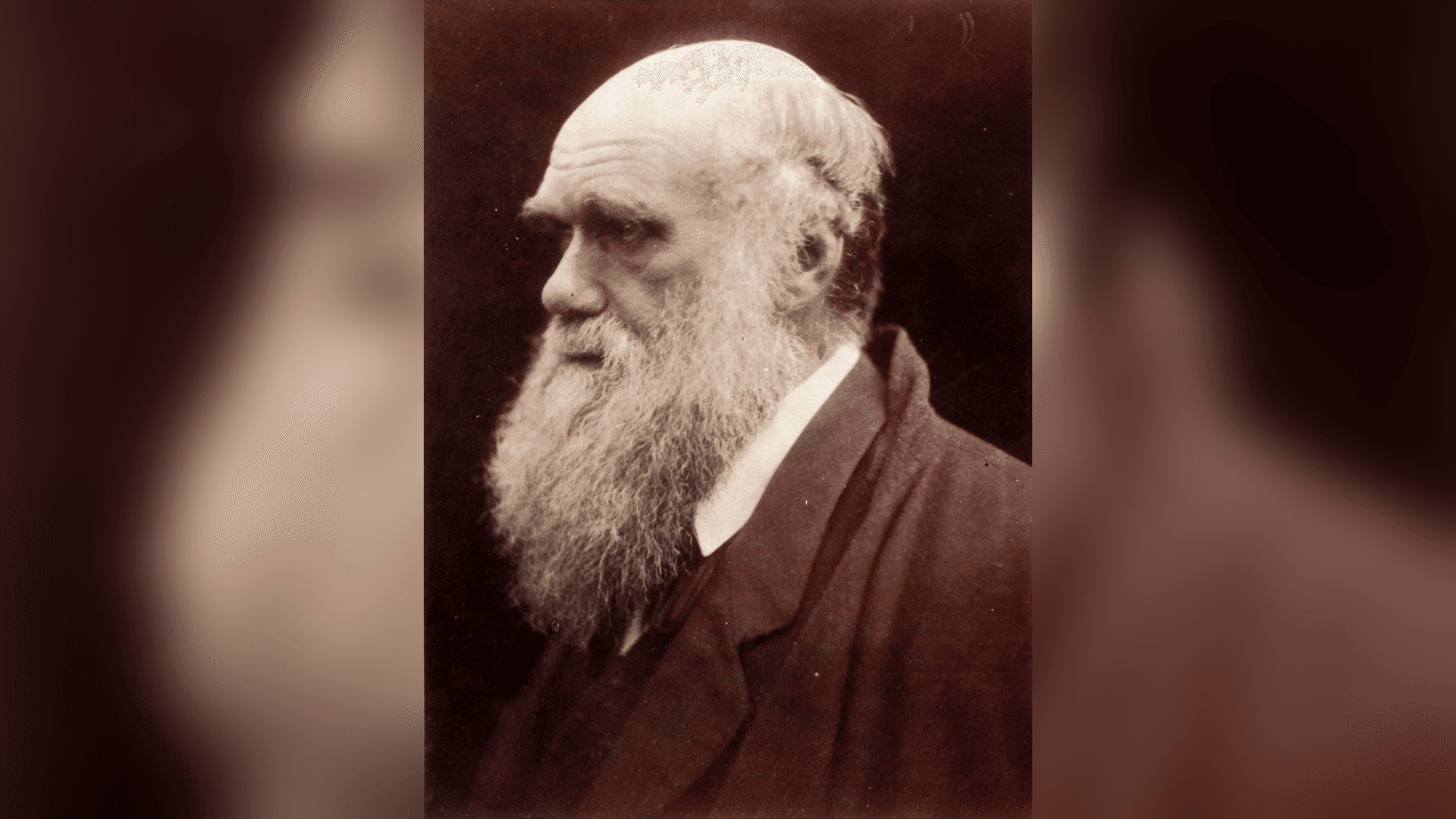
Hero image: Charles Darwin, by Julia Margaret Cameron (1868), public domain. Via Wikimedia Commons.
Take our professional IQ test
Want to know your IQ? Try the first ever professional online IQ test.