What Was Shakespeare's IQ? Why No Real Estimate Exists
Shakespeare's IQ was never tested or estimated. Cox's 1926 genius study dropped Shakespeare for lack of childhood records, so online IQ figures are guesses.
Dr. Russell T. WarneChief Scientist
Share
William Shakespeare never took an IQ test, and unlike Goethe or Newton he has no scholarly IQ estimate either. Catharine Cox's 1926 study of the early mental traits of eminent people, the source of nearly every historical IQ figure, listed Shakespeare and then set him aside for "insufficient or no data on early years." The 200 and 210 figures that circulate online have no traceable source. This article explains why Shakespeare fell out of the one study that might have rated him, what the surviving records show about his education, what his famous vocabulary does and does not prove, and how to think about intelligence in someone whose childhood is almost a blank.
Why Cox left Shakespeare out
Cox's Genetic Studies of Genius, Volume II took its subjects from a ranked list of the most eminent people in history and then applied three rules. Subjects had to be unquestionably eminent, their eminence had to come from achievement rather than birth, and, in her words, "they must be persons for whom adequate records are available, i.e., records upon which reliable ratings of early mental ability may be based." Her raters then read a case history of each person and estimated the IQ that would typically produce that childhood and youth. Our page on Napoleon's IQ explains the method in more detail.
Eleven famous names failed the third rule. Cox kept them in her master table of individual ratings (Table 12A) for reference, with dashes where the numbers should be. Shakespeare's row reads "Insufficient or no data on early years", the same note given to the painter Titian and the Portuguese poet Camoëns.
The contrast with his fellow playwright Ben Jonson is telling. Jonson, who also never attended university, left enough of a record to be rated: 120 for childhood and 155 for ages 17 to 26. Shakespeare's achievements were never in doubt. The missing ingredient was paper.
What the record shows about Shakespeare's education
Almost everything known about Shakespeare's early life comes from a handful of legal and church documents.
• Birth and family: He was baptized at Holy Trinity Church, Stratford-upon-Avon, on 26 April 1564, according to the parish register. His father, John, was a glove-maker who rose to become the town's bailiff, a role much like mayor, when William was about five.
• School: As the son of a leading townsman he could attend the King's New School, Stratford's free grammar school. The Folger Shakespeare Library says he "almost certainly attended", but no enrolment registers survive to prove it. The curriculum was built around Latin, read, written and spoken, with authors such as Terence, Virgil and Horace, and Ovid's influence runs through his plays and poems. He probably left at around 14 or 15.
• No university: There is no record of him attending university. Marriage at 18, in November 1582, to Anne Hathaway, who was 26 and pregnant, also ruled out a formal apprenticeship.
• The "lost years": Between the baptism of his twins in 1585 and 1592, no document records what he was doing. By 1592 he was an established London actor and playwright, mocked in print by a contemporary as a "Shake-scene."
The best-known verdict on his schooling comes from Jonson's tribute in the First Folio of 1623, which says he had "small Latine, and lesse Greeke." Coming from a famously learned writer, the line is usually read as a comparison with Jonson's own scholarship. A grammar-school education of the period still meant years of intensive Latin, far more than most modern graduates receive.
The vocabulary argument
The number most often used as evidence of Shakespeare's brilliance is the size of his vocabulary. Counts based on Marvin Spevack's computer concordance of the works, published from 1968, put it at around 30,000 distinct words.
Statisticians Bradley Efron and Ronald Thisted examined that count in 1976. Shakespeare's known works contain 884,647 words in total and 31,534 different word types, of which 14,376 appear only once. Using models borrowed from ecology, where scientists estimate how many species they have not yet caught, they concluded that Shakespeare knew at least 35,000 more words that he never happened to use in surviving writing.
Those figures are impressive, and they are easy to misread. Efron and Thisted counted every distinguishable spelling as a separate type, so "girl" and "girls" count twice. Modern vocabulary research counts "lemmas", the base forms of words, and Brysbaert and colleagues estimated in 2016 that an average 20-year-old native speaker of American English knows about 42,000 of them. The two numbers are not on the same scale, and a writer's word count depends heavily on how much he wrote and how many subjects he wrote about.
Vocabulary does track general verbal ability, which is why vocabulary subtests appear in major intelligence batteries; our article on what vocabulary tests measure covers that relationship. A vocabulary count from a body of published work is a different thing from a timed test given under standard conditions, and it cannot be converted into an IQ score.
Where the 200 and 210 figures come from
Search for Shakespeare's IQ and you will find confident answers, usually 210 and sometimes "around 200 verbal IQ". They appear mostly on question-and-answer pages and listicles, and none of them cites a study, a method or a rater. Some attribute the number vaguely to "experts" or "psychologists" without naming anyone. Cox's tables, the obvious place such a figure would come from, show only dashes in Shakespeare's row. The honest answer is that no published estimate exists.
What Shakespeare's work does and does not say about IQ
His output points to formidable verbal ability. The Shakespeare Birthplace Trust credits him with 38 plays, two long narrative poems and 154 sonnets, and notes that he produced roughly two plays a year for almost twenty years as his company's regular dramatist. Sustaining that pace, much of it in verse, implies fluent language and a strong capacity to hold plot and dialogue in mind.
That record still leaves important gaps for anyone trying to infer an IQ. Modern tests sample several kinds of reasoning, including abstract and quantitative problems, and nothing in Shakespeare's surviving papers speaks to those. Creative genius also depends on qualities an IQ test does not try to measure, originality and sheer drive among them. A 2009 review by the psychologist Dean Keith Simonton found that estimated intelligence and adult achievement are related, with a correlation of about .25 in both historiometric and test-based studies, a real but modest link that leaves most of what makes a Shakespeare unexplained. The same caution applies to other universal geniuses, from Leonardo da Vinci's IQ onward.
Frequently asked questions
What was Shakespeare's IQ?
No one knows. Shakespeare was never tested, and Catharine Cox's 1926 study of eminent people excluded him because too little was recorded about his early years.
Is it true Shakespeare had an IQ of 210?
No source supports it. The 210 figure appears on listicles without any study or method behind it, and Cox, whose 1926 study is the source of most historical IQ estimates, published no number for him.
How many words did Shakespeare know?
His works use 31,534 different word forms. Efron and Thisted estimated in 1976 that he knew at least 35,000 more that do not appear in his surviving writing.
Did Shakespeare go to school?
Almost certainly. He is generally thought to have attended Stratford's free grammar school, which taught an intensive Latin curriculum, although no enrolment registers survive. There is no record of him attending university.
Who had a higher IQ, Shakespeare or Goethe?
There is no way to compare them. Cox estimated Goethe at 185 and 200 from a richly documented childhood, while Shakespeare's early life left too little evidence to rate.
The takeaway
Shakespeare's IQ is unknowable, and the reason is instructive: every historical IQ estimate rates a paper trail, and Shakespeare's childhood left almost none. His plays show extraordinary verbal gifts, and his word counts are remarkable, but neither converts into a score. If you would like a number grounded in a real measurement, try an online IQ test built by psychometricians.
References
1. Cox, C. M. (1926). Genetic studies of genius: Vol. II. The early mental traits of three hundred geniuses. Stanford University Press. [archive.org](. archive.org
2. Efron, B., & Thisted, R. (1976). Estimating the number of unseen species: How many words did Shakespeare know? Biometrika, 63(3), 435-447. [doi.org/10.1093/biomet/63.3.435](. doi.org
3. Brysbaert, M., Stevens, M., Mandera, P., & Keuleers, E. (2016). How many words do we know? Practical estimates of vocabulary size dependent on word definition, the degree of language input and the participant's age. Frontiers in Psychology, 7, 1116. [doi.org/10.3389/fpsyg.2016.01116](. doi.org
4. Internet Shakespeare Editions. (n.d.). School at Stratford-on-Avon. University of Victoria. [internetshakespeare.uvic.ca](. internetshakespeare.uvic.ca
5. Folger Shakespeare Library. (n.d.). Shakespeare's life. [folger.edu](. folger.edu
9. Shakespeare Birthplace Trust. (n.d.). William Shakespeare biography. [shakespeare.org.uk](. shakespeare.org.uk
10. Jonson, B. (1623). To the memory of my beloved, the author Mr. William Shakespeare: And what he hath left us. In Mr. William Shakespeares comedies, histories, & tragedies (First Folio; 1910 facsimile). [wikisource.org](. en.wikisource.org
11. Simonton, D. K. (2009). The "other IQ": Historiometric assessments of intelligence and related constructs. Review of General Psychology, 13(4), 315-326. [doi.org/10.1037/a0017141](. doi.org
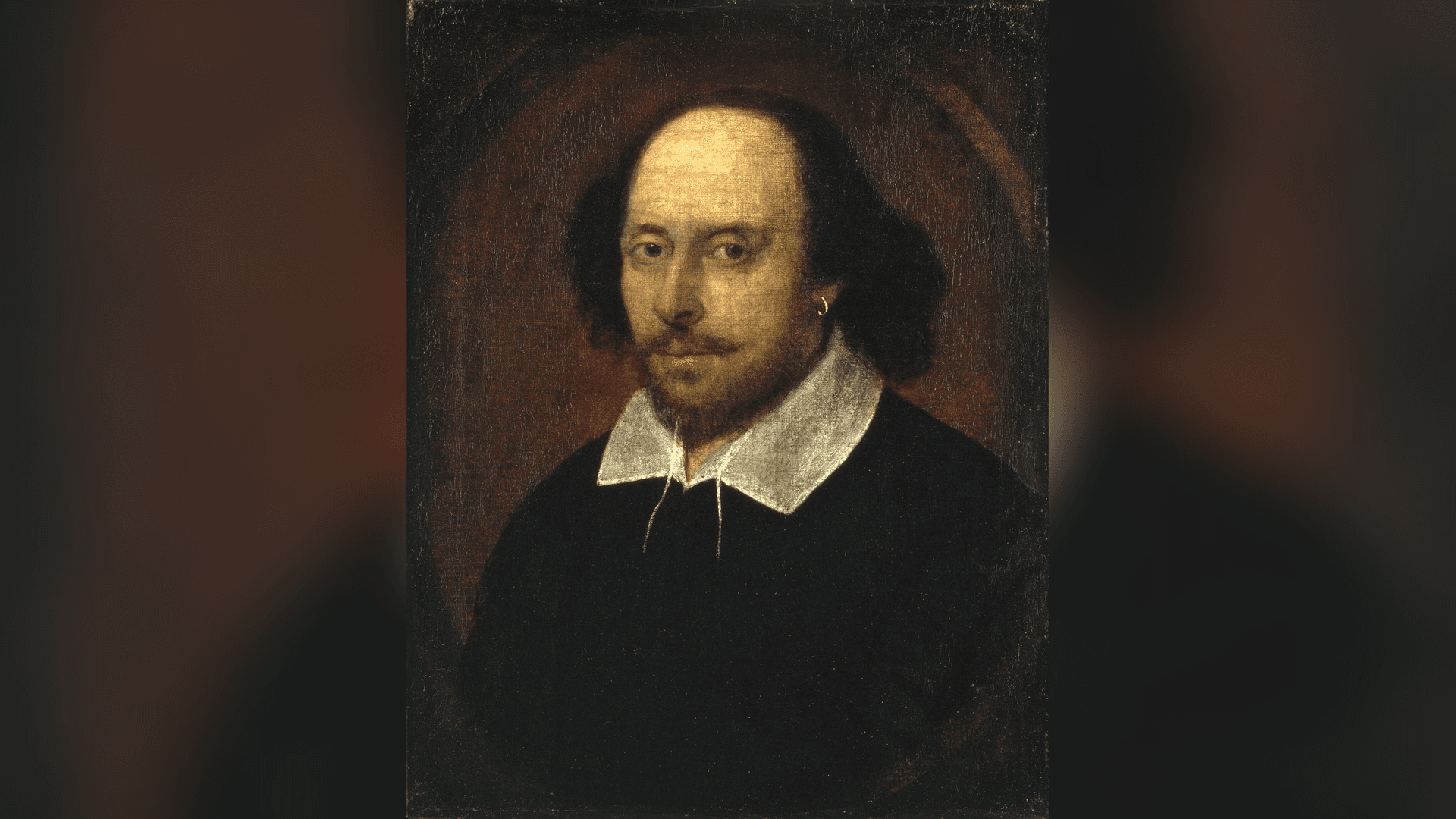
Hero image: the Chandos portrait of William Shakespeare, attributed to John Taylor (c. 1600-1610), public domain. Via Wikimedia Commons.
Take our professional IQ test
Want to know your IQ? Try the first ever professional online IQ test.