Aug 9, 2026·Famous People & IQWho Is Daniel Tammet? Inside a Savant's Mind
Daniel Tammet recited 22,514 digits of pi from memory. Unlike most savants, he can explain exactly how. Inside his synesthesia and what scientists found.
Dr. Russell T. WarneChief Scientist

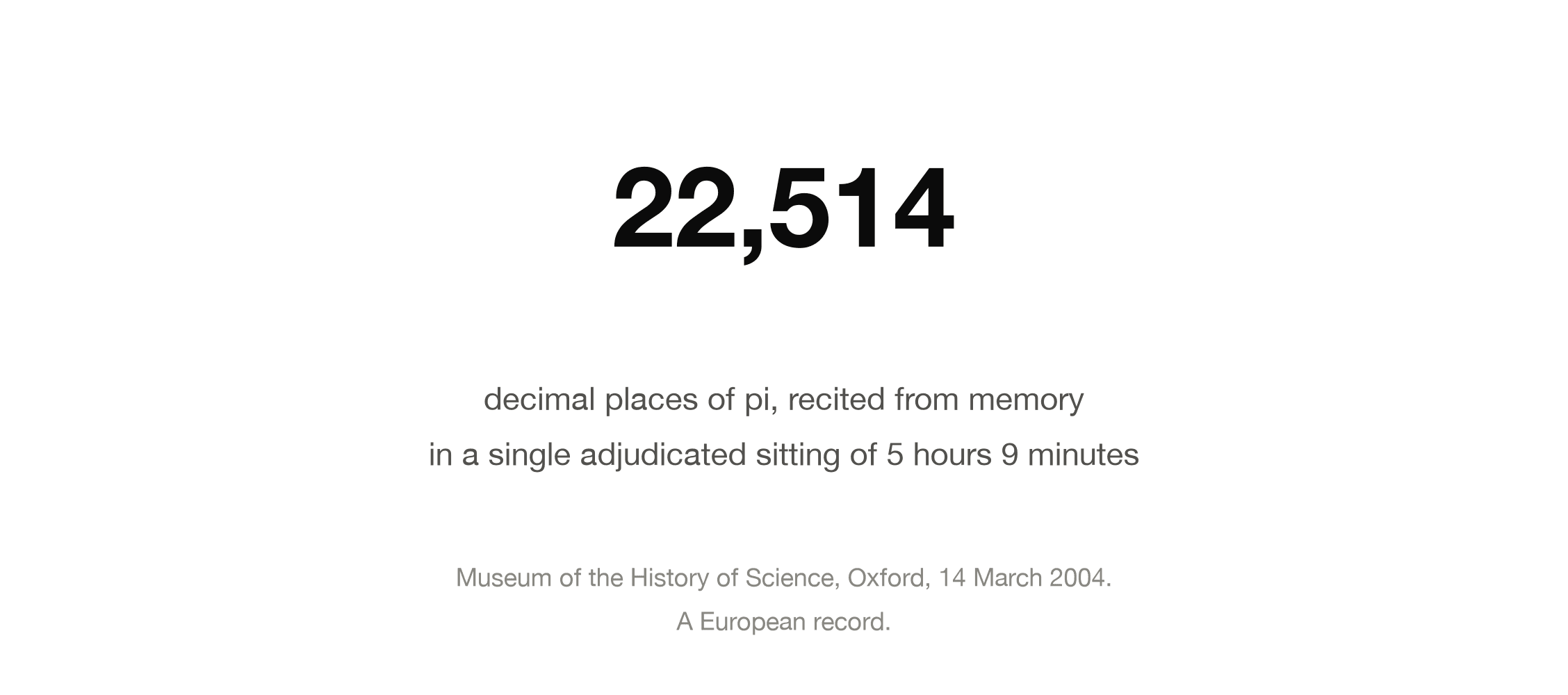
Daniel Tammet is a British-born writer and savant who, on March 14, 2004, recited pi from memory to 22,514 decimal places at the Museum of the History of Science in Oxford. The recitation took 5 hours and 9 minutes and set a European record. Tammet is autistic and has "synesthesia," a blending of the senses in which numbers carry colors, shapes, and textures. What sets him apart from nearly every other person with
savant syndrome is that he can explain, in vivid detail, what happens inside his mind while he performs.
Who is Daniel Tammet?
Tammet was born in London in 1979, the eldest of nine children. At age three he suffered an epileptic seizure, and he has been fascinated by counting ever since; the epilepsy was treated with medication. He was diagnosed with Asperger syndrome as an adult. By his mid-twenties he spoke seven languages and was devising one of his own, called Mänti. While filming a documentary in the United States he met Kim Peek, the celebrated memorist who inspired the film Rain Man.
The day he recited 22,514 digits of pi
The 2004 recitation was public and adjudicated: for an audience at Oxford's Museum of the History of Science, Tammet said the digits aloud for just over five hours without an error. He was 25. His stated motive had nothing to do with celebrity: "I memorised pi to 22,514 decimal places, and I am technically disabled. I just wanted to show people that disability needn't get in the way."
Seeing numbers: synesthesia from the inside
In Tammet's mind, every number up to 10,000 has its own color, shape, and texture. Three is a dotted green crescent moon shape; one is a sort of white sunburst; four is a blue boomerang. A long digit string is therefore a landscape rather than an abstract list. His account of the pi feat: "What I did was make a poem or a novel out of pi, and took those colors and those emotions and used them to perceive patterns."
Most savants cannot describe their process at all; the skill simply happens. Tammet narrates his from the inside, which is why journalists called the Guardian's 2005 profile of him "A genius explains," and why scientists took an unusual interest in his brain.
The scientists who studied him
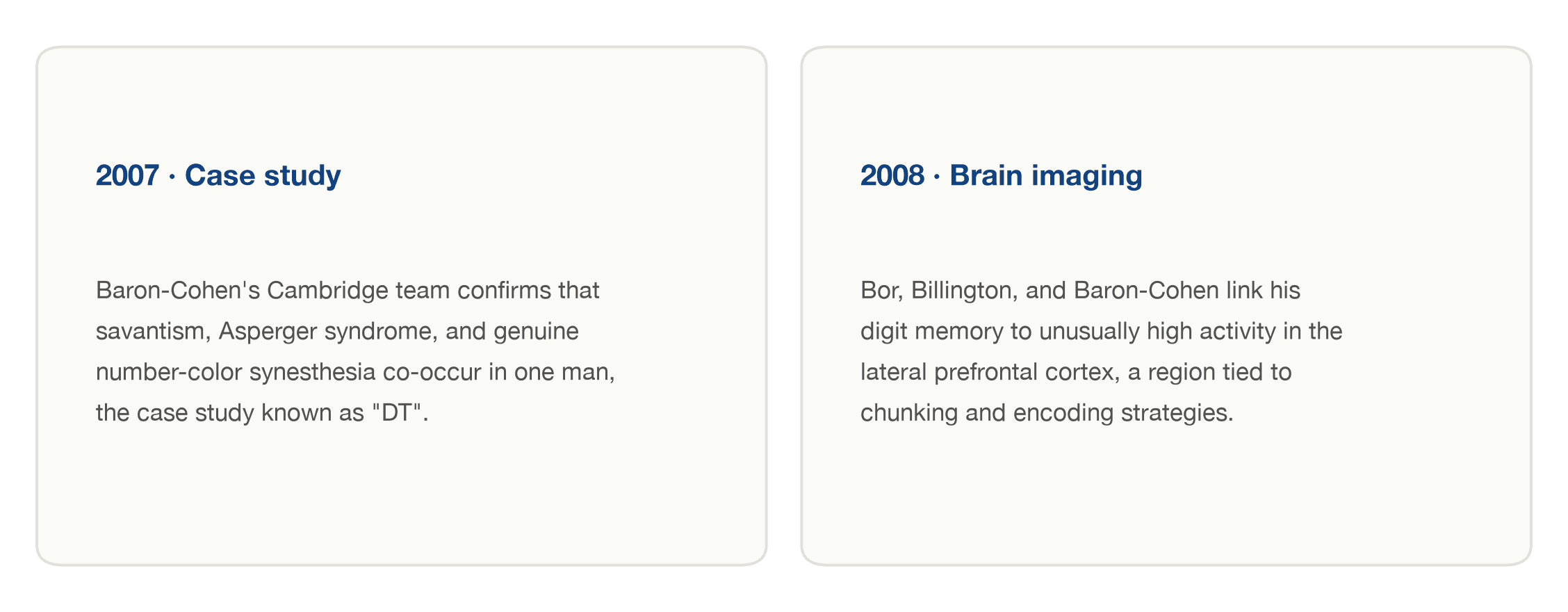
Simon Baron-Cohen's team at Cambridge published a formal case study of Tammet, identified as "DT," in 2007, confirming that savantism, Asperger syndrome, and genuine color-form-number synesthesia co-occur in one person. A 2008 follow-up by Bor, Billington, and Baron-Cohen used neuroimaging and linked his exceptional digit memory to unusually high activity in the lateral prefrontal cortex.
Why researchers care
A savant who can self-report is a rare window into savant cognition. The research picture that emerged is of extreme, highly organized, domain-specific memory built on unusual perceptual coding, alongside otherwise unremarkable performance on many standard measures. No verified full-scale IQ score for Tammet is in public circulation, and his significance does not rest on one.
Born on a Blue Day and life as an author
Tammet turned the inside view into a writing career. His memoir Born on a Blue Day became an international bestseller, followed by Embracing the Wide Sky and Thinking in Numbers, and his books have been translated into 30 languages. He was also the subject of the BAFTA-nominated television documentary The Boy with the Incredible Brain.
What Daniel Tammet teaches us about intelligence
Tammet's feat would never show up on an IQ test, and that is a feature of valid tests rather than a flaw. An intelligence test measures general ability across reasoning, vocabulary, and memory; it is not designed to detect a trained, synesthesia-assisted special skill, just as the skill does not imply uniformly high general ability. The lesson runs parallel to that of fellow savant artist
Stephen Wiltshire: narrow brilliance and broad ability are separate facts about a person, and research on
IQ and autism shows how varied that combination can be. If what you want measured is general ability, a properly normed instrument such as the Reasoning and Intelligence Online Test from RIOT IQ is built for exactly that, and you can take
the RIOT IQ test online.
Frequently asked questions
Who is Daniel Tammet?
Daniel Tammet is a British-born writer and savant, born in London in 1979, who set a European record by reciting pi to 22,514 decimal places in 2004. He is autistic, has number-color synesthesia, and wrote the bestseller Born on a Blue Day.
How many digits of pi did Daniel Tammet recite?
22,514 decimal places, recited aloud over 5 hours and 9 minutes before an audience at the Museum of the History of Science in Oxford in March 2004, a European record at the time.
How does Daniel Tammet memorize numbers?
Through synesthesia. Each number up to 10,000 has its own color, shape, and texture in his mind, so a long digit string becomes a landscape or story. He describes turning pi into something like a poem and reading it back.
What did scientists find when they studied Daniel Tammet?
Baron-Cohen's Cambridge team confirmed in 2007 that savantism, Asperger syndrome, and genuine synesthesia co-occur in Tammet, and a 2008 neuroimaging study linked his digit memory to hyperactivity in the lateral prefrontal cortex.
What is Daniel Tammet's IQ?
No verified full-scale IQ score for Tammet is publicly available. Research on him documents extreme, domain-specific memory built on unusual perception, which is a different thing from the general ability an IQ test measures.
Is Daniel Tammet autistic?
Yes. He was diagnosed with Asperger syndrome as an adult, and he had childhood epilepsy, with a seizure at age three that he links to the start of his fascination with numbers.
References
1. Johnson, R. (2005, February 12).
A genius explains. The Guardian.
theguardian.com2. Landau, E. (2013, March 14).
On Pi Day, finding strength in numbers. CNN.
cnn.com3. Baron-Cohen, S., Bor, D., Billington, J., Asher, J., Wheelwright, S., & Ashwin, C. (2007).
Savant memory in a man with colour form-number synaesthesia and Asperger syndrome. Journal of Consciousness Studies, 14(9-10), 237-251.
researchportal.bath.ac.uk4. Bor, D., Billington, J., & Baron-Cohen, S. (2008).
Savant memory for digits in a case of synaesthesia and Asperger syndrome is related to hyperactivity in the lateral prefrontal cortex. Neurocase, 13(5-6), 311-319.
doi.org5. Treffert, D. A. (2009).
The savant syndrome: An extraordinary condition. Philosophical Transactions of the Royal Society B, 364(1522), 1351-1357.
doi.org6. Tammet, D. (n.d.).
About Daniel Tammet. Official website.
danieltammet.netHero image: Daniel Tammet in Paris, 2018. Photo: De Lorelei, licensed CC BY-SA 4.0, via Wikimedia Commons. Take our professional IQ test
Want to know your IQ? Try the first ever professional online IQ test.
AuthorDr. Russell T. WarneChief Scientist