What Was Pablo Picasso's IQ? The School Myths and the Real Record | Riot IQ
Nov 1, 2026·Famous People & IQ
What Was Pablo Picasso's IQ? The School Myths and the Real Record
Picasso's IQ was never measured, and no researcher has published an estimate. His school record is thin, and his famous "dunce" story is partly his own myth.
Dr. Russell T. WarneChief Scientist
Share
Pablo Picasso's IQ was never measured, and no researcher has published even a historical estimate for him, so any Picasso IQ score you see online has no traceable source. He was born in 1881, too late for the famous 1926 study that estimated IQs for eminent people of earlier centuries, and he never took an intelligence test that anyone recorded.
What survives instead is a thin school record and an unusually well-documented artistic education, wrapped in colorful childhood stories that Picasso himself helped spread. This article covers why no number exists, what the record shows about his schooling, which famous anecdotes are myths, and what his art can and cannot tell us about intelligence.
Picasso liked to say he had barely learned to read or count. If intelligence tests only measured schoolwork, a boy like that would look dull on paper. The psychologists who tested American army recruits in 1917 and 1918 ran into this problem directly. Their official report says early trials showed that "a large proportion of the soldiers could not properly be given the group psychological examination because of their inability to read English," so in January 1918 they adopted the picture-based Beta examination for those men. By January 1919 they had examined 1,726,966 men. Their methods have aged badly in many ways, but the idea that reasoning can be measured without reading has held up.
Why there is no Picasso IQ score
Almost every historical IQ figure for a famous person traces back to Catharine Cox's Genetic Studies of Genius, Volume II. Cox and her raters read biographies of 301 eminent people born between 1450 and 1850 and judged what IQ would typically produce each person's recorded childhood. Picasso falls three decades outside her range. No later historiometric study has given him a number either.
That leaves a gap that the internet fills with guesses. The Picasso IQ figures on celebrity and listicle pages cite no test, examiner or study. When a number has no source at all, the honest description is that someone made it up. Our article on Vincent van Gogh's IQ found the same pattern for the other painter people most often ask about.
The "dunce at school" story and what the record shows
The best-known claim about Picasso's mind is that he was hopeless at school. Some of this rests on solid ground. The Musée national Picasso-Paris, summarizing his childhood in Málaga, says that "Pablo did not like school very much, he was bored and did not concentrate," that he "screamed every morning when the maid took him to school," and that "in class, he spent his time drawing and cutting out figures from paper." After the family moved to A Coruña in 1891, when he was about ten, his father enrolled him at the Instituto de la Guarda, "but he was still not interested in the schooling."
The stronger version, that he could hardly read or add, comes largely from Picasso. John Richardson's A Life of Picasso, the standard biography, went back to the documents with the art historian Marilyn McCully. In the words of Jack Flam's review in The New York Review of Books, Richardson "convincingly challenges Picasso's claims that he never drew like a child, that he was a dunce at school barely capable of reading or adding numbers," along with the story that his father handed over his brushes and vowed never to paint again.
• What is documented: He disliked school, daydreamed and drew in class, and was a poor and unwilling pupil in his early years.
• What is Picasso's own legend: That he was close to illiterate and innumerate, and that he never went through a childlike stage in drawing.
• What it means for IQ: Boredom in a classroom is weak evidence about ability in either direction. Plenty of very able children dislike school, and an adult's retelling of his own childhood is not a test result.
He was also living in several languages at once. Flam notes that the family's moves took a boy with an Andalusian accent to Galicia, then to Catalan-speaking Barcelona and later to Madrid, and that his French was still very poor in 1901, when he was spending long stretches in Paris.
A father who taught drawing, and the La Llotja legend
Picasso had a professional art teacher at home. His father, José Ruiz Blasco, taught drawing at the School of Fine Arts in Málaga and later in A Coruña and Barcelona, and the Museu Picasso in Barcelona says he "did not hesitate from the beginning to guide his son in his first steps as an artist." From 1892 Pablo attended drawing classes at the fine arts school in A Coruña. Years of daily instruction from a trained teacher are part of the explanation for his early skill, and they are easy to forget when a child's ability is described as pure genius.
The most repeated story about his training is a myth. Picasso convinced Roland Penrose and other biographers that in 1895 he passed the entrance examination for the La Llotja art school in Barcelona in a single day, when the test "normally took a month." Richardson found that "only two days were normally allotted for the examination," and he gives evidence that Picasso used both of them. Flam adds that Richardson "similarly debunks the legends" about Picasso's entrance exam at the Royal Academy of San Fernando in Madrid. The real record is impressive enough. The Musée Picasso-Paris says he entered La Llotja in September 1895, at 13, thanks to "his exceptional success in the entrance exams."
Science and Charity at 15
Early in 1897, at 15, Picasso began Science and Charity, a large canvas of a sick woman attended by a doctor and a nun. According to the Museu Picasso, it was shown at the General Fine Arts Exposition in Madrid that year, "where it was awarded one of the one hundred and twenty-five Honourable Mentions." In October 1897 he enrolled at the Real Academia de San Fernando in Madrid, and, by the Paris museum's account, regularly visited the Prado to study and copy the old masters. By 1899 his formal academic training was over.
What his art does and does not say about IQ
Precocious, sustained excellence in a demanding craft tells you something. Picasso learned the full academic method of drawing and painting while still a boy, then spent decades inventing new ones. Richardson's conclusion, in Flam's summary, is that Picasso was "not only one of the most naturally gifted artists of all time but also one of the most hard-working." That is a statement about talent and effort, and the evidence supports it.
It is not a statement about IQ. The two overlap less than people expect. A meta-analysis by Kyung Hee Kim pooled 447 correlations from 21 studies with 45,880 participants and found a mean correlation of only .17 between creativity test scores and IQ. Visual art also depends on trained perception and hand skill, which an IQ test does not try to capture. Our article on IQ and drawing covers what the research says about drawing and cognition, including why skilled drawing makes people seem especially intelligent.
The fairest reading of Picasso's record is that it fits high general ability without proving any particular level of it. Someone who masters the academic tradition by 15 and then reorganizes how a century sees pictures is unlikely to be ordinary in reasoning, and nothing in the documents lets anyone put a number on it. "Genius" is not a score range, as our explainer on what counts as a genius IQ score explains.
Frequently asked questions
What was Picasso's IQ?
Nobody knows. He never took a recorded IQ test, and no researcher has published a historical estimate, so the numbers on celebrity sites have no source.
Is Picasso in Catharine Cox's 1926 study of geniuses?
No. Cox estimated IQs only for eminent people born between 1450 and 1850, and Picasso was born in 1881.
Was Picasso bad at school?
He disliked school and drew through his lessons, according to the Musée Picasso-Paris. His later claim that he could barely read or add was largely his own legend, and his biographer John Richardson challenged it.
Did Picasso pass the La Llotja art school exam in one day?
That is a myth Picasso told his early biographers. Richardson found that the exam normally took two days and that Picasso used both.
How old was Picasso when he painted Science and Charity?
He was 15. He began the canvas early in 1897, and it won an honorable mention at that year's General Fine Arts Exposition in Madrid.
The takeaway
There is no Picasso IQ. He never sat a recorded test, he is outside the Cox study, and the numbers online are invented. The documented record shows a boy who hated the classroom, learned to draw under a teacher father, earned a place at art school at 13 and showed a major canvas at 15, which says a great deal about talent and work and nothing exact about IQ. If you want a real measurement of your own reasoning rather than a guess, you can take a full-length online IQ test that reports modern, normed scores.
References
1. Cox, C. M. (1926). Genetic studies of genius: Vol. II. The early mental traits of three hundred geniuses. Stanford University Press. [archive.org](. archive.org
2. Yerkes, R. M. (Ed.). (1921). Psychological examining in the United States Army (Memoirs of the National Academy of Sciences, Vol. 15). Government Printing Office. [archive.org](. archive.org
3. Musée national Picasso-Paris. (n.d.). Picasso's childhood. [museepicassoparis.fr](. museepicassoparis.fr
4. Musée national Picasso-Paris. (n.d.). Picasso's training. [museepicassoparis.fr](. museepicassoparis.fr
5. Flam, J. (1991, March 28). Invader [Review of the book A life of Picasso, Vol. 1: 1881-1906, by J. Richardson]. The New York Review of Books. [nybooks.com](. nybooks.com
6. Museu Picasso de Barcelona. (n.d.). José Ruiz Blasco, father of a genius. [museupicassobcn.cat](. museupicassobcn.cat
7. Museu Picasso de Barcelona. (n.d.). Science and Charity. [museupicassobcn.cat](. museupicassobcn.cat
8. Kim, K. H. (2005). Can only intelligent people be creative? A meta-analysis. Journal of Secondary Gifted Education, 16(2-3), 57-66. [doi.org/10.4219/jsge-2005-473](. doi.org
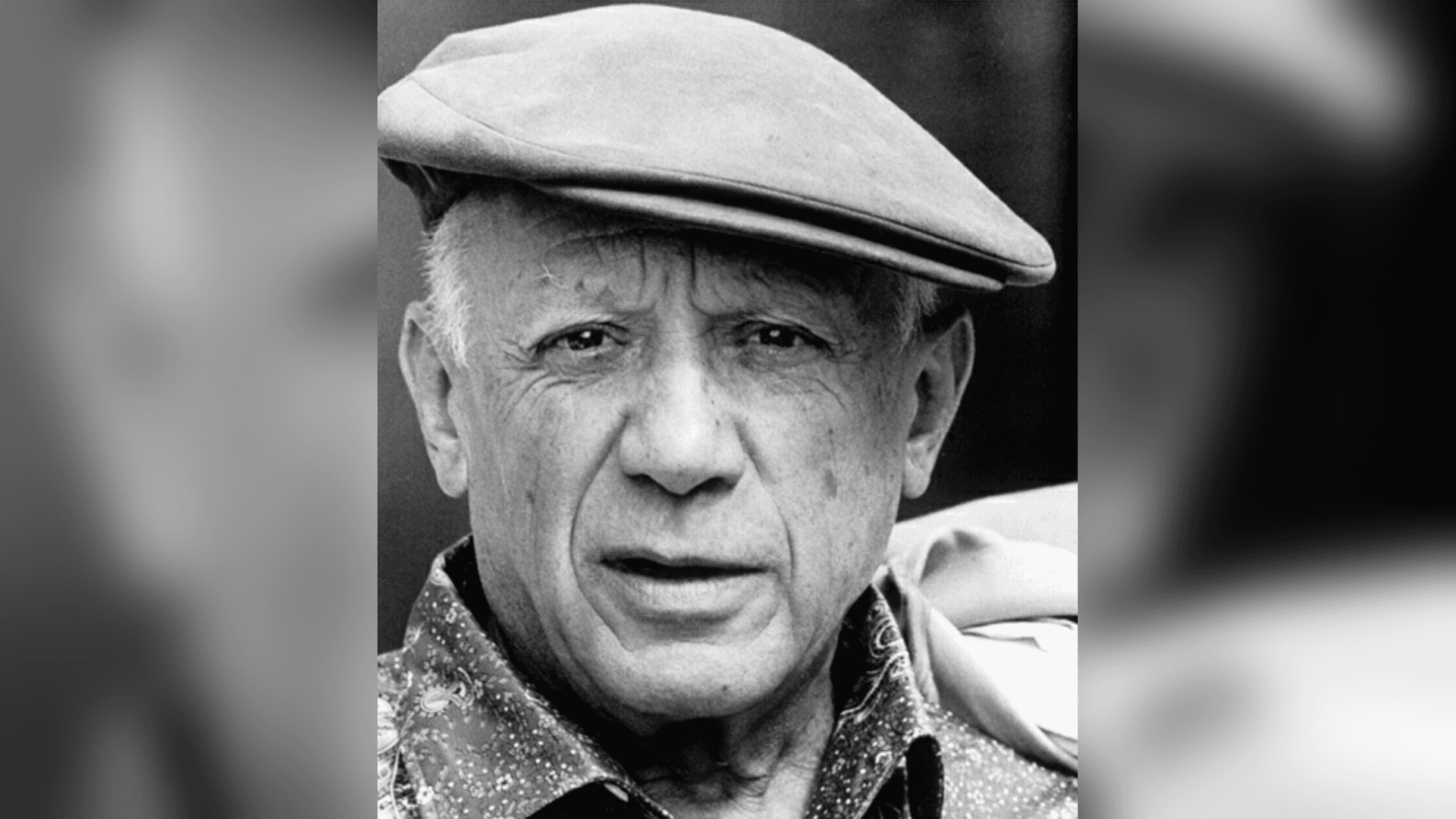
Hero image: Pablo Picasso, photograph published in the Argentine magazine Vea y Lea. Public domain, via Wikimedia Commons.
Take our professional IQ test
Want to know your IQ? Try the first ever professional online IQ test.