Bobby Fischer's IQ is often quoted as 180 or higher. The number traces to one secondhand school anecdote. Here is what is documented and what is myth.
Dr. Russell T. WarneChief Scientist
Share
Bobby Fischer never had a documented IQ score made public. The famous claim that his IQ was "in the 180s" traces to a single secondhand anecdote in a 1973 biography, and other publications have printed 184, 187, and even 123, none with a test record behind them. What is documented is the most extraordinary prodigy run in chess history: United States champion at 14, the world's youngest grandmaster at 15, and world champion in 1972. This article separates the paper trail from the folklore.
Where the 180 number actually comes from
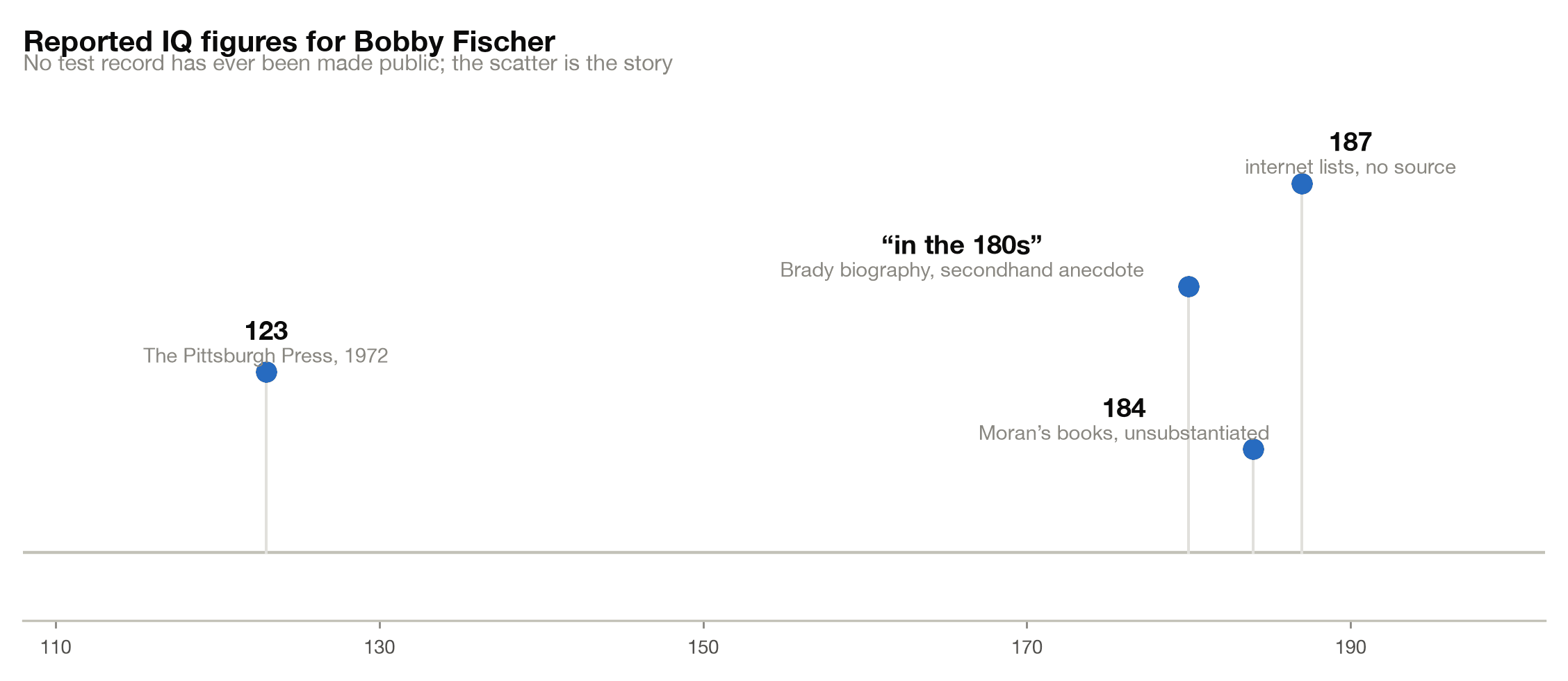
The source is one paragraph. In the 1973 edition of Profile of a Prodigy, page 22, biographer Frank Brady reported a conversation with a professor who had once worked in the Grade Advisor's Office at Erasmus Hall High School in Brooklyn while Fischer was a student there. "His IQ was in the 180s," the professor said. "Give or take a point or two. He was definitely a high genius, but with no interest or capacity for schoolwork." That is the entire evidence: an unnamed staff member, recalling a school record from memory, years after the fact. No test name, no date, no document.
Contemporary reporting confirms the score was never released. In February 1958 the New York Times wrote that "the boy's intelligence quotient has never been made public, but school authorities indicate that it is high in the upper percentile." New York schools tested students routinely in that era, so a score probably existed at some point. It has never surfaced.
The numbers do not agree, which is the point
Chess historian Edward Winter, who has traced these claims in his Chess Notes series, documents a second figure, 184, given "without substantiation" in two 1970s books by Pablo Moran. Internet lists add 187 with no source at all. And in June 1972 The Pittsburgh Press ran the opposite claim, describing Fischer as "the prodigy whose IQ tested only 123 at Erasmus High School in Brooklyn." That clipping has never been checked against any school record either.
When published figures for the same person scatter from 123 to 187, you are not looking at measurement. You are looking at folklore. A real score comes with a test name, a date, and a known margin of error, and none of the Fischer numbers has any of the three.
The record that is actually documented
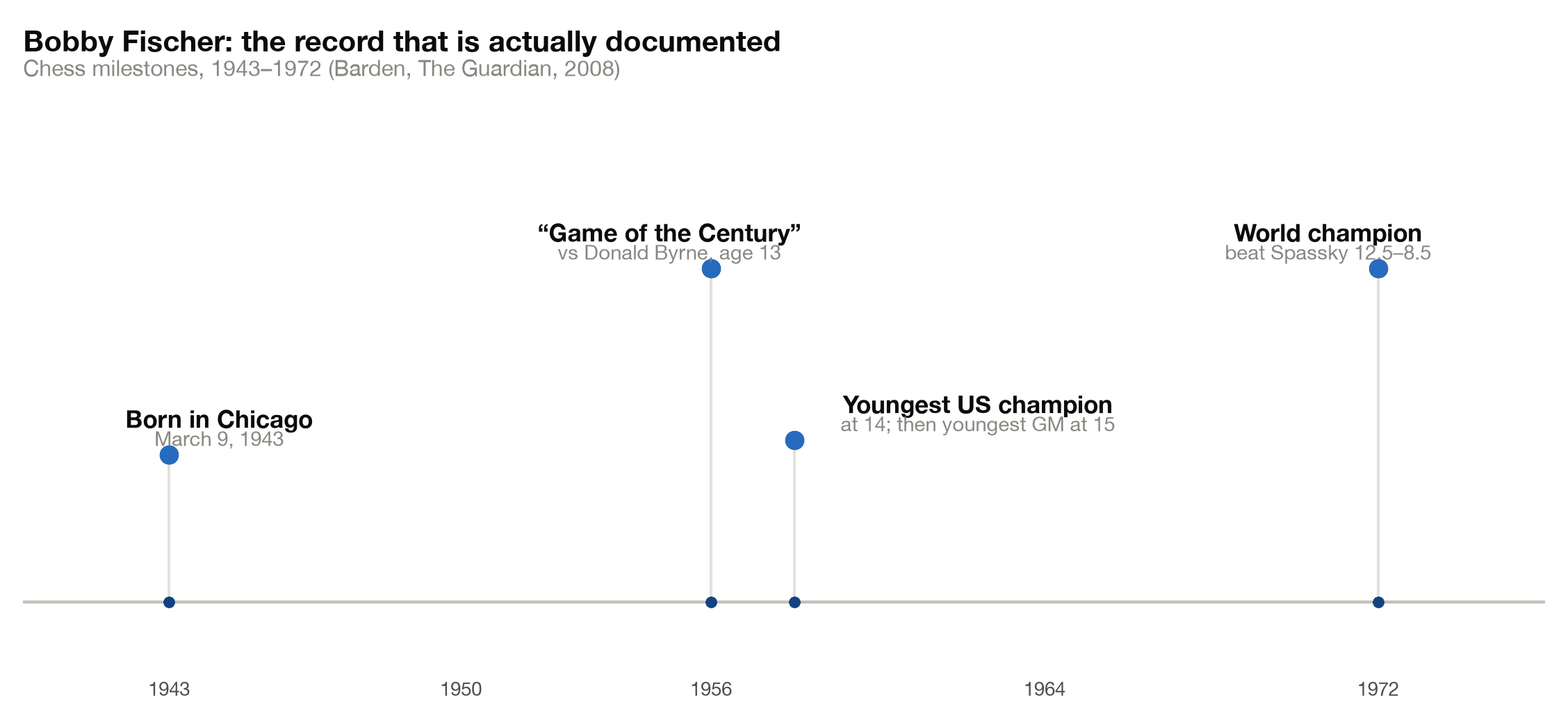
Robert James Fischer was born in Chicago on March 9, 1943. In late 1956, at 13, his queen sacrifice against Donald Byrne in New York was dubbed "the game of the century" by Chess Review. In the 1957-58 US Championship he scored eight wins and five draws without a loss to become the nation's youngest ever titleholder at 14. Months later, at the 1958 Portoroz Interzonal, he became the youngest world title candidate and the youngest grandmaster in history at 15, a record that stood for decades. In 1972 at Reykjavik he beat Boris Spassky 12.5 to 8.5 for the world championship.
What chess prodigies tell us about IQ
It is fair to ask whether a record like that implies a specific IQ. The research answer is no. A 2016 meta-analysis by Burgoyne and colleagues, covering 19 studies, found that chess skill correlates only modestly with cognitive ability, about r = .24 with "fluid reasoning," the capacity to solve novel problems. The correlation is weakest, roughly .11 to .14, among elite ranked players. Classic work by Chase and Simon showed why: a master's advantage rests on an enormous learned store of chess patterns, which is expertise rather than general intelligence. The same logic applies to modern champions; see our article on Magnus Carlsen's IQ for the identical pattern.
It is reasonable to infer that Fischer was highly intelligent. It is not reasonable to attach a number to him, and any number in the 180s would sit above the ceiling of what modern standardized tests can measure at all.
The bottom line on Fischer
• A quote is not a score: The 180s figure is an unnamed professor's recollection of a school record, relayed secondhand in a biography. No test document has ever surfaced.
• Scatter means folklore: Credible-sounding sources have put Fischer anywhere from 123 to 187. Real measurements of one person do not behave that way.
• The chess record is the evidence: Youngest US champion, youngest grandmaster of his era, world champion. That is documented, and it is enough.
No documented test score exists. The famous "180s" figure comes from a single secondhand anecdote in Frank Brady's biography, in which an unnamed professor recalled Fischer's school record. Other sources have printed 181, 184, 187, and even 123, none with documentation.
Was Bobby Fischer's IQ higher than Einstein's?
The comparison cannot be made. Neither man has a verified score. Einstein never took an IQ test, and Fischer's reported numbers are unsourced anecdotes, so any ranking of the two is invented.
Was Bobby Fischer a genius?
His chess record is genuinely historic: youngest US champion at 14, youngest grandmaster in the world at 15, world champion in 1972. But research shows elite chess skill reflects domain-specific expertise more than raw IQ, so the record does not translate into a specific number.
Did Bobby Fischer ever take an IQ test?
Probably, since New York schools tested students routinely in that era, and a 1958 New York Times article said school authorities called his IQ "high in the upper percentile" without releasing it. No actual score or test document has ever been made public.
How high an IQ do you need to become a chess grandmaster?
There is no cutoff. A 2016 meta-analysis found chess skill correlates only modestly with cognitive ability, and the correlation is weakest among elite players. Study volume, memory for chess patterns, and temperament separate champions from the rest.
The takeaway
Fischer's ability was demonstrated over the board, in games that are still studied, and it needs no invented number. If you are curious where you stand, your own score, unlike celebrity folklore, is measurable. The Reasoning and Intelligence Online Test from RIOT IQ was developed by a team led by psychologist Dr. Russell T. Warne and reports a modern, properly normed score with stated precision, which is what a defensible IQ number looks like.
References
1. Brady, F. (1973). Bobby Fischer: Profile of a prodigy (rev. ed.). David McKay. archive.org
3. Barden, L. (2008, January 18). Obituary: Bobby Fischer. The Guardian. theguardian.com
4. Burgoyne, A. P., Sala, G., Gobet, F., Macnamara, B. N., Campitelli, G., & Hambrick, D. Z. (2016). The relationship between cognitive ability and chess skill: A comprehensive meta-analysis. Intelligence, 59, 72-83. doi.org
5. Chase, W. G., & Simon, H. A. (1973). Perception in chess. Cognitive Psychology, 4(1), 55-81. doi.org
6. Warne, R. T. (2020). In the know: Debunking 35 myths about human intelligence. Cambridge University Press. doi.org
7. Chess.com. (n.d.). Bobby Fischer: Chess player profile.chess.com
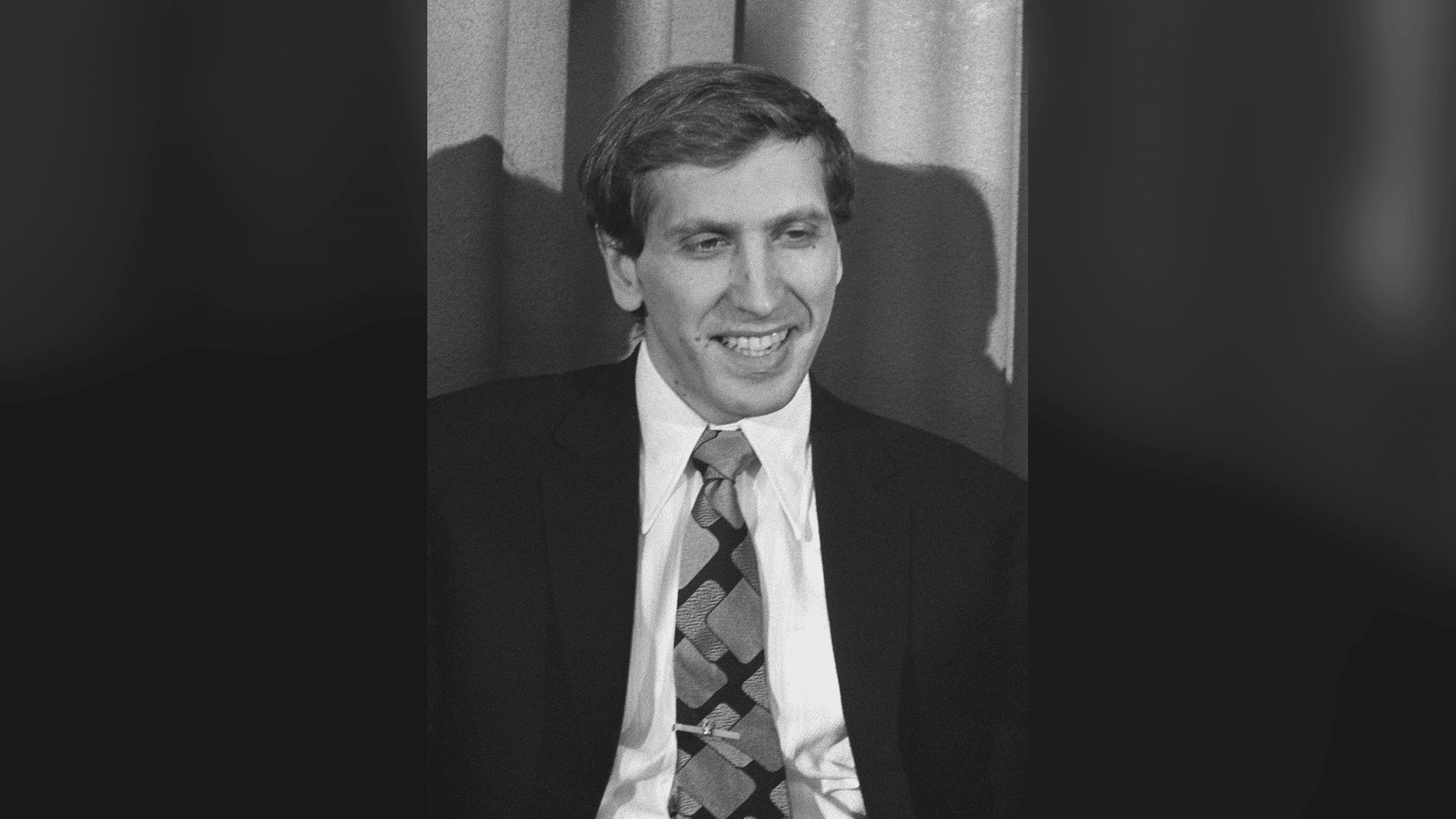
Hero image: Bobby Fischer, 1972. Photo: Bert Verhoeff / Anefo, Nationaal Archief, CC0, via Wikimedia Commons.
Take our professional IQ test
Want to know your IQ? Try the first ever professional online IQ test.