What Was Galileo's IQ? Cox's 1926 Estimate and the Story Behind 185 | Riot IQ
Oct 31, 2026·Famous People & IQ
What Was Galileo's IQ? Cox's 1926 Estimate and the Story Behind 185
Galileo's IQ was never tested. Cox's 1926 study estimated it at 145 in childhood and 165 by age 26; the popular "185" is her corrected figure. Here is why.
Dr. Russell T. WarneChief Scientist
Share
Galileo Galilei never took an IQ test, so any number attached to him is an estimate. The best-sourced figures come from Catharine Cox's 1926 Stanford study of 301 eminent people, which estimated Galileo's IQ at 145 for his childhood and 165 for ages 17 to 26, and the popular "Galileo IQ 185" is Cox's statistically corrected version of that second figure. Galileo died in 1642, more than 260 years before Alfred Binet's first intelligence scale appeared in 1905, so no measured score can exist. This article explains how Cox reached her numbers, where the 185 comes from, what the documented record of Galileo's early life actually shows, and what his achievements can and cannot tell us about his intelligence.
Galileo in Cox's 1926 study
Cox's Genetic Studies of Genius, Volume II is the only scholarly source for a Galileo IQ figure. Her raters read compiled biographical records for each subject and judged what IQ would typically produce the recorded achievements at each age, an approach called "historiometry," meaning the measurement of psychological traits from historical documents. The method is explained in more detail in our article on Napoleon's IQ, so here the focus stays on Galileo's own file.
Cox's case study of Galileo, printed on pages 526 to 528, is headed "AI IQ 145, AII IQ 165." The AI figure covers birth to age 17 and the AII figure covers ages 17 to 26. Her summary table for the 145 group (Table 30) gives the full values with their error bands: 145 ± 7 for the early period and 165 ± 7 for the later one. The reliability coefficients of the underlying data were .53 and .60 on her scale, which runs from very thin records to very full ones; Galileo's sit in the middle.
The individual ratings show how much judgment is involved. In Cox's master table (Table 12A), the three main raters gave Galileo's childhood record 120, 150 and 160. For ages 17 to 26 they gave 140, 185 and 170, and a fourth, partial rater gave 175. The published 165 is the average of the three main ratings. A 45-point spread between two raters reading the same file is a reminder that these numbers are informed opinions about documents.
The file itself is short. Under "Evidences of precocity," Cox's entry for Galileo's childhood reads, in full: "(No further record.)" The early rating rests mostly on his mechanical toys, his skill at the lute and at drawing, his ease with Greek and Latin at the Vallombrosa monastery school, and a general statement that he was "remarkable for intellectual aptitude of various kinds." The higher AII rating reflects what he did as a young man, covered below.
Where "Galileo IQ 185" comes from
The 185 that circulates on celebrity-IQ lists is traceable, which is unusual for this genre. Cox believed her raw estimates were pulled down toward 100 whenever records were thin, so she applied a statistical correction that pushes each person's score toward the average of their professional group, by an amount that grows as the data get less reliable. Galileo was classed with the Scientists, whose average AII estimate was 152. The correction lifts his 145 to 160 and his 165 to 185, and both corrected values appear in the last columns of Table 12A.
Cox was explicit about how far those corrected figures should be trusted. On page 84 she wrote that "the purpose of the corrected estimates is not to furnish exact values for the score of an individual or even of a group." She thought they were still probably too low. The psychologist Dean Keith Simonton, who has reanalyzed Cox's data for decades, has noted the opposite risk, that the corrected scores "may be overestimates." Either way, 185 is an adjusted estimate built on a 400-year-old paper trail. Figures above 185 that appear online, such as 200 or more, have no source I could find in Cox or in any later scholarly study.
What the documented record shows
The reliable record of Galileo's youth comes mostly from later biographies, and it shows a gifted student who arrived at mathematics fairly late.
• Early schooling: Galileo was born in Pisa in 1564, the son of the musician and music theorist Vincenzo Galilei. He was tutored in Florence by Jacopo Borghini and then schooled by Camaldolese monks at Vallombrosa, where he became a novice before his father brought him home.
• Medicine at Pisa: In 1581 his father enrolled him to study medicine at the University of Pisa. He never took the subject seriously and, by 1585, left without a degree.
• Turning to mathematics: Around 1582 to 1583 he attended Ostilio Ricci's course on Euclid, and Ricci helped persuade his father to let him study mathematics. Within a few years he was writing original work: La Bilancetta (1586), on measuring specific gravity with a balance, and studies of centers of gravity that impressed the Jesuit mathematician Christopher Clavius.
• Early professorship: He was appointed to the chair of mathematics at Pisa in 1589, at 25, and moved to a far better-paid chair at Padua in 1592.
Two of the best-known Galileo stories should be treated with caution. The tale that he worked out the regularity of the pendulum by timing a swinging lamp in Pisa Cathedral, and the tale that he dropped weights from the Leaning Tower, both come from the 1654 biography by his last student, Vincenzo Viviani, written more than a decade after Galileo's death. Museo Galileo describes the cathedral story as resting on "tradition" and the tower experiment as "an unverifiable legend." Galileo certainly studied pendulums and falling bodies, through careful work with inclined planes from 1602 onward; the dramatic single moments are the uncertain part.
His mature achievements are well documented. After hearing of a Dutch spyglass in 1609, he ground his own lenses, built telescopes far better than the original, and in 1610 published Sidereus Nuncius, reporting mountains on the Moon and four moons orbiting Jupiter. His Dialogue Concerning the Two Chief World Systems (1632) favored the Copernican view, and in June 1633 the Inquisition convicted him of "vehement suspicion of heresy"; the prison sentence was commuted to house arrest. Confined to his villa at Arcetri, he completed Two New Sciences, published in Holland in 1638, which set out his mature physics of motion. He died in 1642.
What his achievements do and do not say about IQ
Galileo's work required abstract reasoning of a very high order: describing motion mathematically and designing experiments that could decide between rival theories. These are exactly the kinds of reasoning that correlate with the "general intelligence" or "g" factor, the common ability that runs through performance on all mental tests (see our explainer on the g factor). It is reasonable to infer that Galileo would have scored well above average on a modern test.
Beyond that, the inference weakens fast. Cox herself found that "the more complete the record the higher the average IQ" for any sizeable group in her study, which means her rankings partly measure how well a childhood was documented. Galileo's early file is thin, so his childhood estimate is held down by missing evidence as much as by anything the evidence shows. Historiometric IQs also correlate only modestly with eminence itself; Simonton reports a correlation of about .25 across Cox's sample. Many people with very high IQs never produce anything like the Sidereus Nuncius, and Galileo's breakthroughs also depended on practical craft, such as grinding his own lenses, and on decades of persistence.
The same caution applies to comparisons between geniuses. Isaac Newton, born the year Galileo died, has his own Cox file and his own inflated internet figures, discussed in our article on Isaac Newton's IQ. Ranking the two by these numbers mostly ranks their biographers.
Frequently asked questions
What was Galileo's IQ?
Galileo was never tested; he died in 1642, long before IQ tests existed. Catharine Cox's 1926 historiometric study estimated his IQ at 145 for childhood and 165 for ages 17 to 26.
Where does the "Galileo IQ 185" figure come from?
It is Cox's corrected estimate for ages 17 to 26, produced by adjusting his 165 toward the average of the scientists in her study. Cox warned that corrected figures were not exact values for any individual.
Was Galileo a good student?
He was a quick and versatile learner in languages, music and drawing, but he showed little interest in medicine and left the University of Pisa in 1585 without a degree. His talent showed once he turned to mathematics in his late teens and early twenties.
Did Galileo really drop balls from the Leaning Tower of Pisa?
The story comes from Vincenzo Viviani's 1654 biography, and Museo Galileo calls it an unverifiable legend. Galileo's documented work on falling bodies used inclined planes and pendulums.
Is 185 a genius-level IQ?
On a modern scale a measured 185 would be extremely rare, but Galileo's 185 was never measured. It is a corrected estimate from biographical records and carries wide uncertainty.
The takeaway
Every serious Galileo IQ figure traces back to a single 1926 study that rated a thin childhood file and a remarkable early career: 145 and 165 as estimated, 160 and 185 after Cox's correction. The record leaves no doubt that Galileo was a formidable reasoner, but the numbers are scholarly guesses about documents written centuries ago. If you want a figure that comes from an actual measurement with stated precision, you can take a full-length online IQ test developed and normed by psychometricians.
References
1. Cox, C. M. (1926). Genetic studies of genius: Vol. II. The early mental traits of three hundred geniuses. Stanford University Press. [archive.org](. archive.org
2. Cox, C. M. (1926). Genetic studies of genius: Vol. II [alternate full scan]. Stanford University Press. [archive.org](. archive.org
3. Miller, D. M. (2025). Galileo Galilei. In E. N. Zalta & U. Nodelman (Eds.), The Stanford Encyclopedia of Philosophy. [plato.stanford.edu](. plato.stanford.edu
4. O'Connor, J. J., & Robertson, E. F. (2002). Galileo Galilei. MacTutor History of Mathematics Archive, University of St Andrews. [mathshistory.st-andrews.ac.uk](. mathshistory.st-andrews.ac.uk
5. Museo Galileo. (n.d.). Pisa: Following the path of Galileo. Institute and Museum of the History of Science, Florence. [brunelleschi.imss.fi.it](. brunelleschi.imss.fi.it
6. Museo Galileo. (n.d.). Cathedral of Santa Maria [Pisa]. Institute and Museum of the History of Science, Florence. [brunelleschi.imss.fi.it](. brunelleschi.imss.fi.it
7. Simonton, D. K. (2006). Presidential IQ, openness, intellectual brilliance, and leadership: Estimates and correlations for 42 U.S. chief executives. Political Psychology, 27(4), 511-526. [acsu.buffalo.edu](. acsu.buffalo.edu
8. Warne, R. T. (2020). In the know: Debunking 35 myths about human intelligence. Cambridge University Press. [doi.org/10.1017/9781108593298](. doi.org
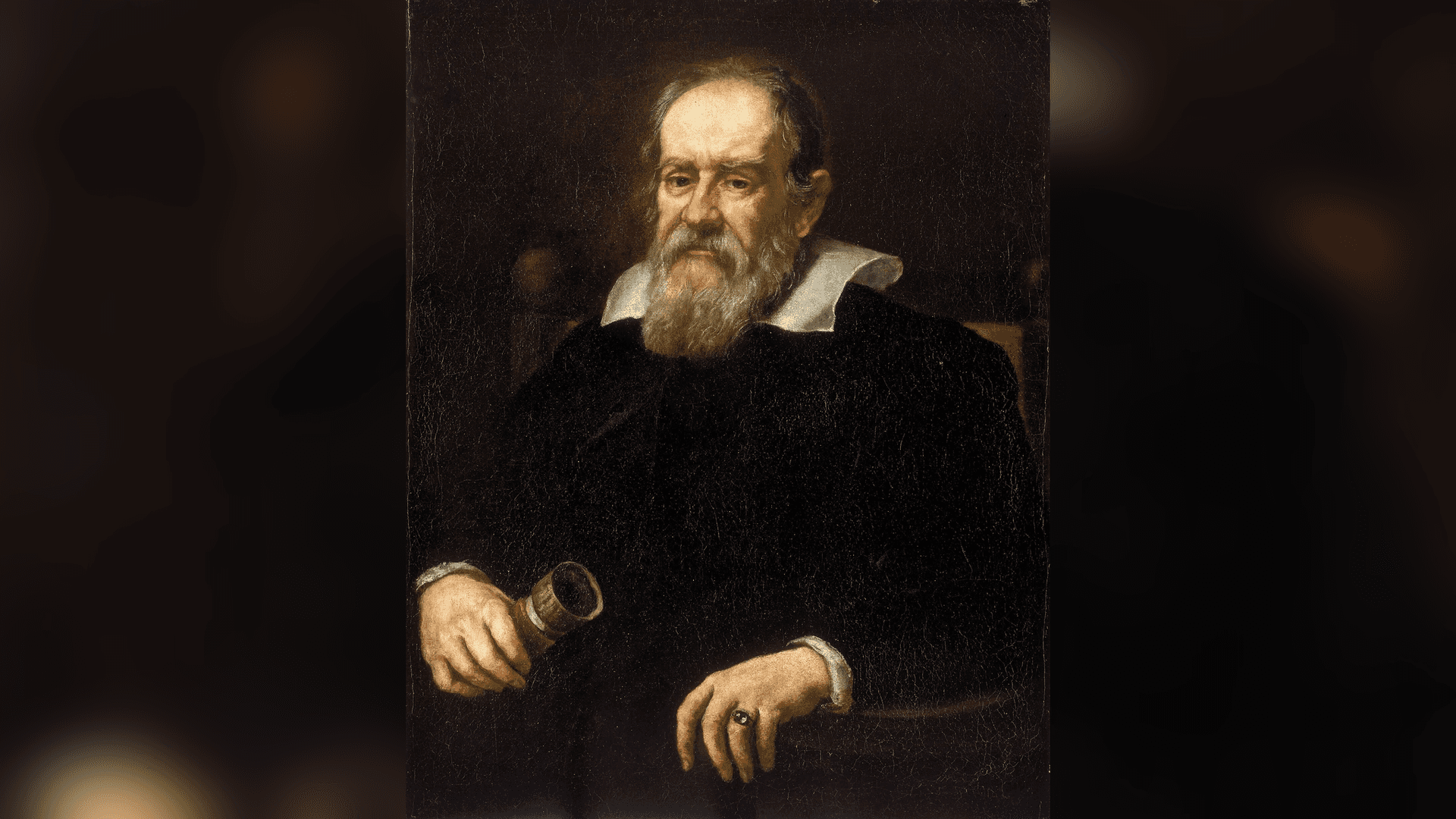
Hero image: Portrait of Galileo Galilei, by Justus Sustermans (1636), public domain. Via Wikimedia Commons.
Take our professional IQ test
Want to know your IQ? Try the first ever professional online IQ test.