What Was Vincent van Gogh's IQ? What His Letters and Life Show | Riot IQ
Oct 31, 2026·Famous People & IQ
What Was Vincent van Gogh's IQ? What His Letters and Life Show
Van Gogh's IQ was never measured, and no researcher has published an estimate. His 820 surviving letters show a well-read writer in Dutch and French.
Dr. Russell T. WarneChief Scientist
Share
Vincent van Gogh's IQ was never measured: he died in 1890, 15 years before Alfred Binet published the first intelligence scale, and no researcher has published even a historical estimate for him. Any Van Gogh IQ score you see online has no traceable source.
He was also born too late for Catharine Cox's famous 1926 study, which estimated IQs only for eminent people born between 1450 and 1850. What does survive is an unusually rich written record, including some 820 of his own letters, and it shows a man who read widely and wrote well in two languages, and who became a major painter within about ten years with little formal training. This article covers why no estimate exists, what his schooling and letters show, what his late start and huge output say about learning, how his mental illness fits in, and what his art can and cannot tell us about IQ.
Why there is no score and no Cox estimate
Historical IQ figures for famous people almost all descend from Cox's Genetic Studies of Genius, Volume II, in which raters read biographies and judged what IQ would typically produce each person's recorded childhood. Our article on Benjamin Franklin's IQ explains how that method worked and where it goes wrong. Van Gogh, born in 1853, falls outside her sample.
Even if he had been included, painters were the hardest group for Cox to rate. The 13 Artists in her main group averaged estimates of 122 for childhood and 135 for ages 17 to 26, and their records got some of the lowest adequacy ratings in the study (.23 and .32 on her 0-to-1 scale), because few people wrote down what future painters did as children. Cox thought the true average of that group was probably much higher, near 160, which shows how much of any such estimate is a judgment about missing paperwork.
What his schooling and letters show
The Van Gogh Museum's biography gives the outline of an interrupted education.
• School: At 11 he moved from the village school in Zundert to a boarding school in Zevenbergen, where he was "deeply unhappy" but completed his elementary schooling. At 13 he entered secondary school in Tilburg, where "he earned good marks, especially for languages." He left halfway through his second year, in 1868, for reasons nobody knows, and never went back to school.
• Work: At 16 he became a trainee at the international art dealer Goupil & Cie, which later sent him to London and Paris. In London he visited the British Museum and the National Gallery and "read everything from museum guides and magazines to literature and poetry." After Goupil dismissed him in 1876, he worked as an assistant teacher at boys' schools in England.
• A failed academic plan: In 1877 and 1878 he prepared in Amsterdam for the entrance exam to study theology, but, in the museum's words, he "lacked the discipline to study" and gave it up.
The letters are the strongest evidence of his mind. The surviving correspondence comprises 903 letters, 820 by Van Gogh and 83 to him, most of them to his brother Theo, and the museum estimates that he wrote more than 2,000 in total. About a third are in French, which he had spoken from an early age and used exclusively after moving to Paris in 1886. They contain more than 240 sketches and long, articulate discussions of color and of the books and painters he admired. The full annotated edition, prepared by the Van Gogh Museum and the Huygens Institute over fifteen years, is free online at vangoghletters.org.
Fluent writing in two languages and sustained argument about art tend to go with strong verbal ability. That is as far as the evidence goes. Letters show what a person did with his abilities, and they cannot be scored like a vocabulary test.
A late start and an enormous output
Van Gogh did not settle on art until he was 27. After the theology plan collapsed and a period as a lay preacher among miners in Belgium, his brother Theo encouraged him to concentrate on drawing, and in 1880 he moved to Brussels to work on his technique. He took lessons in watercolor and oil from his cousin-in-law Anton Mauve in The Hague and practiced, as the museum puts it, "fanatically."
In the roughly ten years that followed, he produced over 850 paintings and almost 1,300 works on paper. During one year at the asylum in Saint-Rémy he completed about 150 paintings. Learning a demanding craft that fast, largely on his own, is consistent with a quick learner. It also reflects extraordinary persistence and thousands of hours of practice. Our article on IQ and drawing covers what research says about drawing and intelligence, including why people who draw well can seem especially intelligent.
Mental illness and the "mad genius" idea
Van Gogh's illness shaped how people remember him, so it is worth stating what is known. In December 1888, after rising tension with Paul Gauguin in Arles, he cut off his ear and was hospitalized. His mental health then fluctuated sharply, and in May 1889 he had himself voluntarily admitted to the psychiatric hospital at Saint-Rémy, where he stayed a year. On 27 July 1890, in Auvers-sur-Oise, he shot himself in the chest, and he died two days later.
His own doctors disagreed. Félix Rey in Arles called the first crisis "a transient over-excitement" and later suggested epilepsy, Rey's superior described "an attack of acute mania with generalized delirium," and Théophile Peyron, his doctor at Saint-Rémy, recorded "attacks of epilepsy, separated by long intervals." Many more theories have followed. In 2020 a team of Dutch clinicians, working with three art historians who know the letters well, ran structured diagnostic interviews about every symptom on record. They concluded he most likely had a mood disorder, probably bipolar, with borderline personality traits, worsened by alcohol use and malnutrition, and that temporal lobe epilepsy cannot be ruled out. Any diagnosis made 130 years after death remains a reasoned guess, and this one is no exception.
The link between serious mental illness and creative work is real but small. In Swedish registers covering more than a million psychiatric patients, people in creative professions were more likely than matched controls to have bipolar disorder, but not the other conditions studied; authors were the exception, with higher rates of several disorders. Mental illness did not make Van Gogh a painter, and the asylum letters show him painting in spite of it. The research on IQ and bipolar disorder also undercuts the idea that it is a high-IQ condition: in the largest study, risk of hospitalization fell as IQ rose.
What his art does and does not say about IQ
Creativity and intelligence overlap less than people assume. A meta-analysis of 21 studies and almost 46,000 participants found a correlation of only .17 between creativity test scores and IQ. Great painting also depends on trained visual and motor skill and on an original eye, which an IQ test does not try to capture.
The most defensible statement is that Van Gogh's documented record (good marks in languages, fluent French, wide reading, articulate letters and rapid progress as a largely self-taught painter) is consistent with above-average general ability, and that nothing in it supports a specific number. People who attach a precise IQ to him are inventing one.
Frequently asked questions
What was Van Gogh's IQ?
Nobody knows. He died in 1890, before IQ tests existed, and no researcher has published a historical estimate, so any number online is invented.
Is Van Gogh in Catharine Cox's 1926 genius study?
No. Cox studied eminent people born between 1450 and 1850, and Van Gogh was born in 1853.
How many languages did Van Gogh speak?
His letters are in Dutch and French, with about a third written in French, and he lived in England for about three years, working for an art dealer and then as a teacher. At secondary school in Tilburg his best marks were in languages.
Was Van Gogh's mental illness linked to his genius?
The evidence for a general link is weak. Registry studies find people with bipolar disorder somewhat overrepresented in creative jobs, but Van Gogh painted through his illness, and his diagnosis is still debated.
How many letters did Van Gogh write?
About 820 of his letters survive, most of them to his brother Theo, and the Van Gogh Museum estimates he wrote more than 2,000 in total.
The takeaway
There is no Van Gogh IQ: he never took a test, and no published study stands behind the numbers that circulate. His letters and his self-taught mastery of painting point to a capable and hard-working mind, and that is as far as honest evidence goes. If you want a number that is an actual measurement of your own reasoning, try an online IQ test built by psychometricians that reports modern scores with stated precision.
References
1. Cox, C. M. (1926). Genetic studies of genius: Vol. II. The early mental traits of three hundred geniuses. Stanford University Press. [archive.org](. archive.org
2. Van Gogh Museum. (n.d.). Vincent van Gogh's early years: 1853-1873. [vangoghmuseum.nl](. vangoghmuseum.nl
3. Van Gogh Museum. (n.d.). Vincent van Gogh's search for his purpose in life: 1873-1881. [vangoghmuseum.nl](. vangoghmuseum.nl
4. Van Gogh Museum. (n.d.). Van Gogh's letters. [vangoghmuseum.nl](. vangoghmuseum.nl
5. Jansen, L., Luijten, H., & Bakker, N. (Eds.). (2009). Vincent van Gogh: The letters [Web edition]. Van Gogh Museum & Huygens ING. [vangoghletters.org](. vangoghletters.org
6. Van Gogh Museum. (n.d.). Vincent van Gogh's hospitalization: 1889-1890. [vangoghmuseum.nl](. vangoghmuseum.nl
7. Van Gogh Museum. (n.d.). Vincent van Gogh's final months: 1890. [vangoghmuseum.nl](. vangoghmuseum.nl
8. Nolen, W. A., van Meekeren, E., Voskuil, P., & van Tilburg, W. (2020). New vision on the mental problems of Vincent van Gogh; results from a bottom-up approach using (semi-)structured diagnostic interviews. International Journal of Bipolar Disorders, 8, 30. [doi.org/10.1186/s40345-020-00196-z](. doi.org
9. Kyaga, S., Landén, M., Boman, M., Hultman, C. M., Långström, N., & Lichtenstein, P. (2013). Mental illness, suicide and creativity: 40-year prospective total population study. Journal of Psychiatric Research, 47(1), 83-90. [doi.org/10.1016/j.jpsychires.2012.09.010](. doi.org
10. Kim, K. H. (2005). Can only intelligent people be creative? A meta-analysis. Journal of Secondary Gifted Education, 16(2-3), 57-66. [doi.org/10.4219/jsge-2005-473](. doi.org
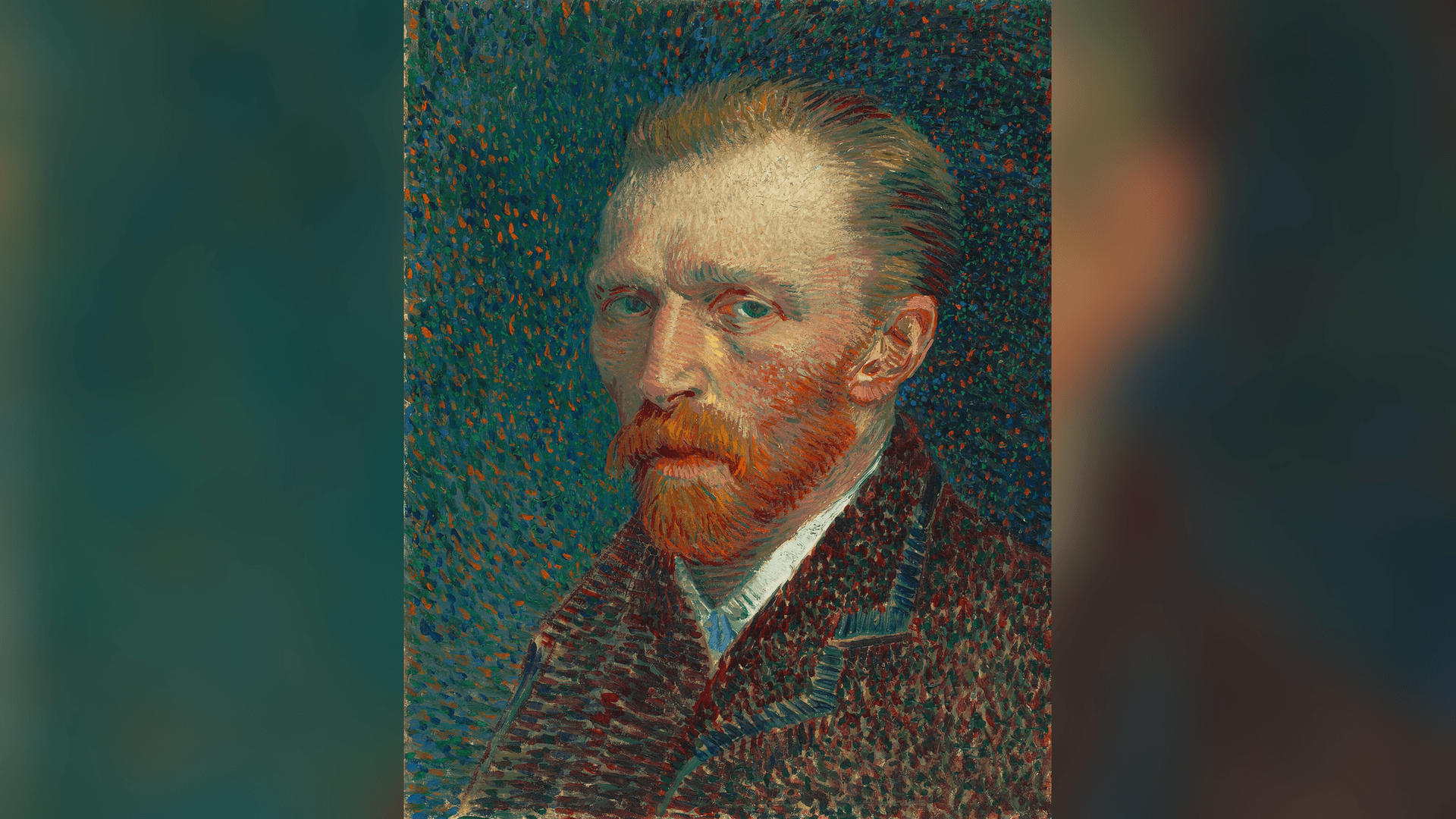
Hero image: Vincent van Gogh, Self-Portrait (1887), Art Institute of Chicago, public domain, via Wikimedia Commons.
Hero image: Self-Portrait, by Vincent van Gogh (1887), Art Institute of Chicago, public domain. Via Wikimedia Commons (Google Art Project).
Take our professional IQ test
Want to know your IQ? Try the first ever professional online IQ test.