George Washington never took an IQ test. Researchers estimate George Washington's IQ at roughly 125 to 140 from historical records. Here is how they did it.
Dr. Russell T. WarneChief Scientist
Share
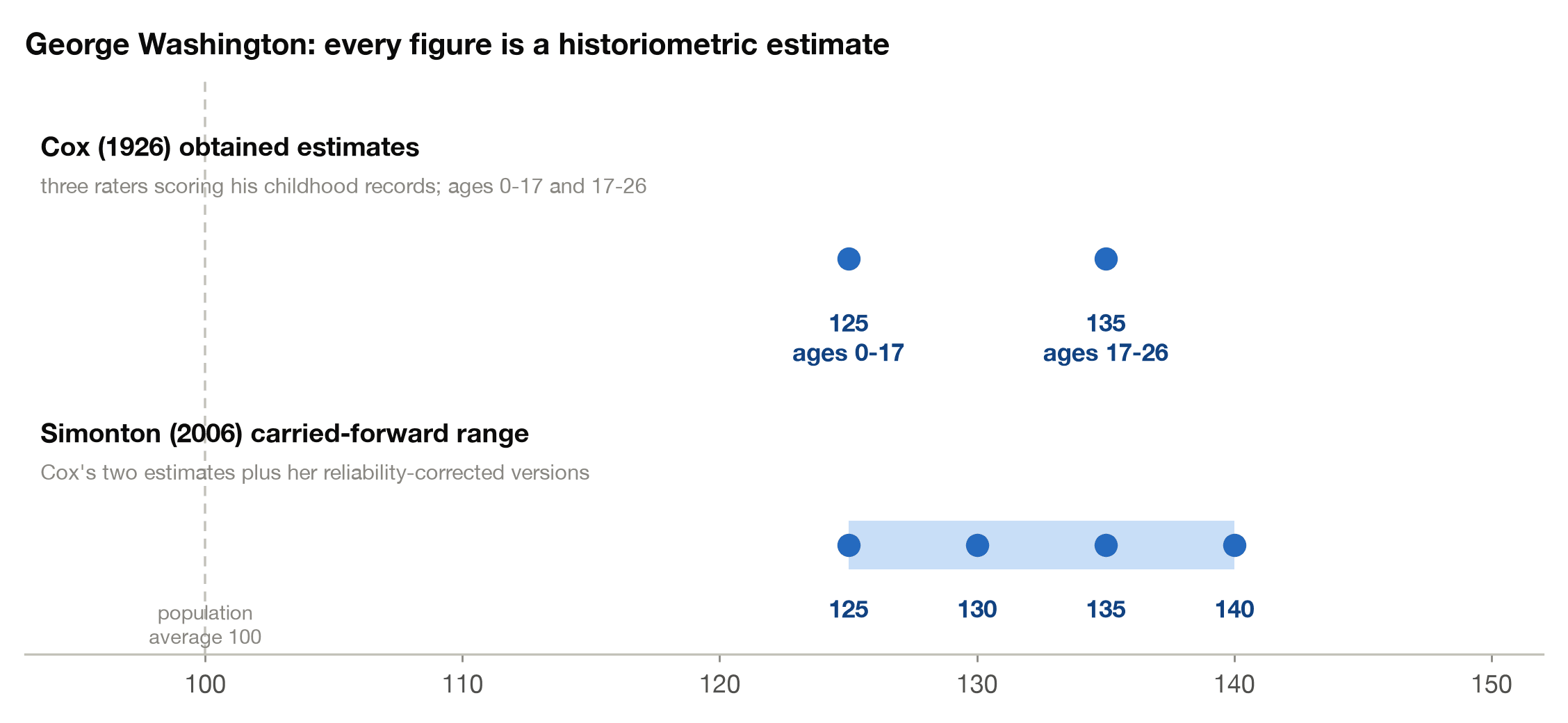
George Washington never took an IQ test, because none existed in his lifetime; he died in 1799 and the first intelligence test appeared in 1905. The best-known figures attached to his name are "historiometric" estimates, numbers researchers assigned by reading his biographical records long after his death. Catharine Cox's 1926 Stanford study estimated his IQ at 125 for childhood and 135 for ages 17 to 26, and Dean Keith Simonton's 2006 study carried those figures forward as a range of roughly 125 to 140. This article explains where those numbers come from and how seriously to take them.
Why there is no real score
The gap is more than a century wide. Washington died in 1799; Alfred Binet's first practical intelligence test arrived in 1905, and the term IQ only entered use in the 1910s. We trace that timeline in our history of IQ testing. Any Washington IQ you encounter online is therefore either a research estimate made from historical records or an invention. The two citable sources are Cox (1926) and Simonton (2006), and both attach warnings that the listicles leave out.
The Cox 1926 estimate: 125 to 135
Cox's Genetic Studies of Genius, Volume II, estimated IQs for 301 eminent historical figures. Three raters (Lewis Terman, Maud Merrill, and Cox herself) read each figure's recorded childhood accomplishments and judged what IQ a child would need to match them, producing two estimates per person: "AI" for birth through age 17 and "AII" for ages 17 to 26. Washington's case file reads: AI IQ 125, AII IQ 135. The reliability coefficient of his data, .60, was tied for the highest in her entire sample.
What did the raters see in his file? "A fair common school education" with some mathematics and no foreign languages; a note that "he was never a good speller"; and under "Evidences of precocity," the entry "(No specific record.)" The strongest material was practical: he was a professional surveyor at 15, and at 16 he was entrusted with surveying the Fairfax estate, producing surveys Cox's file calls "marvels of neatness and careful drawing." His 125 actually sits below the average of Cox's genius group, whose means were 135 and 145 for the two age windows, while still far above the population mean of 100.
The Simonton 2006 numbers: 125 to 140
Simonton's 2006 study in Political Psychology estimated IQs for all 42 presidents. For most of them the figures are statistical imputations, but Washington is one of the few whose values are carried directly from Cox: 125 and 135, plus her reliability-corrected versions of 130 and 140. The table note specifies that these are standard scores with a mean of 100 and a standard deviation of 16, slightly different from the 15 used by modern tests.
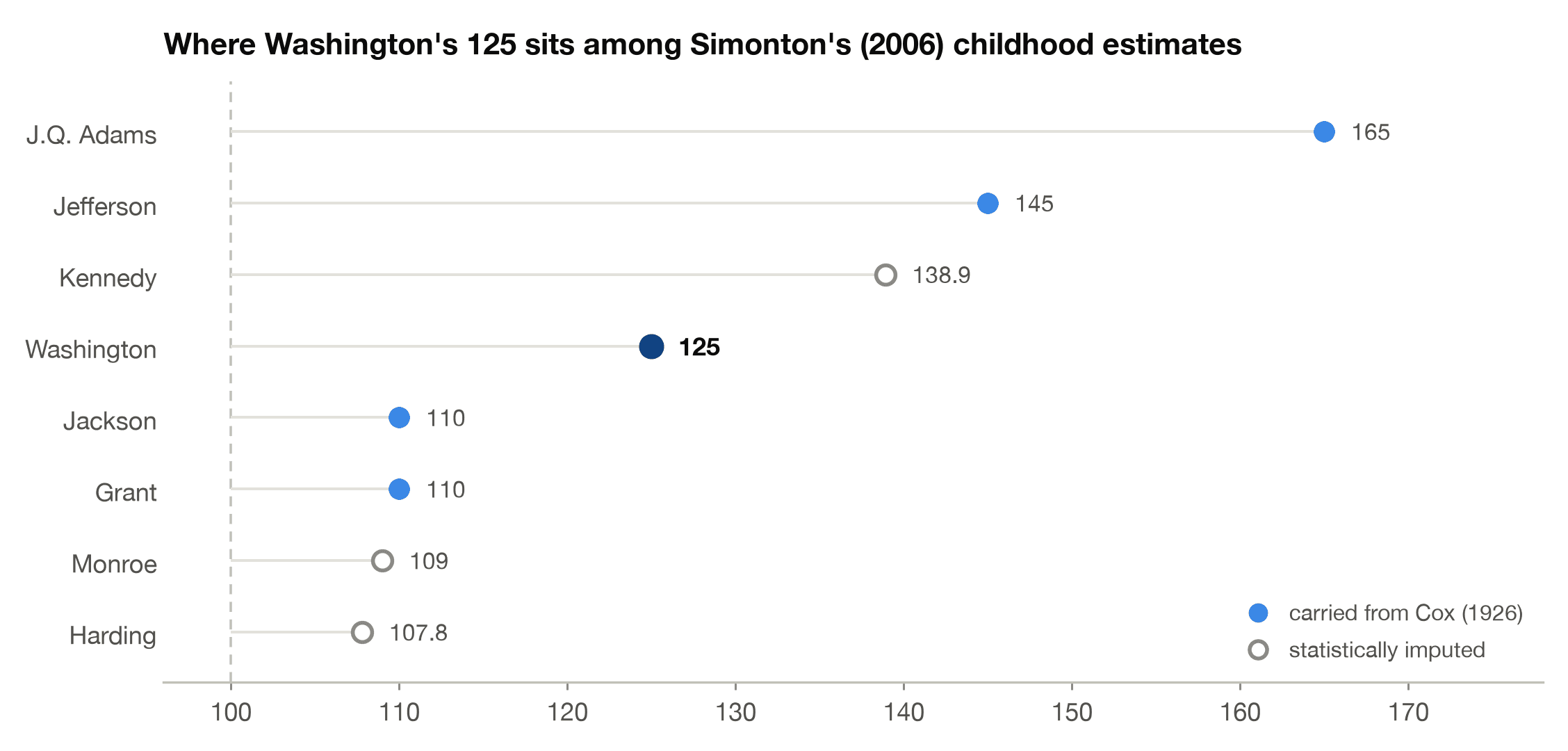
Within the presidential table, Washington lands in the bottom third: above Grant and Jackson (both 110), but well below Jefferson (145) and John Quincy Adams (165). Even so, 125 to 140 corresponds to roughly the top 5 to 10 percent of the general population. The full table, with all its caveats, is covered in our ranking of US presidents by IQ.
The big catch: estimates track the paper trail
Cox stated the method's core limitation herself: "The more complete the record the higher the average IQ for any considerable group in our study. In other words, the IQ is, for the most part, low in a given case not because evidence is available that sets a definite maximum IQ limit, but rather because sufficient evidence is not available to corroborate the highest estimate possible in a given case." Washington is the poster child for this bias. He never attended college, published nothing as a youth, and left thin schooling records, so his estimate says as much about his paper trail as about his mind. Historian Thomas C. Reeves was blunter about the whole enterprise: "In my judgment, this study has little if any value." Treat 125 to 140 as an informed guess with wide error bars, never as a score.
Smart enough to build a country
The estimates also miss what made Washington singular. Surveying the Virginia frontier at 15, commanding the Continental Army, presiding over the Constitutional Convention, and walking away from power twice are feats of judgment, persistence, and character that no childhood-record score can capture. Cox's own study famously concluded that persistence and confidence, combined with high but not necessarily the highest ability, marked her eminent group. Washington fits that conclusion better than almost anyone in it. For the same reason his story pairs well with our article on Albert Einstein's IQ, another towering figure whose famous number was never produced by a test.
Frequently asked questions
What was George Washington's IQ?
He never took an IQ test; none existed in his lifetime. Cox's 1926 study estimated 125 for childhood and 135 for ages 17 to 26 from biographical records, and Simonton's 2006 study carried those figures forward as roughly 125 to 140.
Was George Washington's IQ low for a president?
In Simonton's estimates he lands in the bottom third of presidents, well below Jefferson or John Quincy Adams. But 125 to 140 still corresponds to roughly the top 5 percent of people, and his sparse schooling records likely pulled the estimate down.
How can researchers estimate the IQ of someone born in 1732?
Through historiometry: raters read biographical records of childhood achievements and judge what IQ a child would need to match them. Cox's three raters did this for 301 eminent figures. It yields interesting rankings but measures the record rather than the mind.
Did George Washington go to college?
No. Cox's records describe "a fair common school education" with some mathematics and no foreign languages. He became a professional surveyor at 15 and surveyed the Fairfax estate at 16, which is the kind of early achievement her estimates were built on.
Which Founding Father had the highest estimated IQ?
In Cox's study, Jefferson (145) rates higher than Washington, John Quincy Adams reaches 165 in Simonton's table, and Benjamin Franklin was rated 145. All are estimates from records, none are test scores.
Are historiometric IQ estimates reliable?
They are reproducible enough for group-level research, but Cox warned that estimates rise with the completeness of the historical record, and Simonton calls his figures tentative. Treat them as informed guesses with wide error bars.
The takeaway
Washington's 125 to 140 is a judgment about an 18th-century paper trail, rendered by 20th-century raters, on a scale no modern test uses. It is history, and interesting history, but it is not measurement. If you would like an IQ figure that actually is one, the Reasoning and Intelligence Online Test reports modern deviation scores with stated precision, and you can start with the free RIOT IQ test.
References
1. Cox, C. M. (1926). Genetic studies of genius: Vol. II. The early mental traits of three hundred geniuses. Stanford University Press. archive.org
2. Simonton, D. K. (2006). Presidential IQ, openness, intellectual brilliance, and leadership: Estimates and correlations for 42 U.S. chief executives. Political Psychology, 27(4), 511-526. acsu.buffalo.edu