Hikaru Nakamura's IQ went viral after he scored 102 on an online test on stream. Here is what that score really means and what chess skill measures.
Dr. Russell T. WarneChief Scientist
Share
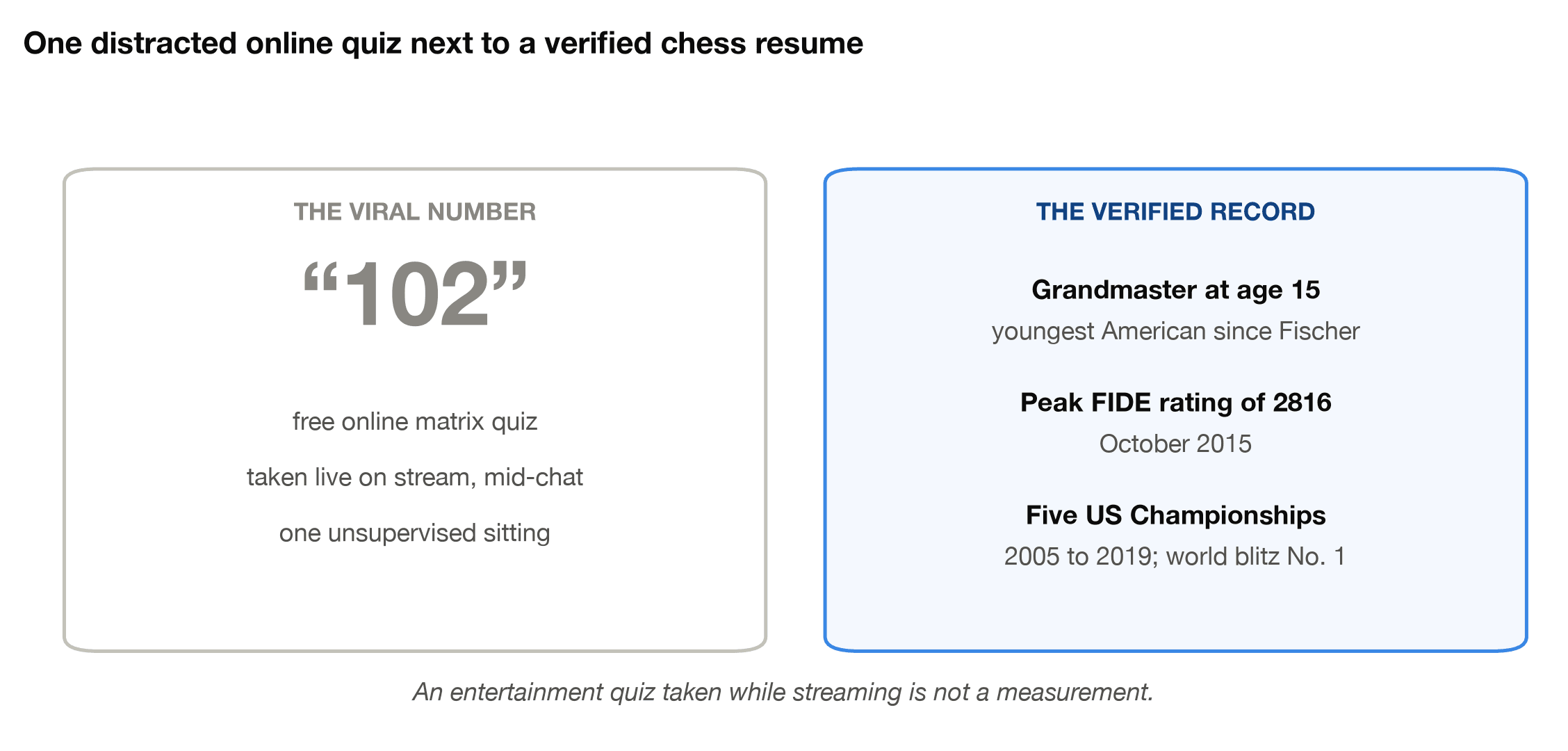
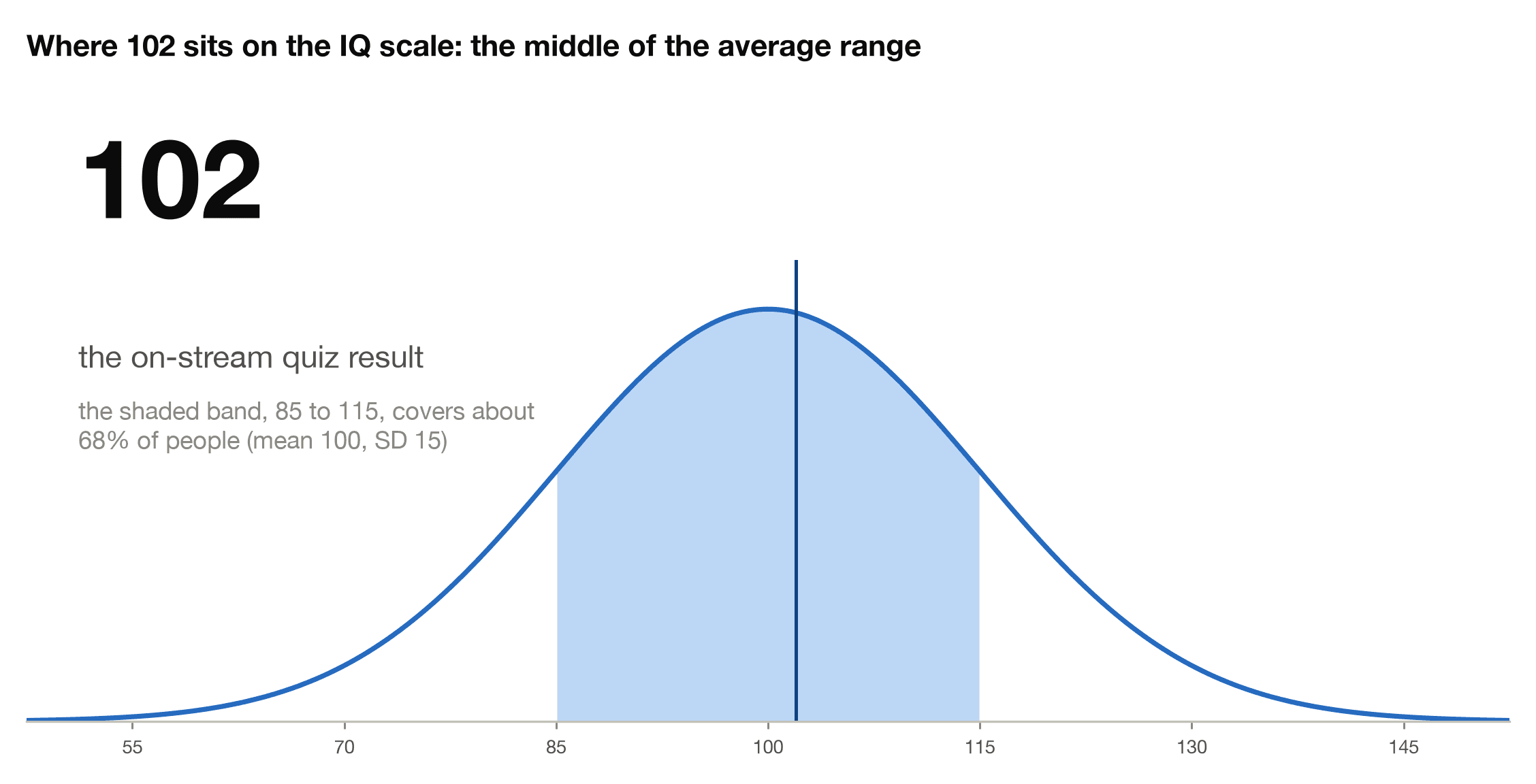
Hikaru Nakamura's only documented IQ-style result is a 102, scored on a free online matrix test he took live on stream around 2020 to 2021, while chatting with viewers. The clip went viral, and Nakamura now jokes about the number on his own YouTube channel. That quiz was an unsupervised entertainment product taken under the worst possible conditions, so his true IQ is simply unknown. His verified record is a different matter: a grandmaster title at age 15, a peak rating of 2816, and five US Championships. This article explains what actually happened on stream, why one online quiz is not a measurement, and what research says about chess skill and IQ.
The viral 102: what actually happened
During a livestream, Nakamura worked through a free Mensa-style online matrix test, a set of nonverbal pattern puzzles, and finished with a 102. Viewers noted that he was reading chat, talking, and short on time while he did it. The segment was clipped, spread everywhere, and became a running meme in the chess world. Nakamura leaned into it: his own channel later posted a short titled "Hikaru's 102 IQ Checking In," which is as close to an official acknowledgment as a meme can get.
Stories that he later retook the test and scored in the 120s circulate in comment sections, but no documented retake score exists at any primary source. The only number on the record is the 102, and the record also shows exactly why that sitting was a poor measurement.
Why one online quiz is not an IQ score
Take our professional IQ test
Want to know your IQ? Try the first ever professional online IQ test.
The test involved was a free online practice-style puzzle set, an entertainment instrument rather than a supervised clinical test. Real IQ testing depends on "standardization": every examinee gets the same conditions, the same timing, and a score anchored to a carefully built norm sample. A single unsupervised sitting, taken mid-conversation with thousands of spectators, has unknown "reliability" (the consistency a score would show across repeated measurements) for that one occasion. Properly administered tests are among the most reliable instruments in psychology; a stream segment is not one. We cover the general problem in our guide to whether online IQ tests are legit.
The right conclusion is precise. It is not that IQ testing is meaningless, and it is certainly not that a world-elite grandmaster has average ability. One distracted online quiz is not a measurement, and nothing more can be squeezed out of it.
Chess skill and IQ: what the research shows
A comprehensive 2016 meta-analysis by Burgoyne and colleagues found that cognitive ability correlates positively but modestly with chess skill, with correlations across ability facets running roughly from .13 to .35. The relationship is strongest among youth and novice players and weakest at the elite level, where thousands of hours of practice, opening preparation, and pattern memory dominate. A super-grandmaster posting an ordinary score on a casual quiz is therefore not a paradox; elite chess strength is a trained expertise, not a raw ability readout. Related research by Sala and Gobet finds that chess instruction transfers only weakly to broader academic and cognitive skills, a question we examine in does chess make you smarter.
The verified chess resume
What is documented about Nakamura leaves no doubt about the quality of his thinking in his own domain. He became a national master in 1998, an international master in 2001, and a grandmaster in 2003 at age 15, then the youngest American to do so since Bobby Fischer. His classical rating peaked at 2816 on the October 2015 list. He won the US Championship five times between 2005 and 2019, and as of August 2020 he was the world's highest-rated blitz player, with a 2900 FIDE blitz rating. For a similar case study at the very top of the game, see our article on Magnus Carlsen's IQ.
Frequently asked questions
What is Hikaru Nakamura's IQ?
The only documented number is 102, from a free online matrix test he took live on stream, and he jokes about it on his own YouTube channel. That was an unsupervised entertainment quiz taken while he chatted with viewers, so his true IQ is unknown.
Did Hikaru really score 102 on an IQ test?
Yes, on stream, and the clip went viral. His own channel later posted "Hikaru's 102 IQ Checking In," leaning into the meme. Viewers noted he was distracted by chat and short on time, which is exactly why one casual online sitting is not a valid measurement.
Do chess grandmasters have high IQs?
On average, chess players score above average, and cognitive ability correlates with chess skill, but the correlation is modest and weakest among elite players. At the top level, decades of deliberate practice and pattern knowledge matter more than test scores.
How good is Hikaru Nakamura at chess?
He became a grandmaster in 2003 at age 15, then the youngest American GM since Bobby Fischer, won five US Championships between 2005 and 2019, peaked at a 2816 FIDE rating in October 2015, and has ranked as the world's top blitz player.
Are online IQ tests like the one Hikaru took accurate?
Mostly no. Unsupervised online quizzes have unknown norms and reliability for any single sitting, and conditions like streaming, chatting, and time pressure lower scores. Standardized tests administered under controlled conditions are far more reliable.
The takeaway
The 102 is real, and it measures the conditions far more than it measures the man. A serious answer to "what is my IQ" requires a properly built instrument taken with actual attention. The Reasoning and Intelligence Online Test was designed by psychometricians for exactly that purpose: take the free RIOT IQ test under quiet conditions and you will get a normed score with stated precision, something no mid-stream quiz can offer.
2. GMHikaru. (n.d.). Hikaru's 102 IQ checking in [Video]. YouTube. youtube.com
3. Mensa Norway. (n.d.). Online IQ challenge [Practice test]. test.mensa.no
4. Burgoyne, A. P., Sala, G., Gobet, F., Macnamara, B. N., Campitelli, G., & Hambrick, D. Z. (2016). The relationship between cognitive ability and chess skill: A comprehensive meta-analysis. Intelligence, 59, 72-83. doi.org/10.1016/j.intell.2016.08.002
5. Sala, G., & Gobet, F. (2016). Do the benefits of chess instruction transfer to academic and cognitive skills? A meta-analysis. Educational Research Review, 18, 46-57. doi.org/10.1016/j.edurev.2016.02.002
6. Warne, R. T. (2020). In the know: Debunking 35 myths about human intelligence. Cambridge University Press. doi.org/10.1017/9781108593298