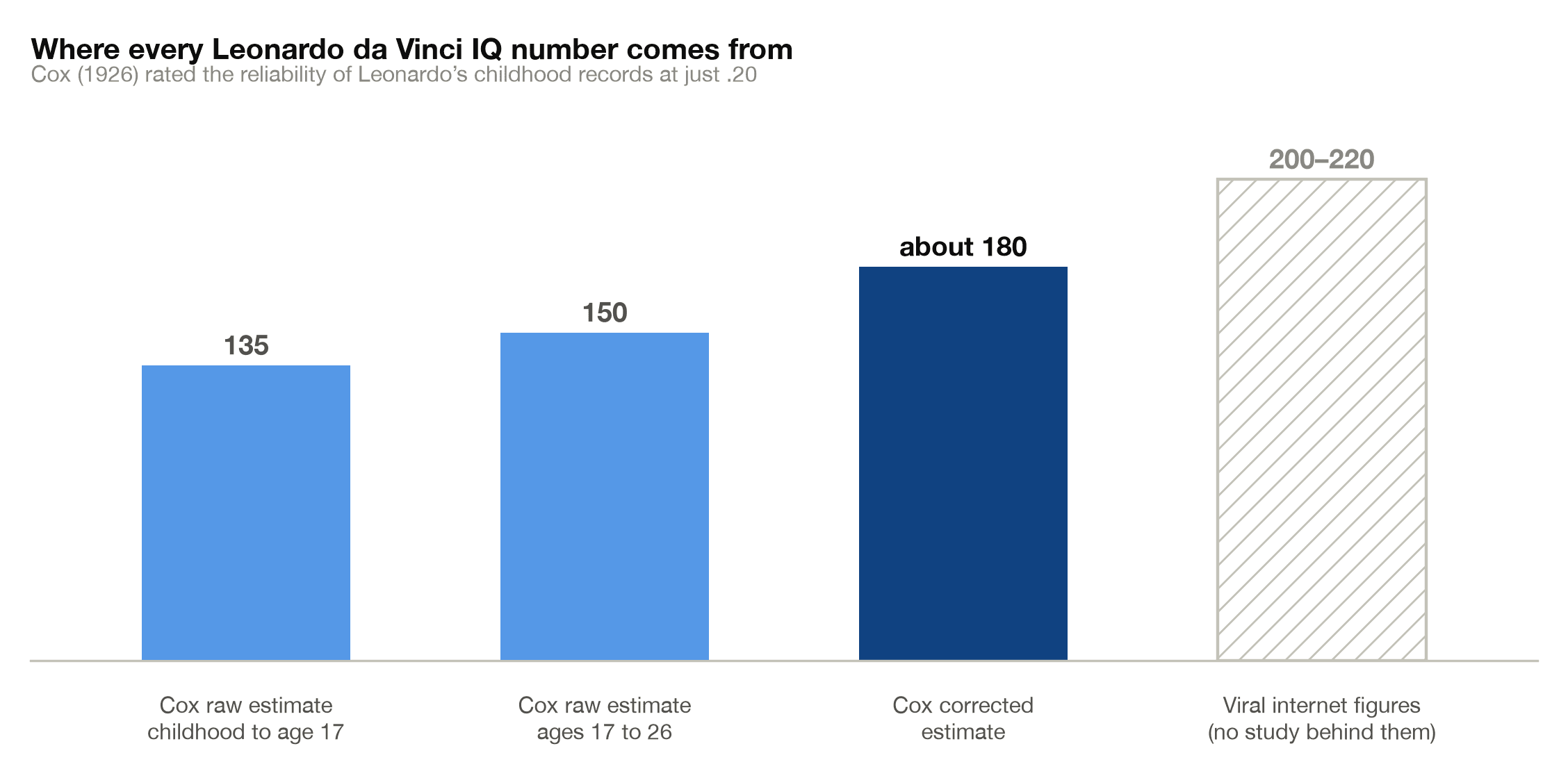
Leonardo da Vinci has no IQ. He died in 1519, and the first practical intelligence test was not published until 1905, nearly four centuries later, so every number attached to his name is a modern guess. The figures you see online, usually 180 and sometimes 200 or 220, descend from a single 1926 study that estimated intelligence from biographical records, and its raw estimates for Leonardo were actually 135 and 150. This article traces how those numbers were made, how 135 became 180, and why none of them deserves to be quoted as fact.
There was no IQ test in 1500
Leonardo was born in 1452 and died in 1519. He trained in Florence under the sculptor Andrea del Verrocchio and left thousands of notebook pages revealing his interests in geometry, anatomy, and engineering alongside painting. The first workable intelligence test, by Alfred Binet and Theodore Simon, appeared in 1905. Nobody who lived before the twentieth century has an IQ score, only estimates made long after death, and estimates are a fundamentally weaker kind of evidence than a test someone actually sat.
The 1926 study behind every Leonardo IQ number
The only serious attempt to estimate Leonardo's IQ is psychologist Catharine Cox's 1926 study The Early Mental Traits of Three Hundred Geniuses. Her method, now called "historiometry," estimated psychological traits from historical records: her team read biographies of 301 eminent figures born between 1450 and 1850, noted what each subject had accomplished by a given age, and asked what "mental age," the developmental level of a typical child, those accomplishments implied. Dividing mental age by chronological age gave an old-style "ratio IQ."
For Leonardo, the raw results were an IQ of 135 for his development up to age 17 and 150 for ages 17 to 26. Just as telling, Cox's team rated the reliability of the underlying records at .20 on a scale from 0 to 1, among the thinnest documentation in the entire study.
How 135 became 180
Cox's statisticians then corrected the raw estimates upward for cases with unreliable data, reasoning that sparse records drag estimates toward the average. Leonardo's corrected estimate came out near 180, and that single table entry is the number every internet genius list has repeated since. Cox herself warned that the purpose of the corrected estimates "is not to furnish exact values for the score of an individual," only to indicate a region of the IQ scale. Of the low raw group she wrote that ratings of 135 "clearly involve a regression for lack of data" and that the true upper limit for cases like Da Vinci, Darwin, and Kant is "probably in the IQ range above 160."
The 200 and 220 figures trace to no study at all. Cox's corrected ceiling for Leonardo was about 180; everything above it was invented by aggregator sites that kept her biggest number and dropped every caveat attached to it.
Why historiometric IQs are shaky
Dean Keith Simonton, who has reviewed a century of historiometric research, notes that these estimates track the surviving documentation as much as the person. Leonardo was the illegitimate son of a notary in 1450s Tuscany, and records of his childhood are sparse, which is exactly the situation that made Cox's raw figure low and her correction large. The estimates also use ratio-IQ logic that psychology abandoned long ago in favor of the modern "deviation IQ," which ranks a person against their own age group on a bell curve with a mean of 100. The same method and the same limits sit behind the numbers quoted for Isaac Newton and behind the estimated IQs of US presidents. A number built from biographies is a reading of the record, never a measurement of the mind.
The genius that needs no number
• The training is documented: An apprenticeship under Verrocchio in Florence, followed by commissions across Italy.
• The versatility is documented: Painting, anatomy, geometry, engineering, and music, all attested in his own surviving notebooks and by the institutions that hold his work.
• The score is not: No test existed in his lifetime, and no estimate made 400 years later can substitute for one.
The instinct to put a number on long-dead genius is old and durable; we cover the same pattern in the search for Albert Einstein's IQ. In every case the documented work is the evidence, and the number is decoration.
Frequently asked questions
What was Leonardo da Vinci's IQ?
Unknown and unknowable. IQ tests did not exist until 1905, almost 400 years after his death. The numbers online descend from a 1926 study that estimated his IQ from biographical records, whose raw figures were 135 and 150.
Did Leonardo really have an IQ of 200 or 220?
No study supports those figures. The only scholarly estimate, Cox (1926), gave raw figures of 135 and 150 and a statistically corrected figure of about 180. Anything above 180 was invented by internet genius lists.
How did researchers estimate IQs for historical figures?
Cox's team read biographies for evidence of early achievement, then asked what mental age a child would need to do those things at that chronological age. That ratio approach, plus corrections for patchy records, produced her estimates. It measures the quality of the historical record as much as the person.
Was Leonardo da Vinci the smartest person in history?
There is no defensible way to rank him. His documented range across painting, anatomy, engineering, and geometry is extraordinary, but comparing people across centuries without test scores is speculation. Cox herself said her estimates only indicate a region of the IQ scale.
Could someone like Leonardo score 180 on a modern test?
Nobody can say. Modern deviation IQs of 180 and above are beyond the reliable ceiling of standardized tests, and the qualities that made Leonardo exceptional included curiosity, observation, and obsessive practice, which no IQ test fully captures.
The takeaway
Leonardo's claim on the word genius rests on work you can still see, and no posthumous arithmetic adds to it. If you want a number that actually means something, it has to come from a real test with modern norms. The Reasoning and Intelligence Online Test from RIOT IQ reports a contemporary deviation score with stated precision, which is exactly what a 500-year-old estimate can never be.
References
1. Cox, C. M. (1926). Genetic studies of genius: Vol. 2. The early mental traits of three hundred geniuses. Stanford University Press. archive.org
2. Simonton, D. K. (2021). Versatility in genius: A history of historiometric studies of historic creators.simonton.faculty.ucdavis.edu
3. The National Gallery, London. (n.d.). Leonardo da Vinci (1452-1519).nationalgallery.org.uk
4. Warne, R. T. (2020). In the know: Debunking 35 myths about human intelligence. Cambridge University Press. doi.org
5. Gottfredson, L. S. (1997). Mainstream science on intelligence: An editorial with 52 signatories, history, and bibliography. Intelligence, 24(1), 13-23. doi.org
6. IQ Comparison Site. (n.d.). Cox's IQ estimates of 301 eminent geniuses born from 1450 to 1850.iqcomparisonsite.com
Hero image: Presumed self-portrait of Leonardo da Vinci, c. 1512. Public domain, via Wikimedia Commons.
Take our professional IQ test
Want to know your IQ? Try the first ever professional online IQ test.