Aug 9, 2026·Famous People & IQWho Is Stephen Wiltshire? The Human Camera
Stephen Wiltshire draws entire city skylines from memory after one helicopter ride. Meet the human camera and the science of savant syndrome behind him.
Dr. Russell T. WarneChief Scientist
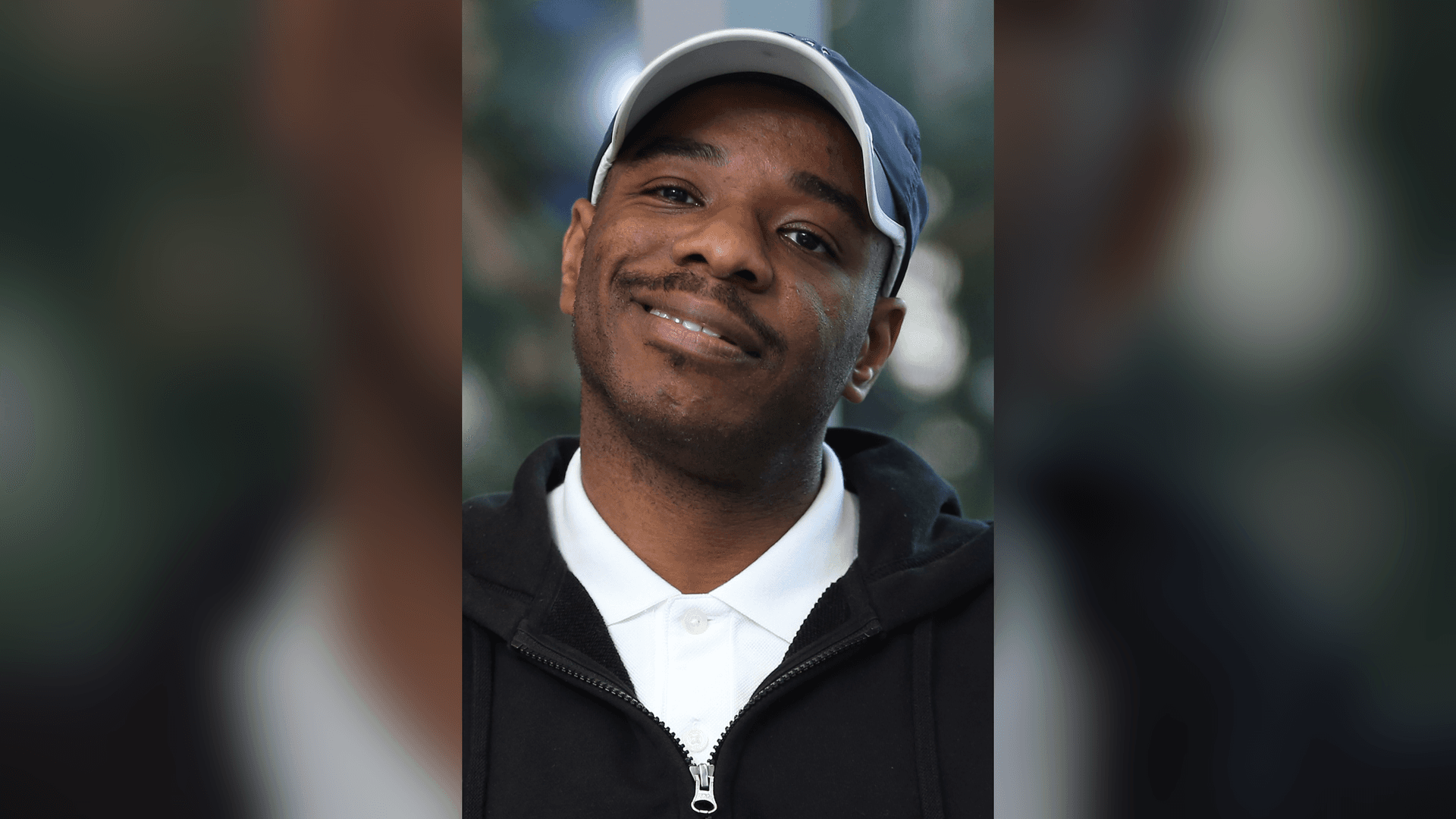
Stephen Wiltshire is a British artist, born in London on April 24, 1974, who draws vast, accurate city panoramas entirely from memory, often after a single short helicopter flight. Diagnosed autistic at age three and mute through early childhood, he was appointed MBE for services to the art world in 2006 and has drawn London, Tokyo, Rome, and New York at a level of detail that earned him the nickname "the human camera." He is the world's best-known living example of
savant syndrome, the pairing of a developmental condition with one extraordinary specific ability.
Who is Stephen Wiltshire?
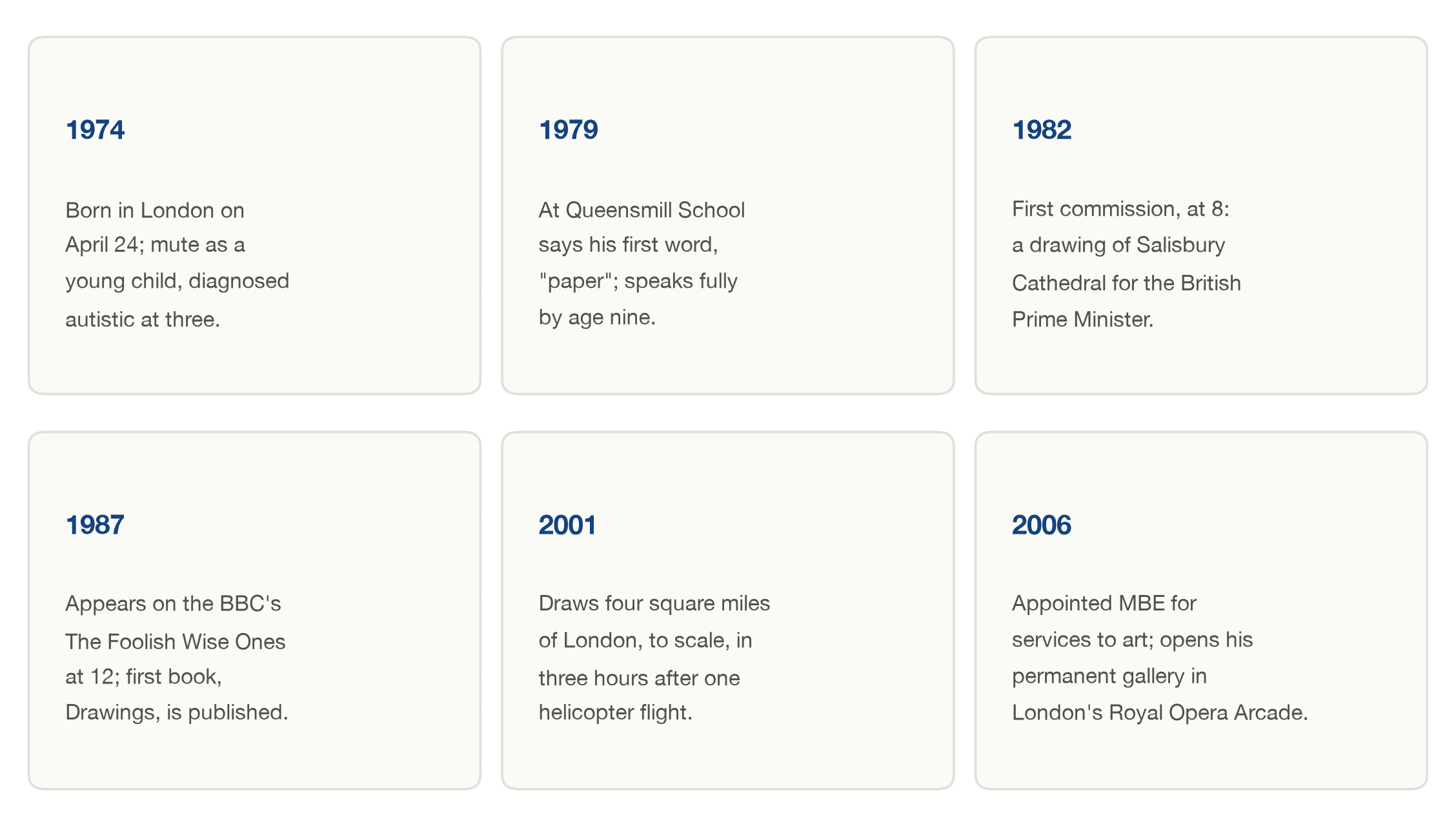
Wiltshire was born in London to West Indian parents. As a child he was mute and did not relate to other people; at three he was diagnosed as autistic. At five he was sent to Queensmill School in London, where staff noticed that the only pastime he enjoyed was drawing. To encourage him to speak, his instructors temporarily took away his art supplies so that he would have to ask for them. He responded by making sounds, and eventually uttered his first word: "paper." He learned to speak fully at age nine.
From first word to first commission
The drawing came faster than the speech. By the time he turned eight, Wiltshire had received his first commission, a drawing of Salisbury Cathedral for the British Prime Minister. In February 1987, at twelve, he appeared on the BBC programme The Foolish Wise Ones, where Hugh Casson, a former president of the Royal Academy of Arts, called him "possibly the best child artist in Britain."
His first book of drawings, Drawings, appeared in 1987, followed by Floating Cities in 1991 and American Dream in 1993. On a trip to New York he met the neurologist Oliver Sacks, who went on to write extensively about him. Wiltshire later studied Fine Art at City & Guilds Art College in London.
The human camera: panoramas from memory
London in three hours
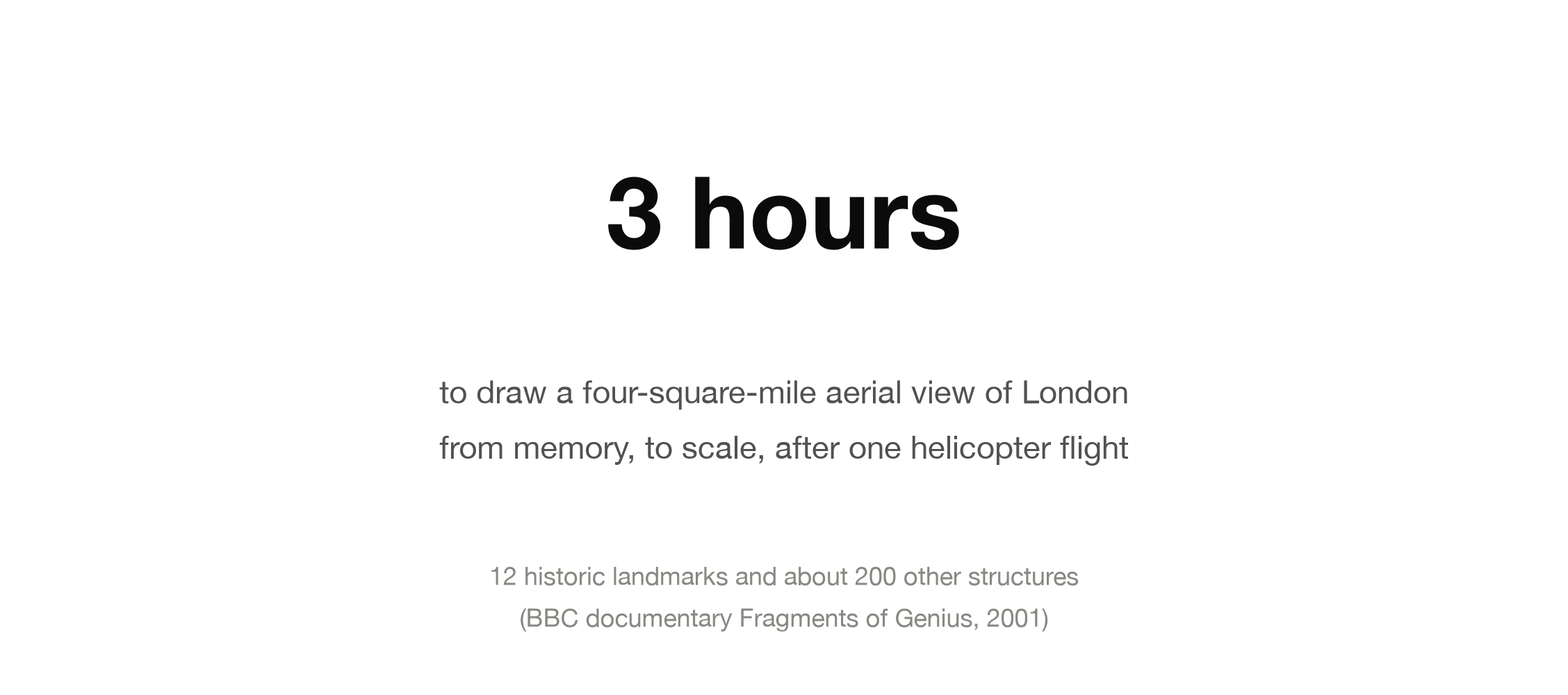
The feats behind the nickname are documented on film. For the 2001 BBC documentary Fragments of Genius, Wiltshire took a helicopter flight over London and then completed a detailed, correctly scaled aerial drawing of a four-square-mile area in three hours. The drawing included 12 historic landmarks and about 200 other structures.
Rome, Tokyo, New York
The savant researcher Darold Treffert described the Rome version of the exercise in a 2009 Royal Society paper: after a 45-minute helicopter ride over the city, Wiltshire completed, in a three-day drawing marathon on a canvas more than five yards long, an "impeccably accurate" panorama. A blueprint of the Colosseum superimposed on his drawing showed an astonishingly accurate replication.
The list kept growing. In May 2005 he drew the largest panorama of his career in Tokyo, and two months later drew Rome from memory, including the Vatican. In 2006 he opened his permanent gallery in London's Royal Opera Arcade, which moved to Chelsea Harbour in 2019. A 2014 Singapore panorama entered that country's National Collection, and he once spent five days drawing New York on a 6-metre canvas live on CBS. In 2019 the redesigned 80th-floor observatory of the Empire State Building reopened bearing a design based on his 2017 panorama of the city.
What savant syndrome explains
Treffert's synopsis of savant syndrome places Wiltshire's gift in context: savant skills are narrow, they cluster in domains like art, music, calculation, and calendar reckoning, and they occur alongside a developmental condition, most often autism. No credible IQ score for Wiltshire has ever been published, and his case is not about IQ. Measured IQ among savants ranges widely, and one spectacular ability says nothing about the broad set of capacities an intelligence test samples. We cover the research on
IQ and autism separately.
Treffert also used Wiltshire to correct a myth. Savants, the stereotype goes, only copy. Wiltshire can replicate what he sees in stunning fashion, and he can also improvise, part of a broader pattern in which savant skills progress from replication to improvisation to creation. For a savant who can narrate that inner process from the inside, see our article on
Daniel Tammet.
What Stephen Wiltshire teaches us about intelligence
Wiltshire is the clearest living demonstration that one extraordinary narrow ability can dissociate from "g," the general factor that IQ tests measure across many domains. His visual memory for cityscapes is world class; that skill is specific, and it does not transfer into a general score, in either direction. This is why a valid intelligence test samples reasoning, vocabulary, spatial ability, and memory together rather than crowning any single talent. A test built that way, such as the Reasoning and Intelligence Online Test from RIOT IQ, measures general ability rather than special gifts, and you can take
the RIOT IQ test online.
Frequently asked questions
Who is Stephen Wiltshire?
Stephen Wiltshire MBE is a British artist, born in London in 1974 and diagnosed autistic at three, who draws hyper-detailed, accurate city panoramas from memory. He has run his own London gallery since 2006.
Why is Stephen Wiltshire called the human camera?
After short aerial flights he can reproduce square miles of cityscape with correct scale and detail. After a 45-minute helicopter ride over Rome he drew the city over three days, with the Colosseum accurate enough to match a blueprint overlay.
What is Stephen Wiltshire's IQ?
No credible IQ score for Wiltshire has been published. Savant syndrome pairs an extraordinary specific ability with a developmental condition, and measured IQ among savants ranges widely; his talent is a narrow skill rather than a general score.
Is Stephen Wiltshire autistic?
Yes. He was diagnosed autistic at age three, was mute as a young child, said his first word, "paper," around age five, and learned to speak fully at about nine, according to his official biography.
When did Stephen Wiltshire get his MBE?
He was appointed a Member of the Order of the British Empire in 2006 for services to the art world, the same year he opened his permanent gallery in London's Royal Opera Arcade.
Does Stephen Wiltshire only copy what he sees?
No. Savant researcher Darold Treffert documented that Wiltshire improvises as well as replicates, part of a pattern in which savant skills move from replication toward genuine creation.
References
1. The Stephen Wiltshire Gallery. (n.d.).
Biography of Stephen Wiltshire, MBE. stephenwiltshire.co.uk2. Treffert, D. A. (2009).
The savant syndrome: An extraordinary condition. A synopsis: past, present, future. Philosophical Transactions of the Royal Society B, 364(1522), 1351-1357.
doi.org3. Treffert, D. A. (2009).
The savant syndrome [free full text]. PubMed Central.
pmc.ncbi.nlm.nih.gov4. Sacks, O. (1995).
An anthropologist on Mars. Vintage.
archive.orgHero image: Stephen Wiltshire drawing a Mexico City panorama in 2016. Photo: Gobierno CDMX, CC0, via Wikimedia Commons. Take our professional IQ test
Want to know your IQ? Try the first ever professional online IQ test.
AuthorDr. Russell T. WarneChief Scientist